About the Project
Inspiration
SecondBrain AI Learning Platform was inspired by a simple observation: modern learning is scattered across PDFs, YouTube videos, online articles, books, and personal notes. Learners constantly switch between different platforms, making it difficult to organize knowledge, track progress, and maintain long-term understanding.
Existing learning platforms also follow fixed curricula and predefined subjects, which don't adapt to individual learning goals. Whether someone is a school student, university student, researcher, software engineer, or lifelong learner, they deserve a learning environment that they can fully customize.
Our vision was to build a Universal AI Learning Platform where users have complete control over what they learn, while AI helps organize knowledge, generate learning materials, and provide personalized guidance throughout their journey.
What it does
SecondBrain AI Learning Platform allows users to:
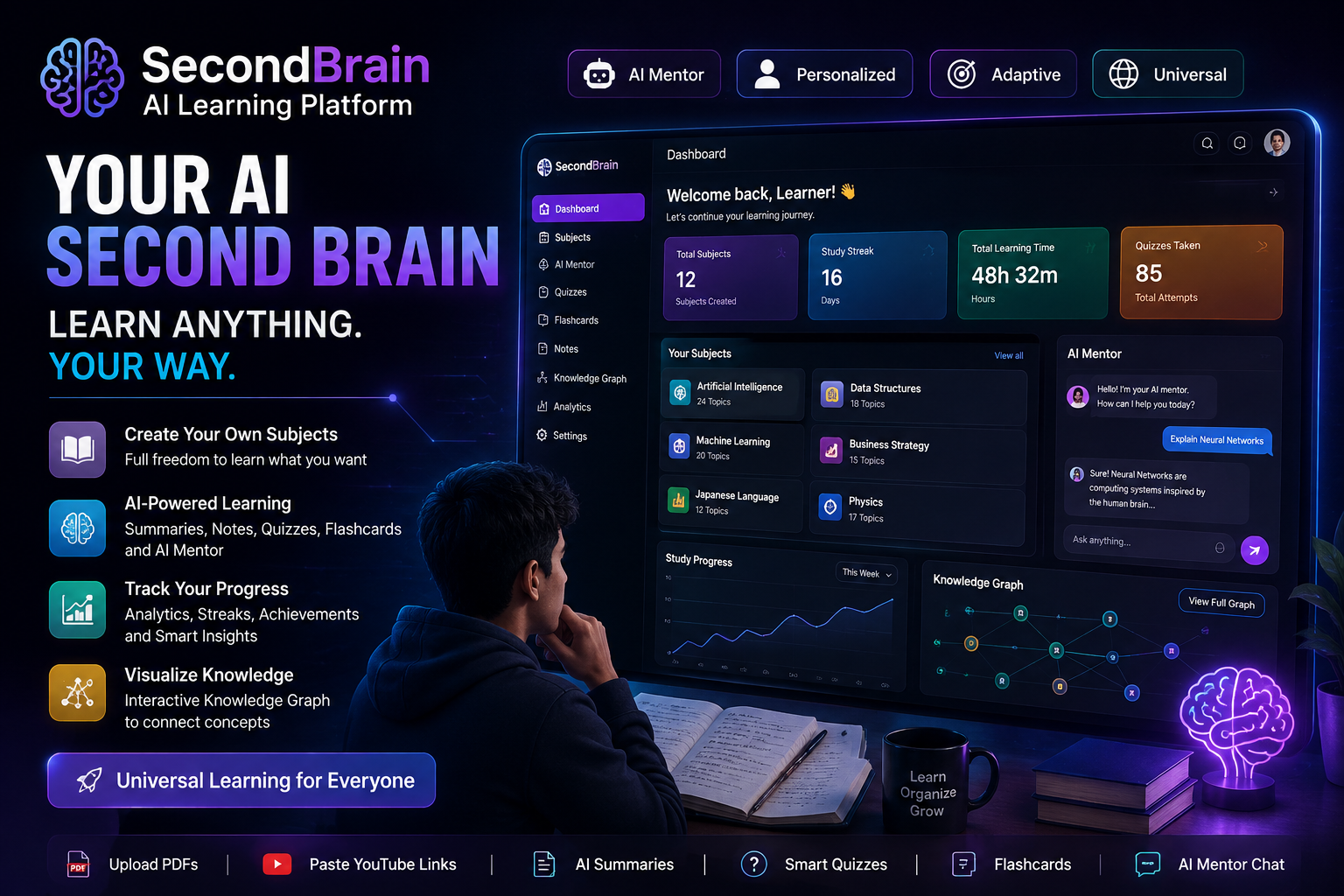
- Universal Subject Management: Create, rename, edit, organize, archive, and delete completely custom subjects.
- Personal AI Learning Workspace: Every subject becomes its own AI-powered learning environment.
- AI Learning Assistant: Chat with an intelligent AI mentor for explanations, guidance, and interactive learning.
- PDF Learning: Upload documents and automatically generate summaries, flashcards, quizzes, and key concepts.
- YouTube Learning: Paste YouTube links to generate notes, summaries, important concepts, and quizzes.
- Knowledge Graph: Visualize relationships between concepts and discover learning gaps.
- Adaptive Study Planner: Receive personalized study schedules based on goals and learning progress.
- AI Quiz & Flashcards: Automatically generate learning materials from any uploaded content.
- Learning Analytics: Track progress, study streaks, achievements, learning time, and overall growth.
- Universal Learning Environment: Suitable for students, professionals, researchers, and lifelong learners without curriculum limitations.
How we built it
The project was developed through several phases.
Phase 1: Product Architecture
- Designed the overall learning platform architecture.
- Built a scalable frontend and backend structure.
- Designed a flexible database to support unlimited custom subjects and learning resources.
Phase 2: Universal Learning Workspace
- Implemented custom subject management.
- Added create, rename, edit, archive, and delete functionality.
- Built isolated AI workspaces for every subject.
Phase 3: AI Learning Engine
- Integrated AI-powered conversations.
- Implemented PDF analysis and document understanding.
- Added YouTube transcript processing.
- Generated summaries, quizzes, flashcards, and study materials automatically.
Phase 4: Learning Intelligence
- Built personalized study planning.
- Implemented adaptive quiz generation.
- Created revision reminders and learning recommendations.
- Designed Knowledge Graph visualization.
Phase 5: Dashboard & Analytics
- Built progress tracking.
- Added achievements and study streaks.
- Implemented learning statistics and personalized insights.
- Created a responsive dashboard for every learner.
Phase 6: Platform Optimization
- Optimized application performance.
- Improved responsiveness across devices.
- Enhanced security, scalability, and user experience.
Challenges we ran into
1. Building a Truly Universal Platform
Creating a learning platform that works equally well for school students, university students, professionals, and researchers required designing a completely flexible learning model instead of relying on predefined courses.
2. Organizing Unlimited Learning Content
Supporting custom subjects while keeping PDFs, notes, videos, quizzes, flashcards, and AI conversations organized inside individual workspaces required careful data architecture.
3. Personalized AI Learning
Generating useful summaries, quizzes, and recommendations for completely different subjects demanded flexible AI prompts and content processing pipelines.
4. Knowledge Visualization
Representing relationships between concepts in an intuitive Knowledge Graph while keeping the interface simple was one of the most challenging design tasks.
5. Scalability
Designing the platform to support thousands of users and unlimited learning resources required scalable backend architecture and efficient database design.
Accomplishments that we're proud of
- Built a completely customizable learning platform.
- Designed a universal subject management system instead of fixed courses.
- Successfully integrated AI into multiple learning workflows.
- Created an adaptive learning experience powered by personalized recommendations.
- Combined PDFs, YouTube videos, notes, quizzes, flashcards, and AI conversations into one unified platform.
- Built a modern, responsive, and scalable web application.
- Designed an educational platform suitable for learners of every age and profession.
What we learned
Developing SecondBrain AI Learning Platform helped us gain valuable experience in several areas:
- Designing AI-powered educational experiences.
- Building personalized learning systems.
- Managing complex user-generated learning content.
- Integrating AI with document and video processing.
- Creating scalable frontend and backend architectures.
- Developing adaptive learning workflows.
- Designing intuitive user experiences for education technology.
What's next for SecondBrain AI Learning Platform
- Voice-based AI learning assistant.
- Collaborative learning spaces.
- AI-powered research assistant.
- Multi-language learning support.
- Interactive whiteboard and visual explanations.
- AI-generated learning roadmaps.
- Advanced knowledge graph visualization.
- Smart revision prediction using learning behavior.
- Mobile application.
- Community-driven learning marketplace.
- AI-powered career learning pathways.
- Offline learning synchronization.
Our long-term vision is to build a lifelong AI learning companion that empowers anyone to learn anything, organize knowledge effectively, and continuously grow throughout their personal and professional journey.
Built With
- ai-embeddings
- ai/llm
- fastapi
- framer-motion
- knowledge-graph
- next.js
- pdf-processing
- postgresql
- python
- rag
- react
- rest-api
- shadcn/ui
- tailwind-css
- typescript
- vector-database
- vercel
- youtube
- zustand


Log in or sign up for Devpost to join the conversation.