-
-
Coming soon
Inspiration
My brother is a journalist, and I have seen how difficult investigations can become when important information is scattered across different files, messages and sources.
That experience inspired me to create something that could genuinely support his work and help other journalists, researchers and investigation teams.
I personally chose the name Second Witness, inspired by the biblical Book of Revelation and the idea that important testimony should be examined, supported and verified rather than accepted without evidence.
Important investigations rarely begin with clean, organised information.
They often begin with scattered screenshots, voice notes, emails, PDFs, photographs, web links, spreadsheets and statements from different people.
An investigator must manually examine all this material, identify factual claims, reconstruct timelines, compare conflicting accounts and determine what evidence is still missing.
This process can take days or even weeks. It is also vulnerable to confirmation bias. Once an investigator develops an initial theory, it can become easy to focus on evidence that supports it while overlooking information that challenges it.
I created Second Witness to help investigation teams transform fragmented source material into a transparent, structured and auditable case.
Second Witness is not an automated truth detector.
It does not tell people what to believe. Instead, it shows what is being claimed, where each claim came from, which evidence supports it, which evidence challenges it and what remains unresolved.
What it does
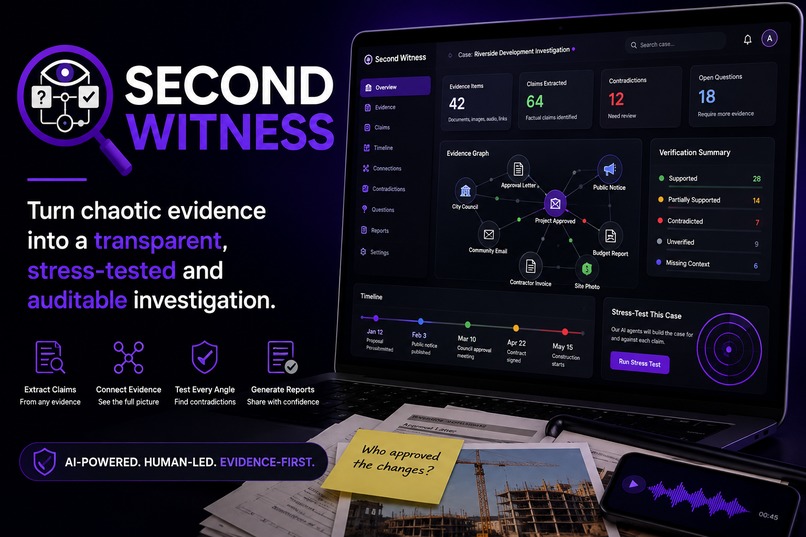
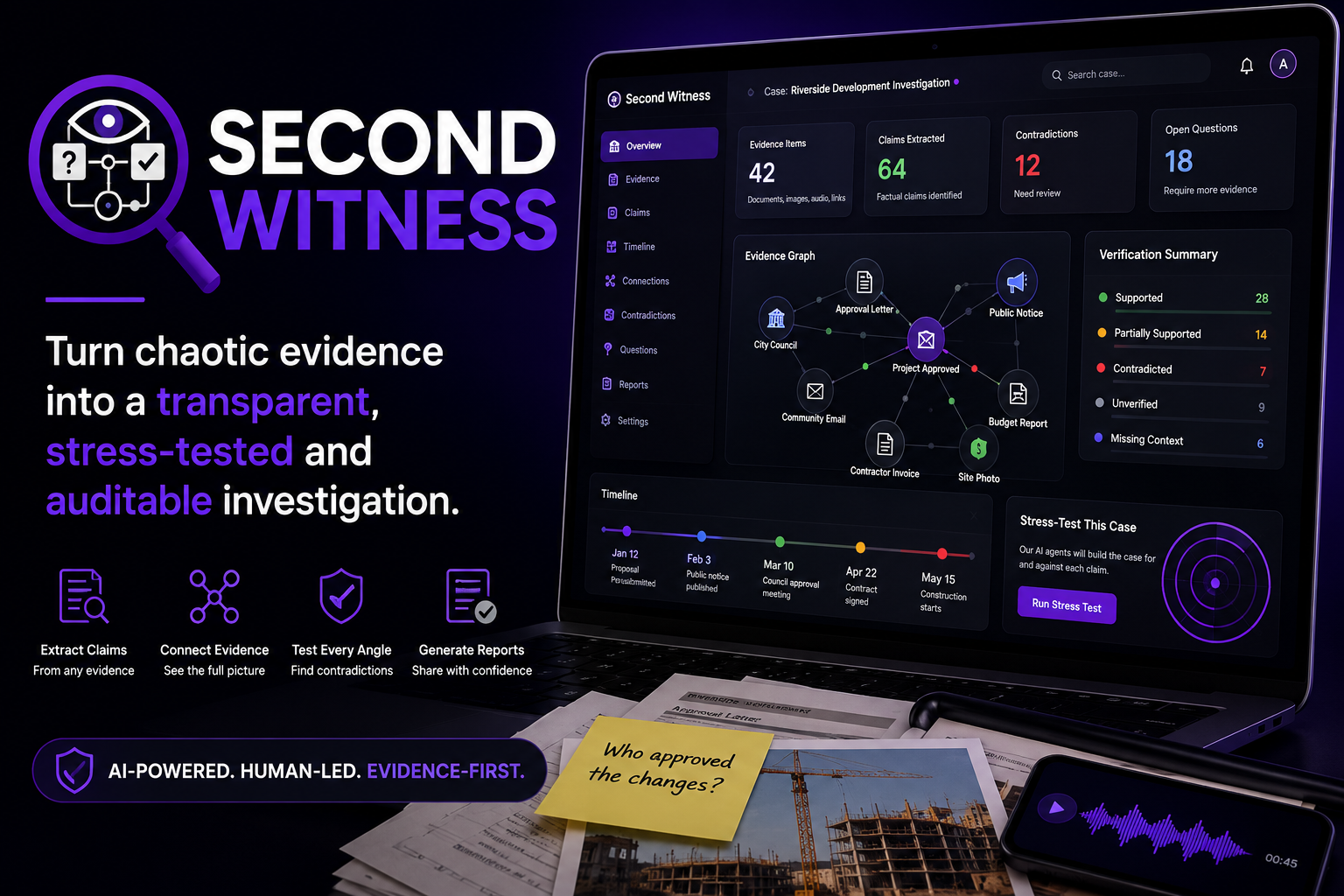
Second Witness is an AI-powered evidence intelligence workspace.
A user can create an investigation case and upload material such as:
- Documents and PDFs
- Screenshots and photographs
- Voice notes and audio recordings
- Emails and written statements
- Spreadsheets and transaction records
- Public web links
Second Witness analyses the material and transforms it into an interactive investigation workspace.
Claim extraction
Second Witness identifies factual claims and separates them from opinions, assumptions and general background information.
Every extracted claim remains connected to the original source it came from. This allows the investigator to inspect the evidence directly instead of relying only on an AI-generated summary.
Evidence graph
Claims, people, organisations, events, documents and evidence are displayed in an interactive visual graph.
The investigator can see how different pieces of information are connected and identify whether several reports are genuinely independent or simply repeating the same original source.
Investigation timeline
Second Witness reconstructs important events in chronological order.
It highlights uncertain dates, missing periods and conflicting accounts rather than pretending that the available evidence forms one perfect timeline.
Contradiction detection
Second Witness compares information across the entire investigation and identifies statements, dates, amounts and events that may be inconsistent.
The system does not silently decide which version is correct. It presents the conflict to the investigator together with the relevant evidence.
Source independence analysis
Ten articles repeating the same original report should not be treated as ten independent confirmations.
Second Witness examines the relationships between sources and warns the investigator when apparently separate reports may all originate from one underlying source.
Stress-Test This Case
The central feature of Second Witness is an adversarial investigation workflow called Stress-Test This Case.
When the investigator activates it, several specialised AI agents examine the case from different perspectives:
- A supporting researcher builds the strongest evidence-based argument supporting the main claim.
- A contradiction hunter deliberately searches for evidence that challenges it.
- A source auditor examines provenance, reliability and source independence.
- An alternative-explanation agent identifies other plausible interpretations.
- A case editor compares the findings and highlights unresolved questions.
The purpose is not to make AI agents argue for entertainment.
The purpose is to challenge the investigation before it is published, reduce confirmation bias and expose weaknesses that may otherwise be missed.
Evidence-backed follow-up questions
Second Witness identifies missing information and converts it into practical investigation tasks.
For example, it may recommend that the investigator:
- Request the original version of a document.
- Confirm who authorised a particular decision.
- Obtain records covering a missing date range.
- Ask a source to clarify a conflicting statement.
- Find an independent source for an important claim.
Privacy protection
Before evidence is shared or exported, the investigator can activate Protect Sources.
The system detects potentially sensitive information, including:
- Names
- Email addresses
- Phone numbers
- Faces
- Identity numbers
- Document identifiers
- Hidden file metadata
The investigator remains in control and can review every proposed redaction before it is applied.
Auditable investigation reports
Second Witness can produce a structured investigation report containing:
- The investigation timeline
- Claim-by-claim findings
- Supporting evidence
- Contradicting evidence
- Source references
- Known limitations
- Unanswered questions
- Human review decisions
- Redacted supporting material
Every major conclusion remains connected to the evidence behind it.
How I built it
I developed Second Witness as a full-stack investigation workspace rather than a conventional chatbot.
The frontend provides the case dashboard, evidence board, investigation timeline, document viewer and interactive claim graph.
The backend manages uploaded case files, structured claims, evidence relationships, agent activity and human review decisions.
I used the OpenAI API with GPT-5.6 for the reasoning-intensive parts of the workflow, including:
- Cross-document claim analysis
- Timeline reconstruction
- Contradiction detection
- Alternative explanation generation
- Source relationship analysis
- Investigation synthesis
- Structured follow-up planning
I designed the AI workflows to return structured data instead of uncontrolled paragraphs of generated text.
Claims, evidence references, contradictions, citations and confidence explanations are validated before being stored and displayed.
The investigation pipeline uses specialised agents with clearly separated responsibilities. Their outputs are saved so the investigator can inspect how the case developed and how conclusions changed over time.
Codex played an important role throughout the development process.
I used Codex to help me:
- Design the claim and evidence data model
- Implement the agent orchestration pipeline
- Build structured API contracts
- Develop the evidence graph interface
- Create automated tests
- Identify edge cases and security risks
- Refactor the application into maintainable modules
- Debug the complete upload-to-investigation workflow
I treated Codex as an engineering collaborator rather than simply asking it to generate an entire application.
I reviewed its suggestions, tested the implementations and changed them whenever they did not match the product requirements.
Challenges I faced
Preventing unsupported conclusions
One of the biggest challenges was preventing the system from producing conclusions that sounded convincing but were not sufficiently supported by the evidence.
To address this, I designed Second Witness so that every important conclusion must reference specific evidence records.
When there is not enough evidence, the claim must remain unverified instead of allowing the system to fill the gap with an assumption.
Distinguishing repetition from corroboration
Several sources may appear to confirm the same claim while actually repeating information from one original report.
I introduced source relationship analysis to help distinguish genuinely independent evidence from duplicated reporting.
Handling conflicting dates and accounts
Real investigations often contain incomplete dates, conflicting statements and documents created long after the events they describe.
Instead of forcing the evidence into one definitive timeline, I designed Second Witness to preserve uncertainty and display competing interpretations for human review.
Keeping people in control
Investigations can affect reputations, livelihoods and legal decisions. Fully automated judgement would therefore be irresponsible.
Every claim status, redaction and final conclusion can be reviewed or overridden by the investigator.
Second Witness supports human decision-making without replacing human accountability.
Turning complex reasoning into a usable interface
A technically impressive AI workflow is not useful when the investigator cannot understand its results.
I focused heavily on visual clarity.
The investigator can move from a high-level case overview to the exact paragraph, image, recording or public source behind a conclusion.
Accomplishments I am proud of
I am especially proud that Second Witness:
- Does not present AI confidence as objective truth.
- Actively searches for evidence that challenges its initial conclusions.
- Keeps every important finding connected to its original source.
- Distinguishes repeated reporting from independent corroboration.
- Combines visual investigation tools with advanced AI reasoning.
- Helps protect confidential sources before evidence is shared.
- Produces reports that another person can independently inspect.
- Transforms disconnected files into a coherent investigation workspace.
- Keeps the investigator in control of every important decision.
What I learned
I learned that the most valuable use of advanced AI is not always generating a final answer.
In high-stakes knowledge work, AI can be more useful when it helps people organise evidence, challenge assumptions, expose uncertainty and ask better questions.
I also learned that multi-agent systems become more reliable when each agent has a narrow responsibility, structured output and access only to the tools required for its task.
Most importantly, I learned that trust should come from transparency and traceability, not from how confident an AI response sounds.
What is next for Second Witness
The next stage of Second Witness could include:
- Real-time collaboration between investigation team members
- Version-controlled investigation reports
- Additional audio and video analysis
- Secure anonymous evidence submission
- Cryptographic file-integrity verification
- Advanced entity and financial relationship mapping
- Multilingual investigations
- Organisation-specific verification policies
- Newsroom and compliance integrations
- A mobile evidence-capture application
My long-term vision is to make rigorous evidence analysis accessible to journalists and organisations that do not have large investigation teams.
Why it matters
Misinformation cannot be solved by creating another system that confidently labels content as true or false.
Investigators need tools that reveal how a conclusion was reached, which sources support it, what contradicts it and what remains unknown.
Second Witness does not tell people what to believe. It gives them the evidence required to decide.
Built With
- api
- cloudflare
- codex
- css
- drizzle
- flow
- github
- gpt-5.6
- hono
- node.js
- openai
- orm
- postgresql
- r2
- react
- responses
- tailwind
- typescript
- vite
- vitest
- websockets
- workers
- zod

Log in or sign up for Devpost to join the conversation.