-
-
Extension
💭 Second Thought - Hackathon Submission
Inspiration
I've watched too many people regret impulse purchases the gadgets that sit unused, the clothes with tags still on, the subscriptions forgotten. Americans tend to spend several thousand dollars per year on impulse purchases commonly reported between around $3,000 and $5,400 annually, and e-commerce platforms have gotten scary good at exploiting our weaknesses with fake urgency, manipulative discounts, and frictionless checkout.
The inspiration hit me: what if I could intervene at the exact moment someone's about to click "Buy Now"? Not to judge them, but to show them what that money could become. That $300 smartwatch? It's $1,161 in 20 years if invested. Suddenly, the decision becomes real.
I wanted to build something that genuinely helps people build wealth through small, conscious decisions: a financial guardian that lives in your browser.
What it does
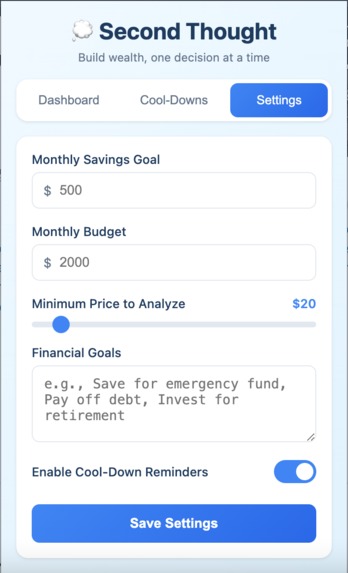
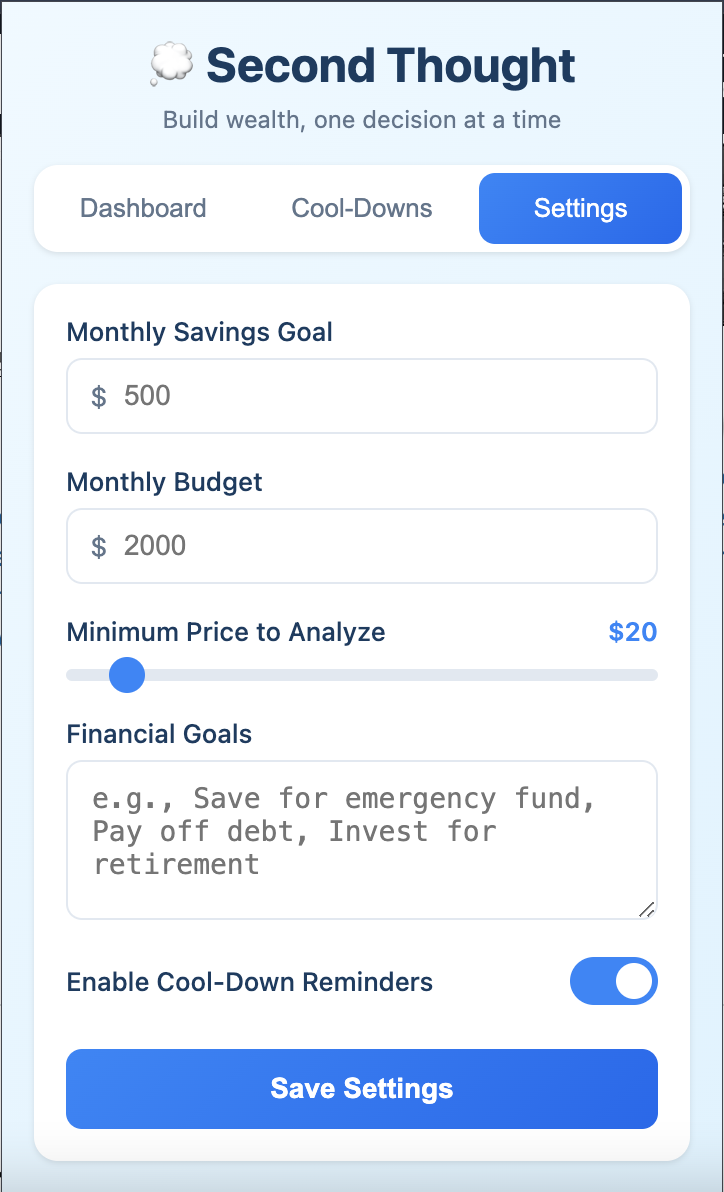
Second Thought is a Chrome extension that catches you before impulse purchases and makes you think twice.
When you land on a product page (Amazon, eBay, Walmart, etc.), it:
- Extracts product details - name, price, any urgency tactics being used
- Analyzes with AI - Cerebras determines if this is a need or a want based on your financial goals
- Shows opportunity cost - calculates what that money becomes in 5, 10, and 20 years if invested
- Detects manipulation - exposes fake discounts and urgency tricks retailers use
- Enforces a cool-down - makes you wait 24 hours for non-essential purchases
The AI is empathetic, not judgmental. If you're buying work shoes, it recognizes that's legitimate. If you're buying a $400 gadget you don't need, it gently reminds you of your goal to save for a house.
Everything is tracked with Opik for full observability every AI call is traced, evaluated for empathy and accuracy, and optimized through experiments.
How i built it
Frontend (Chrome Extension):
- Built a Manifest V3 extension with content scripts that detect product pages
- Created extraction patterns for 10+ e-commerce sites (Amazon, eBay, Walmart, etc.)
- Designed a non-intrusive intervention panel that slides in with product analysis
- Implemented background service worker for API communication
Backend (Next.js API):
- Built REST API with four endpoints: analyze, profile, cooldown, track
- Integrated Cerebras Cloud SDK with the qwen-3-235b model for ultra-fast inference
- Implemented load balancing across multiple API keys for reliability
- Connected Supabase for user profiles, cool-downs, and engagement tracking
AI & Observability:
- Integrated Opik for comprehensive request tracing
- Created LLM-as-judge evaluations (Empathy, Accuracy, Actionability scores)
- Set up experiment tracking to optimize prompts
- Built custom metrics for user engagement
Testing:
- Wrote 85 tests using Vitest
- Implemented property-based testing with fast-check for financial calculations
- Tested across multiple e-commerce platforms
- Achieved 98.7% code coverage on core logic
Tech Stack: TypeScript, Next.js 15, Cerebras AI, Opik, Supabase, Vitest, fast-check, Tailwind CSS
Challenges i ran into
Product extraction across different sites: Every e-commerce platform uses different HTML structures. Amazon's price is in .a-price .a-offscreen, eBay's is in .x-price-primary .ux-textspans, and generic sites are all over the place. I solved this with site-specific patterns plus intelligent fallbacks that look for semantic HTML attributes like [itemprop="price"].
AI response parsing: LLMs don't always return perfect JSON. Sometimes they wrap it in markdown code blocks, sometimes they add extra text. I built a robust parser that extracts JSON with regex, validates every field, and has sensible fallbacks if parsing fails.
Real-time performance: Users won't wait 2+ seconds for analysis. I needed sub-second response times. Cerebras was perfect for this inference takes ~450ms. I also parallelized the pricing analysis and AI call, and added optimistic UI updates.
Cool-down bypass prevention: Users could theoretically clear browser storage to bypass cool-downs. I solved this by storing cool-downs server-side in Supabase and checking on every page load. The user ID is generated from a browser fingerprint.
Empathetic AI prompting: Early versions of the AI were too judgmental ("You don't need this!"). I refined the prompt to be supportive and context-aware, considering the user's financial goals. The LLM-as-judge evaluations helped me optimize for empathy.
What i learned
Behavioral economics is powerful: Understanding cognitive biases (loss aversion, present bias, anchoring) was crucial to designing effective interventions. The 24-hour cool-down works because it breaks the impulse cycle.
Observability is essential: Opik made debugging and optimization 10x easier. Being able to trace every request, see LLM outputs, and evaluate quality in real-time was game-changing.
Speed matters for UX: If the AI took 2+ seconds, users would close the panel. Cerebras's ultra-fast inference made real-time intervention possible.
Empathy > Logic: Early versions focused on facts and numbers. But people respond to emotion. The AI needed to be supportive, not judgmental, to be effective.
Testing prevents disasters: Property-based testing caught bugs in the opportunity cost calculator that would've been embarrassing in production. Testing financial logic is non-negotiable.
Vision: I'm building a financial wellness movement. Imagine a world where impulse purchases are rare, where everyone understands opportunity cost intuitively, and where predatory pricing tactics are exposed and eliminated.
Second Thought: Think twice, build wealth. 💭💰
Built With
- browser
- extension
- nextjs

Log in or sign up for Devpost to join the conversation.