-
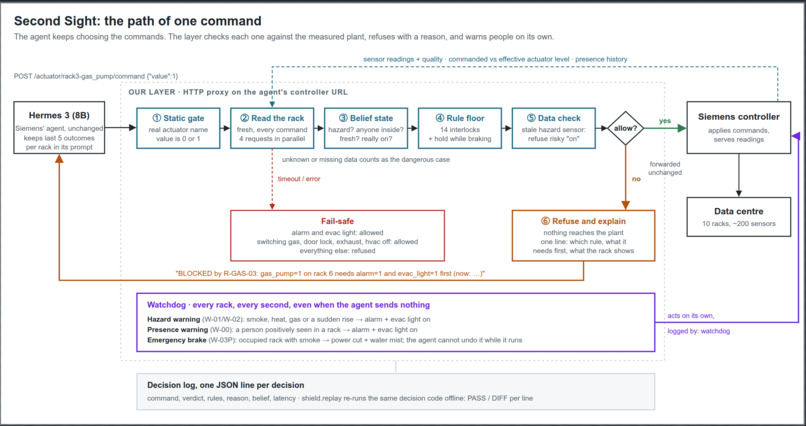
SecondSight - Architecture
Inspiration
How do you hand a data centre to a general-purpose LLM? You don't. Google DeepMind gave neural networks one job, cooling. Siemens did the same with Vigilent. Research systems like OperAItor and DPPT put twins and checks around their models. The working systems give the AI a narrow, well-defined job.
Siemens' challenge asks the harder question: their Hermes 3 agent runs fire and cooling response for a whole simulated hall, and it can propose any command, including the one that kills, such as gas into a rack with a person inside.
A pilot is in the same position. Capable, in charge, and still the aircraft gives them honest instruments and will not let certain commands through. An LLM is only as good as the picture it is given: garbage in, garbage out. We cannot make the model deterministic, but we can make sure what reaches it, and what it sends to the plant, matches what the equipment is actually doing.
What it does
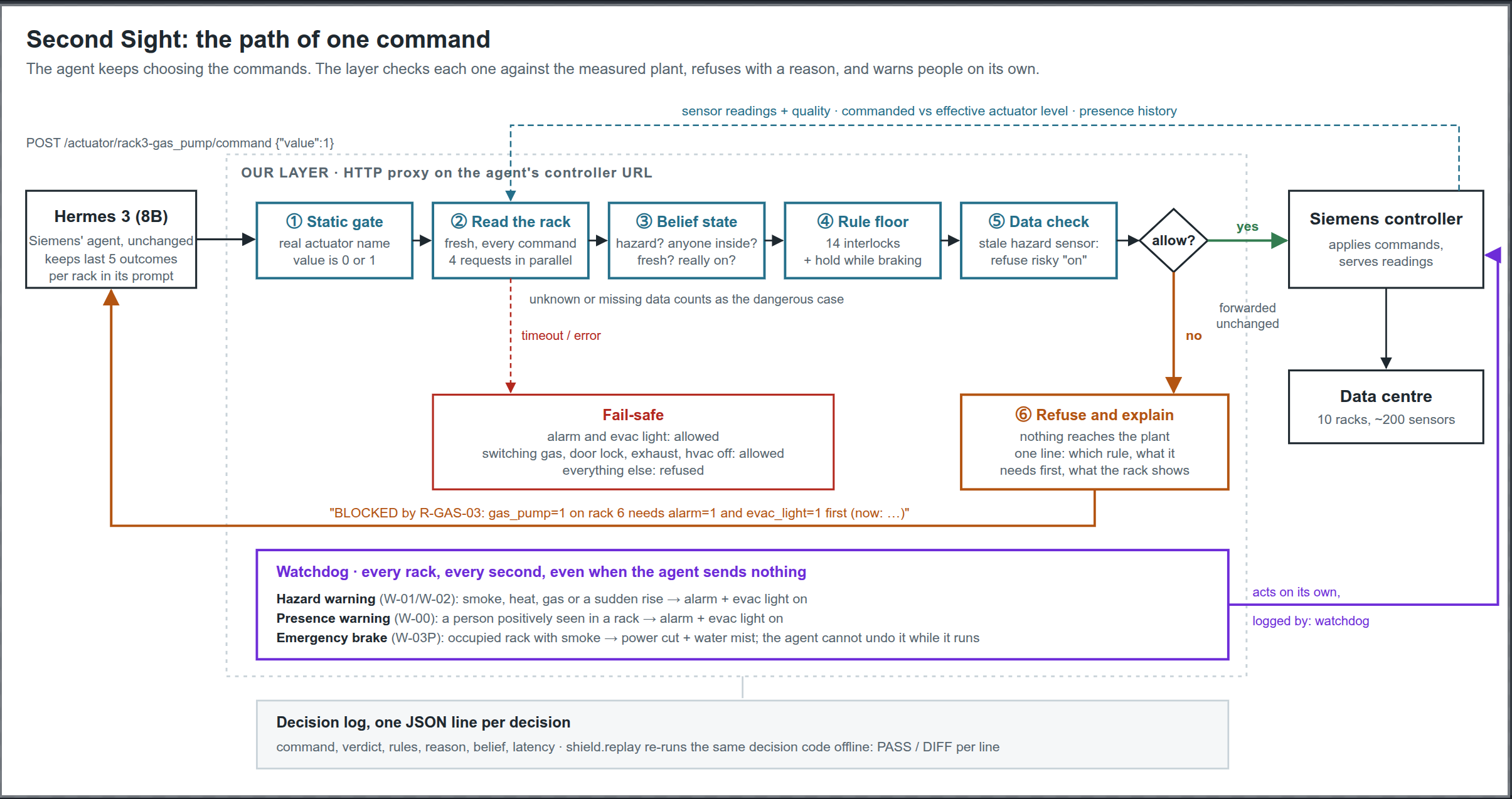
Second Sight sits between the agent and the plant. The agent talks to it exactly as it would talk to Siemens' controller, so the agent stays unchanged.
For every command:
- Static check: a real actuator and a valid value.
- Fresh read: the layer reads that rack again, right before the command would go through. Sensors with their quality, recent presence readings, and for each actuator both what it was told to do and what it is actually doing.
- Belief state: the raw numbers become four plain facts. Is there a hazard? Could someone be inside? Is the data fresh? What is each actuator really doing? Missing or doubtful data counts as the dangerous case.
- Rule floor: 14 interlocks, several from Siemens' own guardrails, the rest from fire-suppression practice and our own tests.
- Data check: a stale hazard sensor blocks risky "switch on" commands.
- Allow or explain: a safe command passes unchanged. An unsafe one is refused, and Hermes gets the missing condition in the format it already reads, for example
BLOCKED by R-GAS-03: gas_pump=1 on rack 6 needs alarm=1 and evac_light=1 first.
A watchdog watches every rack even when the agent sends nothing, and acts as a fallback when waiting for the agent would be too slow. Every decision is logged and can be replayed with the same code, and Parth's 3D view and dashboard show the hall and each decision.
One real decision: Rack 10
In a real Hermes run (early fire, seed 6), Hermes asked for gas and the evacuation light on Rack 10 in the same turn.
- Tick 10: we held the gas (warnings not on yet) and let the light through. The controller accepted the light command, but at that moment the light's measured level was 0.0.
- Tick 19: the light read 0.994. Hermes asked for gas again, and it passed.
"I flipped the switch" and "the light came on" are two different facts. An agent that treats accepted as done is acting on a plant that does not exist.
How we built it
- Python proxy in front of Siemens' controller API, with one pure decision function shared by live decisions and replays.
- A bench on Siemens' own simulator and scorer: 8 scenarios × 5 seeds, realistic profile, 1500 ticks, scripted copy of their agent, at two agent speeds.
- Ablations that switch one part off at a time, and an audit that checks every refusal against the true plant state.
- Lockstep runs with the real Hermes 3 model.
- A 3D replay of the hall and a decision dashboard.
- OpenSpec for the plan, test-first for the code.
Results
Siemens' simulator and scorer, scripted agent, 40 runs, one rack decision per tick:
| Setup | Deaths | Combined score |
|---|---|---|
| No layer | 97 | 19.48 |
| Interlocks + explanations, watchdog off | 51 | 55.37 |
| Full layer with watchdog | 47 | 67.44 |
- 47 is the floor. In three scenarios people die at the very first tick. We checked: switching every actuator on before the first tick saves none of them.
- One rule we found ourselves: after a fire, an empty rack can still hold suppression gas. If the agent switches the warning off, the next person walks in. We hold the all-clear while the air is not breathable. Switching that one rule off (watchdog off) took deaths from 52 to 98.
- 0 over-blocks in 16,125 audited refusals: 15,442 needed, 683 cautious.
- Real Hermes after a refusal changed its command 78 times, retried 2 times, did nothing 3 times (two short runs).
Challenges we ran into
- A layer that only refuses cannot act for an agent that stays silent. Without the watchdog, the last preventable deaths were on racks Hermes never sent a command to.
- Worn equipment. We tried requiring an actuator to reach 90% before allowing the next step. Worn devices stall around 60%, and the slower benchmark fell from 53.35 to 35.75. We switched it off: a fixed threshold is the wrong tool.
- The twin. We built a look-ahead twin that simulates a command before allowing it. In matched runs it saved no one on top of the interlocks, so it is not in the demo path.
- The simulator's first tick. Some scenarios start lethal, and the scorer counts a presence reading that leaks into a neighbouring rack as a person. We measured this instead of tuning around it.
Accomplishments that we're proud of
- A real Hermes run where the gap between accepted and actually on is visible and logged.
- An interlock on the all-clear, not just on the gas release, found by our own tests and proven by switching it off.
- Zero over-blocks, and every decision replayable with the code that made it.
- A clear line between what we shipped, what we tested and cut, and what we propose.
What we learned
The most useful thing a safety layer gives an agent is not more rules. It is an honest picture of the plant: which readings are fresh, what is still unknown, and whether the last command actually did anything.
What's next
- Did the action work? Siemens' simulator has airflow sensors in every rack, and stock Hermes never sees them. If HVAC reports on but airflow does not rise, tell the agent the device did not deliver, instead of letting it assume it did. On a real plant: drive acknowledged, RPM up, airflow flat.
- Does the agent have time? Let Hermes respond while there is time, and hand a predefined action to the watchdog only when another model turn would come too late.
- Priority: point Hermes at the rack that needs attention first.
- Shadow mode: run on one real control path with writes disabled, so operators can review what we would have blocked before granting authority.
