Inspiration
It started with a question we couldn't shake: have you ever felt like nothing special happened today — yet somehow sensed you missed something? We interviewed 6 people about their relationship with their own days. Every single one described the same quiet disconnection:
"I scrolled for two hours and felt like nothing happened." "Someone smiled at me on the subway. I didn't even notice." "What if I've lost the ability to be moved by small things?"
The problem wasn't busyness. It was something deeper — the not feeling.We started digging into why. What we found was that the human body does respond to small beautiful moments — a stranger's warmth, four minutes of sunlight, someone remembering your name. Heart rate shifts. Breathing slows. Dopamine moves. The body registers it before the mind ever does.
We called these micro-joys: sub-conscious physiological responses to moments of beauty, connection, and stillness — signals that flash through the body faster than conscious thought and disappear before the mind has a chance to notice them.
Research suggests approximately 3 micro-joy moments pass through a person every single day. Fewer than 0.5 are ever consciously remembered. The more screen time, the less access to them.These moments don't disappear. They just go unperceived. And that gap — between what the body feels and what the mind never knows — became our design space.
What it does
Second Sight gives users a genuinely new sense: the ability to perceive micro-joy signals in real time — the sub-conscious physiological responses to beauty, connection, and stillness that the body registers before the conscious mind ever can. This is not a mood tracker. It doesn't ask you how you feel. It already knows — because it's listening to the signals your body sends before you do. The system works across three layers:
- Moment Sense — the ring A holographic, translucent ring with hidden biometric sensors tracks three signal types simultaneously:
Environment → temperature shifts, light quality, ambient sound Social → the warmth of human connection, a familiar voice, a smile nearby Body → heart rate variability, breathing rhythm, physiological calm
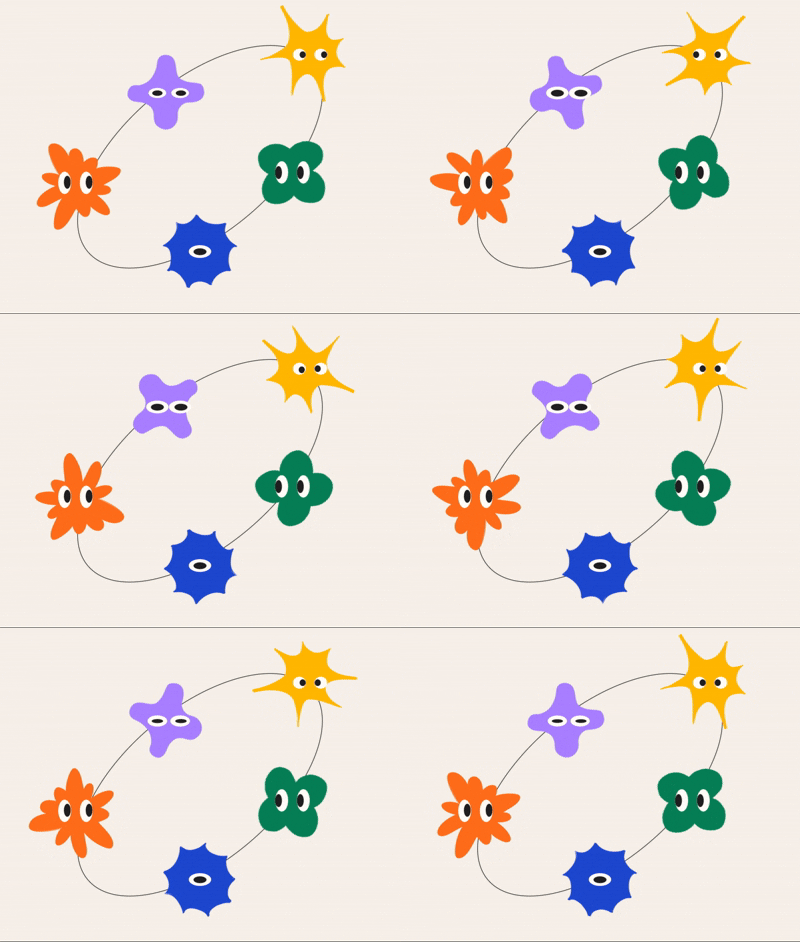
When all three signals align — when the body is quietly responding to a micro-joy moment — the ring pulses gently. Like the world tapping your hand. Five animated characters appear on its holographic surface, one per signal type, making invisible micro-joy visible on your finger without ever interrupting your attention.
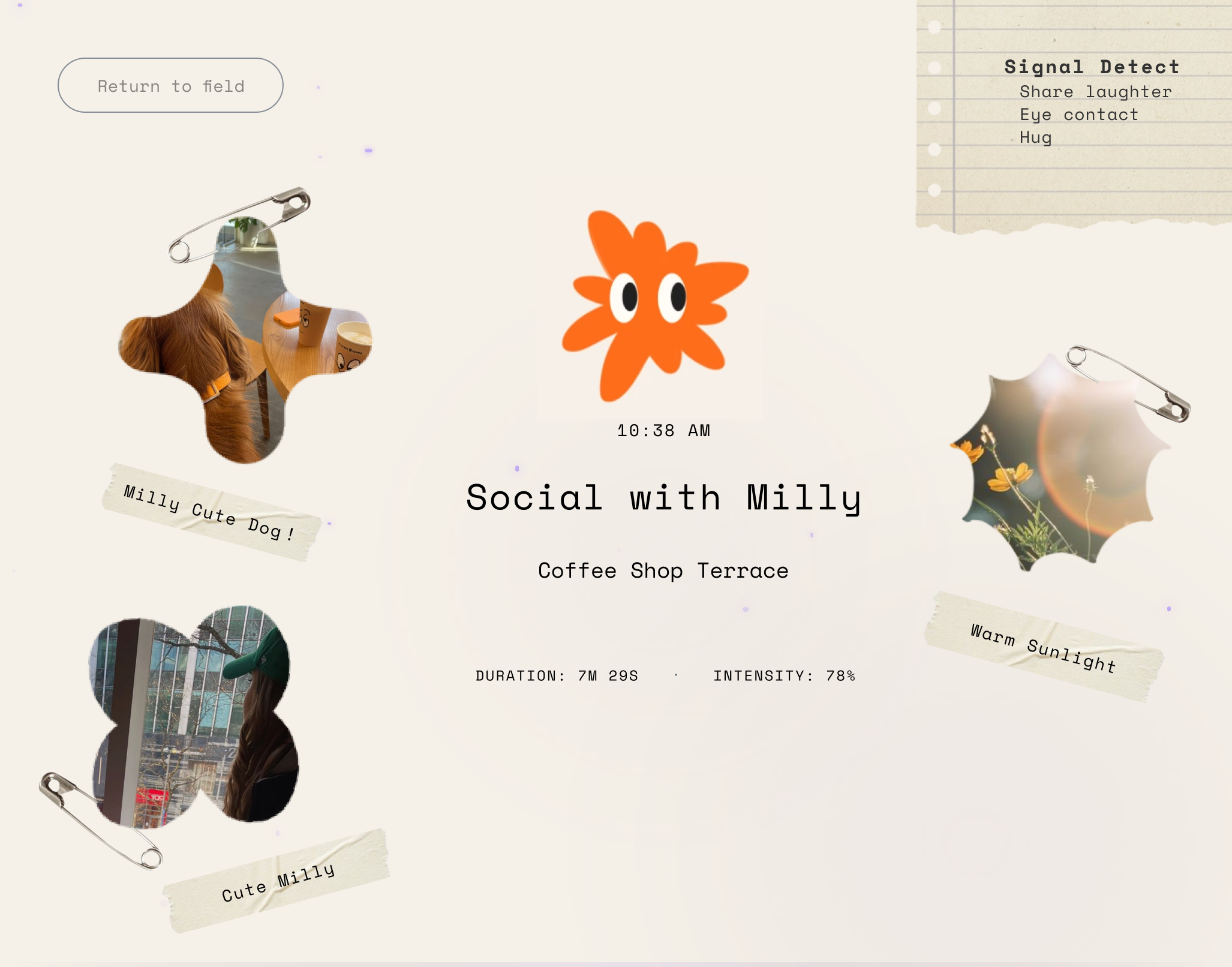
- Evening Replay — the app Micro-joy moments are captured silently throughout the day. That evening, the app surfaces them — not as data, not as scores, but in the language your body felt them:
03:20 — sunlight, leaves, four minutes. 08:47 — someone gave up their seat. 22:00 — heart slowed on the walk home.
This is the moment the new sense completes its loop: from body signal → to captured moment → to conscious memory → to self-knowledge.
- Rediscover — the pattern layer One micro-joy is a moment. Many micro-joys are a map. Over weeks and months, Second Sight reveals the patterns of what quietly moves you — the environments, the people, the times of day when your body comes most alive. This is where micro-joy stops being a feeling and becomes a foundation for real emotional wellness.
How we built it
We designed Second Sight entirely in Figma, building an interactive Figma Make prototype alongside a full presentation deck covering the complete user journey — from ring hardware concept and micro-joy signal detection logic, to the evening replay interface and long-term pattern visualization.
Our entire design process was anchored to one repeated question: does this decision interrupt the micro-joy moment, or protect it?
This led us to a silence-first interaction model. The ring never buzzes for attention. The app never pushes alerts. There are no streaks, no scores, no notifications. Because micro-joy is fragile — the moment you feel observed, it disappears. Silence is what keeps the channel open. We also developed a micro-joy color language to encode emotional tone without words:
Warm amber + rose — micro-joys rooted in human connection Mist blue + soft lavender — micro-joys of stillness and solitude Cream + soft gray — the quiet ordinary moments hiding in plain sight
Challenges we ran into
The wellness app trap. Every instinct in product design pushes toward gamification — streaks, scores, progress bars. We had to fight that pull constantly. Micro-joy is not a metric. The moment you quantify it, you change what it is. Our hardest design work was building something meaningful without making it measurable.
Designing beneath conscious thought. Micro-joy signals move faster than awareness. That meant our sensing layer had to work without the user doing anything — no logging, no tagging, no check-ins. Building an interaction model around doing nothing is a genuinely difficult design constraint, and one that required us to rethink what "interface" even means.
Communicating an invisible sense. How do you show someone what it feels like to perceive something they've never perceived before? We solved this through Emma's day — a concrete, lived narrative that made micro-joy tangible for anyone encountering the concept for the first time.
Accomplishments that we're proud of
We're proud that Second Sight doesn't feel like an app. It feels like a sense — something that quietly expands what you can perceive without demanding anything in return.
We're proud of the concept of micro-joy itself: that we identified a real, physiologically grounded phenomenon that sits in the gap between what the body feels and what the mind notices, and built an entire design system around making that gap visible.
And we're proud that we started from a human feeling — that quiet sense of having missed something beautiful today — and designed backwards from there. No technology looking for a problem. Just a feeling that deserved a tool.
What we learned
Restraint is a design skill. Every feature we cut made Second Sight more powerful. Less data, more meaning. Fewer interactions, more presence.
We also learned that the interface shouldn't be the experience — the ring is the experience. The app is just where the experience becomes understood. This shifted our entire design focus from screen to body, from UI to sensation.
Most importantly: emotional wellness doesn't begin with intervention. It begins with noticing. Designing for that realization changed how we think about what tools can and should do for people.
What's next for Second Sight
Micro-joy can't be forced, only noticed. The more we designed, the more we understood that our job wasn't to create joy — it was to create the conditions for perceiving what was already there. That reframing changed everything about how we approached the interface.
Restraint is a design skill. Every feature we cut made Second Sight more powerful. Less data, more meaning. Fewer interactions, more presence. The silence-first model only works because we were willing to remove everything that broke it.
The interface shouldn't be the experience. The ring is the experience. The app is just where the experience becomes understood. Designing from the body outward — rather than from the screen inward — was the most important shift we made.
Emotional wellness begins with noticing, not intervening. You can't improve what you can't perceive. Second Sight doesn't try to fix how you feel. It just gives you back the micro-joy signals your body was already sending — and trusts that seeing them is enough.
— Team Microbloom Adalyn Jin & Rebecca Zhang · ArtCenter College of Design · FigBuild 2026
Built With
- ae
- figma-make
- lovart


Log in or sign up for Devpost to join the conversation.