-
-
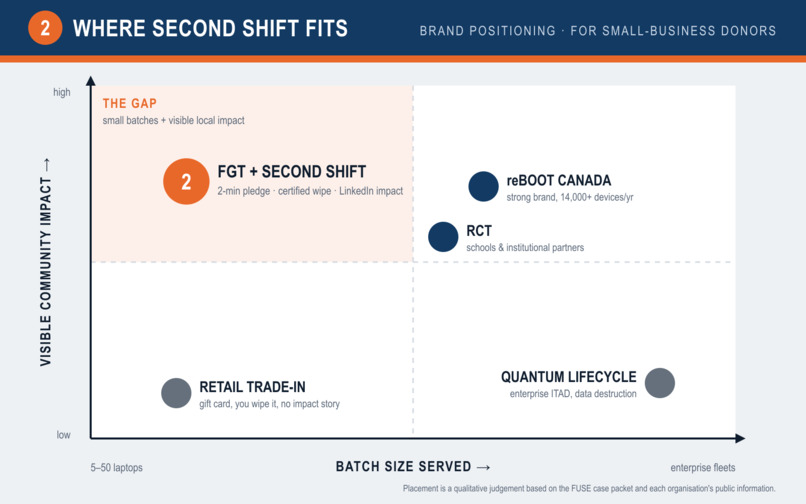
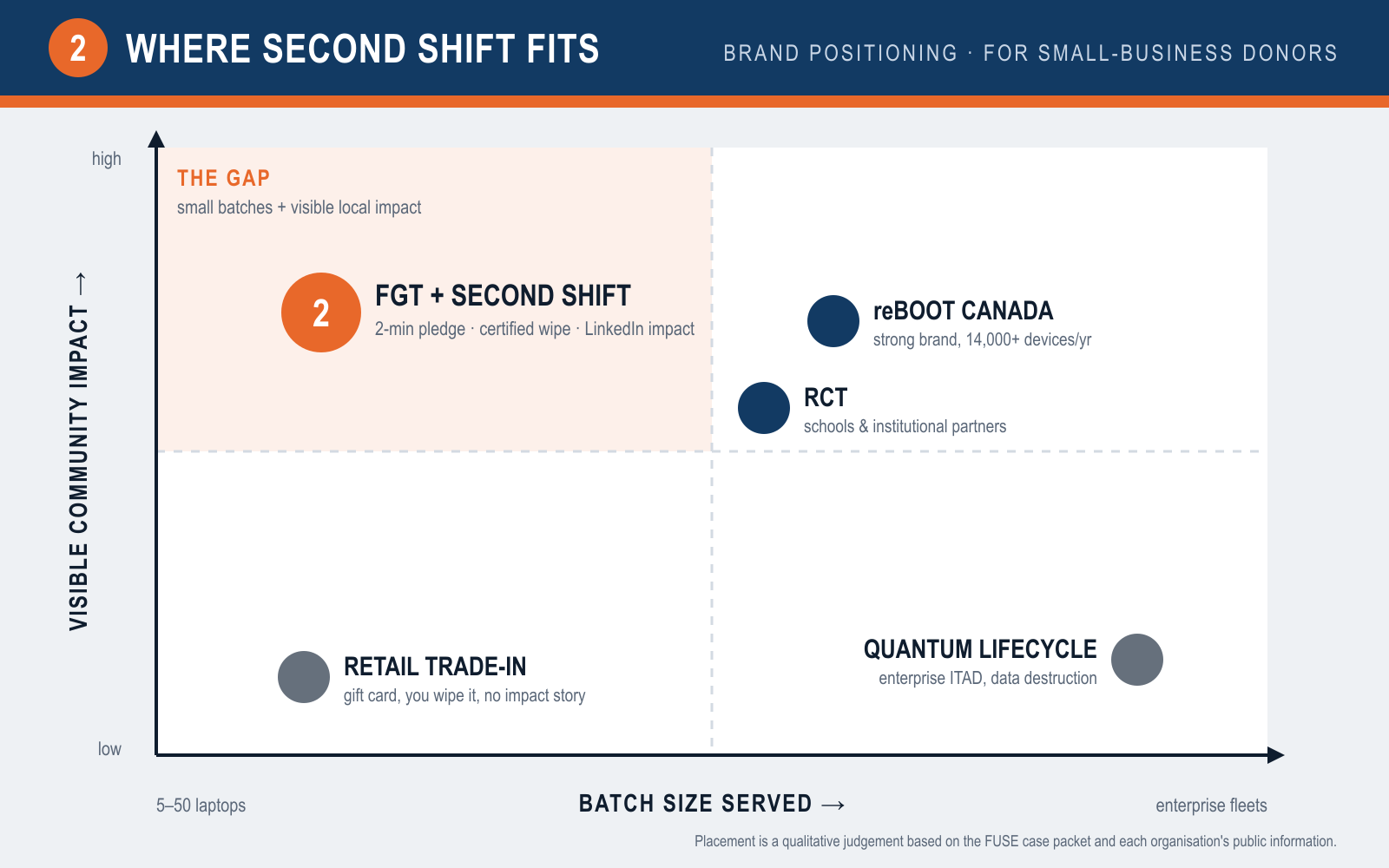
The gap: nobody offers small businesses certified data security and visible local impact. Second Shift sits there.
-
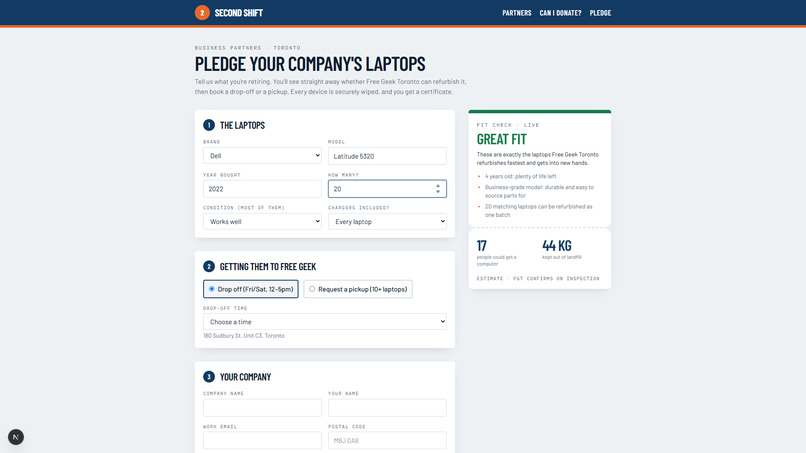
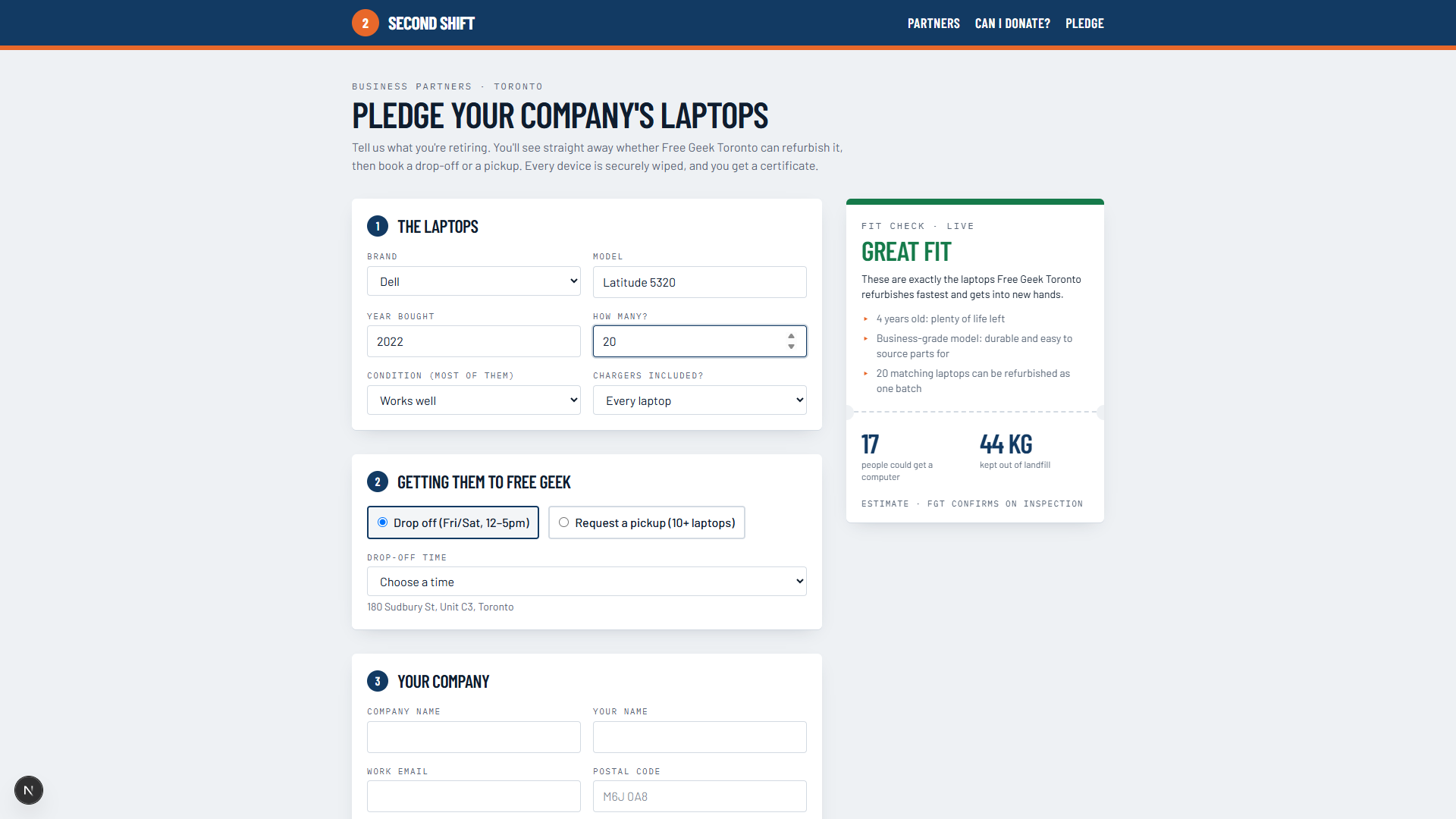
A business pledges its laptops and the live fit check scores the batch instantly, before anything arrives.
-
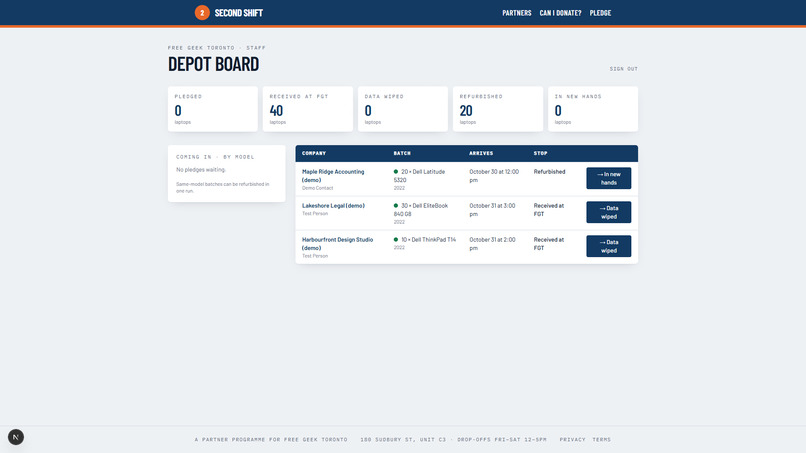
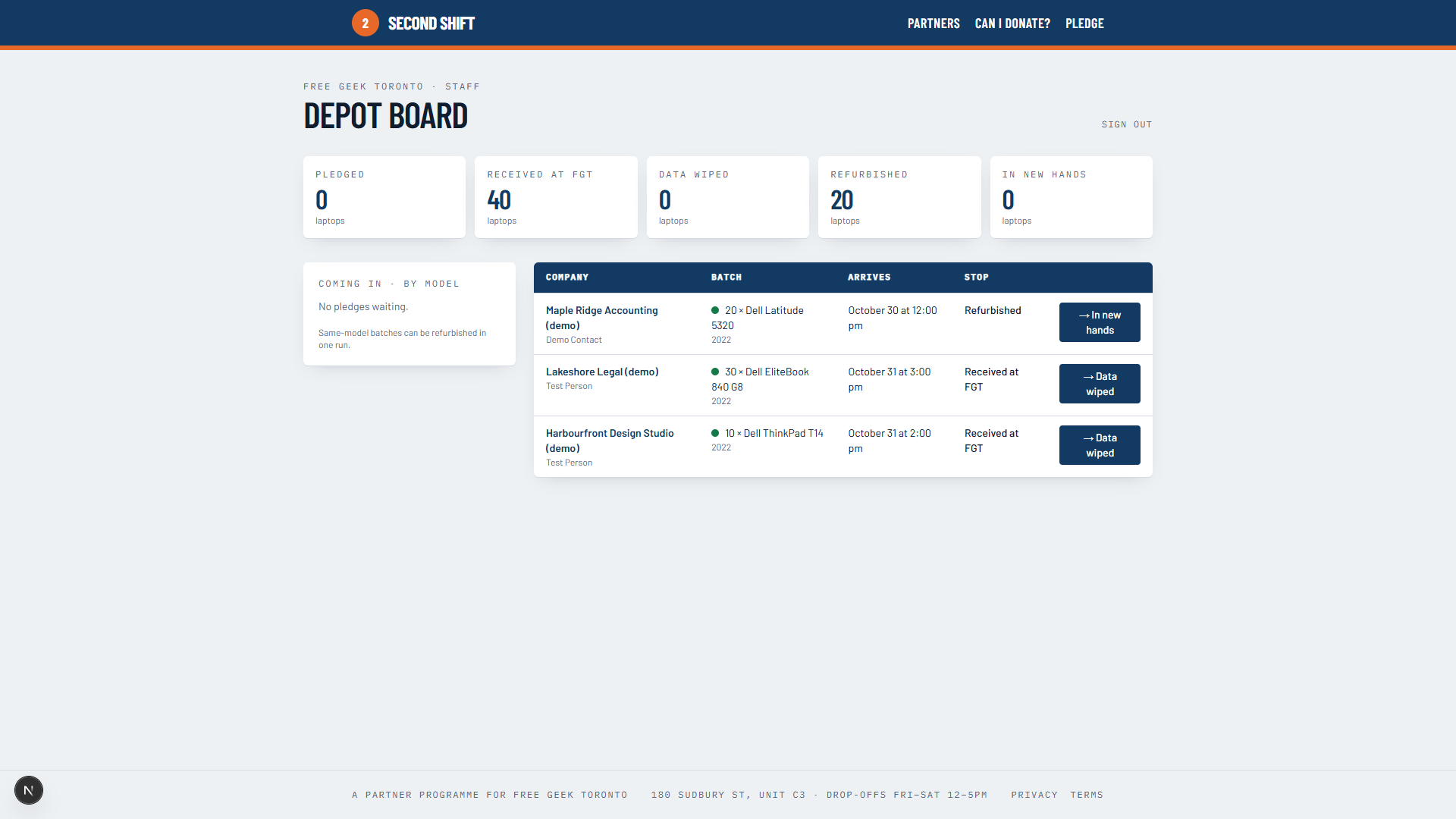
Free Geek staff see every batch by stage, with incoming laptops grouped by model for same-model refurbishing runs.
-
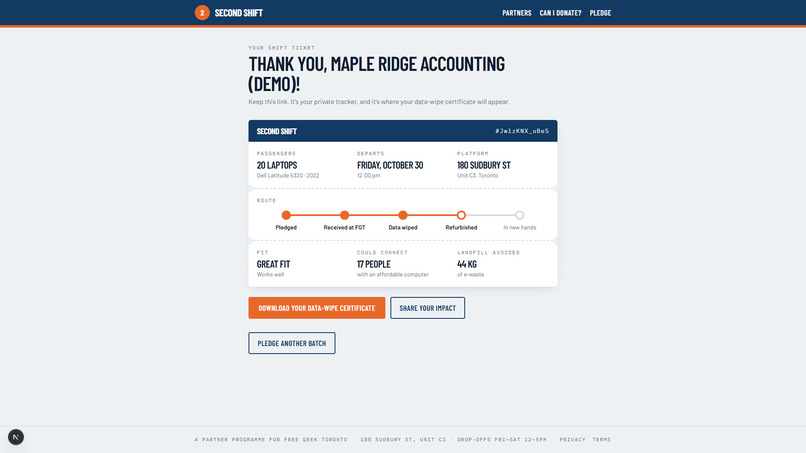
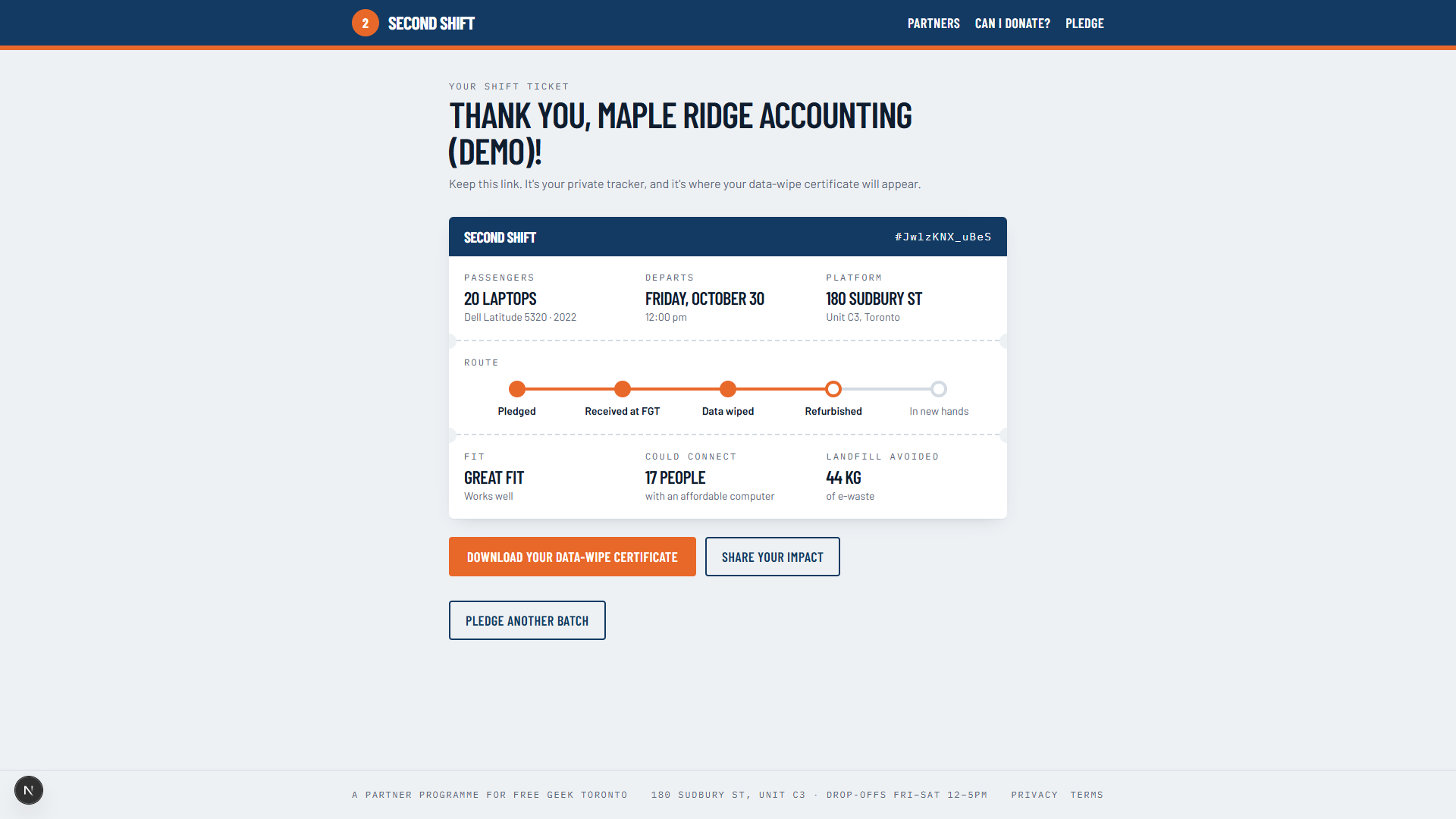
The business's private shift ticket tracks the batch: pledged, received, wiped, refurbished, in new hands.
-
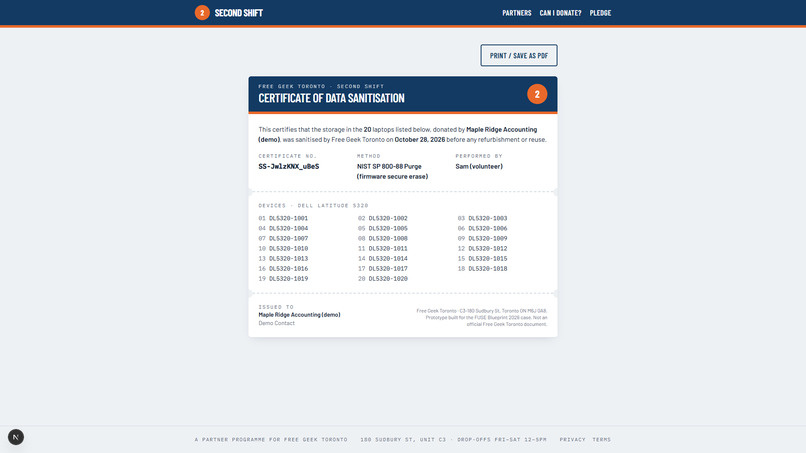
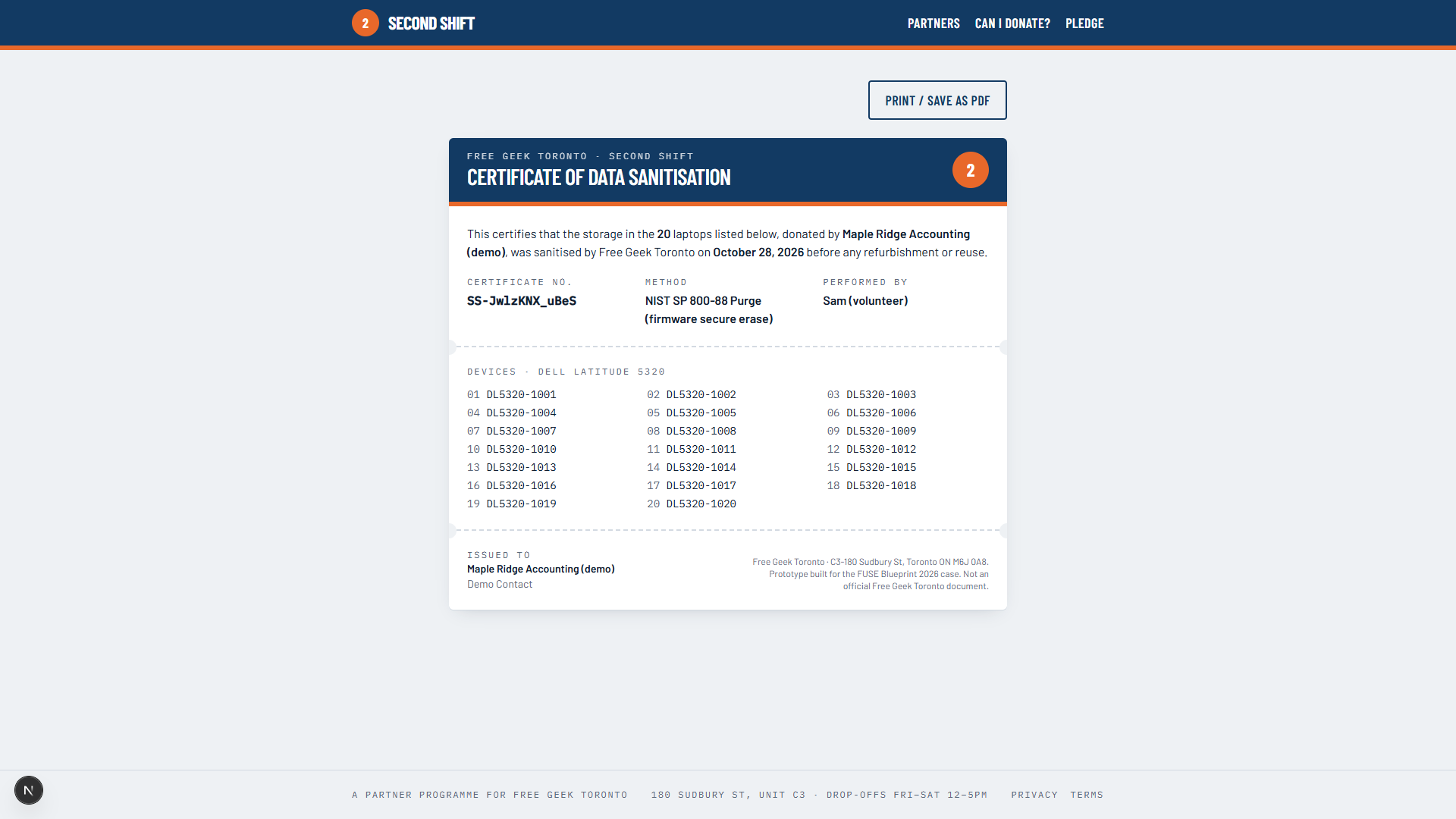
A data-wipe certificate listing every serial number, which solves the business's biggest worry: data liability.
Team: Jeremy Nduati · Live: https://second-shift-omega.vercel.app · Code: https://github.com/jeremydev-c/second-shift · Video: https://youtu.be/6y5BLMZT5LM
The one change: turn business laptop donations into a steady, trusted pipeline into Free Geek Toronto. Everything in Second Shift is a stage of that one pipeline: in, checked, wiped, refurbished, sold.
Built on what FGT already has
Second Shift adds no new prices, staff or space. It gets more value from things FGT already owns:
- A skill: FGT already wipes every drive. Second Shift turns that hidden work into a certificate businesses actively want.
- Its hours and space: the same Friday–Saturday drop-off window, now booked in two-batch slots instead of arriving at random.
- Its people: staff and volunteers refurbish identical laptops in one run, instead of mixed, slow-to-fix items.
- Its relationships: one-off donors become named partners on a wall and on LinkedIn, the platform FGT already plans to grow.
1. The problem
On the surface, Free Geek Toronto (FGT) faces falling donations, unwanted household items, no corporate partners and an under-used hub (case pp. 7–8).
Underneath, it's a supply problem. Sales are ~77% of FGT's revenue (2025), on an average of ~$240,000 a year (2023–25) (case pp. 3–4, Exhibit 1). FGT's own shop lists its business laptops, refurbished Dell Latitudes at $270–$380 (FGT shop). Yet "the most valuable and most uniform devices rarely reach organizations like FGT" (case p. 4), FGT has no corporate partners to supply them (case p. 8), and irregular household drop-offs "necessitate additional time and resources" (case p. 7).
Root cause: FGT sells as many computers as it can refurbish, but uniform business laptops go to trade-ins and resale, and FGT gets mixed, slow-to-fix items instead, because businesses have no easy, trusted, visible way to give laptops to FGT, and households have no guidance before they arrive.
FGT's objective: grow revenue in a way that strengthens the mission (case p. 7), with no price rises and no favouring richer buyers, and deliver its three goals: revenue, volunteer engagement, brand and partnerships (case p. 8).
Why this problem
| Challenge | Revenue | Mission | Feasible for 6 staff | Digital edge | /20 |
|---|---|---|---|---|---|
| Supply of uniform business laptops | 5 | 5 | 4 | 4 | 18 |
| Customer expectations ("it's free") | 3 | 4 | 5 | 3 | 15 |
| Volunteer retention (a platform is already planned, p. 7) | 3 | 5 | 3 | 2 | 13 |
| Under-used Community Hub (needs space and staff) | 2 | 5 | 2 | 2 | 11 |
| Grant dependence | 3 | 3 | 2 | 1 | 9 |
Supply is the only problem whose fix raises revenue, cuts refurbishing time and creates FGT's first partners at the same time. So we chose to change one thing: how business laptops reach FGT. We left the other four alone on purpose.
2. Who it's for
FGT's buyers stay the same: students, newcomers, seniors, low-income families. Our target customer is the donor: small and medium businesses, a segment FGT already names (case p. 6).
The office manager or IT lead at a 10–200-person Toronto firm, retiring 5–50 laptops. Ontario has 410,154 small employer businesses (ISED 2025). FGT needs 10 in year one.
- Needs: clear out a batch of old laptops quickly when the fleet is refreshed.
- Pains: data liability. Under PIPEDA a business must irreversibly destroy personal information before disposal, and stays responsible after handing devices to a contractor, so it must check that contractor's credentials (Privacy Commissioner). Trade-ins pay in store gift cards, vary with age and condition, and make you wipe the data yourself (Best Buy).
- Gains: proof the data is gone, a local-impact story, zero hassle.
- Behaviour: chooses on trust and convenience; lives on LinkedIn, where FGT wants to grow (case p. 7).
3. Competitors and the gap
| reBOOT Canada | RCT | Quantum Lifecycle | Retail trade-in | FGT + Second Shift | |
|---|---|---|---|---|---|
| Type | Direct | Direct | Direct (for-profit) | Indirect | |
| Offer | Refurbishing, non-profit IT | Refurbishing, CFS+, internships | Enterprise ITAD, data destruction | Store credit | Refurbishing + certified wipe + impact report |
| Edge | Brand: 14,000+ devices/yr | Charitable status, school boards | Canada's largest ITAD | Convenience | Local, mission-led, 2-minute process |
| Gap for a 20-laptop firm | Hard for a small org to out-brand | Hard to match its partner network | Built for big contracts | No impact, you wipe it | This is the gap |
(Case pp. 5–6; OECM.)
Nobody offers small businesses certified data security and visible local impact in a two-minute process. FGT already "securely eras[es] all data" (FGT). Second Shift turns that existing strength into something a business can see, prove and share.
(See the brand positioning graph in the image gallery above.)
4. Value proposition
For the business: Second Shift helps Toronto small businesses who want to retire laptops safely by giving them a two-minute pledge, a booked drop-off and a certificate listing every serial number, so it reduces data-security risk and hassle and creates a shareable local-impact story.
For FGT: Second Shift helps FGT grow revenue without mission drift by bringing in batches of uniform, high-value laptops and its first corporate partners, so it reduces refurbishing time and junk drop-offs and creates more affordable computers at the same prices.
5. The solution: one pipeline, five stages (live)
| Pipeline stage | What Second Shift does | Why it matters |
|---|---|---|
| 1. Attract | Impact page + LinkedIn card (separate public link) and an opt-in partner wall (Bronze 5+ / Silver 20+ / Gold 50+) | Each donor becomes FGT's advert to the next one: FGT's first visible partners |
| 2. Qualify | Pledge + live fit check (age, condition, chargers, model line, batch size) | Sellable laptops are confirmed before they arrive |
| 3. Arrive | Booking in FGT's real Fri–Sat 12–5pm hours, max 2 batches per slot; pickup for 10+ | No rush at the door, no new hours |
| 4. Wipe and prove | Depot board (laptops per stage, "coming in by model") + intake (serials, wipe method, who did it; a batch can't be marked wiped without them) → data-wipe certificate listing every serial | Removes the business's #1 pain; same-model refurbishing runs for staff |
| 5. Close the loop | Shift-ticket tracker: Pledged → Received → Wiped → Refurbished → In new hands | Trust without staff phone calls; feeds stage 1 again |
The "Can I donate this?" checker is the pipeline's front-door filter for households: it keeps the Fri–Sat slots for computers by turning away printers, TVs and appliances before they arrive.
Why digital? A flyer or phone line can't check a batch before it arrives, fill two-batch slots, produce a serial-by-serial certificate or post impact to LinkedIn. Every call costs staff time FGT doesn't have.
6. Business impact (estimates, clearly labelled)
| Need | → Solution | → FGT objective | → Measure |
|---|---|---|---|
| Safe, easy disposal | Pledge, booking, certificate | Revenue | Uniform laptops/month; sales |
| Proof + story | Impact card, partner wall | Brand and partnerships | Partners; LinkedIn shares |
| Know what to bring | Checker | Efficiency | Non-computer drop-offs |
| Easier, uniform work | Same-model batches | Volunteer engagement | Minutes per refurbish |
Year one: 10 partners × 20 laptops = 200 laptops → ~70% resold at ~$270 = ≈$37,800 in additional sales (≈16% of revenue), ≈140 more people with an affordable computer, and ≈440 kg of e-waste reused. The partner and batch numbers are targets; the resale rate and 2.2 kg/laptop are planning estimates; the price is from FGT's shop. FGT can't share customer data (case p. 6), so the pilot measures the real figures.
7. Feasibility
| Cost (CAD, estimate) | One-off | Per year |
|---|---|---|
| Build | $0 (done, open source) | |
| Hosting (Vercel Pro, commercial use) | ~$340 | |
| Database (MongoDB Atlas free tier) | $0 | |
| Domain (optional) | ~$20 | |
| USB barcode scanner | ~$40 | |
| Year one | ≈ $400 (≈ $460 with a 15% buffer) |
Year one costs less than two refurbished laptops. A single 20-laptop batch (≈$3,780 in sales) covers it many times over.
Capacity: no new hires, no new space, the same Fri–Sat hours. About 2 staff hours a week, owned by one part-time staff member. Data security and compliance are already FGT duties (case p. 8); Second Shift records them.
| Phase | When | Milestone |
|---|---|---|
| Set-up | Nov–Dec 2026 | FGT sets its password; 2 × 1-hr staff trainings |
| Pilot | Jan–Mar 2027 | 5 businesses (FGT network, LinkedIn, a local business association) |
| Review | Apr 2027 | Check SMART goals; adjust |
| Roll-out | May–Dec 2027 | Partner wall + LinkedIn campaign → 10 partners |
| Grow | 2028–29 | Impact Partner tier: firms sponsor laptops for community groups → FGT's first sponsorship income |
8. SWOT, SMART goals and risks
Strengths: FGT already wipes drives; working build; ≈$400/yr; fits current hours. Weaknesses: needs awareness; rivals have bigger brands and networks (case p. 5). Fix: compete on what they don't give small firms: certificate, speed, visible impact. Opportunities: 410,154 Ontario small employers; 63% of Canadians already buy refurbished or traded-in tech (case p. 4); FGT's LinkedIn plan. Threats: trade-in offers; busy drop-off days. Fix: slot limits, pickups for 10+.
SMART goals
- 5 business partners by 31 Mar 2027; 10 by 31 Dec 2027.
- 100 business laptops by 31 Mar 2027; 200 by 31 Dec 2027.
- 25% fewer non-computer household drop-offs by 31 Dec 2027 (2-week baseline count first).
- Same-model batches refurbished 20% faster than mixed donations (timed in the pilot).
- 10 partner impact posts on LinkedIn by 31 Dec 2027.
| Risk | Mitigation |
|---|---|
| Few sign-ups | Start with FGT's contacts + one business association; impact cards spread the word |
| Busy drop-off days | Max 2 batches per slot; pickups for 10+ |
| A data-security slip | "Wiped" is locked until serials, method and name are recorded |
| Laptops too old to sell | The fit check flags them; they still go to responsible recycling |
| Upkeep | Simple stack, free tiers, open source, so a volunteer can maintain it |
9. How it was built
Built new during the competition (24–30 Oct 2026) with Next.js, TypeScript, MongoDB Atlas and Vercel. Tested end to end, with automated tests for the fit scoring, booking and impact maths. Estimates are labelled in the app as well. I used Claude (AI) to help me with the difficult parts.
10. Challenges, lessons and what's next
Challenges: choosing one problem when the case lists five; turning "data security" from a worry into something a business can actually hold (the certificate); keeping it light enough for a team of one full-time and five part-time staff; and getting phone video and a live database working in production.
What I learned: start from the business's objective and root cause, not from features; label every estimate as an estimate; and design for the real people using it (an office manager, and staff with only a few hours a week).
What's next for Second Shift: hand it to Free Geek Toronto for its 2027–29 strategy, run the January to March 2027 pilot with five businesses, measure it against the five SMART goals, then grow into the Impact Partner sponsorship tier.
FUSE checklist: ☑ core problem ☑ target customer ☑ direct + indirect competitors ☑ market gap ☑ specific pain ☑ clear gain ☑ aligned with objectives and mission ☑ quantified ☑ risks ☑ specific, realistic, measurable
Built With
- mongodb
- nextjs
- react
- tailwindcss
- typescript
- vercel

Log in or sign up for Devpost to join the conversation.