SECOND SELF
Don't ask AI what to buy. Ask it what to change first.
Most beauty and fashion AI experiences answer a simple question:
"What product or outfit should I recommend?"
SECOND SELF starts with a different question:
Given your actual situation, what change is most worth making right now?
If someone has an important interview tomorrow, a long-term skincare recommendation may not be the highest-value action. If they have more time, a different path might make more sense.
That idea inspired SECOND SELF: an appearance decision system that considers context, constraints, priorities, and possible interventions instead of producing a one-size-fits-all recommendation.
What it does
SECOND SELF guides the user through a decision experience:
Choose an upcoming event
- Important Interview
- First Date
- Big Presentation
- Special Event
Provide a starting point
Build an Appearance State
The system organizes the relevant appearance context into a structured state that can be used by the decision engine.
Choose what matters most
- Fastest result
- Lowest additional spend
- Best overall fit
- Long-term improvement
Simulate possible intervention paths
Instead of immediately recommending one answer, SECOND SELF compares three strategies:
- TREAT — prioritize skin and longer-term improvement
- STYLE — prioritize wardrobe and immediate presentation
- BALANCE — combine multiple interventions strategically
- Find the best next move
The system ranks the paths based on explicit factors such as:
- urgency
- time available
- user priority
- cost
- effort
- immediate suitability
- Explain the trade-offs
SECOND SELF doesn't just announce a winner. It shows why one path fits the current situation better than the alternatives.
The key idea: the answer can change
One of the most important parts of SECOND SELF is that the recommendation is constraint-sensitive.
For example:
Tomorrow + fastest result
may lead to:
STYLE-FIRST
But changing the constraint to a longer timeline or prioritizing long-term improvement can change the best path.
This demonstrates the central idea behind the project:
The right recommendation is not fixed. It depends on what matters, how much time you have, and what constraints you are working with.
How we built it
SECOND SELF combines a structured appearance-analysis flow with an explainable decision engine.
The core architecture follows this flow:
USER CONTEXT
      ↓
APPEARANCE STATE
      ↓
EVENT + DEADLINE + PRIORITY
      ↓
NEXA DECISION ENGINE
      ↓
TREAT / STYLE / BALANCE
      ↓
RANKED NEXT MOVE
      ↓
EXPLAINABLE REASONING
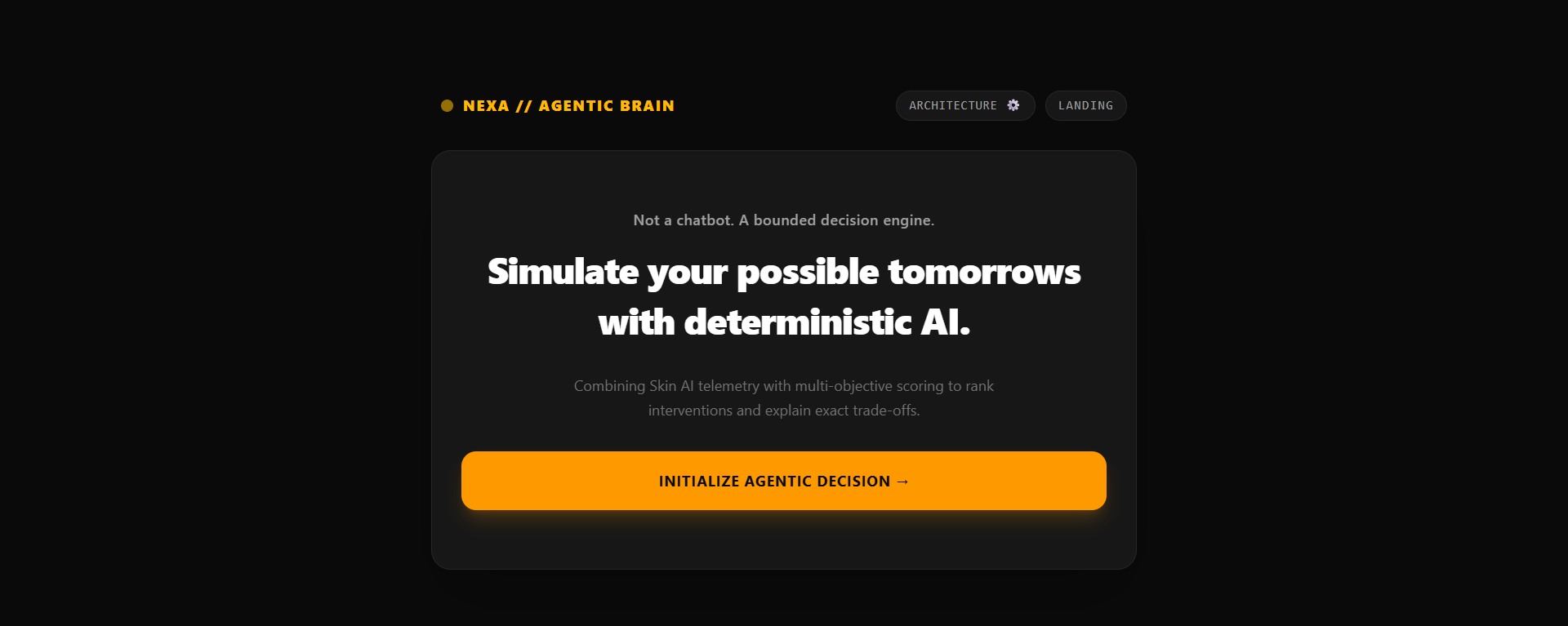
The project uses deterministic decision logic for the ranking process rather than allowing an AI model to randomly decide the outcome.

The scoring and ranking system considers explicit decision factors and produces a structured result. This makes it possible to demonstrate why a path wins and why another path may be less suitable for the user's current constraints.

NEXA is the decision engine behind SECOND SELF.

Its role is not to act as a generic chatbot. Its purpose is to compare bounded options and identify the highest-value next move based on the information provided by the user.

Challenges we ran into

One of the biggest challenges was avoiding the temptation to build another generic recommendation app.

It would have been easy to create:

a skin analysis wrapper
an AI stylist chatbot
a product recommendation engine

But none of those ideas addressed the harder question:

What should the user change first?

Another challenge was making the recommendation system explainable.

A single AI-generated answer can feel arbitrary, so we focused on showing the competing paths and the trade-offs behind the final recommendation.

We also had to balance technical complexity with a clear user experience. The underlying decision system uses structured inputs and deterministic ranking, but the user experience needed to remain simple enough to understand without seeing the entire scoring model.

What we learned

We learned that personalization is not only about knowing more information about a user.

It is also about understanding constraints.

The same person can need different recommendations depending on:

whether their event is tomorrow or next week
whether they care about immediate impact or long-term improvement
whether they want to spend money or use what they already have
how much effort they are willing to invest

We also learned that an AI recommendation becomes more trustworthy when the system can show:

Why this option? Why not the others? What would need to change for the answer to change?

What's next

The next step for SECOND SELF would be to expand the simulation layer and make the alternative paths even more visual.

Future versions could explore deeper integrations across skin analysis, apparel visualization, and more detailed scenario comparison.

The long-term goal is simple:

Move beyond AI that only recommends things, toward AI that helps people make better decisions about what to do next.
Built With
- machine-learning
- next.js
- react
- restapi
- tailwind
- typescript
- vercel
- youcam

Log in or sign up for Devpost to join the conversation.