-
-
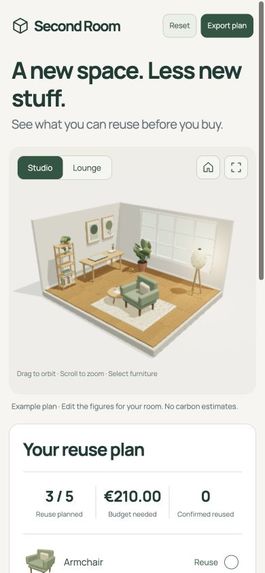
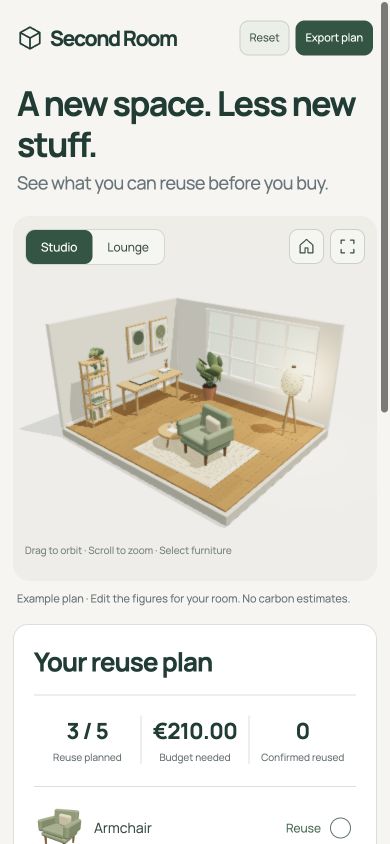
Responsive phone layout — the same planner without a sign-up.
-
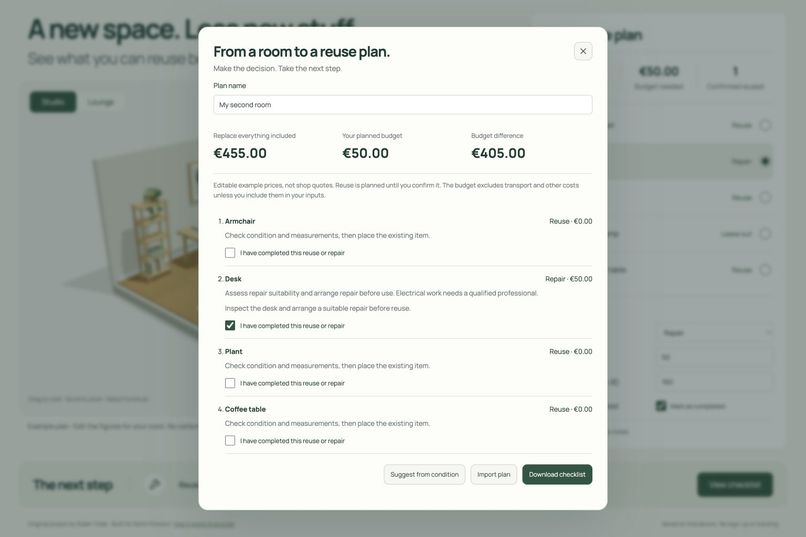
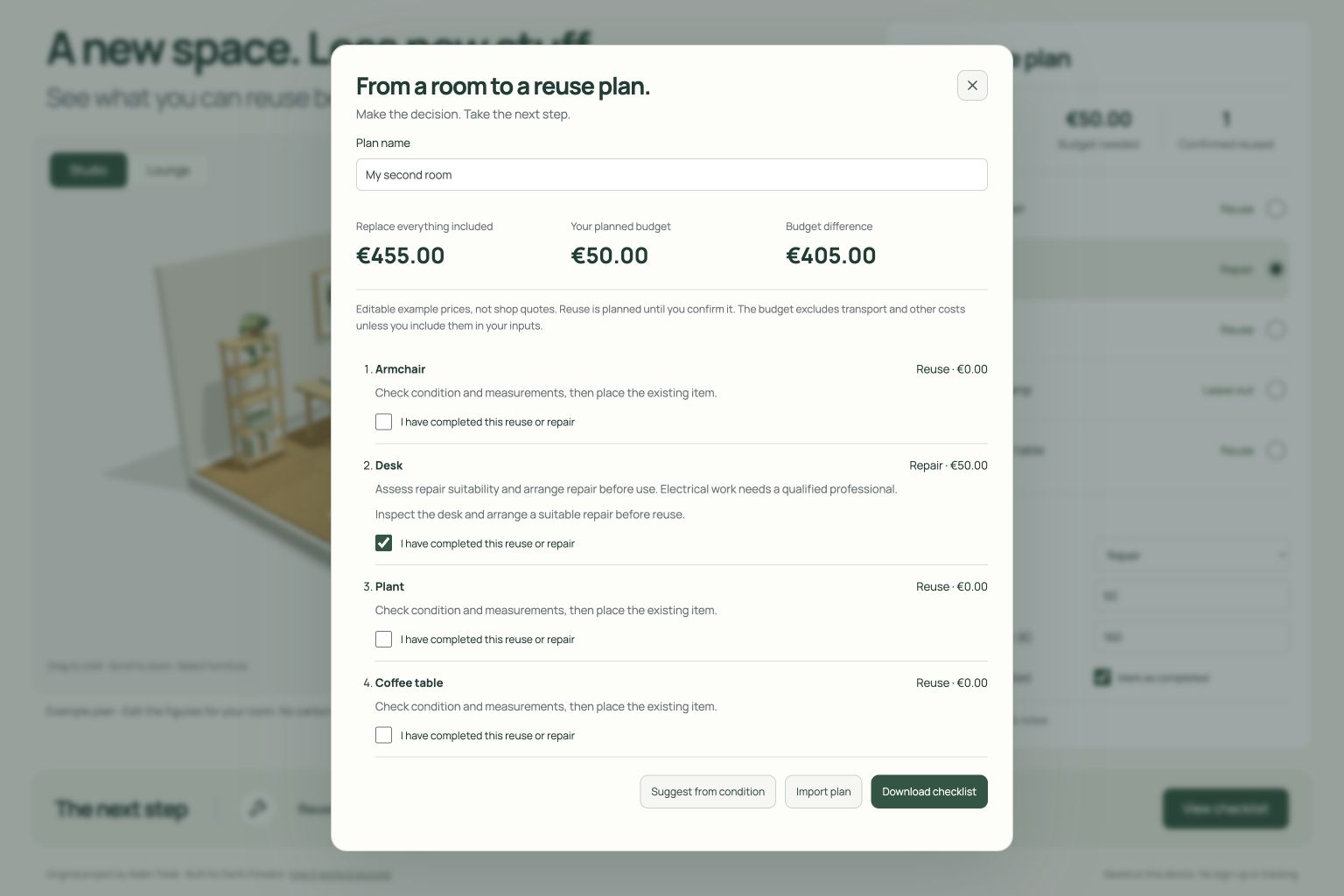
Action checklist — transparent budget comparison and self-reported completion.
-
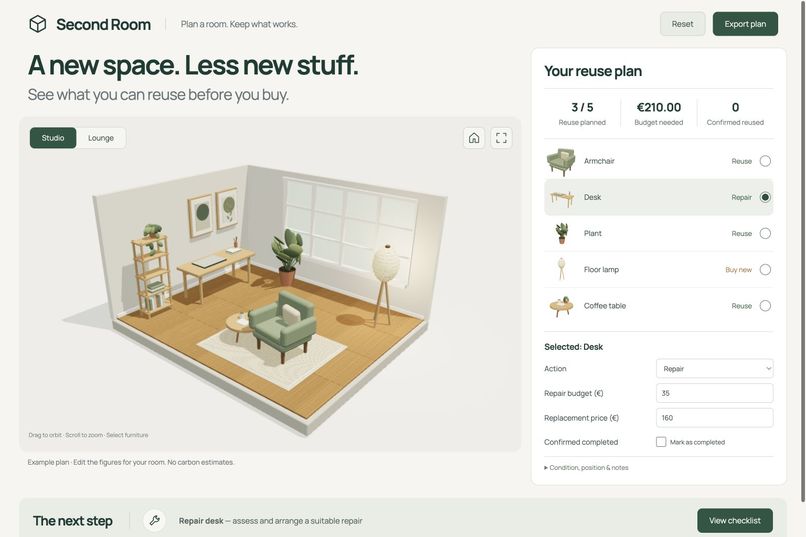
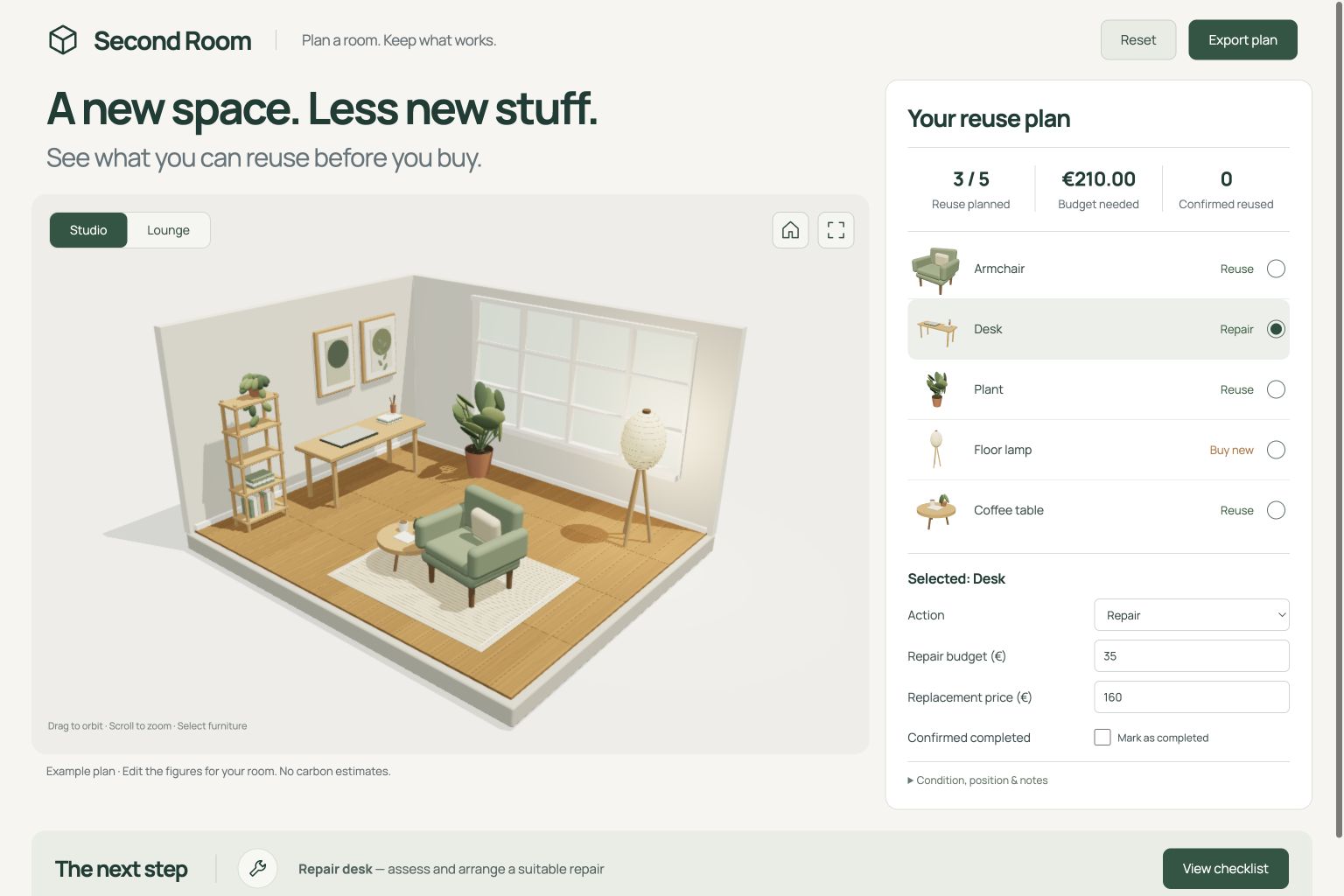
Working desktop planner — example costs, reuse decisions, and original procedural 3D room.
Inspiration
A new room does not have to start with new furniture. Moving, redecorating, or setting up a study space often turns into a shopping list before anyone checks what could be reused or repaired. Second Room makes that decision visible and connects it to a practical next step. It was created for NextStep Hacks' Earth Forward theme.
What it does
Explore a small interactive 3D room and decide, object by object: Reuse, Repair, Buy new, or Leave out. The room, budget, and checklist update together. Enter your own repair and replacement prices, record condition and notes, and mark reuse or repair completed separately from planning. Export a portable JSON plan or download the action checklist. Your plan stays on your device, with no account or backend.
How we built it
React manages one normalized plan shared by the inspector, budget model, checklist, and Three.js scene. Five original procedural furniture objects support selection, two arrangements, orbit/zoom, rotation and bounded movement. Condition suggestions use transparent deterministic rules, not an AI service. Vite builds the standalone app, deployed on Netlify. Source and original procedural assets are MIT licensed.
Created by Ádám Tokár on September 8, 2026, with AI-assisted implementation by Codex. The original Roomcraft renderer and visual direction were created earlier the same day as a separate work sample. Second Room extends that code with the environmental planning logic, decisions, condition records, cost model, checklist, completion semantics, portable files, and methods documentation. This reuse is disclosed; all of the work falls within the published August 21–September 13 build window. This project has not been submitted as a final entry to another event.
Challenges we ran into
Keeping the numbers honest mattered as much as the 3D view. Excluding an object removes it from both the plan and replacement baseline. Changing an action clears old completion. A repair can cost more than replacement, so budget difference can be negative. Planned reuse is not reported as a completed environmental outcome.
Accomplishments that we're proud of
A working deployed prototype with connected spatial and financial decisions, responsive phone layout, device-local persistence, tested JSON import/export logic, and usable action checklists. Seven automated tests passed. Deployed browser checks verified decision changes, budget updates, completion, reload persistence, and file import.
What we learned
A reuse interface needs a clear boundary between intention and execution. Separating planned choices, self-reported completion, and illustrative costs makes the prototype more useful and more credible. The European Environment Agency's circular-economy overview supports the general reuse motivation, not a measured impact claim for this app.
What's next for Second Room
Test whether the planner helps people make actual reuse decisions, then add custom furniture and real dimensions. No field study, school partnership, customer adoption, carbon reduction, or diverted-waste result is claimed yet. The current five-object scene is illustrative, not a CAD, collision, or repair-safety assessment. Prices are editable examples, not shop quotes. Full methods, privacy details and limitations are linked from the live app.
The video uses actual app screenshots and synthetic narration. The source includes the tests and verification record.

Log in or sign up for Devpost to join the conversation.