Inspiration
I built Second Read because screenplay development involves much more than simply reading a script.
When a producer receives a screenplay, they need to understand the story and characters, but they also need to think about comparable films, market positioning, production complexity, risks, and whether the project is worth taking to the next stage.
I wanted to build a system that could bring these pieces together into one workflow. Instead of giving a producer another chatbot that produces an opinion, I wanted Second Read to show how that opinion was formed and where external evidence came from.
That led me to the idea of an evidence-backed screenplay development assistant built around multiple specialized agents.
What it does
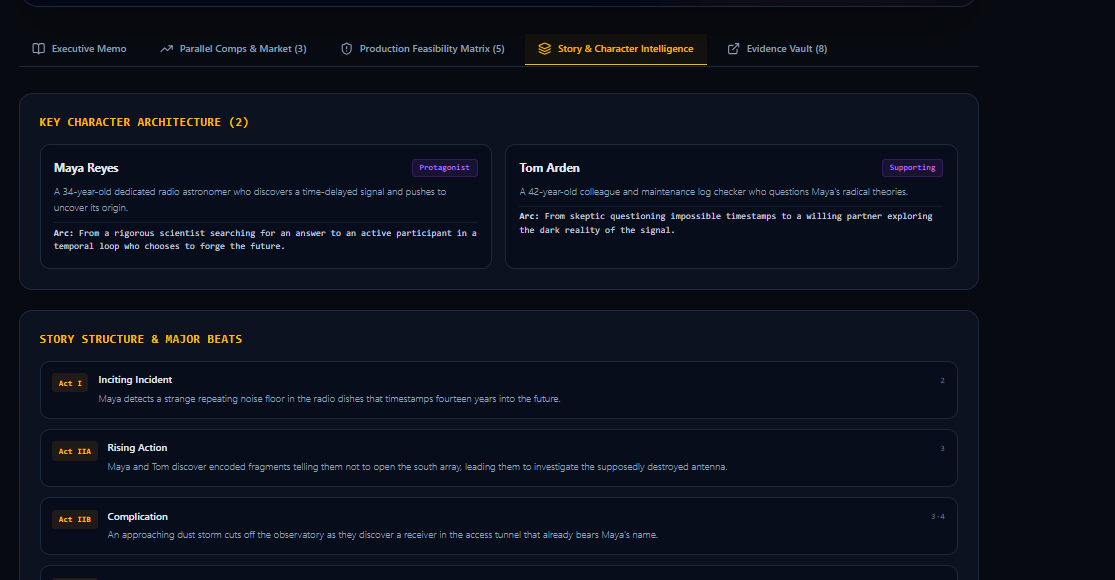
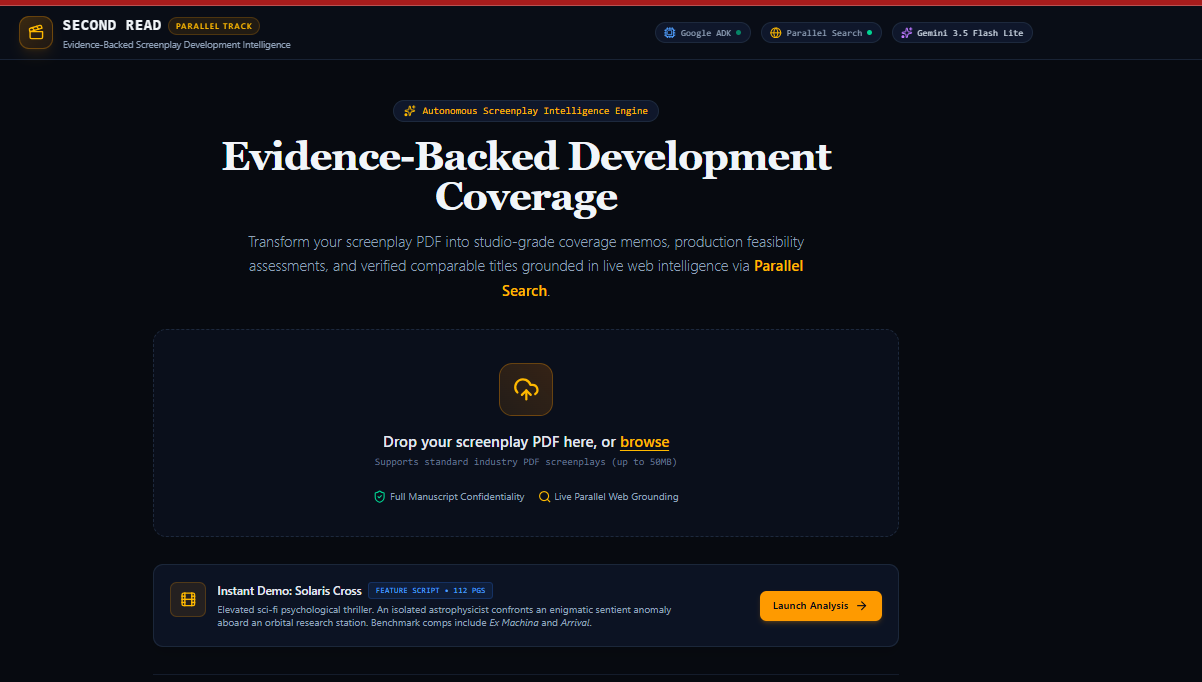
Second Read takes a screenplay PDF and turns it into a structured development analysis.
The workflow starts with screenplay extraction, where Gemini identifies important story, character, genre, tone, and production signals.
Those signals are then used to create a focused research objective. The Research Agent uses the Parallel Search API to find external information about comparable titles and relevant market signals.
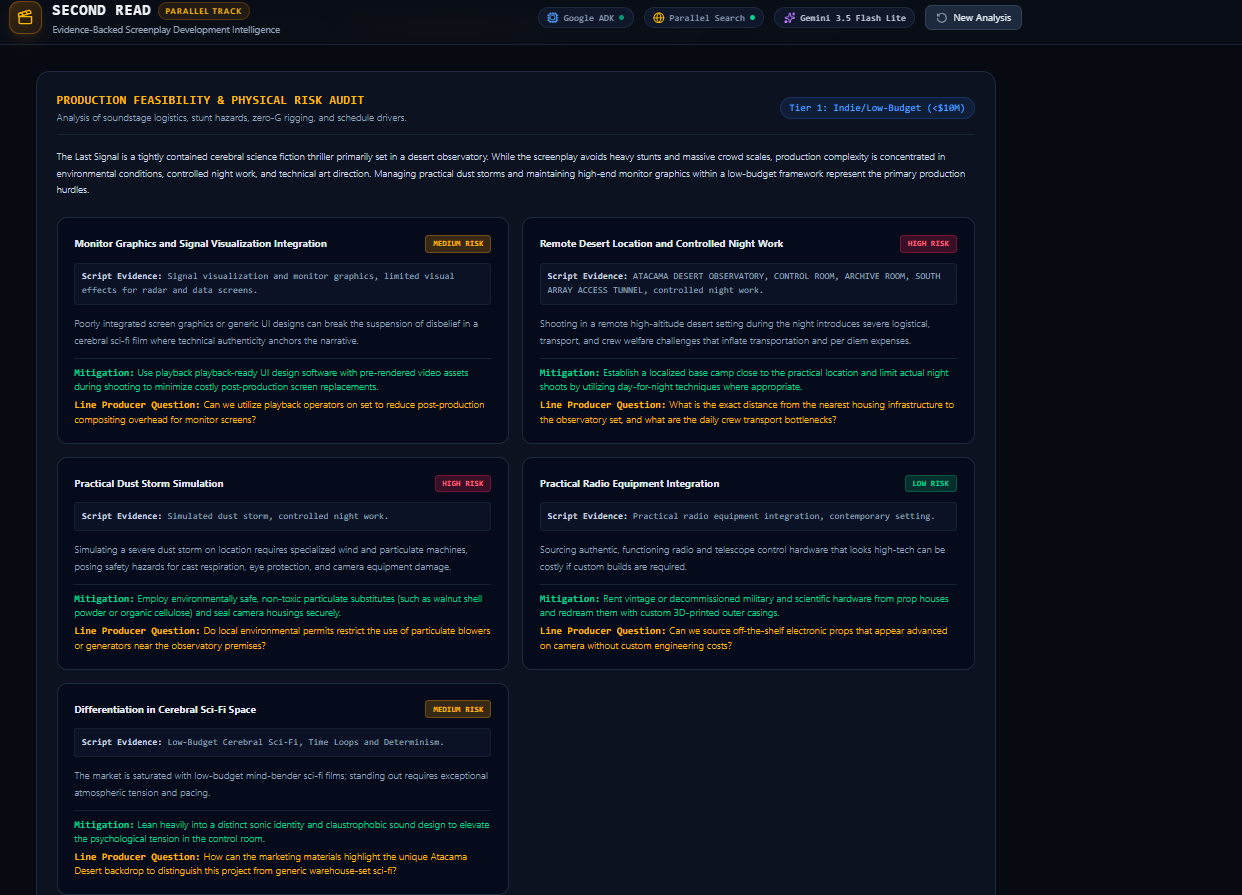
A separate Risk Agent evaluates production feasibility, looking at factors such as locations, VFX, action, scheduling complexity, and other production requirements found in the screenplay.
Finally, the Memo Agent combines the results into an executive-style coverage report with:
- Story and concept analysis
- Character intelligence
- Comparable-title research
- Production feasibility and risk analysis
- Strengths and development considerations
- Critical questions
- A directional development recommendation
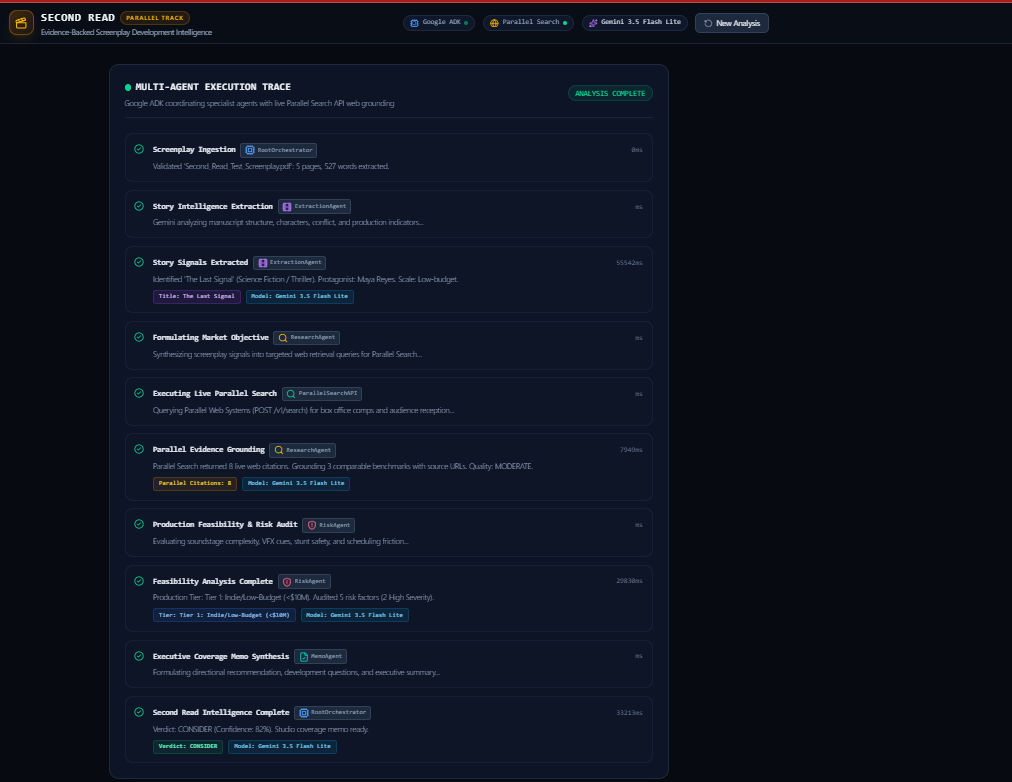
The user can also follow the multi-agent execution trace and ask Second Read follow-up questions about the completed analysis.
How we built it
I built the frontend with React, TypeScript, Vite, and Tailwind CSS, with a FastAPI backend handling the application API and analysis pipeline.
Google ADK is used to orchestrate the different agents, while Gemini powers the screenplay extraction, research reasoning, risk analysis, memo generation, and follow-up questions.
Parallel Search is integrated directly into the research stage. The system generates research objectives from the screenplay rather than simply asking a model to invent comparable titles from its existing knowledge.
The application uses structured Pydantic models between stages so that the output from one agent becomes predictable input for the next.
I also added validation and error handling around PDF uploads, model calls, and external search requests. The application is containerized and deployed on Google Cloud Run.
One of the main architectural ideas was keeping evidence, screenplay facts, model inference, and recommendations separate. This makes it easier to see what came from the source material and what was inferred by the system.
Challenges we ran into
One of the biggest challenges was getting multiple agents to behave like one coherent system.
It was easy to create several prompts, but much harder to define clear responsibilities and structured handoffs between them. I had to think carefully about what information each stage actually needed from the previous stage.
Another challenge was external research. Parallel Search does not always return the same amount or quality of evidence for every screenplay. Instead of hiding that problem, I designed the application to expose research quality and avoid pretending that missing evidence exists.
Model and API reliability was another practical challenge. I had to handle failures, validate responses, track which model was actually used, and make sure an error in one stage did not silently become fabricated output in another.
The final challenge was turning all of this into a product that was understandable to someone who did not build it. That is why the execution trace and evidence-oriented interface became important parts of the final application.
Accomplishments that we're proud of
The biggest accomplishment is that Second Read became a working end-to-end application rather than just a collection of AI prompts.
A screenplay can enter as a PDF and move through extraction, research, production-risk analysis, and executive coverage before the user can inspect the result.
I am especially proud of the multi-agent execution trace because it makes the workflow visible. Instead of showing only a final answer, the user can see the different stages responsible for producing it.
I am also proud of making Parallel a meaningful part of the workflow. It is used for external research and evidence gathering rather than being included only to satisfy an integration requirement.
Finally, I am proud that the application is deployed on Google Cloud Run with a public working interface and a public source repository.
What we learned
The biggest lesson I learned was that building an AI application is much more than writing prompts.
The difficult part is designing reliable boundaries between components, defining structured data contracts, handling failures, and making the system understandable to the person using it.
I also learned that evidence and uncertainty need to be treated as first-class parts of an AI product. A polished answer is not necessarily a trustworthy answer.
Working on Second Read also changed how I think about multi-agent systems. Adding more agents does not automatically make a system better. Each agent needs a clear responsibility and a reason to exist in the workflow.
Most importantly, I learned that the best role for a system like this is decision support. The goal is not to make the decision for a producer, but to give them better information and a clearer starting point for their own judgment.
What's next for Second Read
The next step would be making Second Read more useful for real development workflows.
I would like to add stronger screenplay comparison across multiple drafts, deeper production-budget analysis, richer market research, and better ways to track how a project changes during development.
Another direction would be allowing development teams to save projects and compare analyses over time instead of treating each screenplay as a single analysis.
I would also like to improve evidence quality and make the relationship between screenplay passages, external research, and recommendations even more transparent.
The long-term goal is to turn Second Read from a screenplay analysis tool into a practical development intelligence workspace that helps creative teams make faster, better-informed decisions without removing the human judgment at the center of filmmaking.
Built With
- adk
- api
- cloud
- fastapi
- gemini
- parallel
- python
- react
- run
- search
- tailwind
- typescript
- vite

Log in or sign up for Devpost to join the conversation.