-
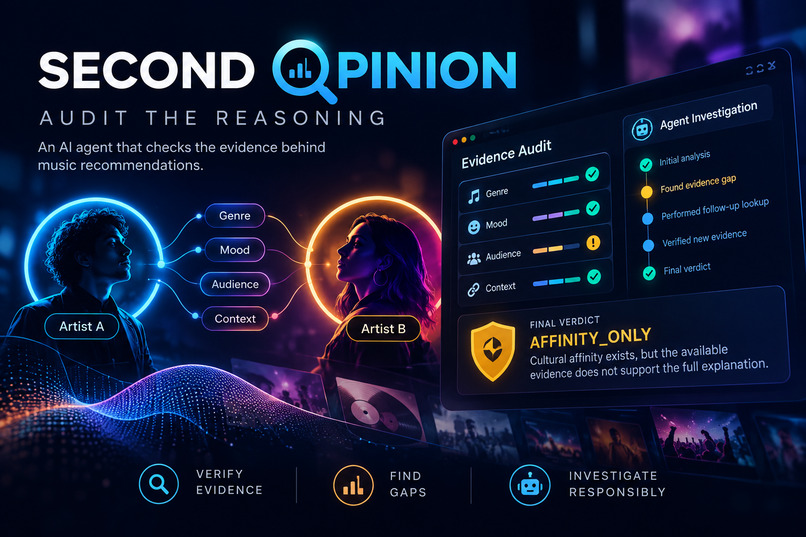
Second Opinion — Auditing the reasoning behind AI-powered music recommendations with evidence-driven cultural intelligence.
Inspiration
Music recommendations are increasingly powered by AI, but there is a problem: an explanation can sound convincing without being supported by evidence.
For example, an AI might recommend one artist for another and claim they share the same musical style simply because their audiences overlap.
But audience affinity does not automatically prove musical similarity.
We wanted to build something that challenges these explanations instead of blindly trusting them.
That idea became Second Opinion — an evidence auditor for AI-generated music recommendation explanations.
What it does
Second Opinion uses Qloo's cultural intelligence API to examine relationships between artists and audit the evidence behind recommendation explanations.
It evaluates metadata evidence across four dimensions and assigns one of three verdicts:
- CORROBORATED: The defined metadata evidence criteria are satisfied.
- AFFINITY_ONLY: An affinity relationship exists, but the evidence does not satisfy the corroboration rules.
- UNVERIFIABLE: Available evidence is insufficient or cannot be verified.
But Second Opinion does more than calculate overlap.
When an eligible evidence gap is identified, its agent can perform one bounded follow-up lookup, verify the returned evidence again and reassess the verdict.
The agent can strengthen its conclusion, retain it or become more cautious.
It does not assume that performing an action means resolving an investigation.
How we built it
We built Second Opinion using Python and FastAPI, integrating Qloo's hackathon API as the cultural intelligence source.
The architecture consists of:
- Qloo integration: Retrieves cultural metadata and artist relationship information.
- Evidence verification: Evaluates metadata overlap across four dimensions and derives evidence receipts.
- Verdict engine: Applies explicit rules to classify relationships as CORROBORATED, AFFINITY_ONLY or UNVERIFIABLE.
- Bounded investigation agent: Identifies eligible evidence gaps and performs at most one follow-up lookup per audit.
- Receipt revalidation: Rechecks evidence before accepting a revised verdict.
- Interactive interface: Presents candidates, evidence, verdicts and the agent's investigation trace.
We also implemented a synthetic demonstration environment. It runs the same investigation logic over invented data, allowing users to observe both improving and unresolved investigation scenarios without consuming live Qloo API quota.
The application is containerized using Docker and deployed on Render.
Technology stack:
- Python
- FastAPI
- Qloo API
- HTTPX
- Docker
- Render
- HTML, CSS and JavaScript
- Python unittest and mocked API testing
Challenges we ran into
Distinguishing affinity from evidence
One of our biggest challenges was avoiding the assumption that two artists with an audience relationship necessarily share musical characteristics.
We designed explicit evidence rules to prevent cultural affinity from being presented as proof of a more specific claim.
Building an honest investigation agent
A follow-up lookup should not automatically change a verdict. Returned evidence must be verified again, and an investigation can legitimately retain its original conclusion.
Testing without exposing private data
We needed reproducible tests without publishing captured Qloo responses. We built synthetic scenarios to exercise the investigation workflow while keeping private API captures out of the public repository.
Deployment constraints
We deployed the Docker application on Render's free instance, configured the Qloo API key as a server-side secret and verified the live API and synthetic demonstration independently.
Accomplishments that we're proud of
- Successfully integrated the Qloo hackathon API into a working application.
- Built three distinct evidence-based verdicts.
- Implemented a bounded follow-up investigation with evidence revalidation.
- Created synthetic scenarios demonstrating both improved and unresolved investigations.
- Published an open-source GitHub repository.
- Deployed a publicly accessible HTTPS application.
- Verified a real hosted Qloo audit returning 20 candidates with independently verified evidence receipts.
- Collected 271 automated tests, with 214 passing and 57 skipped because private captured fixtures are excluded from the public checkout.
Most importantly, we built a system that can acknowledge when its evidence does not support a confident explanation.
What we learned
We learned that an AI system should not confuse correlation, affinity and evidence.
We also learned that agentic behavior is not simply making multiple API calls. A useful agent must identify a meaningful uncertainty, take a justified action, verify the result and remain willing to preserve its original conclusion.
The most trustworthy answer is sometimes the one that admits the available evidence is insufficient.
What's next for Second Opinion
We want to explore how evidence auditing can help music supervisors, creative teams and music discovery platforms evaluate AI-generated recommendations.
Future directions include broader recommendation explanation auditing, more diverse evidence sources and evaluation with real music industry workflows.
Our long-term goal is simple:
Make AI-generated music recommendations easier to question, verify and trust.
Built With
- css
- docker
- html
- javascript
- python
- qloo
- restapi
