-
-
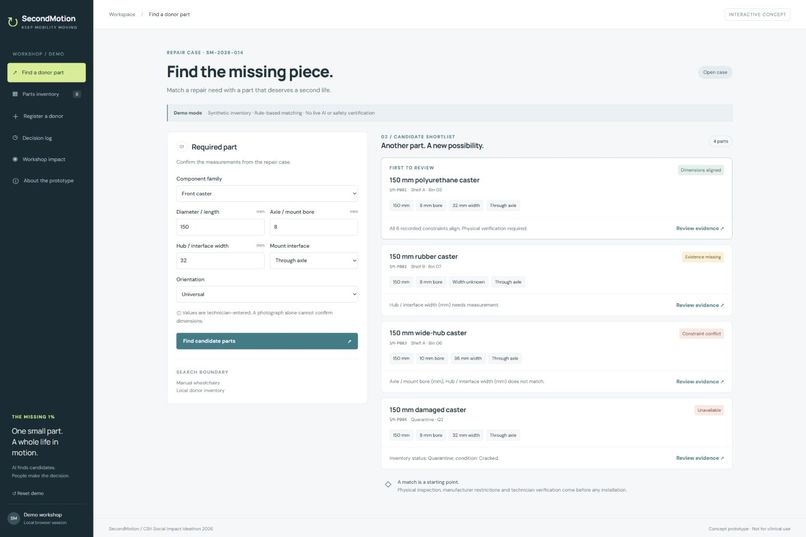
part matching
-
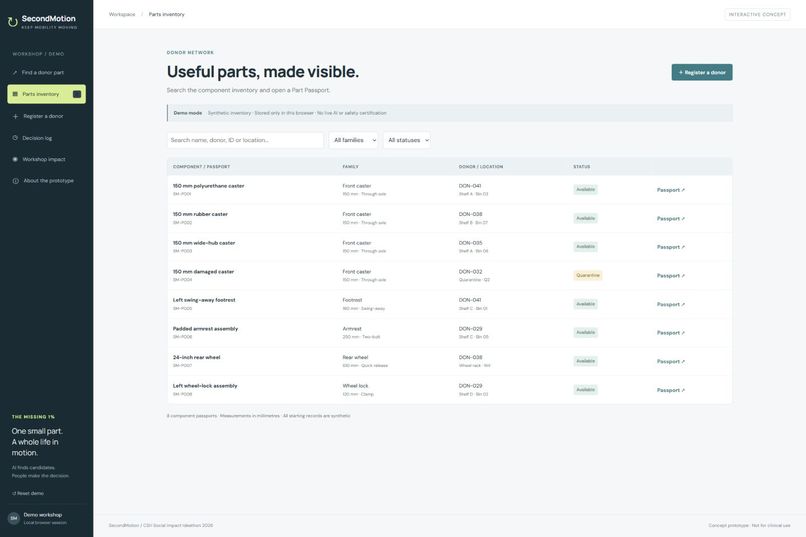
donor inventory
-
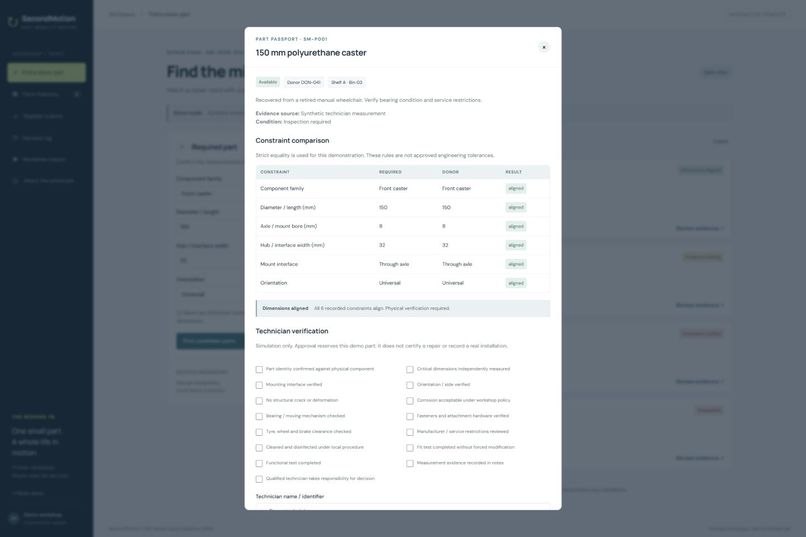
technician verification
-
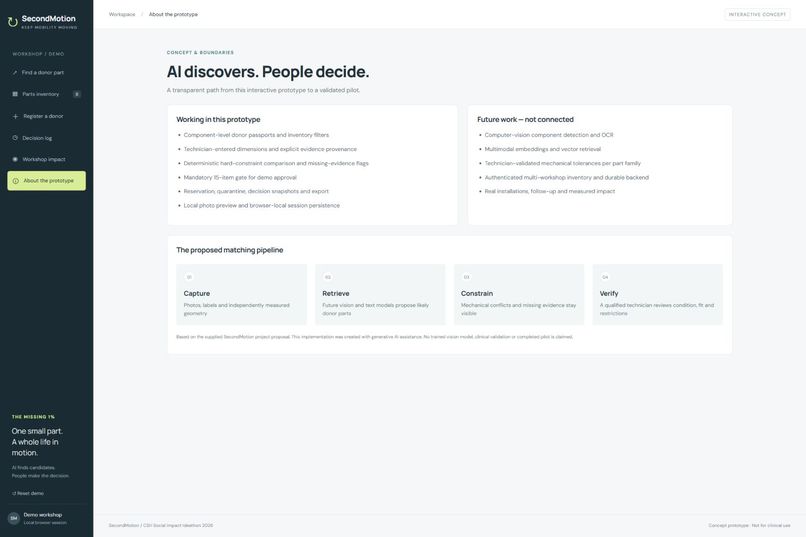
concept and pipeline
Inspiration
A wheelchair can be almost entirely functional and still be unusable because of one broken part.
That was the starting point for SecondMotion. A replacement caster might be sitting on a retired wheelchair somewhere, but if nobody knows its dimensions, condition, or location, it is almost as difficult to find as a part that does not exist.
I wanted to explore a simple question: what if we could search retired wheelchairs for the parts that still have another job to do?
That is where the name comes from. SecondMotion is about giving usable components a second life—and helping keep someone moving.
What it does
SecondMotion is a repair workspace designed for wheelchair technicians, NGOs, and rehabilitation centres.
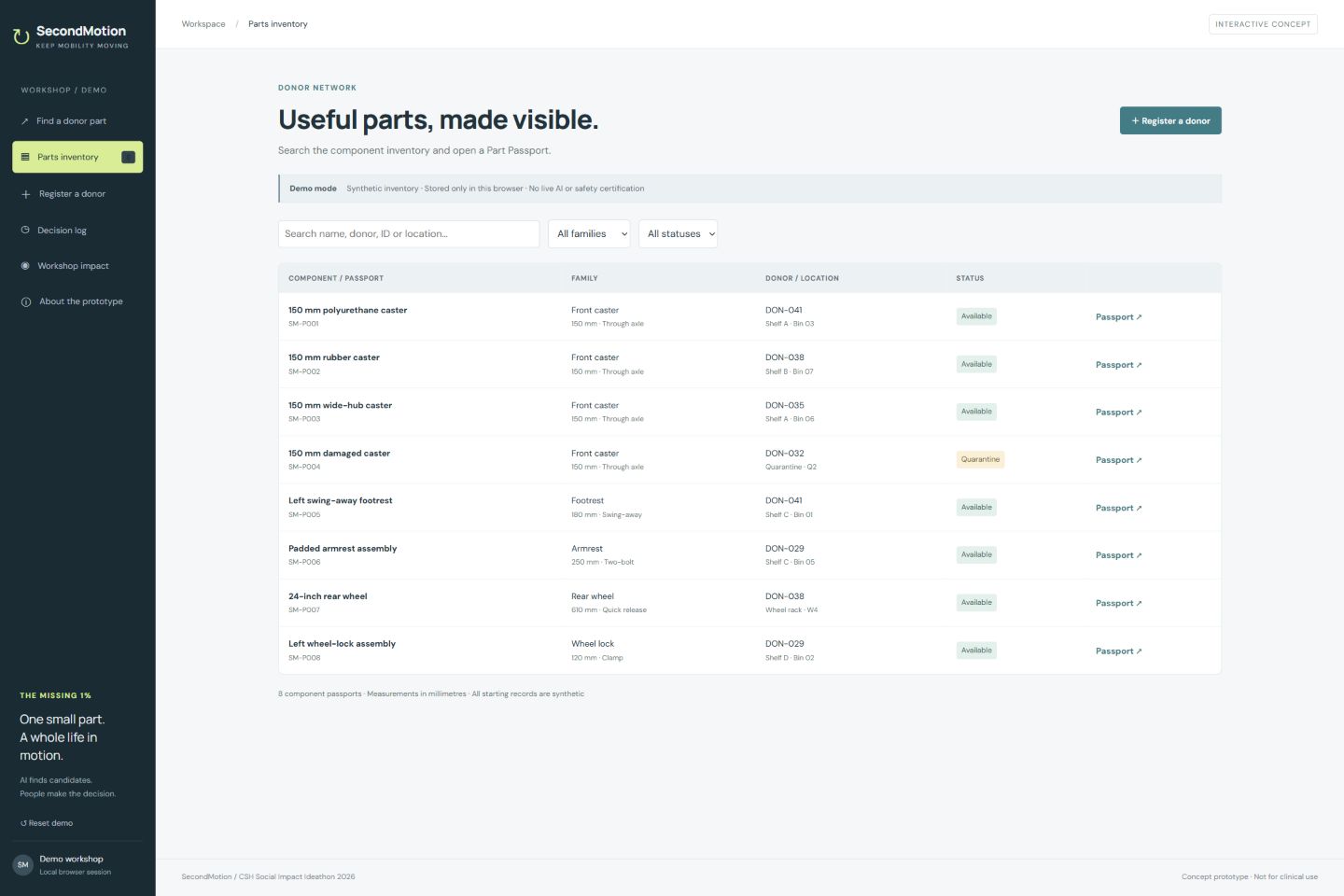
The idea is to turn retired manual wheelchairs into a searchable donor-part inventory. Each component gets a Part Passport: a record of its photos, dimensions, mounting type, condition, source, and storage location.
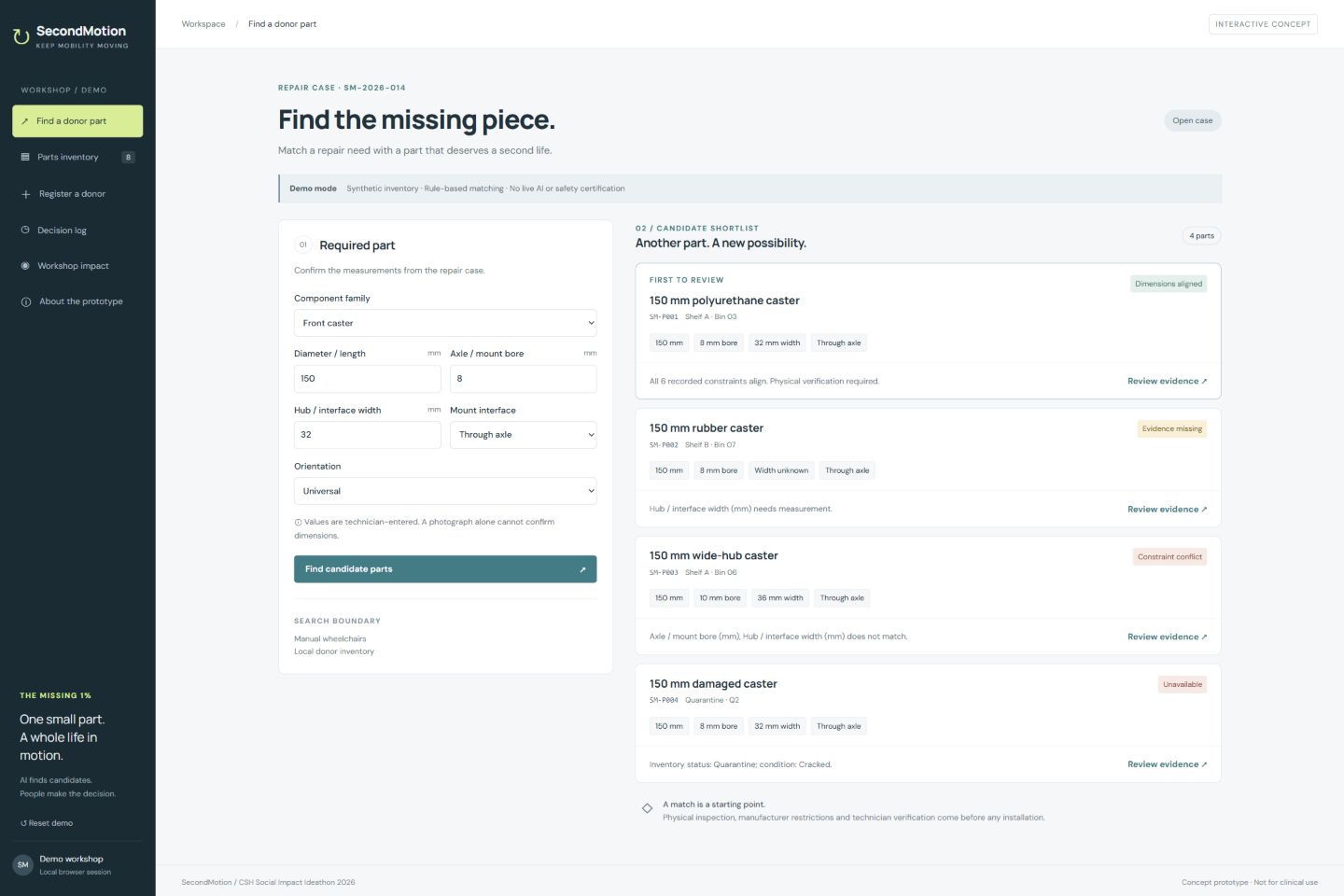
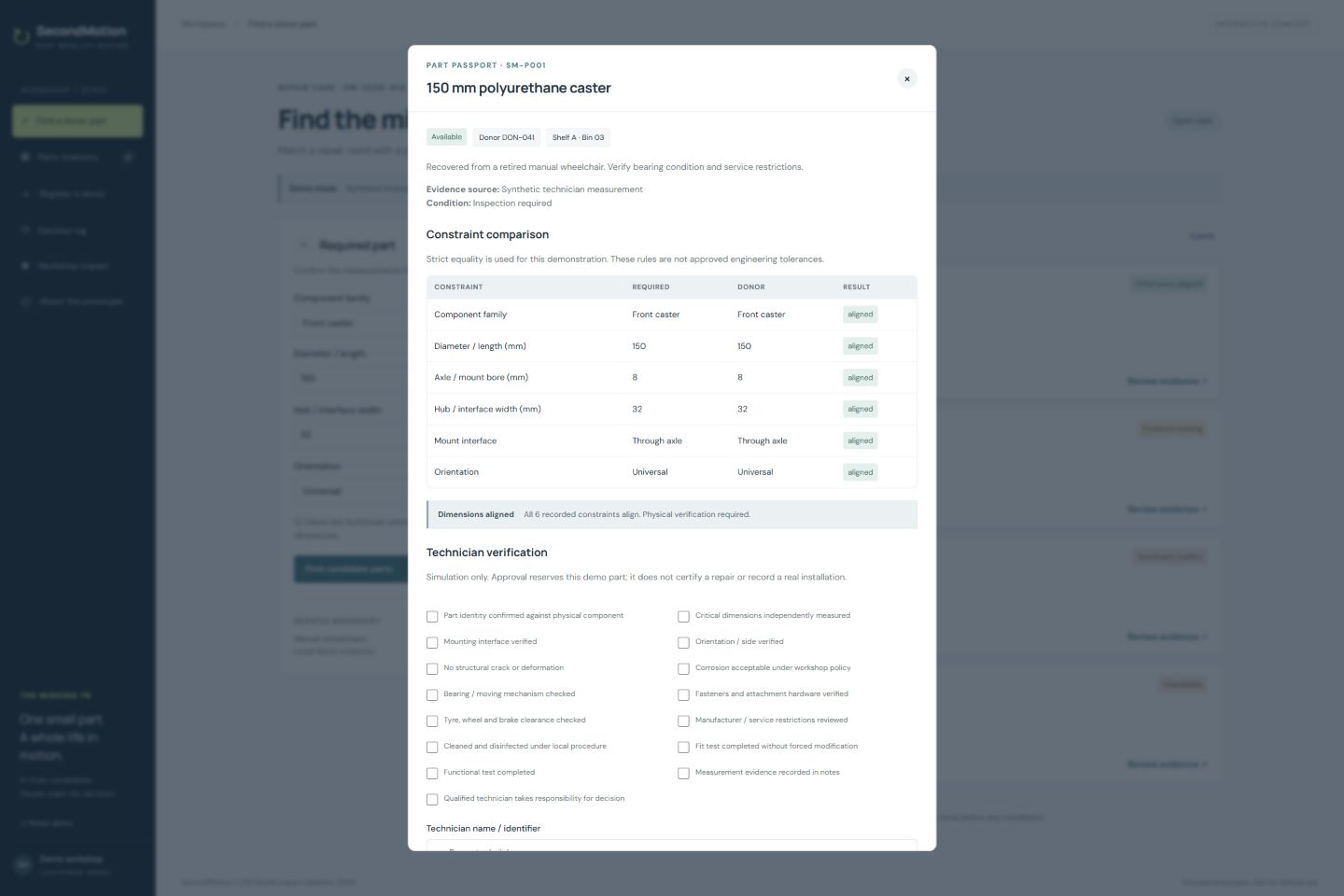
When a repair needs a replacement, the proposed matching system finds potential donor parts and shows the evidence behind each candidate. A technician can see which specifications match, which conflict, and what still needs checking.
The workflow brings this together through:
Command Center — an overview of repairs and donor inventory. Donor Network — searchable components with their specifications and locations. Repair Case — candidate comparisons and compatibility checks. Salvage Lab — a way to catalogue individual parts from retired devices. Technician Safety Gate — physical checks and a recorded approval or rejection.
The core rule is simple: AI finds candidates. A qualified technician makes the final decision.
How we built it
I started with one repair story: a wheelchair needs a caster, and a retired wheelchair might have a suitable replacement. I used that journey to shape the prototype, from recording the damaged part to comparing candidates and documenting the technician’s decision.
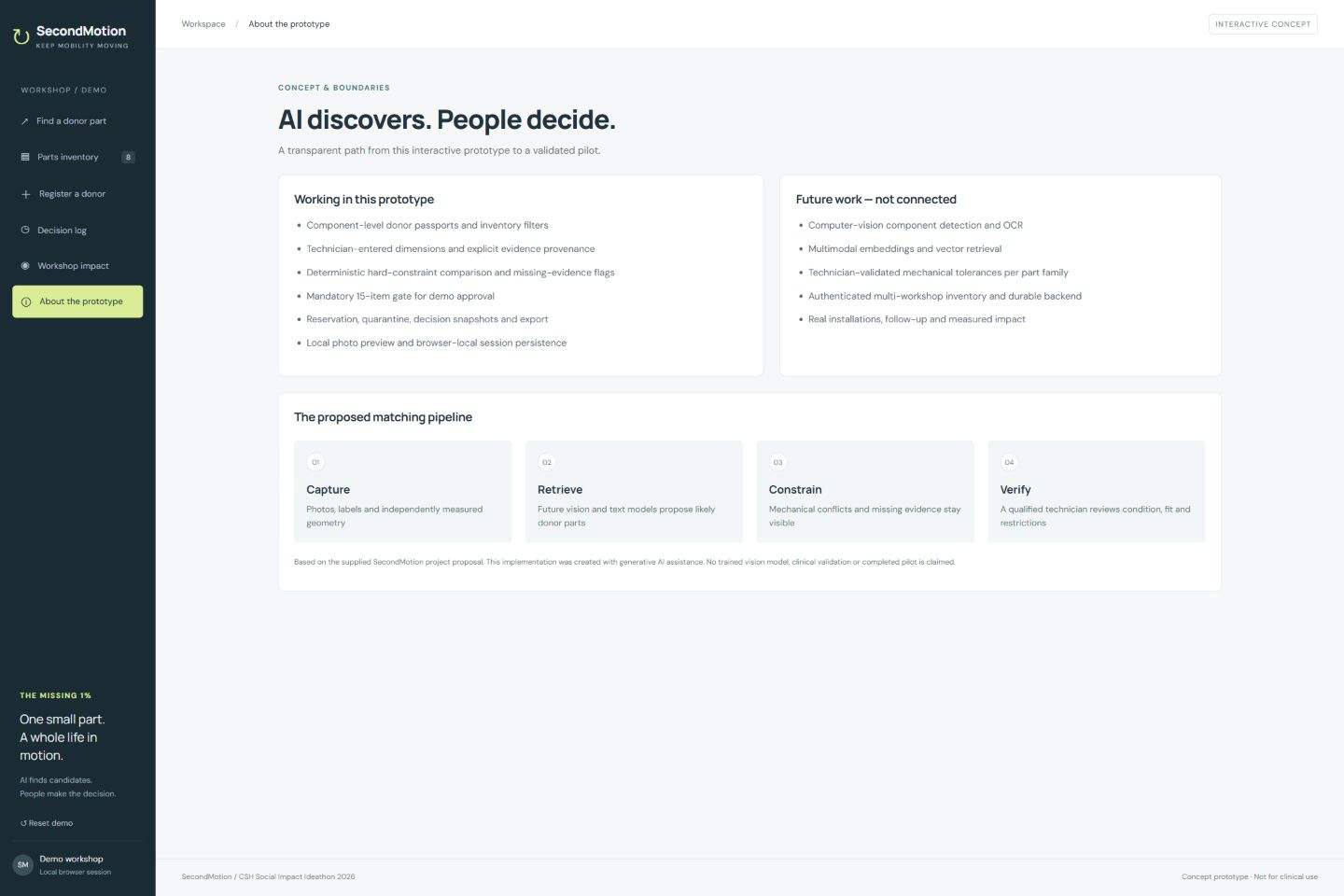
The current version is an interactive frontend concept prototype. It demonstrates the repair workflow, donor inventory, compatibility reasoning, and verification process. It does not yet run a trained computer-vision model on arbitrary wheelchair photos.
For the next stage, I designed a hybrid AI approach. Computer vision would help identify components, OCR would read available labels, and visual search would retrieve similar parts. Measurable constraints, such as axle size and mounting type, would then screen those candidates before technician review.
The Part Passport connects these steps, keeping the evidence attached to the component throughout its journey.
Challenges we ran into
The hardest question was what a “match” should actually mean.
Two parts can look almost identical and still have different mounting dimensions. A clear photo also cannot confirm hidden wear or an unknown load rating. That meant visual similarity alone could never be enough.
I designed the workflow to make missing information visible. If a critical measurement is unknown, it remains unresolved until someone checks it.
Keeping the scope manageable was another challenge. I narrowed the starting point to manual wheelchairs and a limited set of modular components. That gives the project a more realistic path to testing with technicians.
Accomplishments that we're proud of
I’m proud of turning the idea into a workflow that someone can actually walk through: a repair need, a donor candidate, the comparison evidence, and a recorded decision.
The Part Passport is my favourite piece. It gives an otherwise unidentified spare part a useful record—what it is, where it came from, where it is stored, and what still needs inspecting.
I also made technician verification part of the main flow from the beginning. It shapes how the system works, rather than appearing as a note at the end.
What we learned
Designing this project made me think more carefully about where AI would actually help.
Recognising a component is only one step. The useful part is helping a technician find it, understand why it might fit, and identify what needs checking next.
I also learned how much the data structure matters. A good photo is useful, but a photo connected to measurements, condition notes, and a storage location is much more useful during a repair.
What's next for SecondMotion
The next step is to work with a repair organisation on a small, real donor inventory. I want to validate the Part Passport fields and compatibility rules with technicians before training and integrating the vision system.
From there, I would test candidate retrieval alongside normal workshop practice and measure whether it reduces search time and produces useful shortlists.
Connecting inventories across organisations comes later, once the local workflow has been tested.
The goal is simple: help find the missing part that gets a wheelchair moving again.
Built With
- css
- react
- tailwind
- typescript
- vite

Log in or sign up for Devpost to join the conversation.