Inspiration
First, we love video games. Second, we started by researching how investors decide whether to sell their share of a private fund. The higher offer isn’t always the better deal. A buyer might offer more money but keep the fund’s next payout. You need to know what that payout might be, who gets it, and whether anything has changed since the fund’s last report. We thought that was a useful problem to work on: help an LP compare the offers, get the missing answers from the fund, and notice if the terms change after they’ve reviewed them. One of our teammates knows gaming really well, so we started with a fund that invests in game studios. Player reviews and company news gave us something concrete to investigate beyond an old fund report. That became Second Look.
What it does
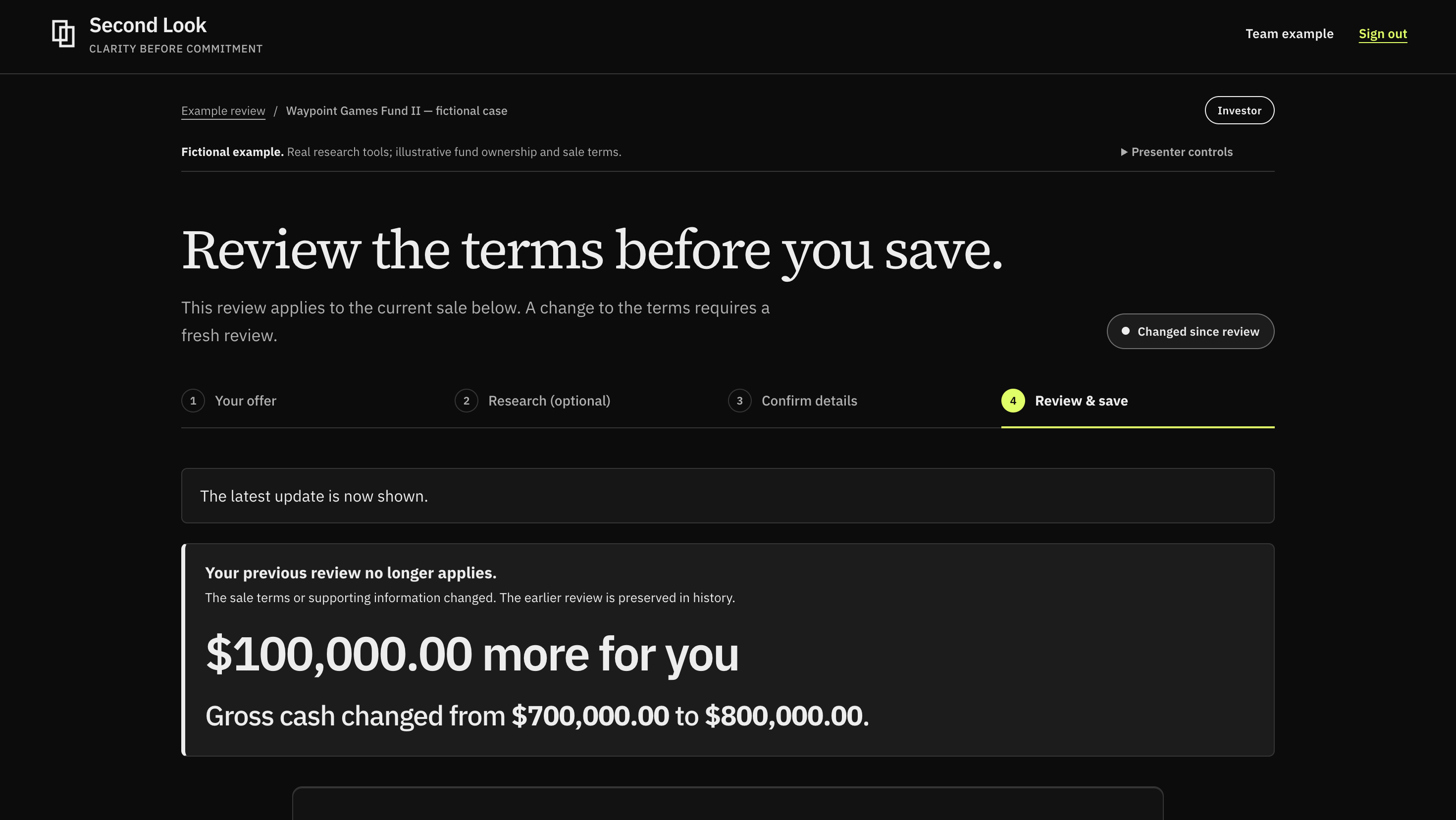
Second Look keeps a venture-fund stake sale honest. In a secondary sale, one changed term, such as who receives the next distribution, can quietly shift the real cash by hundreds of thousands of dollars while the investor’s earlier approval still appears to apply. Buyer, fund manager and investor work in one shared case. When the buyer changes the offer, the earlier approval is marked historical, the cash comparison is recalculated and a new review is required. In our demo, a $700,000 offer shows $800,000 in gross receipts until the distribution recipient changes, and then it drops to $700,000. That difference is a fictional scenario. All figures are calculated by deterministic code in integer cents, and the server rejects any action based on a stale revision. AI models propose facts but can never approve anything. Approval is an app review, not a trade or a signature. Built with React, TypeScript, Express and SQLite, with external data and review tooling from Akta, Nicrron, PRISM and Roundtable. Check with Mat that all four ran live, and delete any that didn’t.
How we built it
We built Second Look with several AI coding agents working together: Claude Code, Codex and Gemini. We directed each agent with specific prompts and assigned each one a defined lane (interface, backend and integrations, and submission materials). Every change was tested and reviewed by a teammate before it was merged.
Challenges we ran into
Two things slowed us down. First, our AI coding agent unintentionally scrambled the version history of our repository. We had to stop, trace what changed and restore a clean state before we could keep building. It reinforced a rule we now follow: the agent works only inside a defined lane, and a person reviews every merge. Second, settling on the idea took far longer than expected. We went through several directions before committing to one clear interaction: a changed offer that makes an earlier approval no longer valid. Narrowing the scope was difficult, but it is what let us build one complete, working flow instead of a broad, shallow product.
Accomplishments that we're proud of
We shipped one complete, working interaction instead of a broad prototype. When a buyer changes a term of the deal, the investor’s earlier approval is automatically marked historical, the cash comparison is recalculated, and a new review is required. Every amount is computed by deterministic code in integer cents, stale approvals are rejected on the server, and state persists across restarts. We also coordinated several AI agents and a team workflow in a single day without losing the shape of the product, and we kept the app honest about what it is: an app review, not a trade or a signature. What we learned We learned that scope matters more than features. Committing to one clear interaction made the product easier to build, test and explain. We also learned that AI coding agents move fast but need boundaries. Defined lanes, small reviews and a firm rule that models propose while deterministic code calculates kept the project intact, and we learned that lesson the hard way when an agent scrambled our version history. Finally, we learned that trust in financial software comes from being honest about what is real, so we labeled our scenarios as illustrative and never implied a live integration we had not verified. What’s next for Second Look Next, we want to replace the demo accounts with real participant authentication and per-case access checks. We plan to extend the X1 document reads and Akta findings beyond the demo account so more sales can surface the right question, and to support more changed-term types beyond the distribution recipient, with taxes, fees and timing included in the comparison. After that, we want to put it in front of real fund managers and secondary buyers to validate the workflow before any production use.
What we learned
Next: talk to LPs and advisors. We'll test Second Look on real, redacted cases and check pricing. Our starting guess is $500 per team per month plus a paid pilot per case. We haven't tested either yet. More of the sale process: track the fund manager's consent and other investors' right to buy first, add a checklist of common terms, and give each open question an owner and a due date. Signals beyond gaming: app rankings, hiring and web traffic, so it works for any venture fund. The LP's own documents: read fund value and payouts from quarterly reports and tax forms (K-1s), with a person confirming each number. The studio side: the same check for a studio's first raise, so nobody signs March's deal in July. An advisor dashboard: one view of every client's case, plus an approval history to export for an investment committee.
What's next for Second Look
Next, we want to replace the demo accounts with real participant authentication and per-case access checks. We plan to extend the X1 document reads and Akta findings beyond the demo account so more sales can surface the right question, and to support more changed-term types beyond the distribution recipient, with taxes, fees and timing included in the comparison. After that, we want to put it in front of real fund managers and secondary buyers to validate the workflow before any production use.
Built With
- akta
- chatgpt
- claude
- claudecode
- codex
- gemini
- nicrron
- prism
- roundtable

Log in or sign up for Devpost to join the conversation.