-
-
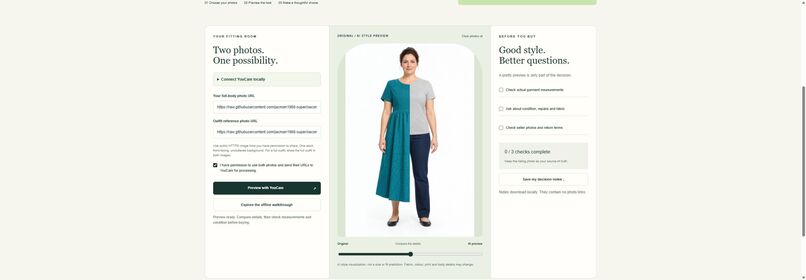
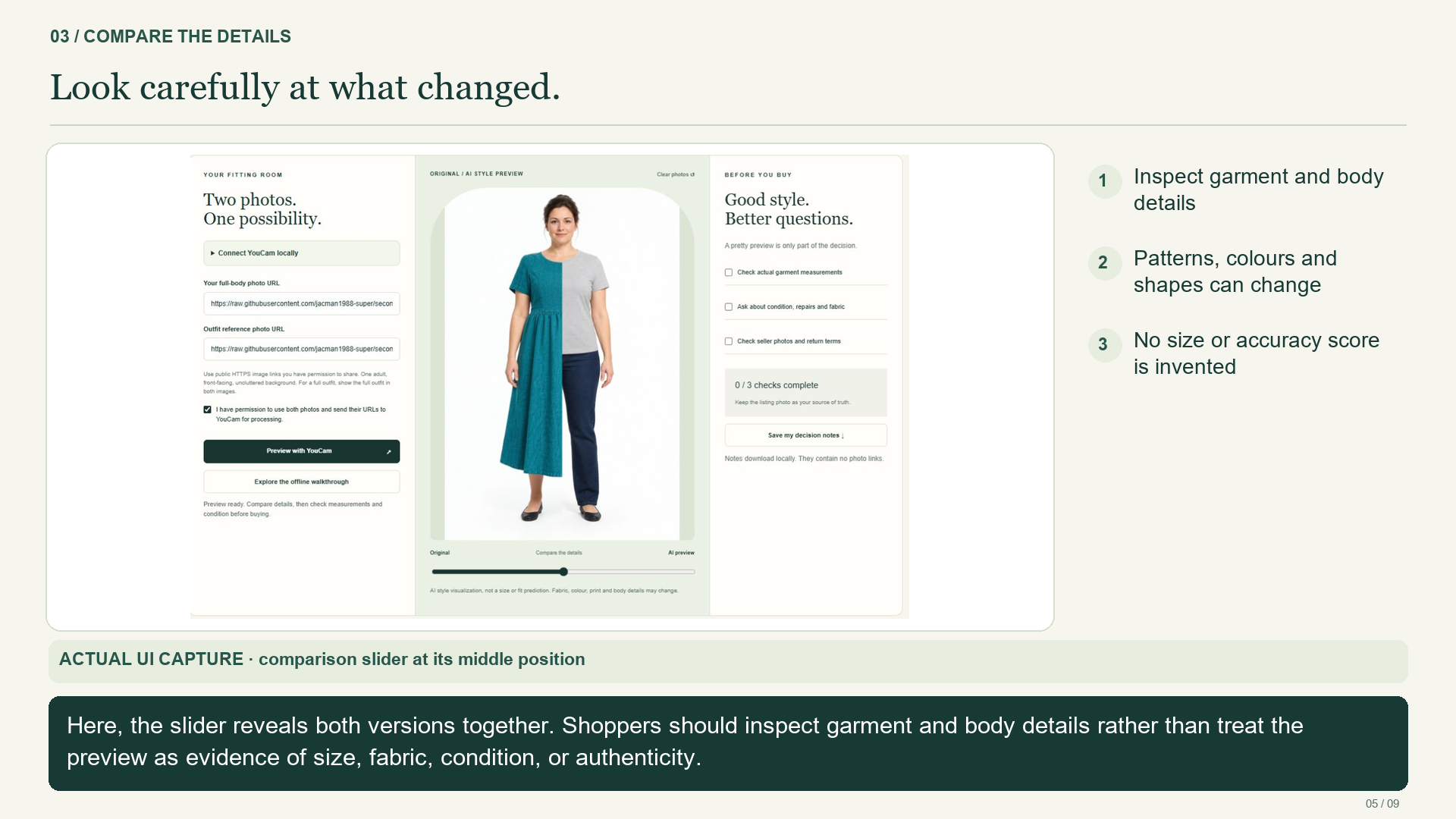
Actual completed Clothes V4 test: original/result comparison. Fictional adult and synthetic garment inputs.
-
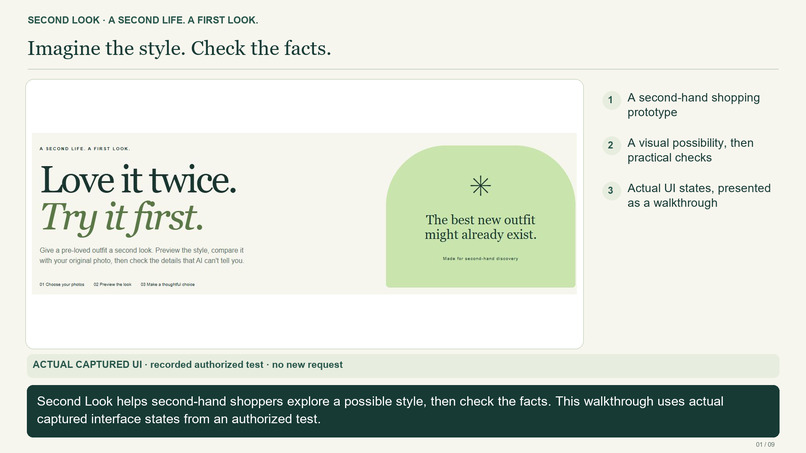
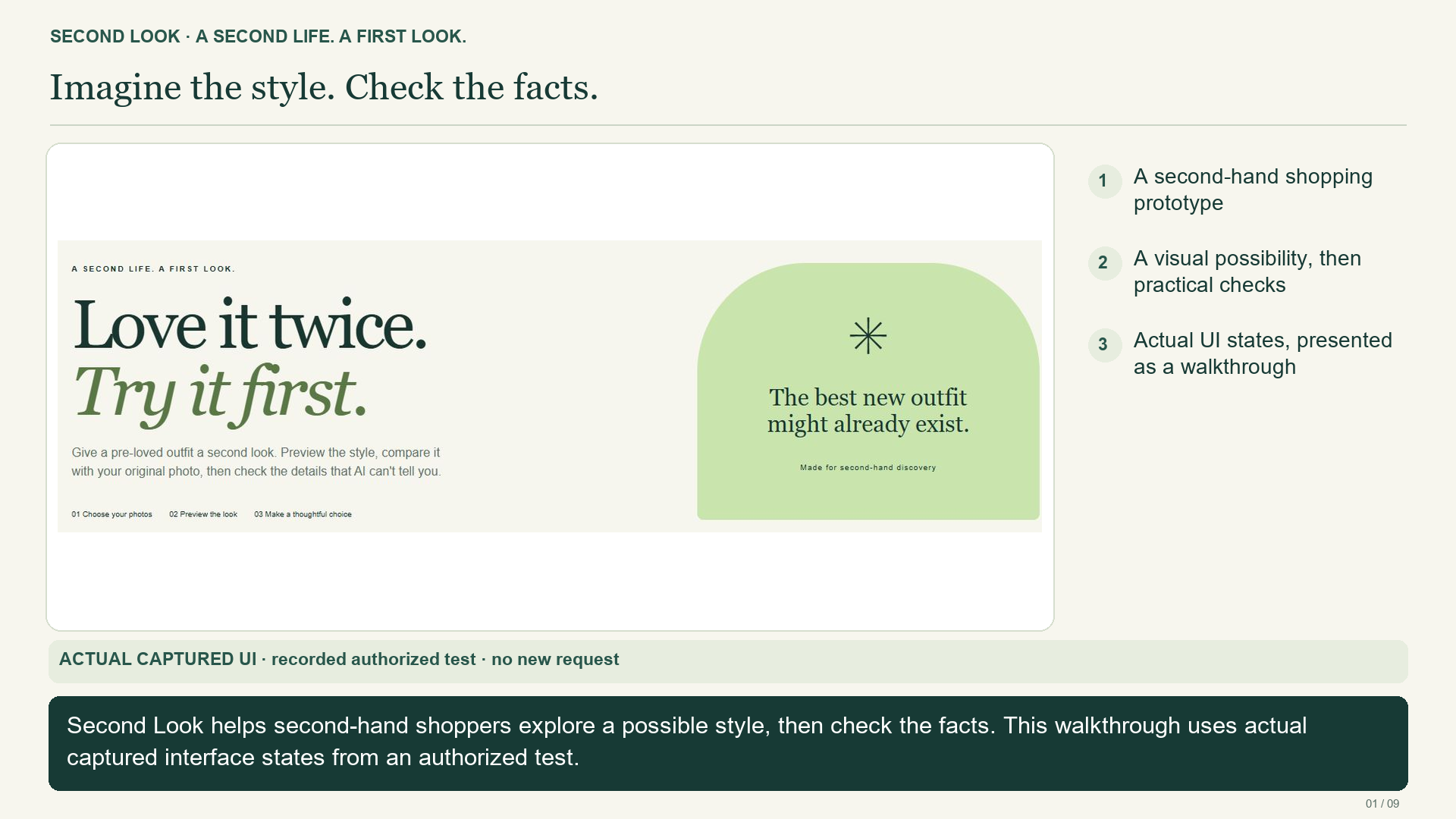
Second Look: explore a second-hand style, then check the facts. Captured interface walkthrough.
-
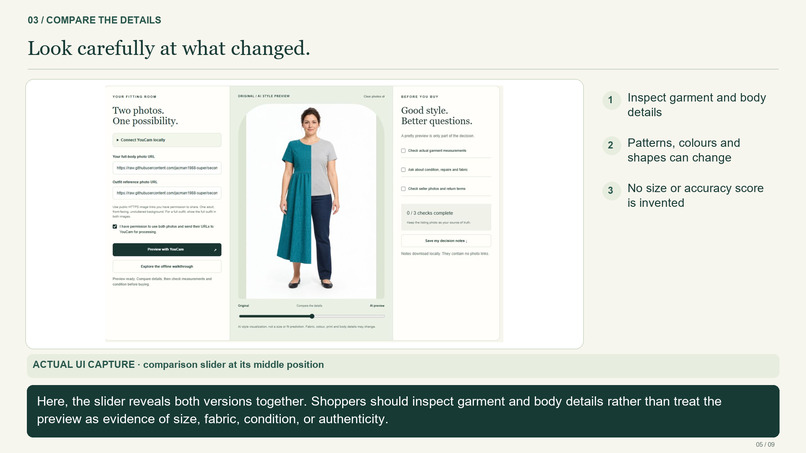
Comparison slider at 50%. Recorded actual result; style preview does not establish size, fit or condition.
Inspiration
Second-hand shopping often starts with an imagination gap: how might this garment look on me? Second Look explores that possibility while keeping the practical buying questions in view. A generated outfit image can suggest a style, but actual measurements, condition and seller evidence still determine whether a purchase makes sense.
What it does
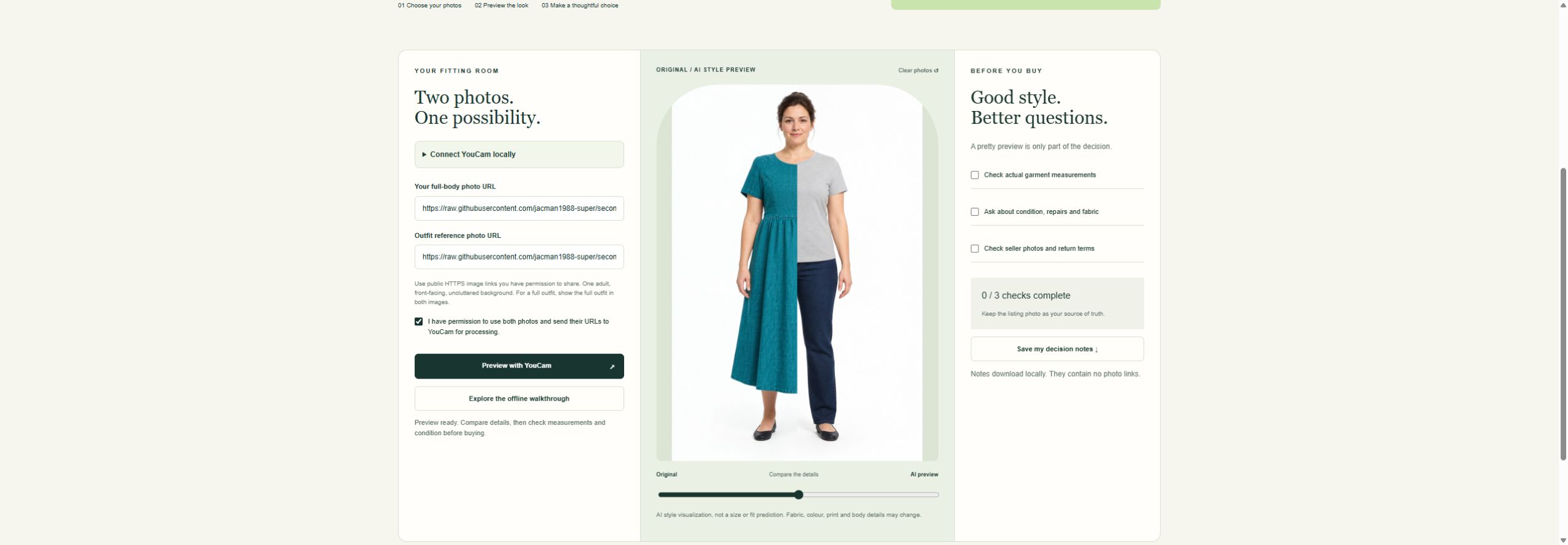
Second Look accepts two permitted public HTTPS image links: a full-body source image and an outfit reference. Its local server creates a YouCam Clothes VTO V4 task using the full_body category, polls for completion and displays the successful result beside the original in a comparison slider.
A buying checklist prompts shoppers to check measurements, fabric, condition, repairs, seller photographs and return terms. They can download their decision notes locally without automatically including photo links. The experience connects style exploration with a deliberate decision rather than treating a generated picture as a buying recommendation.
How we built it
The interface uses vanilla HTML, CSS and JavaScript. A dependency-free Node.js 20+ server binds to the loopback address for a local, single-user workflow. It implements the real Clothes V4 task-creation and polling endpoints.
The user enters their own API key in an optional local password form. The field clears immediately; the server holds the runtime key in RAM without saving, echoing or logging it. Loading a key makes no provider request. A separate, explicit read-only check can confirm authentication without creating an image.
Host and cross-site guards, safe diagnostics and a per-process attempt cap support deliberate testing. Reconnecting a key does not reset consumed attempts. A zero cap disables generation, and completed tasks preserve the exhausted cap while keeping their actual result visible.
What we verified
One real YouCam Clothes V4 generation completed successfully on 1 November 2026. The accepted task produced a 1024 × 1536 JPEG showing the fictional adult in a teal dress. The output and original/result slider were visually inspected. This is one completed integration example, not a model-quality or reliability benchmark.
All 61 automated tests passed: 54 main-application tests and seven recorded-viewer tests. They use controlled provider responses to check application behavior, including credential handling, interrupted flows, diagnostics, duplicate protection, zero-cap enforcement and comparison controls. They do not measure model accuracy.
Try the project
Explore the recorded-result demo, watch the demonstration video, or inspect the MIT-licensed source.
The public viewer displays the genuine saved output and provides comparison, checklist and notes. It is explicitly a recorded example, not live generation.
The separate functional local build requires Node.js 20+, the tester's own permitted YouCam API key, suitable allowance and image permissions. Run node server.mjs, open http://127.0.0.1:4177, and follow the repository's explicit local-key and generation-cap instructions. No dependencies or build step are required. The recorded viewer supplements this build; it does not replace functional testing access or provide a public generation service.
Limitations and AI assistance
Both demonstration inputs were created with OpenAI image generation: a fictional adult and an unbranded dress, without a real person's reference photograph. YouCam Clothes V4 generated the saved outfit preview. Codex assisted with the concept, interface, implementation, tests and copy, with independent agent review.
This is a style visualization, not proof of fit, size, comfort, fabric, colour, condition or authenticity. Generated body and garment details may change. No body scoring, beauty grading, measured environmental benefit or reduction in returns is claimed. Next, we would evaluate more permitted synthetic cases and test the decision checklist with shoppers before making broader claims.
