-
-
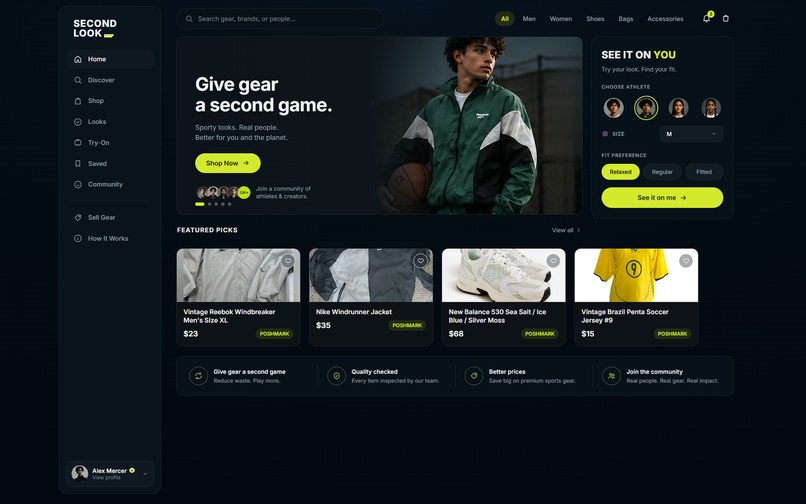
Homescreen
-
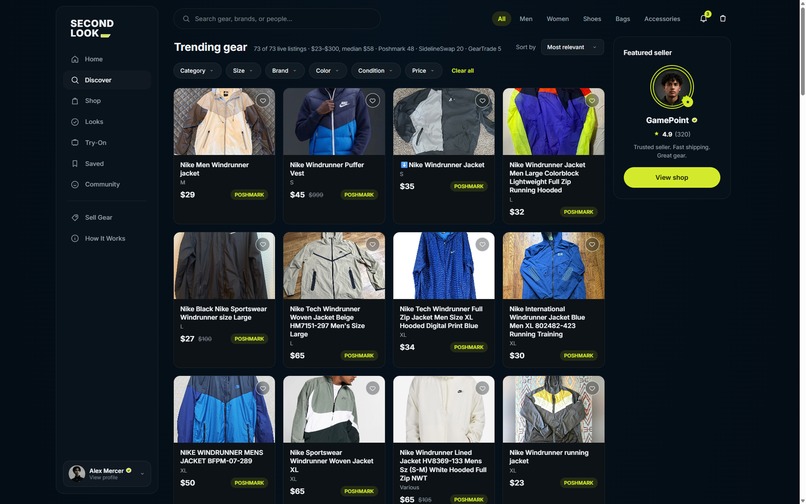
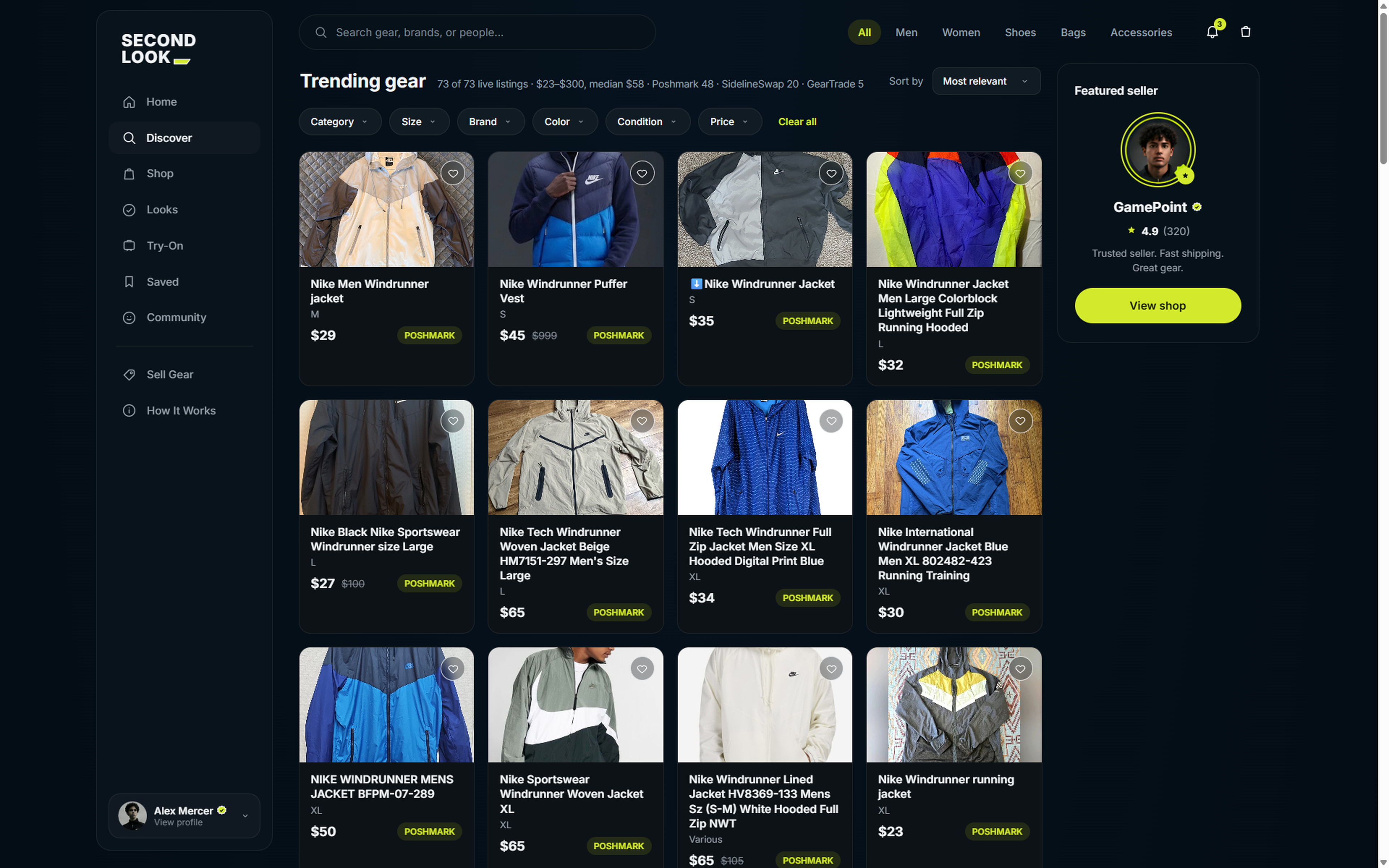
Shopping browse
-
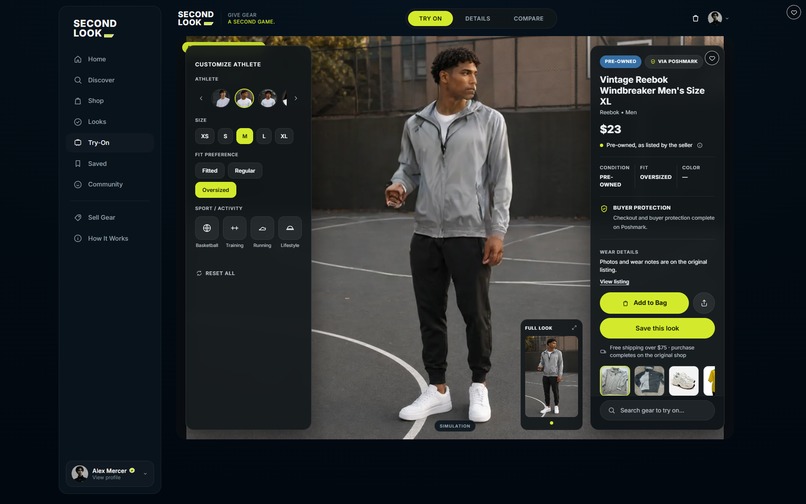
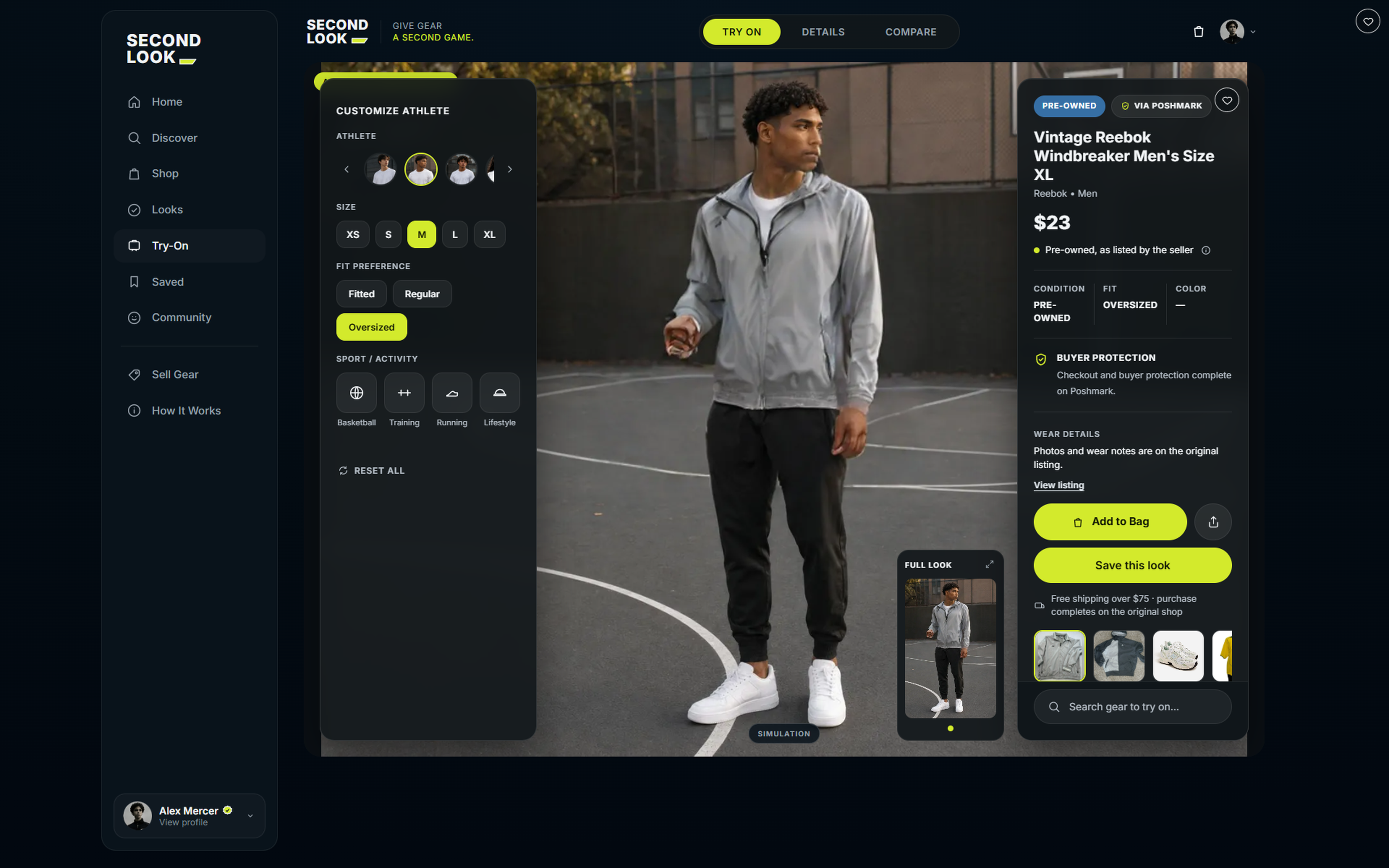
Try it on feature
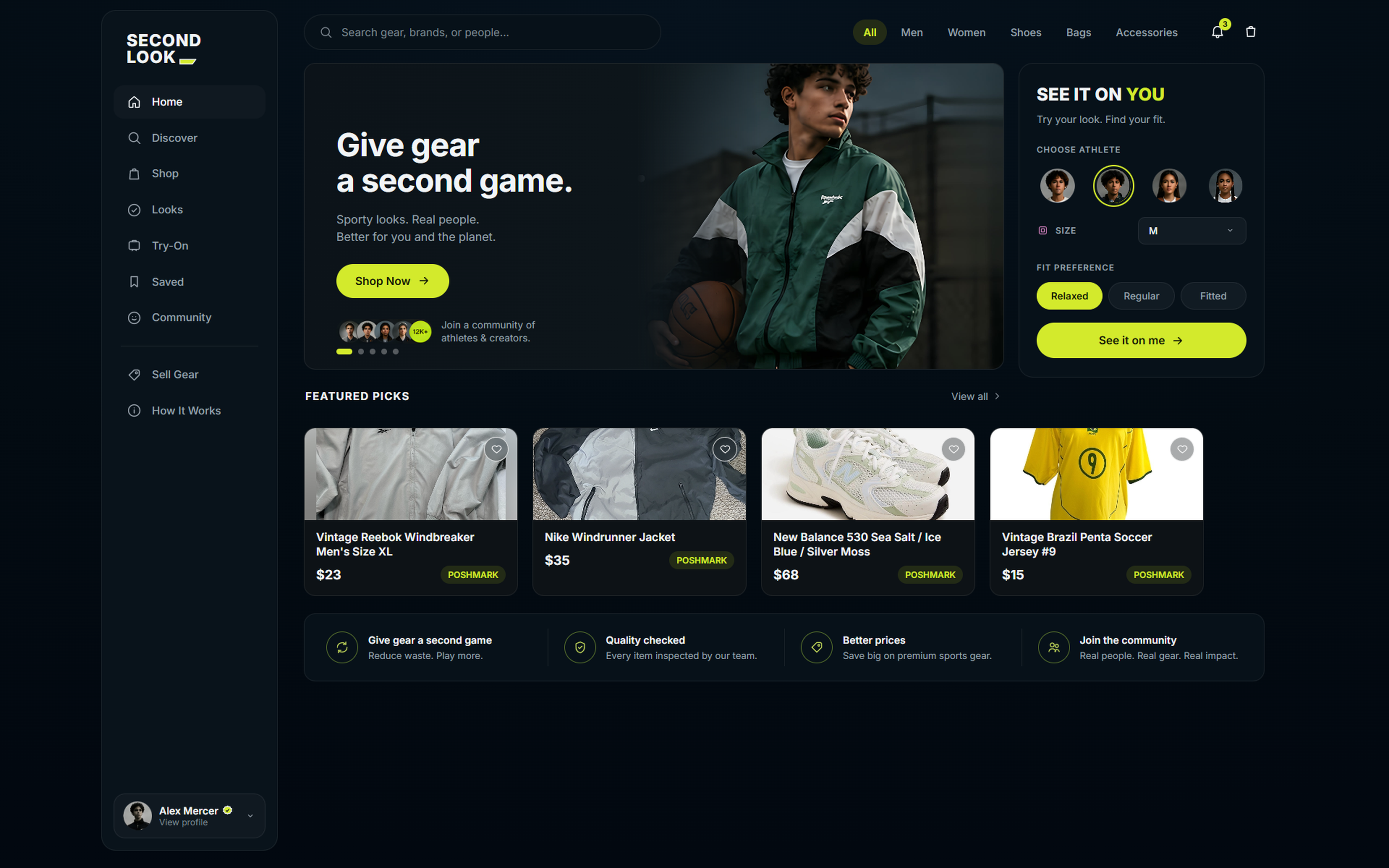
Inspiration
Personally, in my house we have a graveyard full of shoes, jackets, and clothes that don't fit me anymore. My family kept buying me new stuff while perfectly good gear say unused, when it could've been used by someone else.
The weird part is that all the gear is for sale. It's just scattered across Poshmark, SidelineSwap, eBay, GearTrade and a dozen other places, and nobody wants to hunt through five apps. Even when you find something, you hesitate, because you can't actually picture it on yourself. That hesitation is the whole reason why people pay full price for something they'll wear twice.
So I tried to fix both halves: Put all the used gear in one place, and let you actually see it on a person before you buy.
What it does
Second look is one search across multiple secondhand marketplaces all at once. You type "soccer jersey" and it goes out to Poshmark, SidelineSwap and GearTrade at the same time, pulls back every real listing and shows them in one feed with real prices, real sellers, and honest stats like the median price and how many items came from each shop.
The part I care about the most is picking any item and clicking Try-On. An AI cuts the garment ut of the seller's photo, and a second AI generates a real photograph of a model actually wearing it on a basketball court in about 30 seconds. You can switch between six different models to find someone closer to your build.
When you want it we hand you off to the shop the listing actually lives on. We don't take the payment, and we never invent anything about someone else's item.
How we built it
Plain HTML, CSS and JavaScript. No React, no build step, no npm install, the whole site is index.html, a few stylesheets and one JavaScript file.
The backend is a zero-dependancy Node server (server.js) using only modules that ship with Node. When a search comes in, it fans out to all 3 marketplaces in parallel and merges the result. Poshmark doesn't have a public API, so Claude found their listings embedded in the page's own server-rendered JSON and parsed that. SidelineSwap has a clean public API. GearTrade runs on Shopify, which exposes a search JSON endpoint.
For the Try-On we used 2 different AI models for 2 different jobs:
Background removal runs in your browser, a 4.6 MB U²-Net model through onnxruntime-web (WebAssembly). Nothing gets uploaded, it costs us nothing per user, and it finishes in about a second.
The generated photo comes from a free hosted virtual Try-On model that our server talks to, one request at a time, caching every result so a look only ever renders once.
I deployed it twice: a GitHub Pages version that always works, and the full live version on a VPS running as a systemd service next to another project of mine.
Challenges we ran into
eBay blocked me Okay not really but, to get access to eBays API key I would have to apply for a developer account, and when I was setting up the website, I hadn't accounted for that, so I waited until the second day of the hackathon to apply, which said it would take up to 1 business day, time that I did not have.
The AI kept copying the wrong background. My first female model was photographed against a white studio wall, so every generated look came back as a bright white rectangle sitting in the middle of our dark interface. It took me a while to realize the generator reproduces the model photo's background, not the product's. The fix wasn't code at all, I asked GPT to reshoot the models on dark courts and added that in instead.
Our own IP got rate-limited from testing the marketplaces so much that requests started taking 15 seconds. The VPS wasn't throttled, which is how we figured out it was us.
Accomplishments that we're proud of
It's actually live. Nothing on the site is mockery, every listing is a real item someone is selling right now, with a working link to buy it.
- The AI try-on works and is free. No API keys, no per-user cost, no accounts, no uploads.
What we learned
That reading a website's own data is a real skill, the Poshmark listings were sitting in plain sight inside the page the whole time.
Before this I had no clue that you could run an AI model in your browser for free so that was pretty cool in my opinion.
And the biggest thing I learnt, is that people don't distrust used gear they distrust the way it's being presented for example I thought the site VIDEO COPILOT was super sketchy (Video copilot is a company that sells After Effects plugins) because their website didn't look as trustworthy as let's say Nike's website. That small difference in style is what can change the users view on an entire genre of cheaper items.
What's next for Second Look
Hopefully eBay reviews my Developer account and lets me use the API key and then I will have Claude integrate that into the website.
Built With
- claude
- css
- html
- javascript
- node.js


Log in or sign up for Devpost to join the conversation.