-
-
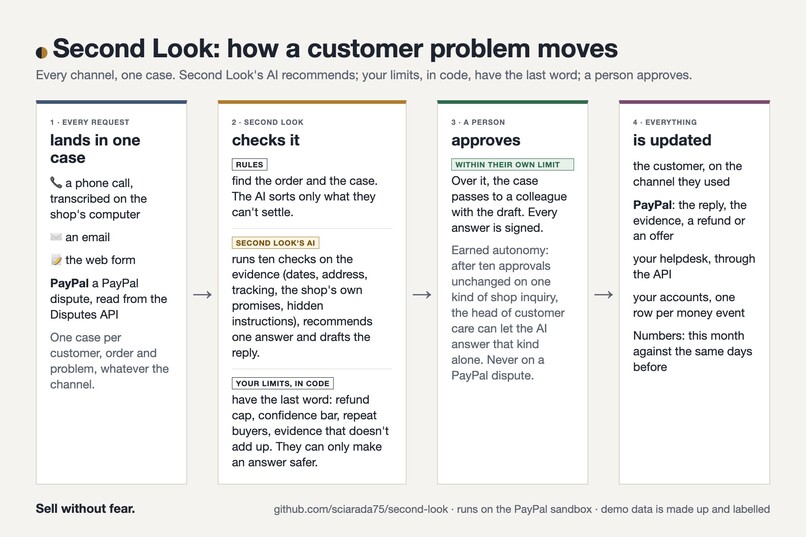
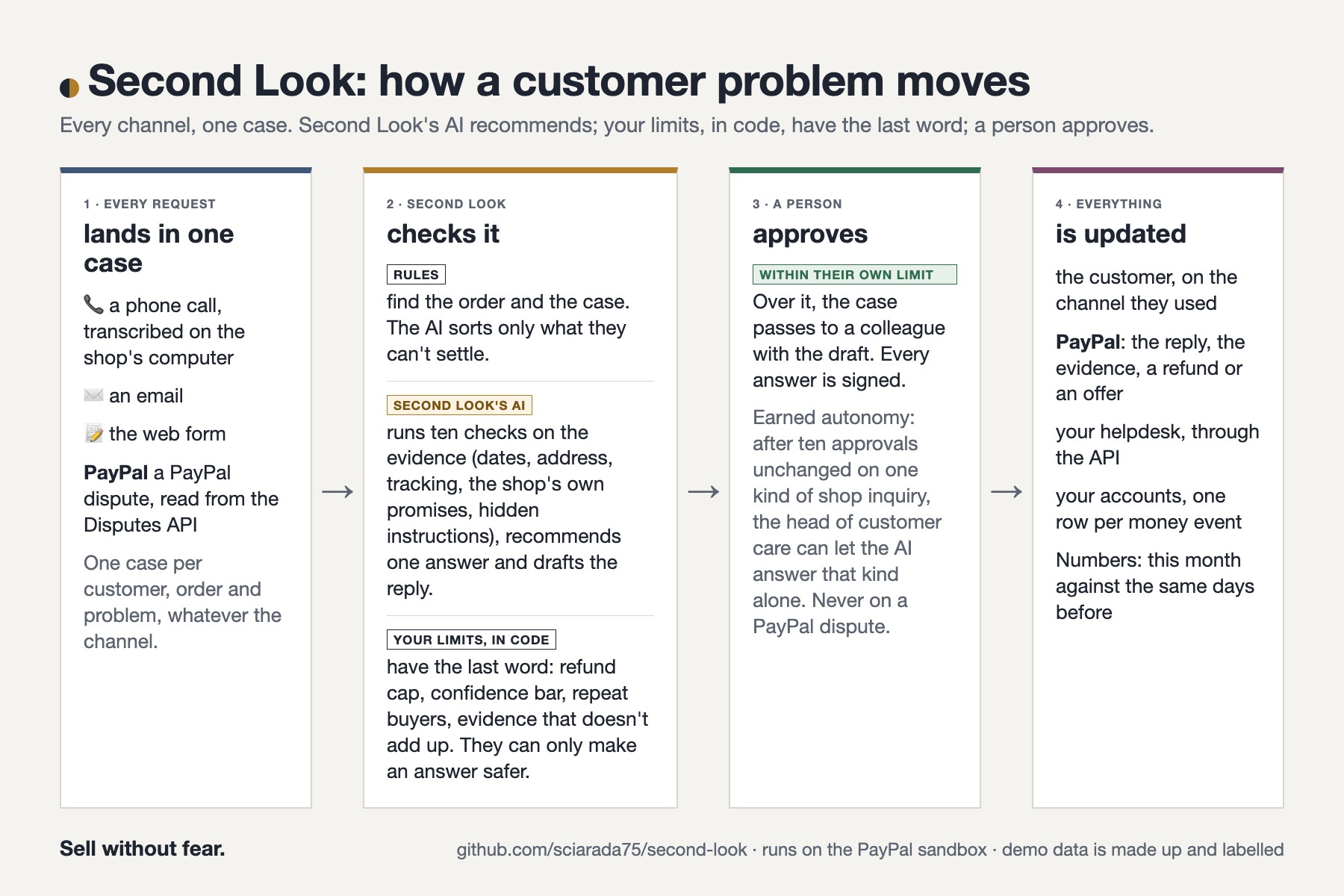
Every request is a case;Second Look's AI checks the evidence;your limits in code have the last word;a person approves;everything is updated.
-
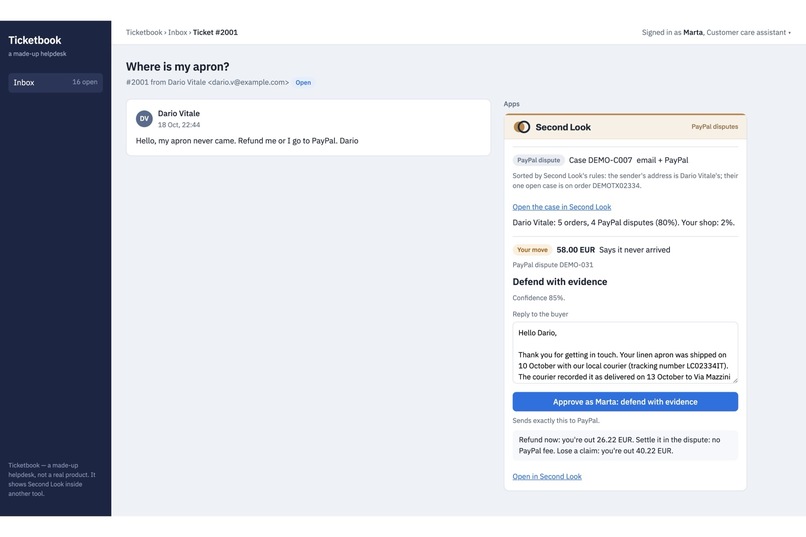
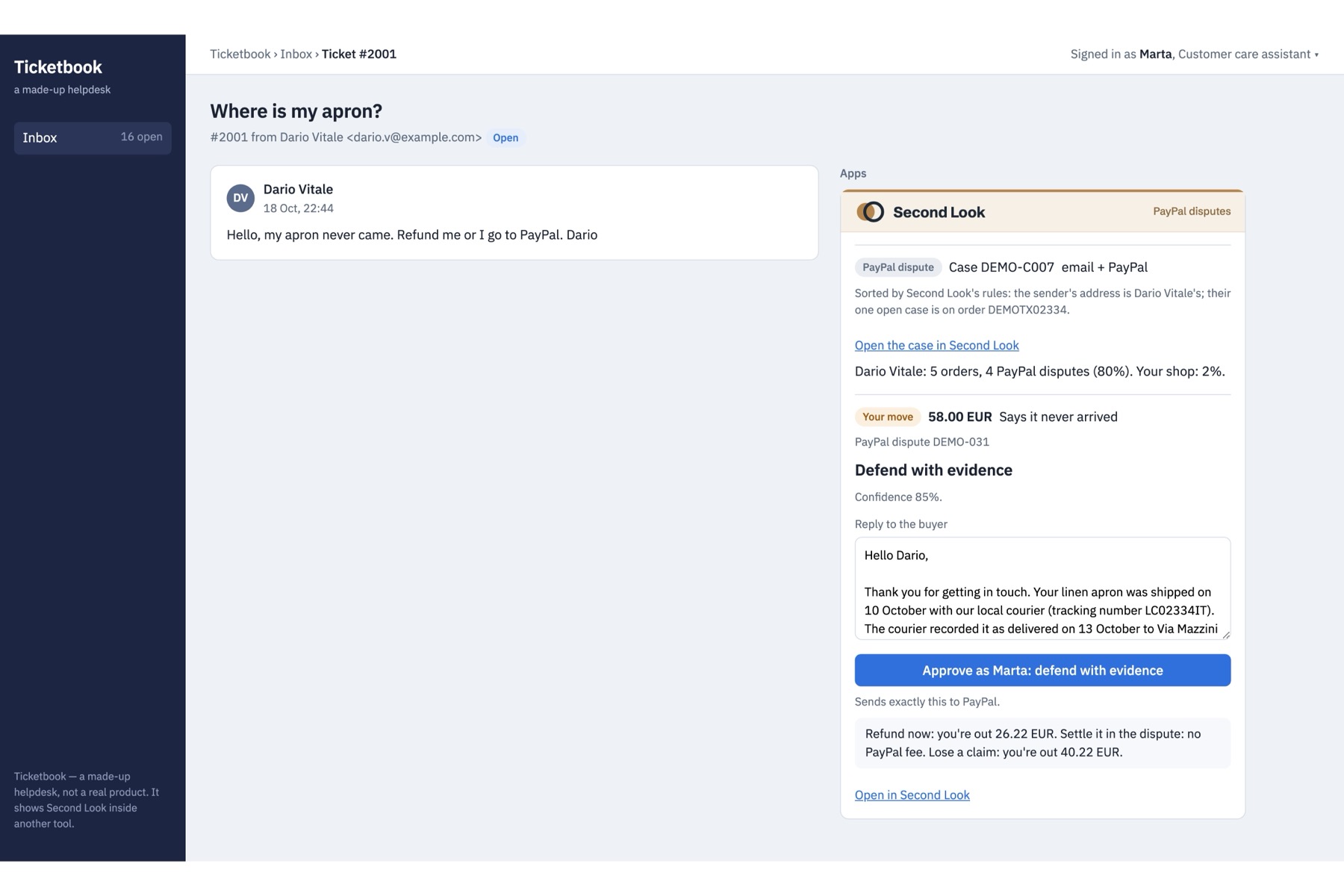
Second Look inside a helpdesk: the recommendation, the costs and the reply, right in the ticket (Ticketbook is made up).
-
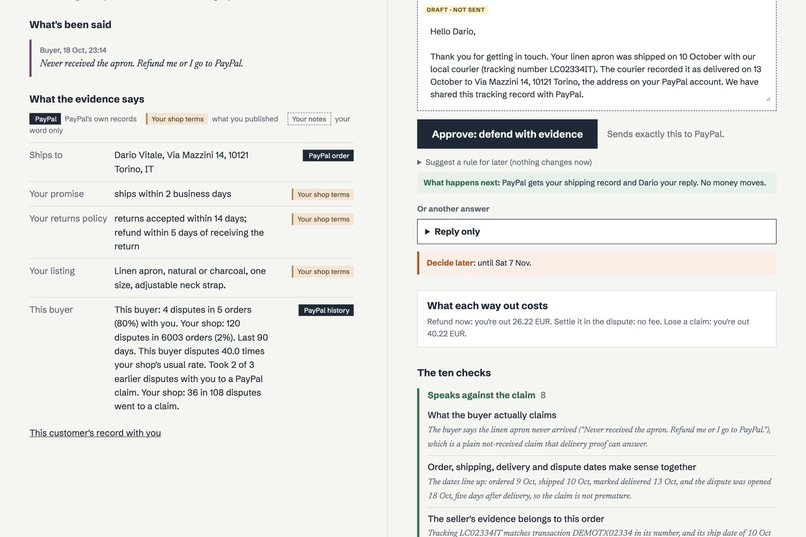
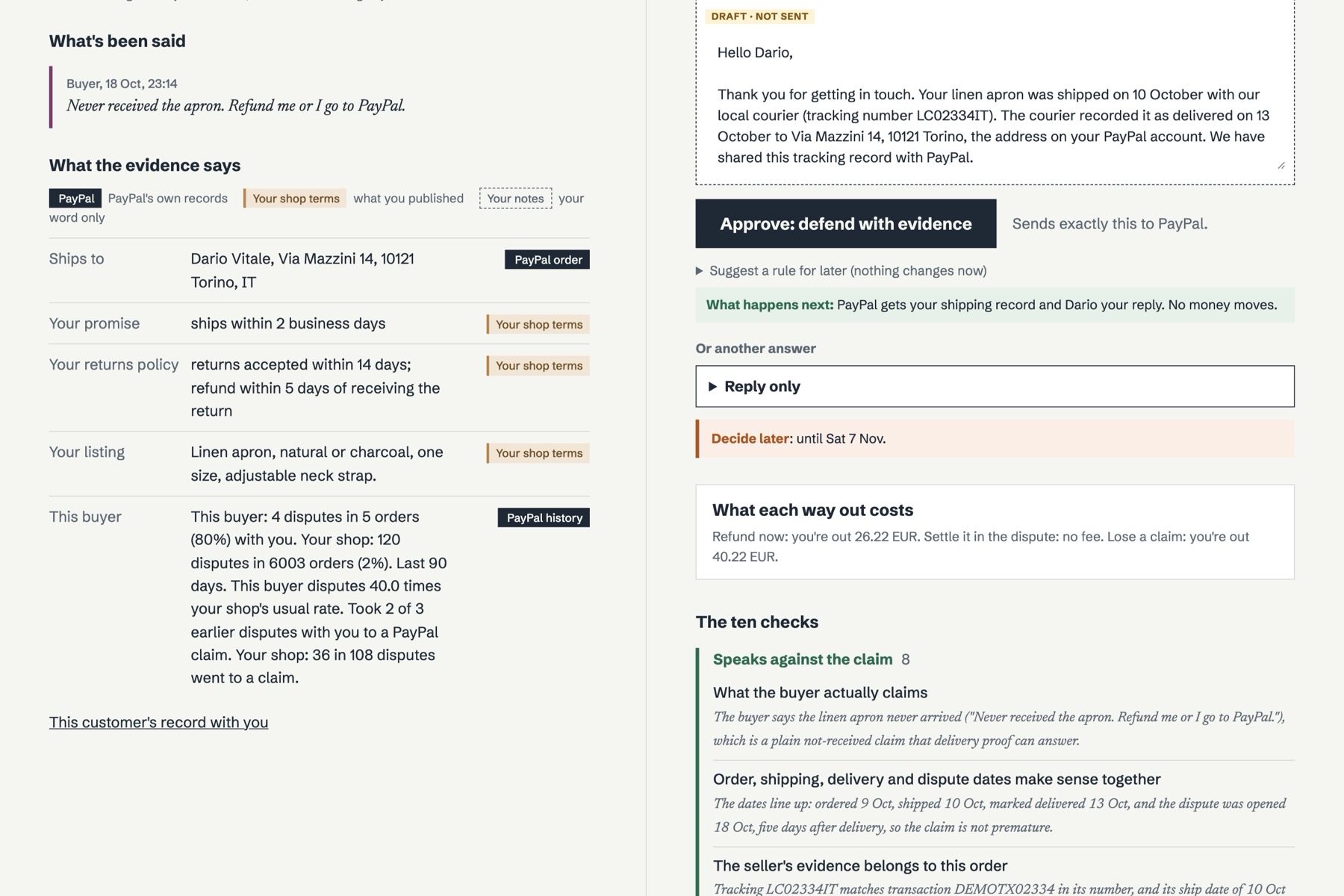
A PayPal dispute: every fact tagged with its source, the ten checks, what each way out costs, and a reply ready to approve (demo data).
-
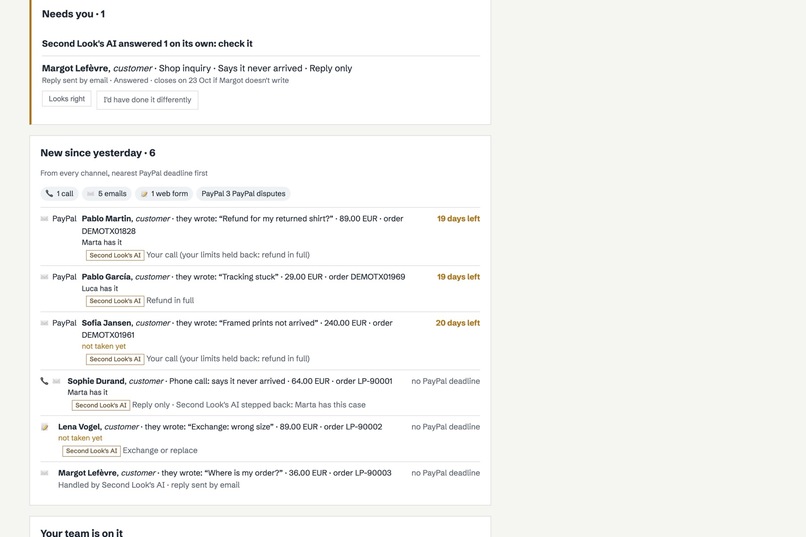
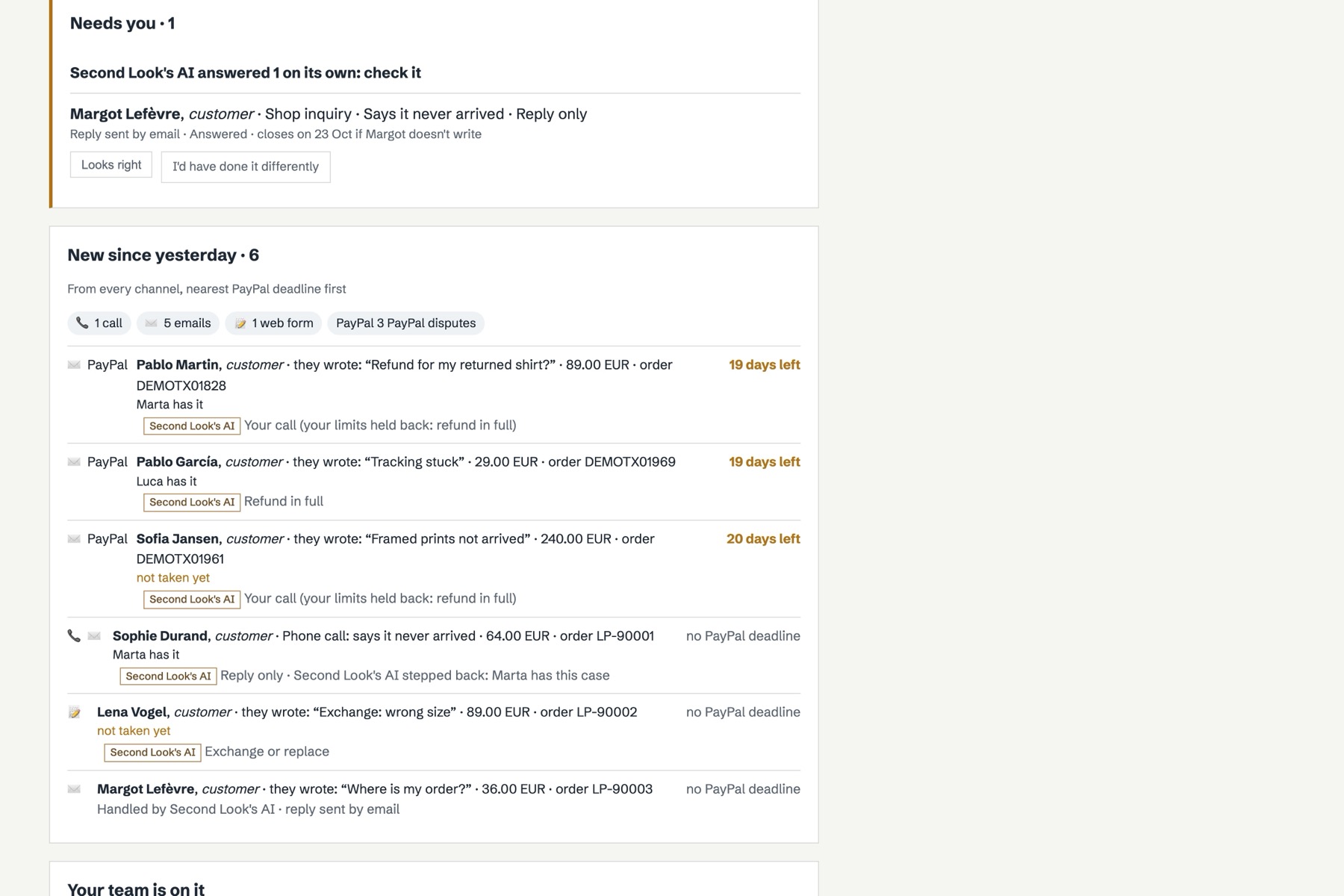
The morning screen: what needs you, then every new request from every channel, matched to its order (demo data).
-
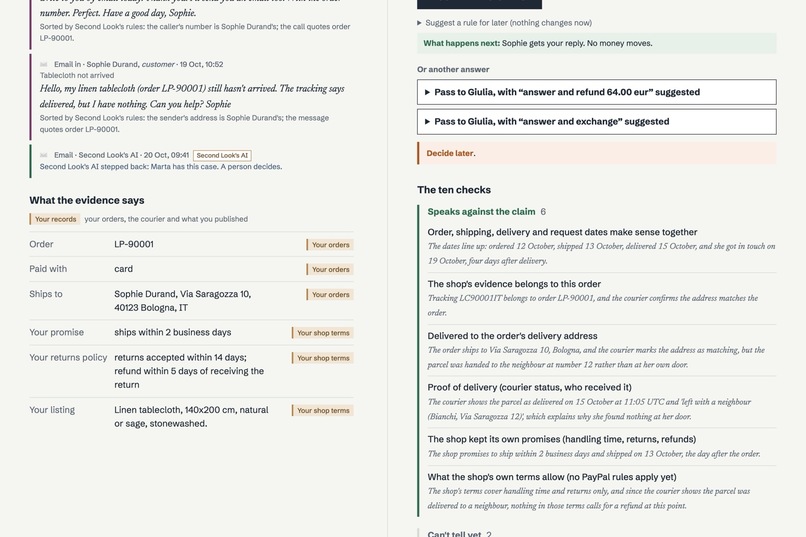
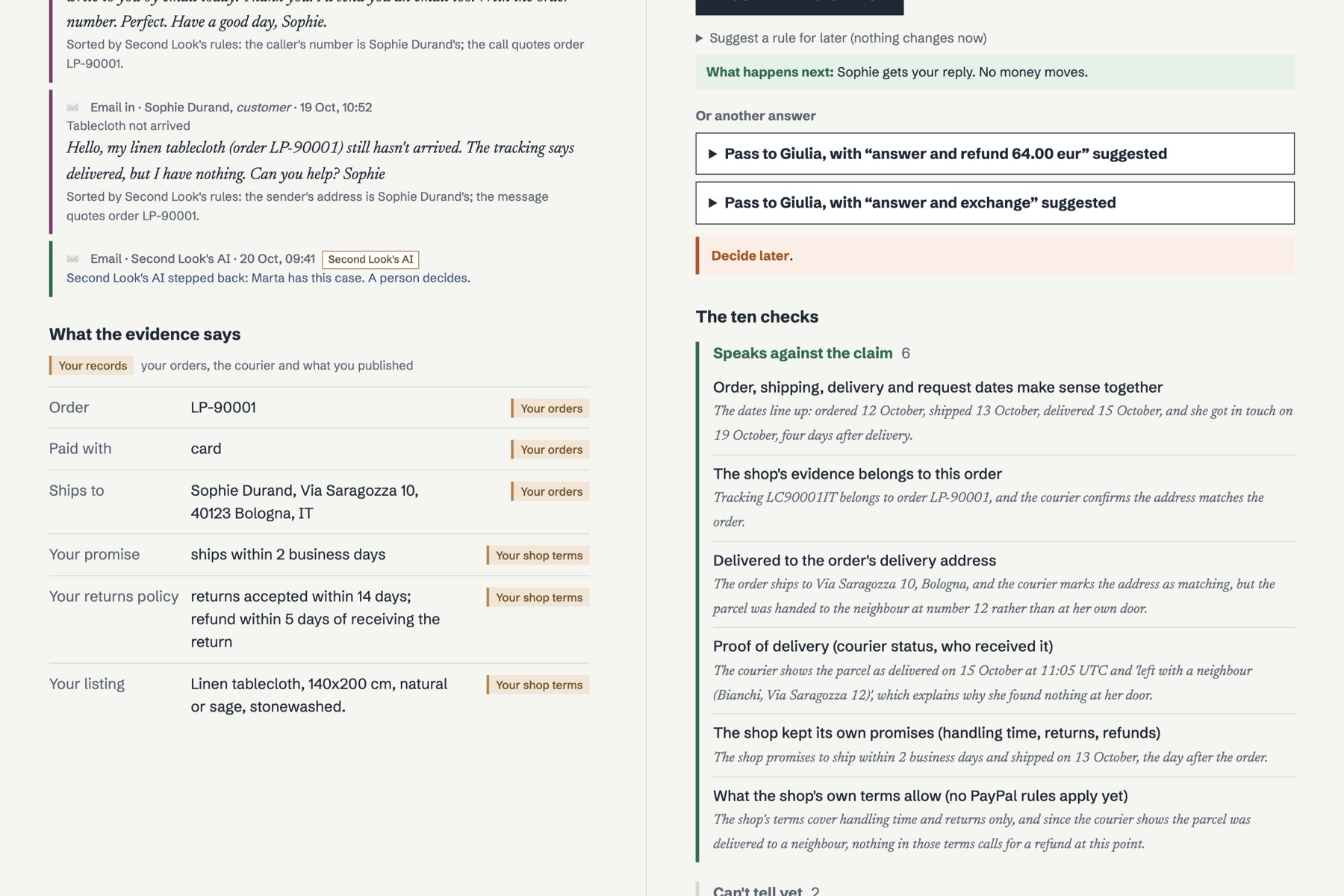
A phone call and an email become one case, checked against the shop's own terms. The AI steps back: a person has this case (demo data).
-
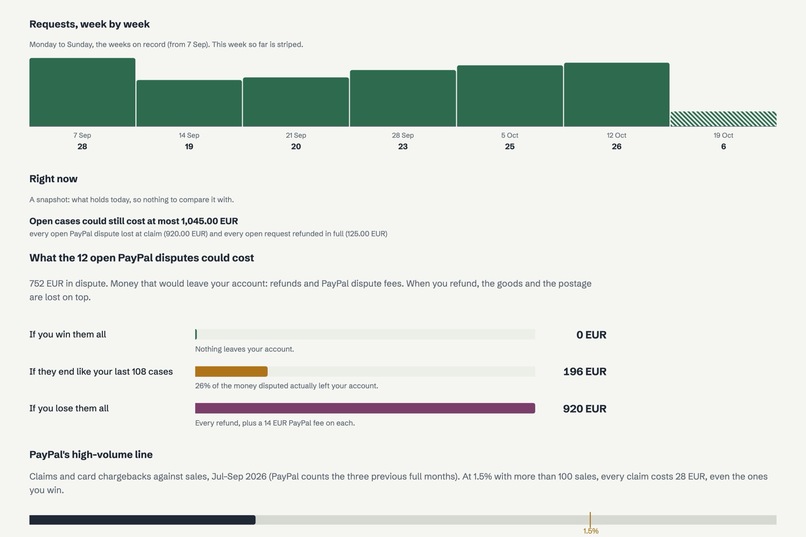
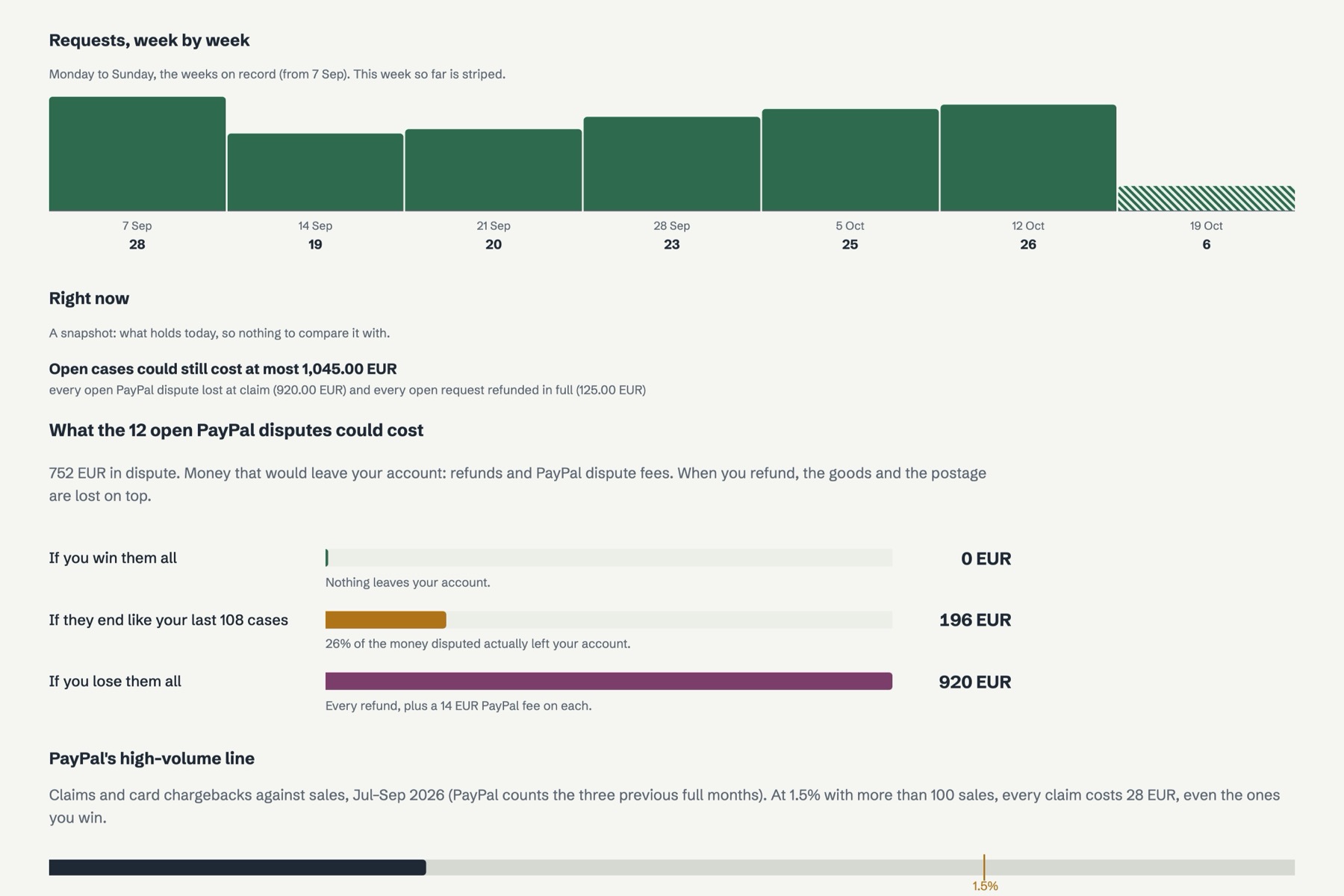
Numbers: requests week by week, what the open cases could cost, and how close the shop is to PayPal's high-volume line (demo data).
-
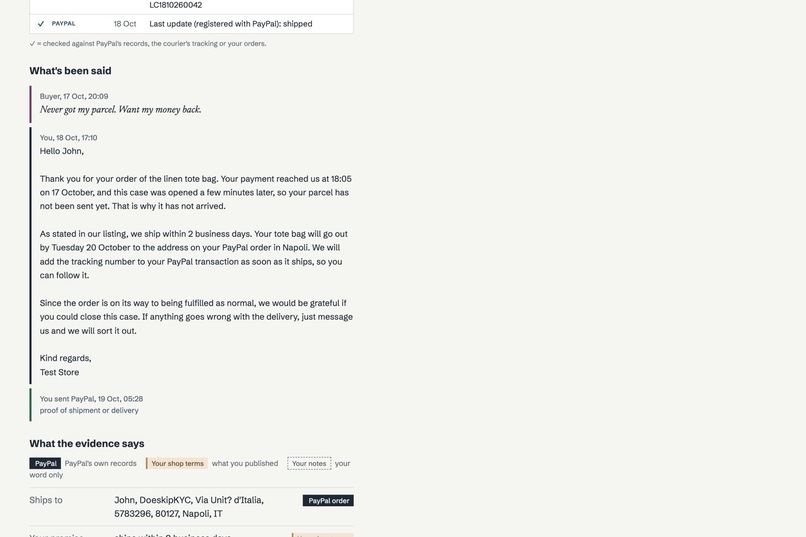
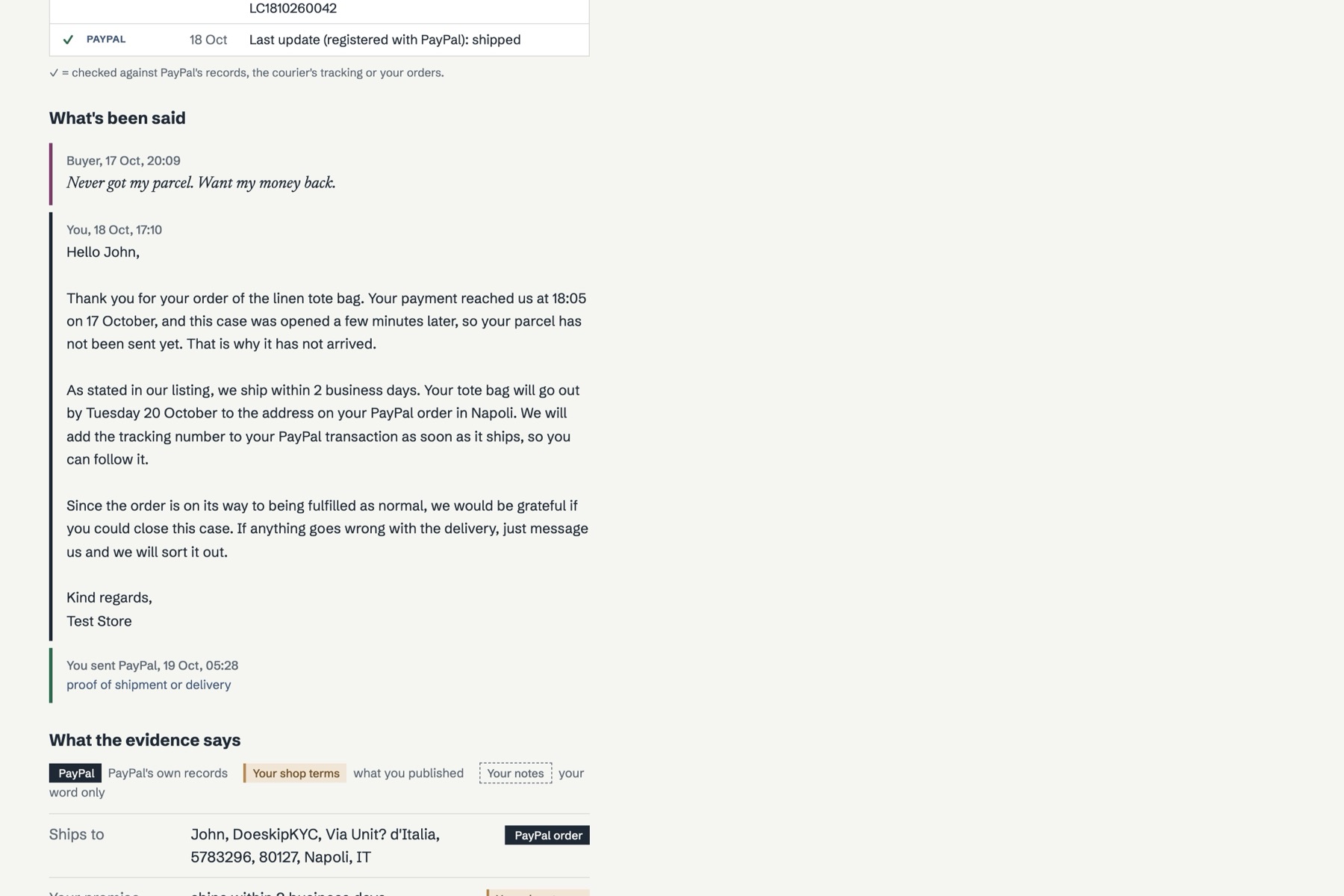
Live on the PayPal sandbox: real test dispute with reply sent and the proof of shipment submitted. The odd address is PayPal's sandbox data.
Inspiration
When you run a product or a service, everyone focuses on selling more. But that isn't always where the money is made. Unknown expenses, untracked costs and hours lost without anyone noticing can hurt a business more than a missing client. Look at any solopreneur's pitch or video and you'll see it: the sale gets all the attention, and what happens after it gets none.
A PayPal dispute is one of those hidden costs. It arrives without warning, it has a deadline, and whoever answers it often has to guess: refund out of fear, or fight a case they will lose. Either way the shop pays, in money and in hours.
What it does
Second Look is the customer-care desk for what goes wrong after a sale. Every request, by phone, email, web form or PayPal dispute, becomes one case: this customer, this order, this problem.
- It reads the case. It pulls the dispute, the payment, the buyer's address and the tracking straight from PayPal's APIs, and labels each fact with where it came from.
- Second Look's AI checks the evidence. Ten fixed checks a specialist would run: the timeline, whether the tracking belongs to this order, delivery to the buyer's PayPal address, what the seller promised, hidden instructions in the buyer's text. Then one recommendation, its reasons, and a reply ready in the customer's language.
- The shop's limits have the last word, in code. The guard runs after the AI and can only make an answer safer: it can turn a recommendation into "a person decides" or "defend", never into a refund.
- A person approves, within their own limit. Over it, the case passes to a colleague who can decide, with the draft. Every answer is signed.
- Everything is updated. The answer goes back on the customer's channel or to PayPal, and the helpdesk and the accounts hear about it as it happens.
How that keeps the costs of a problem under control:
- Every open dispute in one list, nearest deadline first, so none slips past its date.
- Every case weighed in money: what refunding now costs, what settling in the dispute costs, what losing a claim would cost, and how often this buyer took earlier disputes to a claim, against the shop's own rate.
- The whole picture: what the open cases could cost, and how far the shop is from PayPal's high-volume line, where every claim costs more, won or lost. Every figure sits beside the same days of the period before.
- A team that doesn't have to grow with every dispute: the checks happen before anyone opens the case, and each person answers within their own limit.
- Earned autonomy. After a shop's people approve the AI's advice unchanged ten times running on one kind of shop inquiry, the head of customer care can let it answer that kind alone. It signs what it sends, and steps back to a person whenever it isn't sure. On a PayPal dispute, a person always sends the answer.
Why it scales
The bigger the business grows, the more Second Look does. It already handles a team: people, roles, a refund limit for each person, and a hand-off to the manager above it. Through its API it lives inside the tools a customer-care team already uses (shown with Ticketbook, a made-up helpdesk). So a shop doesn't have to switch to a heavier customer-support system later, and switching systems is risky and expensive too.
How we built it
PayPal is the spine, on the sandbox.
- - Disputes (
/v1/customer/disputes): reads the case and what PayPal allows now.send-message,provide-evidence,accept-claimandmake-offerrun on live sandbox disputes. - Transaction Search (
/v1/reporting/transactions): the buyer's address, PayPal's fee on the payment, the buyer's orders and the shop's dispute rate. - Tracking (
/v1/shipping/trackers): registers shipments and reads them back as evidence. - Payments (
/v2/payments/captures/{id},/refund): refunds a shop request's PayPal-paid order. It reads the payment first and sends a stable request id, so a retry can't pay twice. Ran on a live sandbox payment on 26 Oct: the same request sent again returned the same refund.
AI, where judgement is needed and nowhere else.
- Claude Opus 5.5 (Anthropic API, structured output) fills in the ten checks before it picks an action, and drafts the reply. It also sorts the few requests the rules can't match to an order, and code checks its answer against the sender's own orders. About $0.05 per dispute.
- Local whisper transcribes phone calls on the shop's own computer, so a call never leaves the machine.
- Code decides what code can. The guard, the limits, the money arithmetic, the deadlines and the case states
are plain, tested Python. The app itself needs no packages at all; only the Claude call needs
anthropic.
Built with Claude Code, by someone who is not a developer and had never worked with disputes or PayPal's APIs. The film was built as code too (Remotion), with the narration and the demo's phone call voiced by Kokoro, an open-weight model running locally.
Second Look was started for this hackathon: first commit 16 Oct 2026, nothing pre-existing.
Measured, not claimed
Twenty-five cases with the right answers committed before any model saw them, run once in full on 26 Oct:
- Simple rules (baseline): 10/16 PayPal disputes right, 7/9 shop inquiries right, 1 unjustified refund.
- Claude + guard: 16/16 PayPal disputes right, 9/9 shop inquiries right, 0 unjustified refunds.
We wrote these cases ourselves and developed the prompts on cases like them, so this is a development score, not a guarantee. A held-out set is the next honest measure. The eval earned its keep anyway: it found a guard comparing the wrong amount with the refund cap, a prompt sentence of ours that made the model defend a lost parcel, and shortcuts in our own test data that the model's timeline check caught.
Challenges we ran into
- A safety rule hiding another safety rule. When an answer was stopped for its size, a person was allowed to send it, and that stop could hide a stop for trust behind it (hidden instructions, broken evidence). The guard now records why it stopped, one reason per rule, and a person may only overrule a stop for size.
- Money once per order. A customer emails, gets a refund, then opens a PayPal dispute on the same order. Two channels, one order: every refund now counts across all the order's cases, and nothing more goes out until a person has checked. Reviews caught a person being able to send a second refund on an order already refunded when the AI had picked a reply.
- A refund that may or may not have happened. After a timeout, nobody knows. Second Look records it as unconfirmed and holds that order until someone checks PayPal, and never reports it as done.
- The sandbox can't age an order and has one buyer. So it can't show a shop's quarter. The live sandbox disputes are the proof it runs on PayPal; a clearly labelled demo shop runs the same code on a busier business.
What we learned
I am working to bring AI into a big, running company, and I see the struggle up close: new AI processes and tools overlap with something that already exists. What exists could benefit from AI, but it has to adapt and change.
The same holds here. Something that works perfectly on PayPal disputes can still be wrong for a real client. Their customers' problems also arrive by phone, email and web form. They also take cards and bank transfers. They already run other systems and other communication tools. The time you save on PayPal, you lose updating everything else. So Second Look grew from a PayPal dispute assistant into one place for every customer problem: it can run on its own screen, or connect to the tools a shop already has and keep them updated (shown here with a made-up helpdesk and a made-up bookkeeping tool).
Most of the businesses that could benefit from AI already exist. They have competence and tools, and they are scared of adding new ones. Making one thing better and two worse is not an improvement. Few businesses can start from zero. If it doesn't fit most of them, it's wrong.
Autonomy has to be earned. We started with a person approving everything. Now, when people have approved the AI's advice unchanged ten times in a row on one kind of shop inquiry, the head of customer care can let it answer that kind alone. On a PayPal dispute, a person always sends the answer.
What's next
- A held-out test set of new cases from real public dispute stories, right answers written first.
- Sign-in. Today a shop runs it on its own machine and you pick who you are; the public demo holds only made-up data. Real accounts come before any shared use with real data.
- More of PayPal's dispute reasons. Three are covered: not received, not as described, and a refund not processed. Unauthorised payments and duplicates are not.
- Base rates by product and season for a buyer's history, and a list of closed cases with their outcomes.
Not built, so nobody assumes it: card chargebacks and digital goods; refunding a card or bank payment (it's logged for the payment provider); earned autonomy on PayPal disputes. The eval scores the action, not the wording.
Try it
Public demo, no install: https://second-look-4rrz.onrender.com/today?shop=demo . It's on a free plan, so the first page can take a minute or two to wake. If an error page appears, reload. It's shared with other visitors and starts over after 15 quiet minutes.
To run it yourself: no keys, no packages, Python 3.9 or newer. The demo shop's data is made up and labelled; nothing reaches PayPal:
git clone https://github.com/sciarada75/second-look.git && cd second-look
python3 -m secondlook serve
Then open http://127.0.0.1:8765/today?shop=demo . The README's "Try it" walks through the cases, the helpdesk, the books, the practice cases and the eval, and how to connect your own PayPal sandbox and Anthropic keys.
