-
-
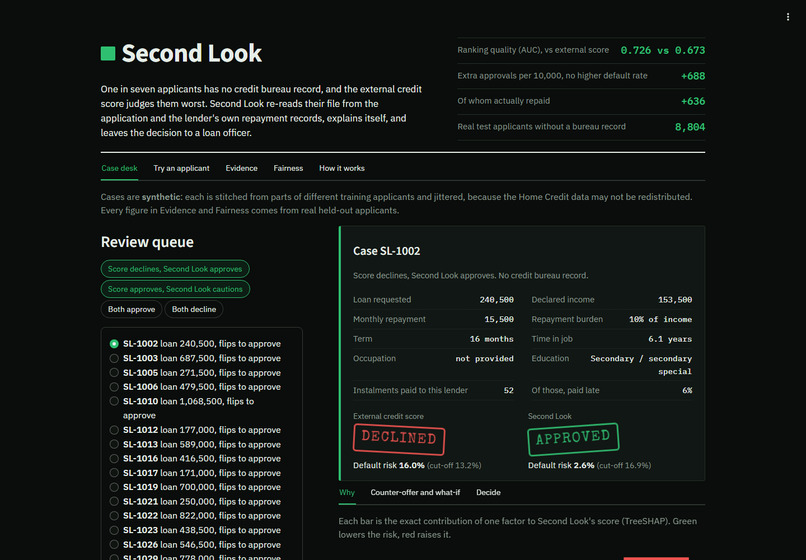
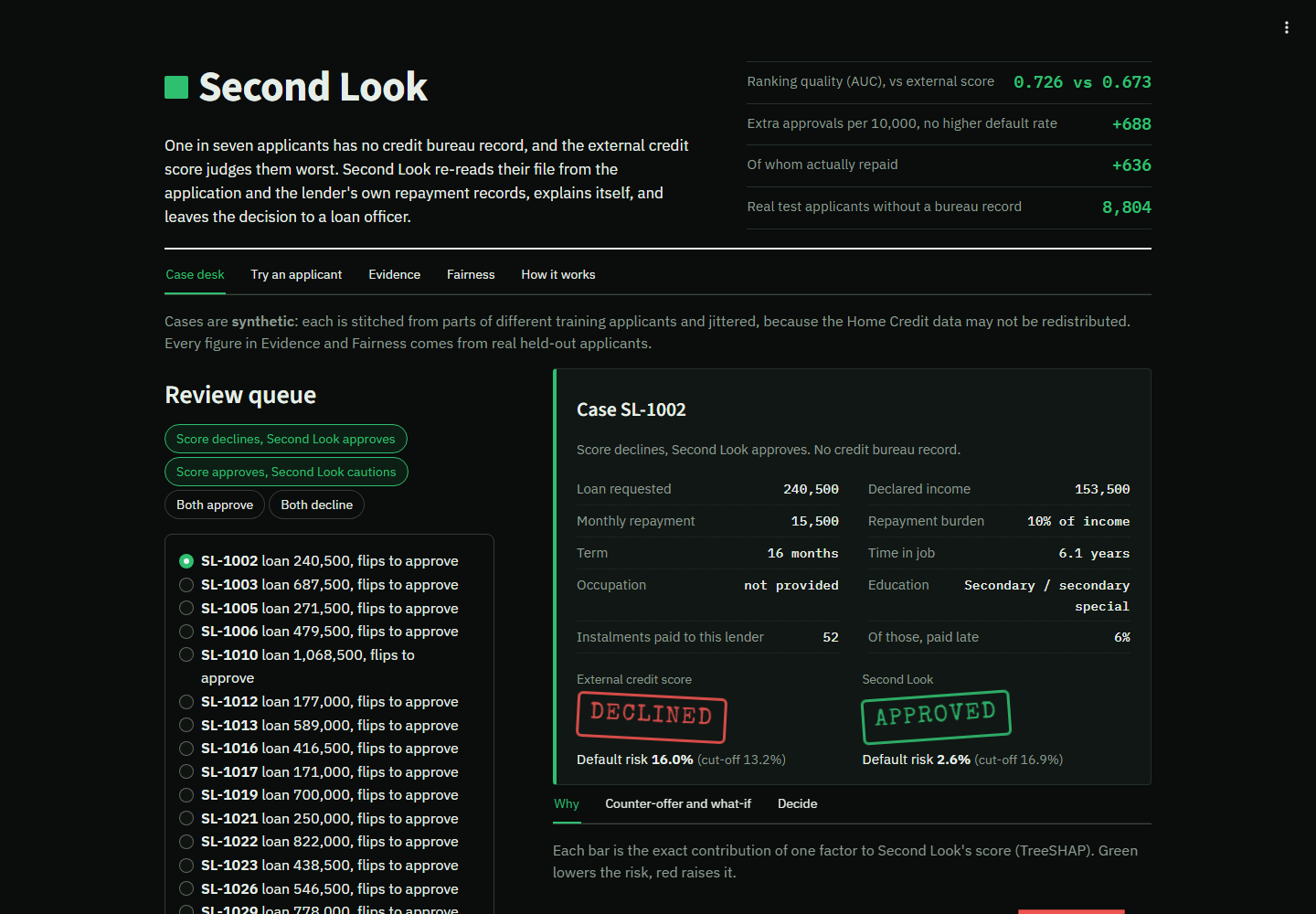
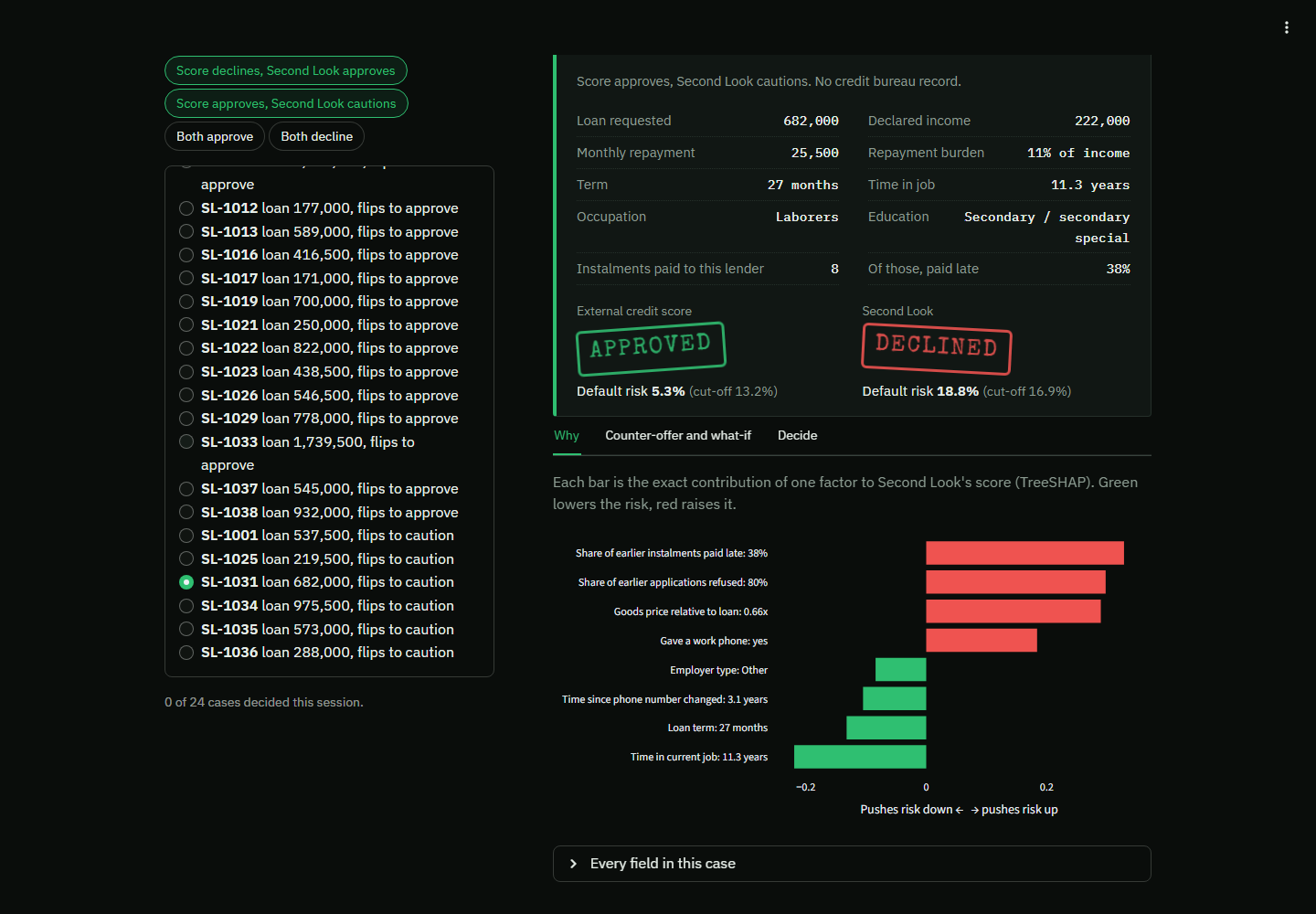
Case desk: the external score declines this applicant, Second Look approves at 2.6% risk.
-
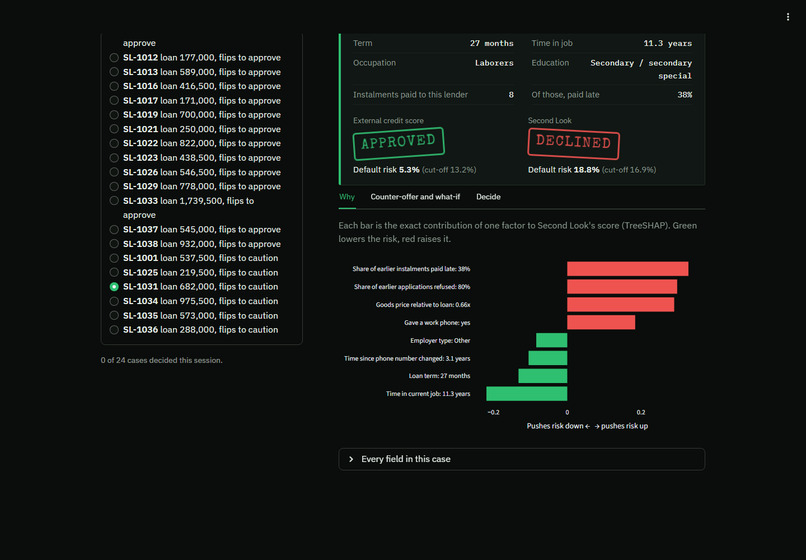
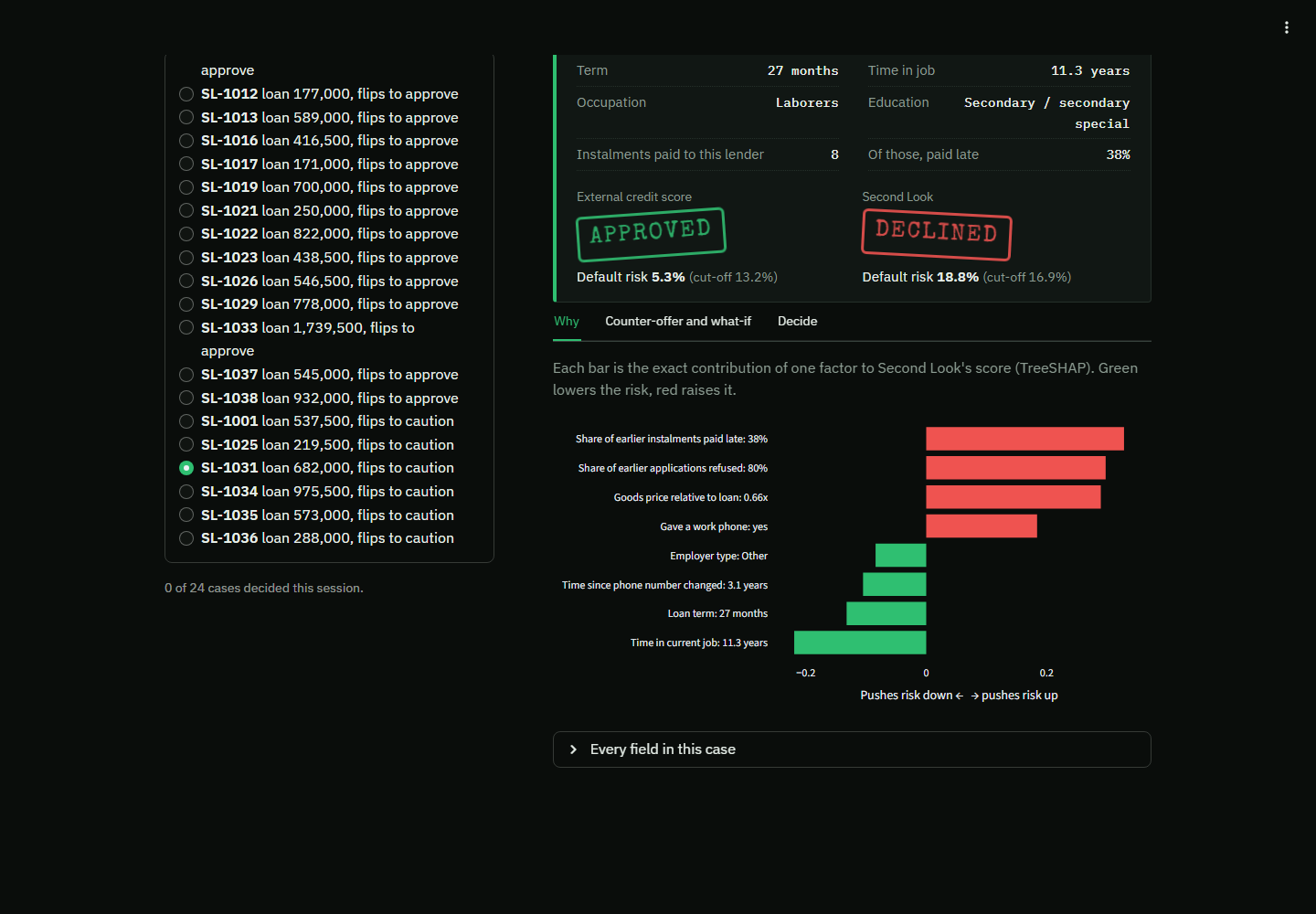
Why Second Look disagrees: each bar is one factor's exact contribution (TreeSHAP). Green lowers risk, red raises it.
-
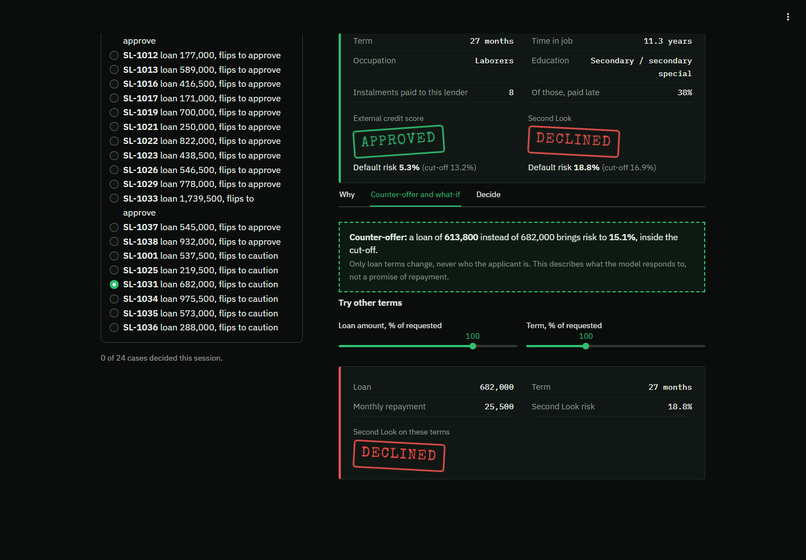
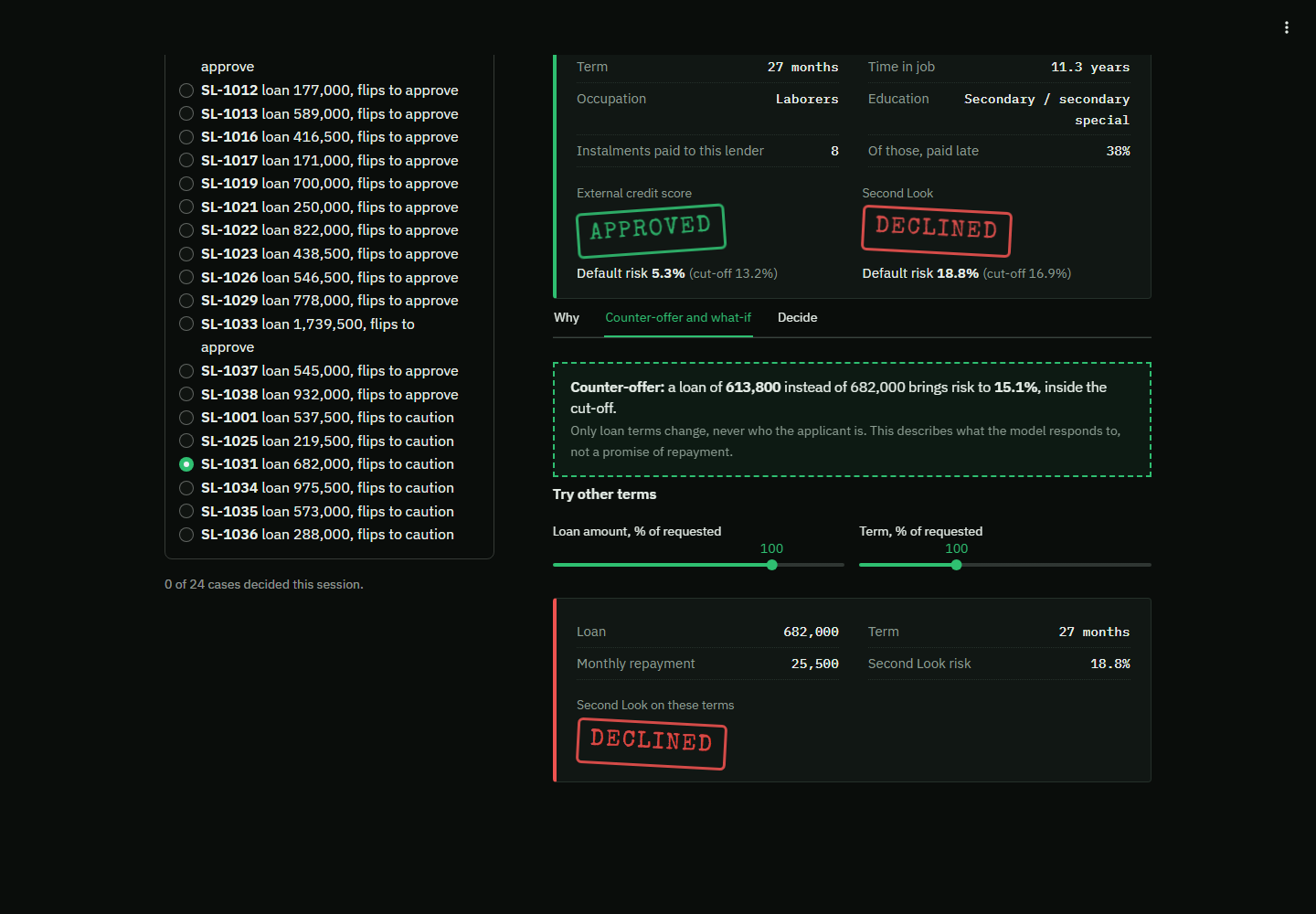
Counter-offer: a 10% smaller loan brings risk under the cut-off. Only loan terms change, never who the person is.
-
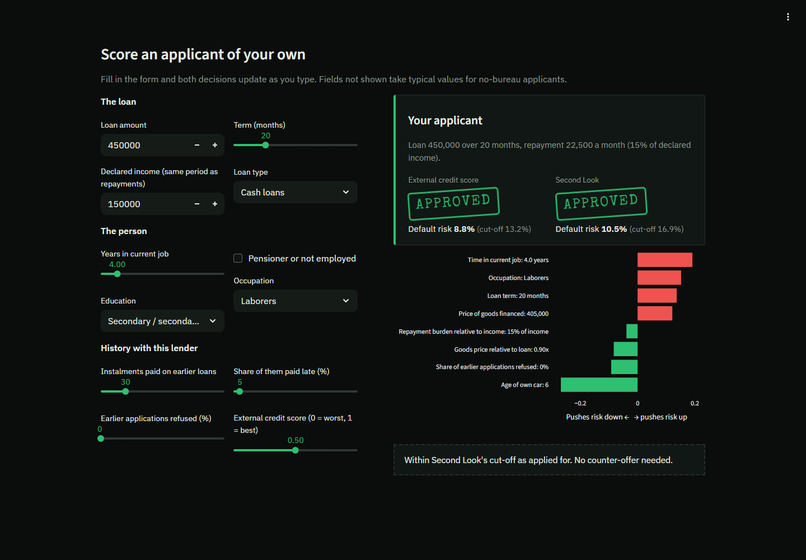
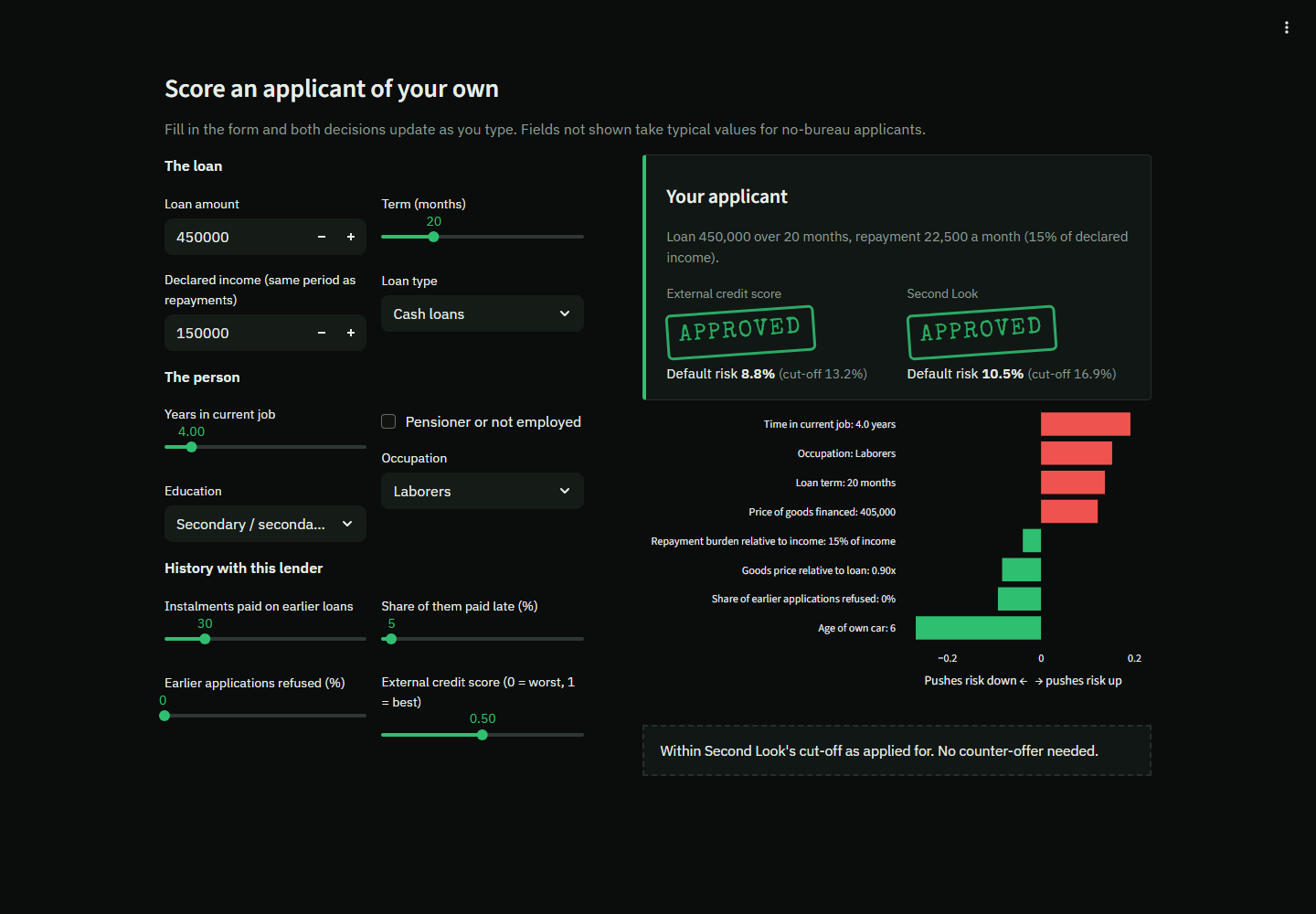
Try an applicant: change the loan, job or repayment history and both decisions update live.
-
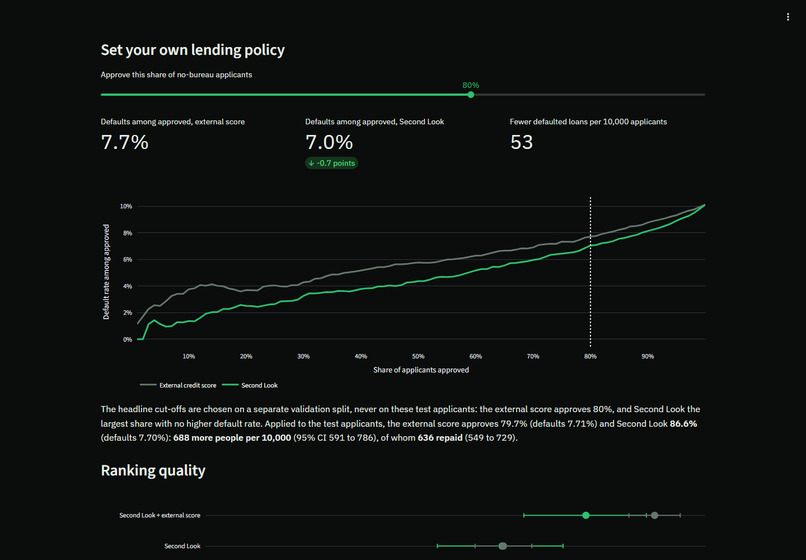
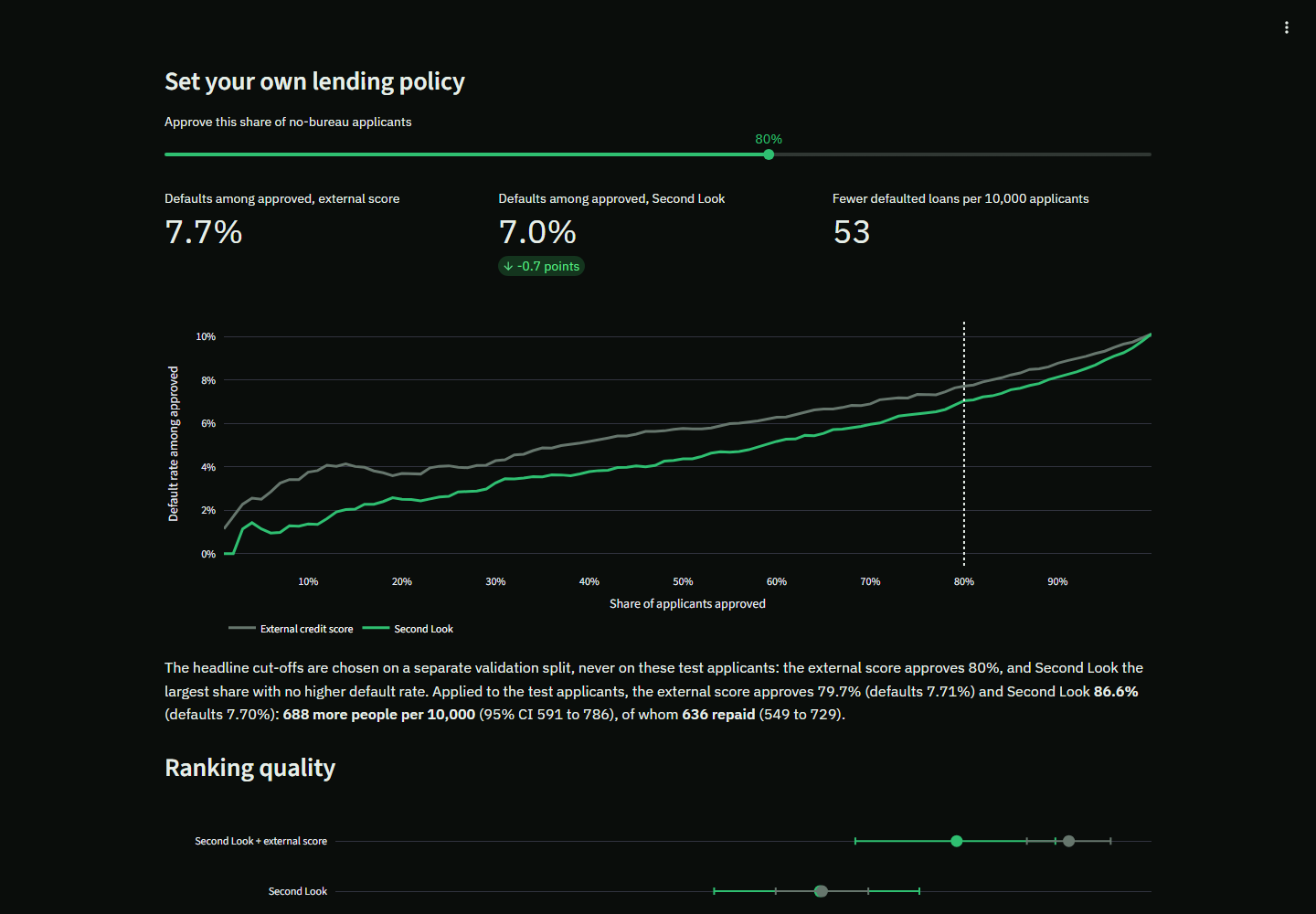
Evidence: at any approval rate, Second Look's approved group defaults less. 8,804 real held-out applicants.
-
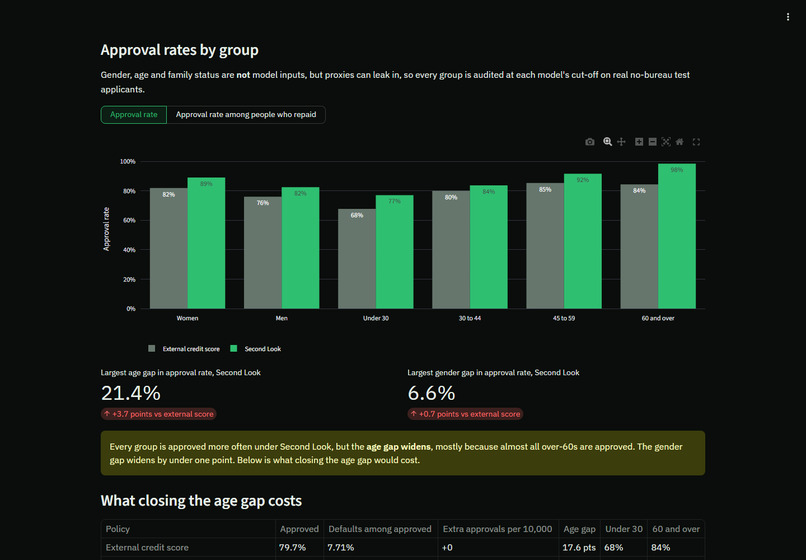
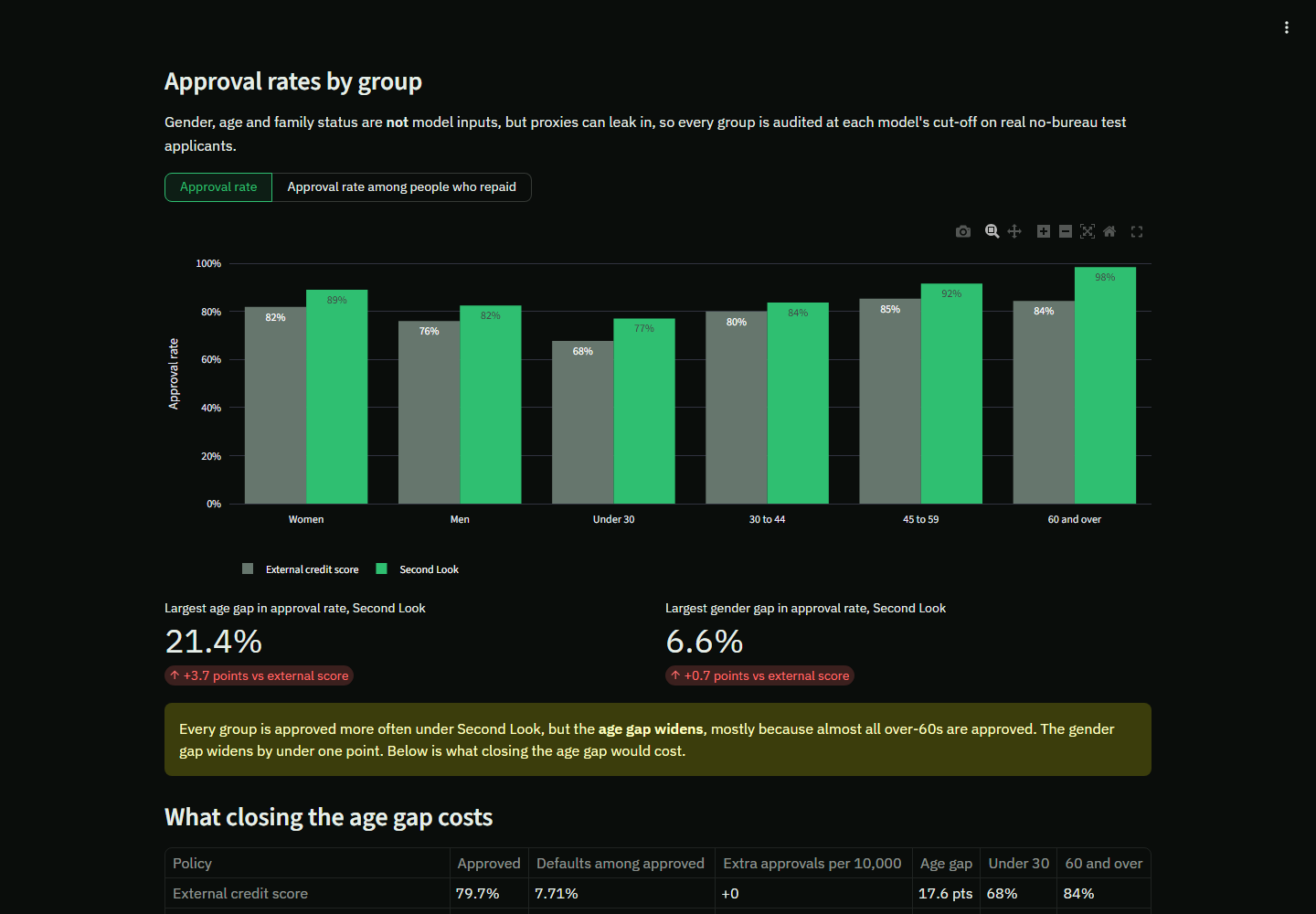
Fairness audit: every group is approved more often, but the age gap widens. The app shows what closing it costs.
-
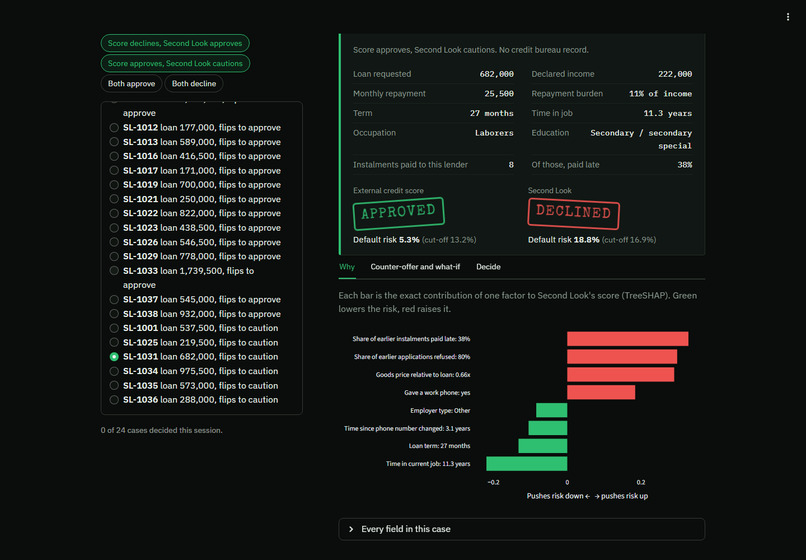
Case SL-1031: the external score approves, but Second Look sees 38% of earlier instalments were paid late.
Inspiration
One in seven applicants in the Home Credit data has no credit bureau record. Lenders still judge them with a purchased external credit score, and that score is weakest exactly for them: AUC 0.673, against 0.718 for everyone else. People without a credit history can't get credit because they have never had credit.
What it does
Second Look is a case desk for loan officers. For every applicant with no bureau record it:
- Re-scores them from the application form and the lender's own records (earlier applications, instalment repayment history), without the external score or any bureau data.
- Explains the score: the exact contribution of each factor (TreeSHAP), in plain English.
- Suggests a counter-offer when it disagrees, such as a 10% smaller loan that brings risk under the cut-off. It changes only loan terms, never who the person is.
- Leaves the decision to a person. The officer picks approve, counter-offer, request documents or decline, writes a reason, and every decision goes into an exportable log.
Officers can also score any applicant of their own and watch both decisions update live.
Results
Measured on 8,804 real held-out applicants with no bureau record. Cut-offs are chosen on a separate validation split, never on the test set.
- Ranking quality: AUC 0.726 vs 0.673 for the external score (+0.052, 95% CI +0.030 to +0.074).
- Lending impact: 688 more approvals per 10,000 (95% CI 591 to 786) at the same default rate (7.70% vs 7.71%), and 636 of them repaid.
- The people it adds default less often (14.7%) than the people it drops (20.7%).
Who it helps, honestly
The gain comes from the lender's own history, which 94% of these applicants have. For the 472 true first-time borrowers (no bureau record and no lender history), Second Look ranks no better than the external score. So the app flags them on the case card and tells the officer to treat them as a standard review.
Fairness
Gender, age and family status are never model inputs, but we audit them. Every group is approved more often, but the age gap widens from 17.6 to 21.4 points. We measured what it would take to close it:
- Removing age proxies (income type, employment fields) leaves the gap at 19.8 points. Older applicants in this data genuinely default less.
- Equal approval rates by age close the gap to 4.4 points at the same default rate, at the cost of about a third of the extra approvals (+470 instead of +688).
Using age at the decision step needs legal review, so the app shows the trade-off and leaves the choice to the lender.
How we built it
- Data: Home Credit Default Risk (307,511 real loans): application, previous applications, instalment payments; bureau table used only to find who has no record.
- Baseline: logistic regression on the three external scores.
- Model: LightGBM with monotone constraints, so more late payments can never lower risk. No external scores, bureau data, gender, age or family status.
- Evaluation: paired bootstrap confidence intervals, cut-offs fixed on validation, an ablation without lender history, and a fairness audit per group.
- App: Streamlit reads every number from metrics files written by the training script, so nothing is typed in by hand.
- Quality: 13 tests, GitHub Actions CI, and a scheduled job that keeps the live demo awake.
Challenges we ran into
- Keeping the evaluation honest. The cut-offs were first tuned on the test set, which flatters the headline. Moving them to a validation split held up: +688 instead of +660.
- The age gap. The obvious fix, removing proxies, didn't work. We had to measure the real trade-off instead.
- Privacy. The data may not be redistributed, so the demo cases are synthetic, stitched from parts of different applicants.
Accomplishments that we're proud of
A credit model that is honest about where it helps and where it doesn't, shows the cost of fixing its own fairness problem, and never takes the decision away from a person.
What we learned
On data like this, the gain for thin-file applicants comes from the lender's own repayment records, not from cleverer modelling of the application form. Fairness also turned out to be a trade-off with a measurable price.
What's next
- Retrain on Indian lending data.
- Add alternative data (utility, mobile and rent payments) so true first-time borrowers benefit too.
- Get a legal review of age-aware cut-offs.
- Run a pilot where officers' decisions are compared with outcomes.
Built with AI
Built with Claude Code (Anthropic). The demo voiceover is AI-generated (Microsoft neural text-to-speech).
Built With
- github-actions
- lightgbm
- numpy
- pandas
- playwright
- plotly
- pytest
- python
- scikit-learn
- shap
- streamlit
