-
-
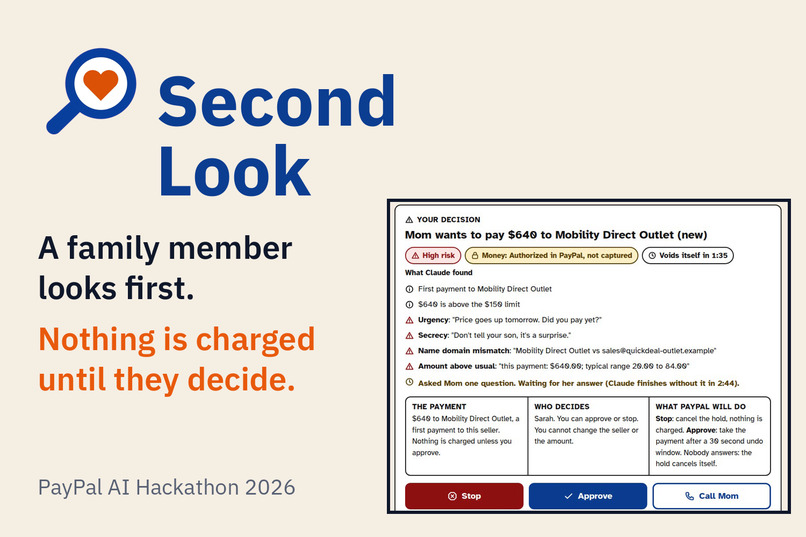
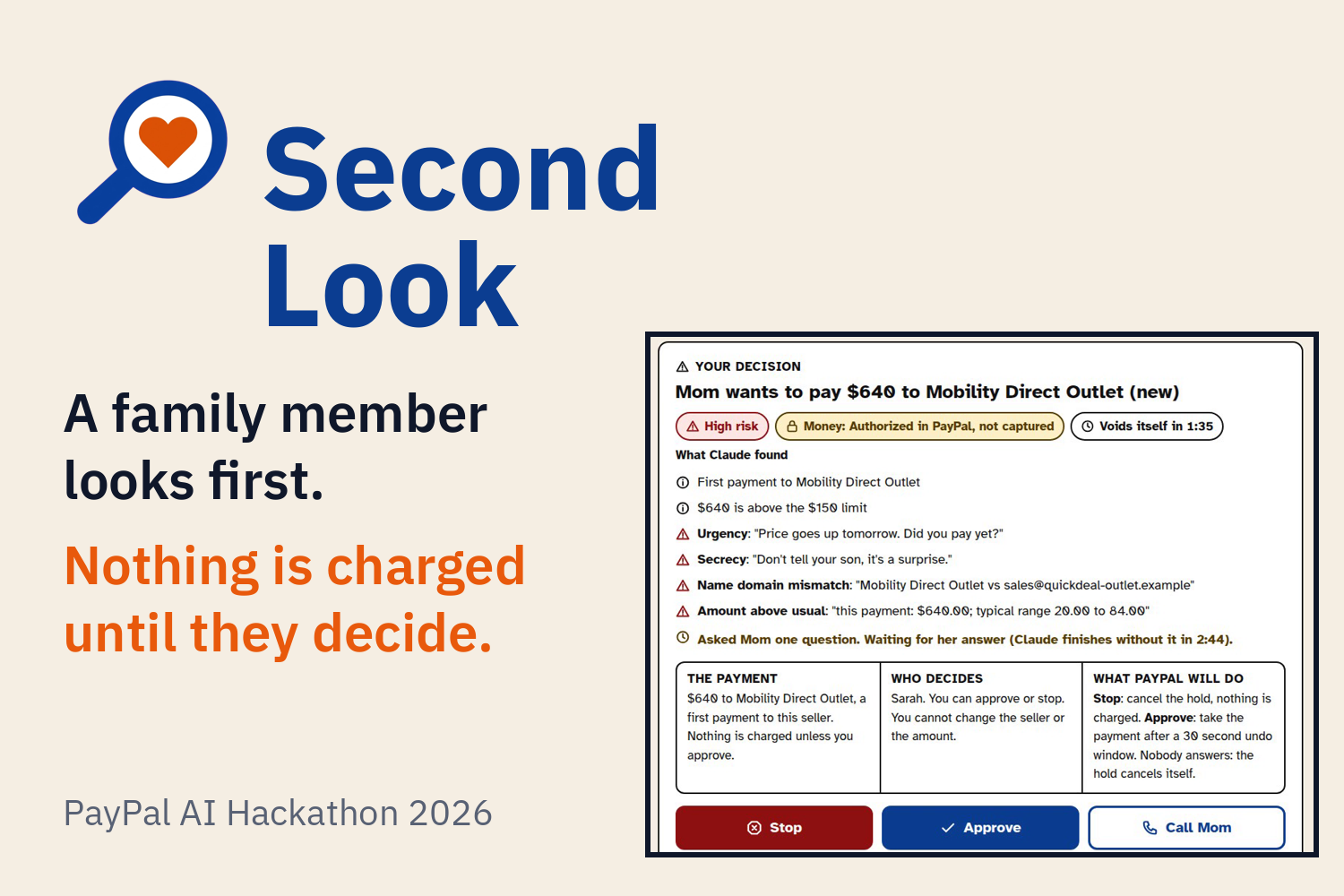
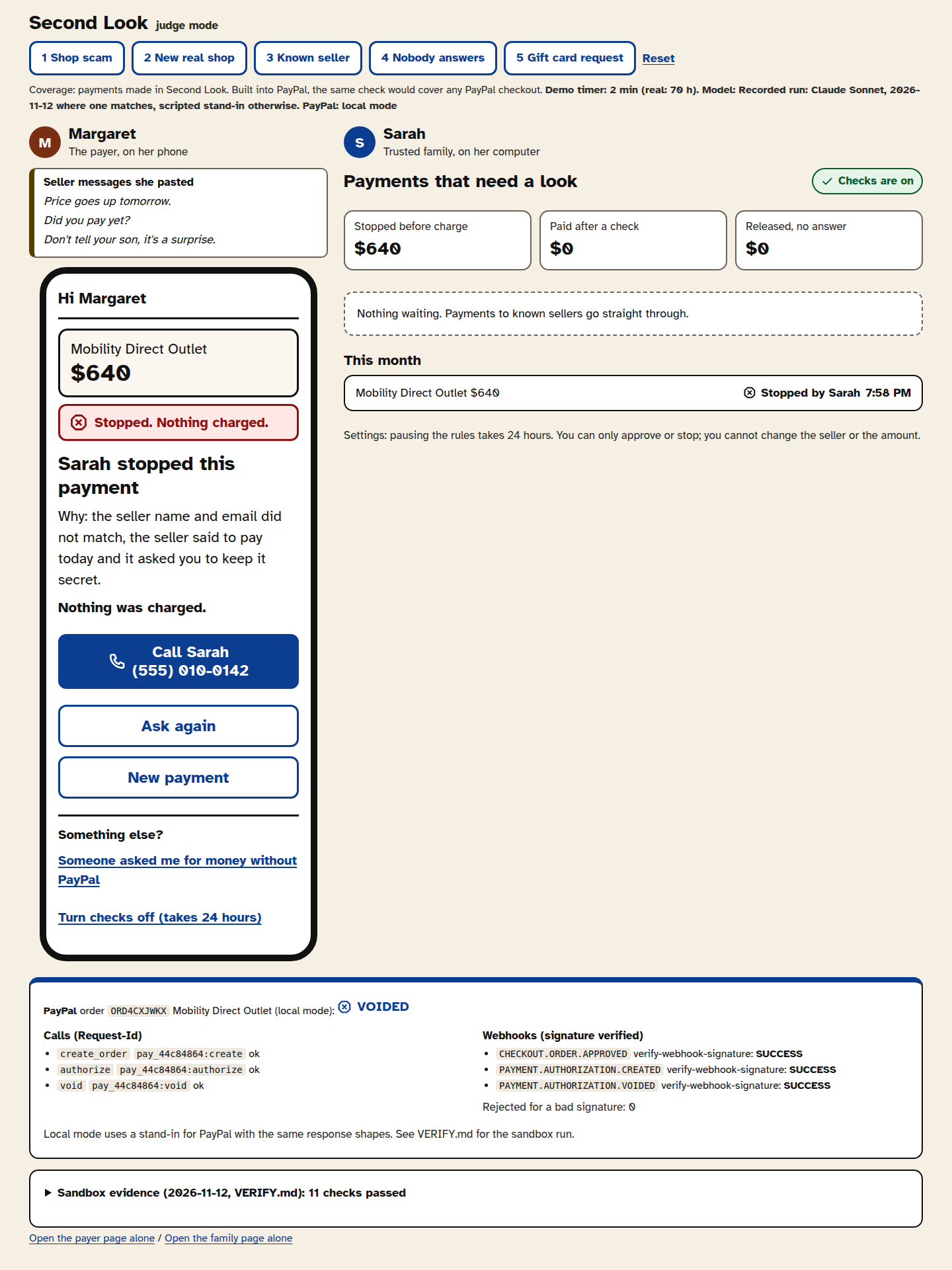
Second Look: a trusted family member checks a payment before the money moves.
-
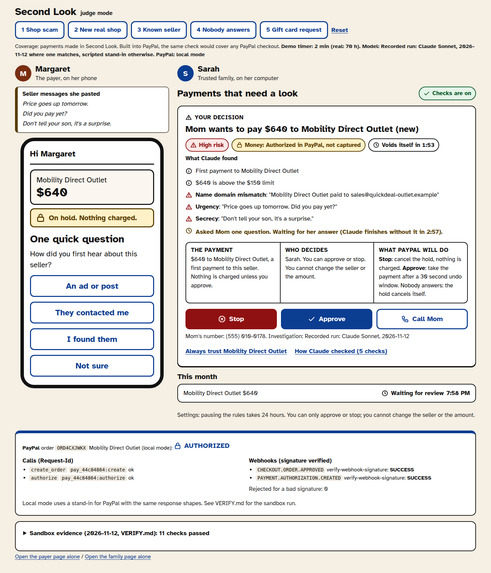
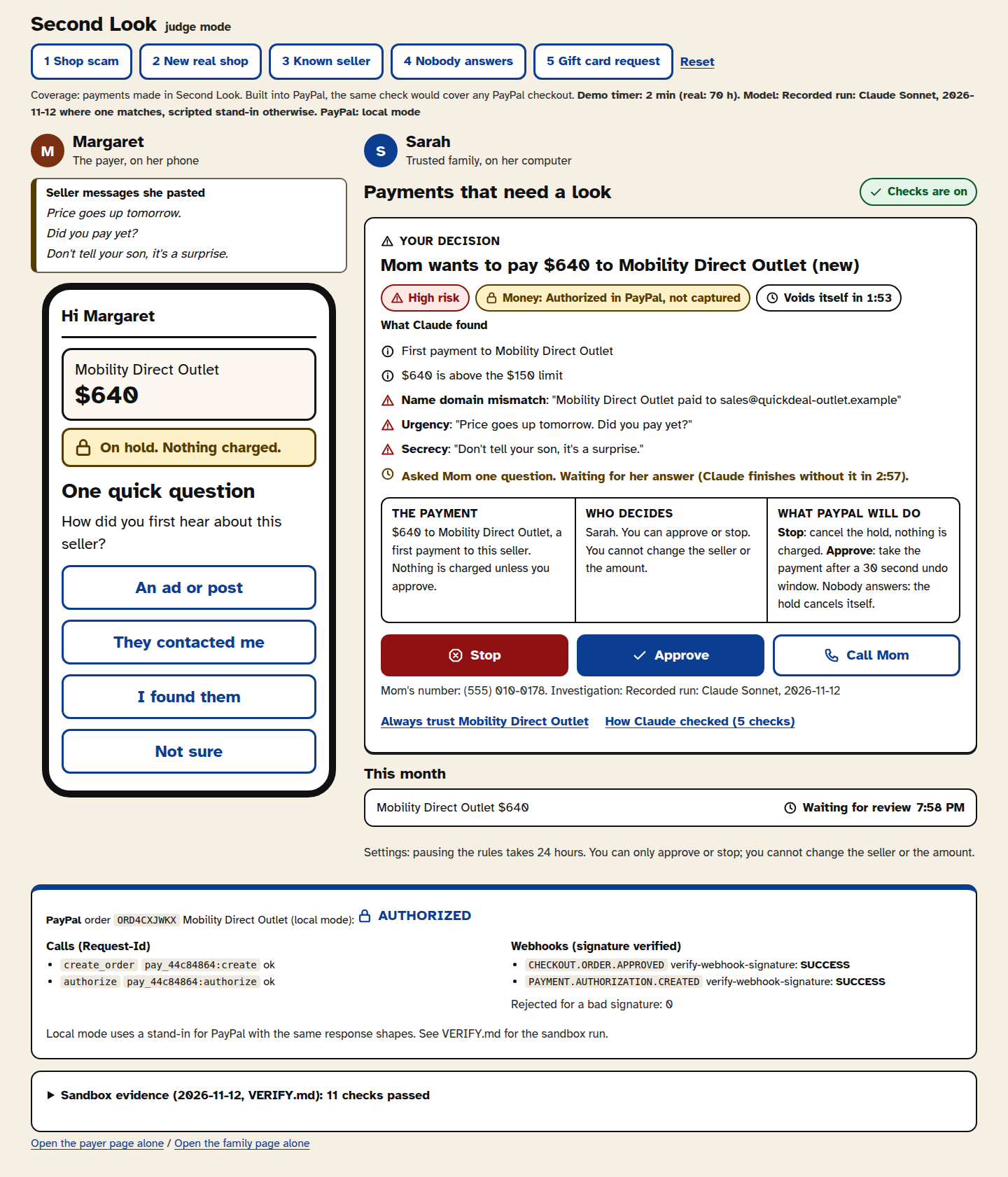
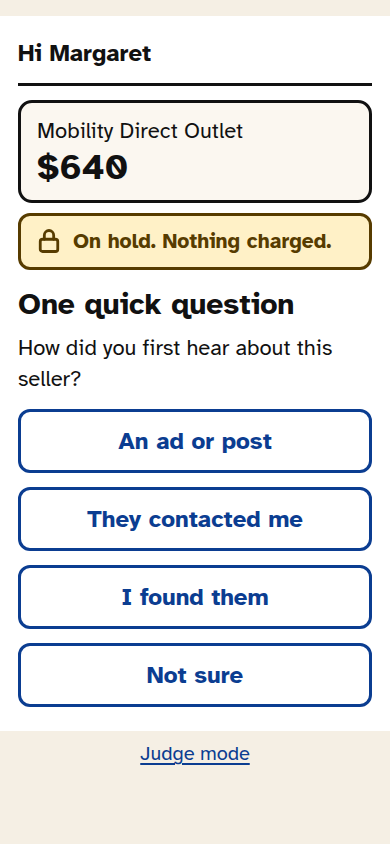
Claude's report on a risky first payment and its one question to the payer.
-
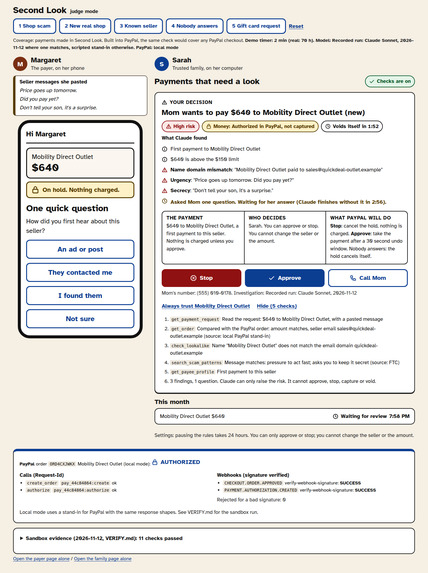
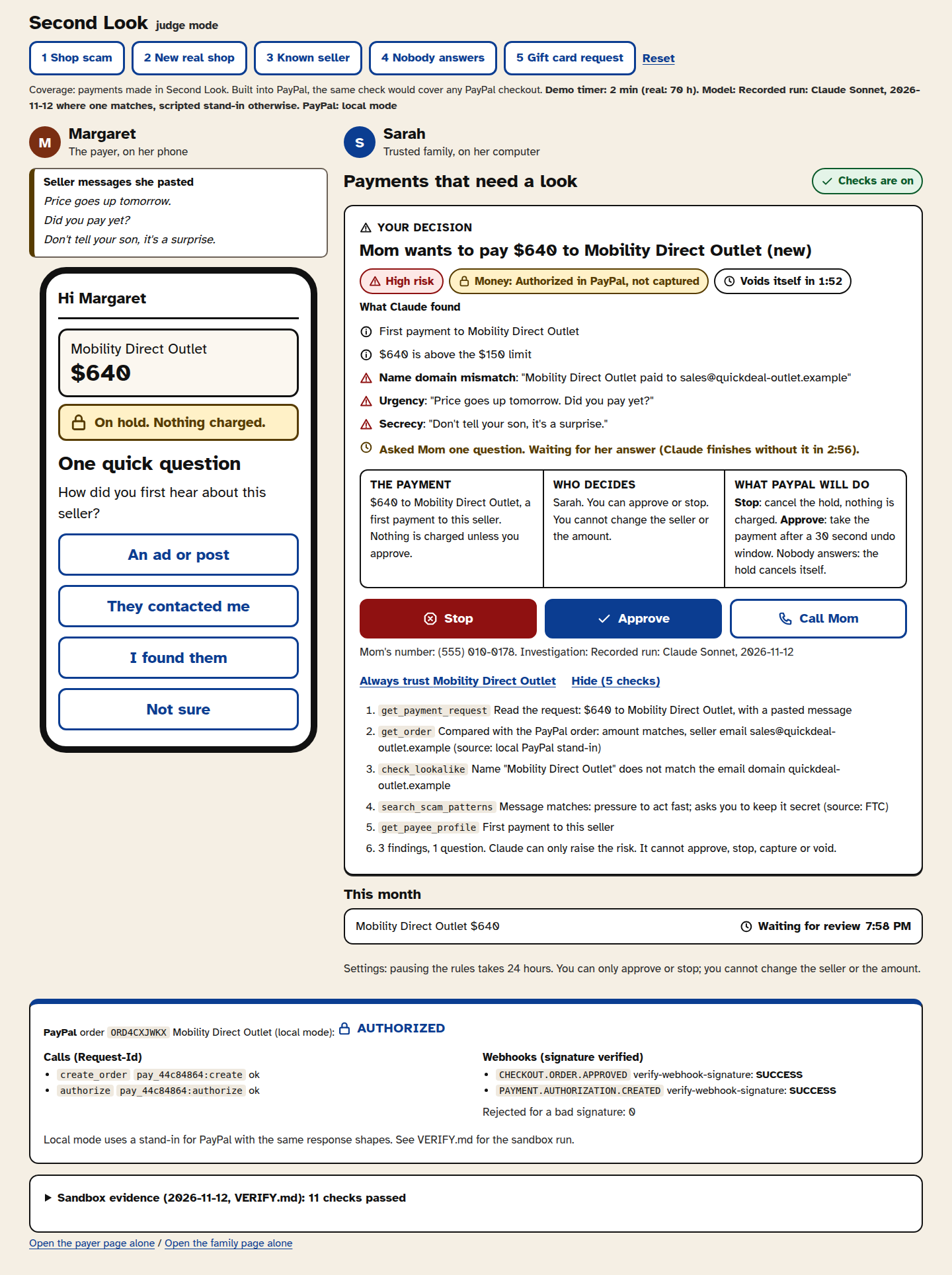
"How Claude checked": every tool step the family can read.
-
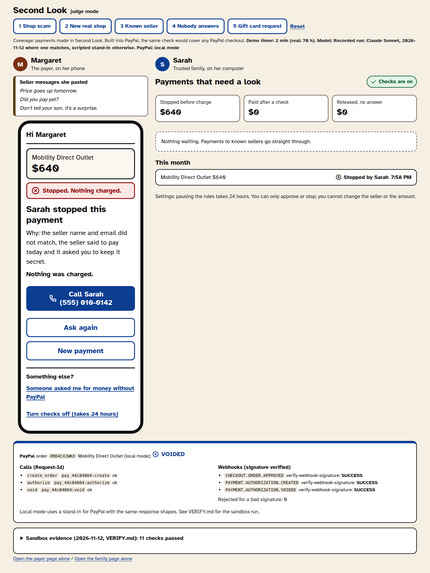
Family taps Stop and the PayPal authorization is VOIDED, no money moved.
-
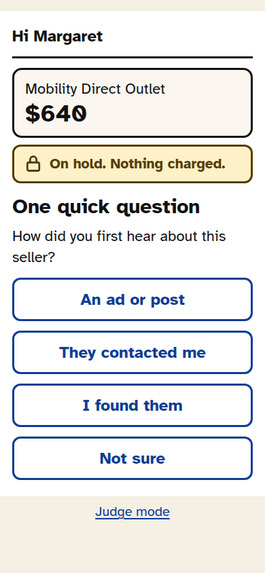
The payer's phone view at 390 px, plain large text.
Inspiration
The FTC's advice to older adults is "Stop and talk to someone you trust" (https://consumer.ftc.gov/consumer-alerts/2025/11/agent-told-me-stay-internet-it-scam). People 60 and older reported $7.748 billion in losses to the FBI's Internet Crime Complaint Center in 2025, up 59% from 2024 (https://www.ic3.gov/AnnualReport/Reports/2025_IC3Report.pdf). In the FTC's 2025 data, online shopping fraud drew more loss reports from older adults than any other fraud type, and debit cards and payment apps were frequently the payment method (https://www.ftc.gov/system/files/ftc_gov/pdf/2026-older-adults-report-10192026.pdf). A payment app is exactly where that advice should happen: at the moment before the money moves.
What it does
A payment from an older adult to a first-time or risky seller stays an uncaptured PayPal authorization. Plain server code decides to hold (new seller, amount above the limit, or a repeat request); the model never decides that. Claude then investigates with tools and shows its work to the family: seller name against email domain, the order read back from PayPal, known scam patterns in the seller's message, the payer's usual amounts. If the risk is high and the origin unclear, Claude asks the payer one question. A trusted family member then taps Approve (capture, after an undo window) or Stop (void). If nobody answers, the hold voids itself. The payer's answer is shown to the family but never lowers the risk, and Claude has no capture, void or release tool. Requests outside PayPal (for example a gift card demand) cannot be held, so the app only checks the text and alerts the family.
Known sellers and small payments are captured at once, so checkout is not blocked.
How we built it
- Claude tool loop with ten investigation tools, call budgets, and two segments so no model runs while the app waits for a person. The hosted demo runs live Claude Sonnet (claude-sonnet-5-5, Anthropic API) with per-visitor-hour and per-day caps. If the API fails or a cap is hit, the action still finishes with a labelled recorded run (saved from real Sonnet runs on 2026-11-12) or a rule-based stand-in, and each card says which one was used.
- PayPal Orders v2 (intent AUTHORIZE) and Payments v2 (capture, void, get authorization) through the APIMatic-generated PayPal TypeScript SDK, built by following the APIMatic Context Plugin's skills, with a fixed PayPal-Request-Id per action so a retry never captures or voids twice. Webhooks are verified with verify-webhook-signature.
- PayPal Agent Toolkit get_order for the investigation of sellers that have sandbox credentials.
- Express 5, React 19, Vite, zod, a state machine with per-payment locks, and a local PayPal stand-in with the same response shapes and the same ownership rule.
Challenges we ran into
- Against the sandbox, authorizeOrder answered 415 until we sent an explicit empty JSON body; the APIMatic contract sheet matched everywhere else.
- A lost answer after a timeout must never capture twice: the server reads the order back and settles the state.
- Making sure the AI cannot move money by design rather than by prompt: it has no money tool, its risk can only go up, and hold decisions are plain code.
- A second sandbox app tried to read and capture another merchant's authorization and got 401 PERMISSION_DENIED both times, so a third-party app cannot do this for other merchants.
Accomplishments that we're proud of
On the PayPal sandbox (2026-11-12) create, authorize, capture and void passed through the SDK, a repeated PayPal-Request-Id returned the same capture and the same order, and scenario 1 ran end to end on a fresh sandbox order and ended VOIDED. A separate sandbox run confirmed the hold voids itself with no family answer (an 8-second demo deadline, no capture). Claude's investigation is readable step by step by the family. 93 tests pass with every outside service faked.
What we learned
The honest conclusion is that this belongs inside PayPal. PayPal's capture API already defines a PENDING status with a PENDING_REVIEW reason ("The captured payment is pending manual review"); a Trusted Contact setting could reuse that state and let the family decision move it to COMPLETED or DENIED. That is our proposal, not an existing feature. We also learned the limits: the largest losses move by bank transfer and crypto, which Second Look cannot hold. It targets online shopping scams paid through a payment app.
What's next for Second Look
Trusted Contact in PayPal account settings; several contacts in order and amount tiers; financial-institution contacts (FINRA 4512 and 2165); re-authorization after the 3 day honor period.
Built With
- accessibility
- agent-toolkit
- ai-agent
- anthropic
- apimatic
- authorization
- claude
- elder-fraud
- express.js
- family
- fintech
- fraud-prevention
- node.js
- orders-api
- payments
- payments-api
- paypal
- paypal-sandbox
- paypal-sdk
- react
- scam-protection
- tool-use
- vite
- webhooks
- zod
