## Inspiration
Every day, useful things are thrown away simply because people don't know what else they can do with them.
A shoe might only need a small repair. An old chair could still be useful. A bottle could be reused instead of immediately becoming waste.
That led to one simple question:
What else could this become?
Second Life was built to make that question easy to answer with just a photo.
What it does
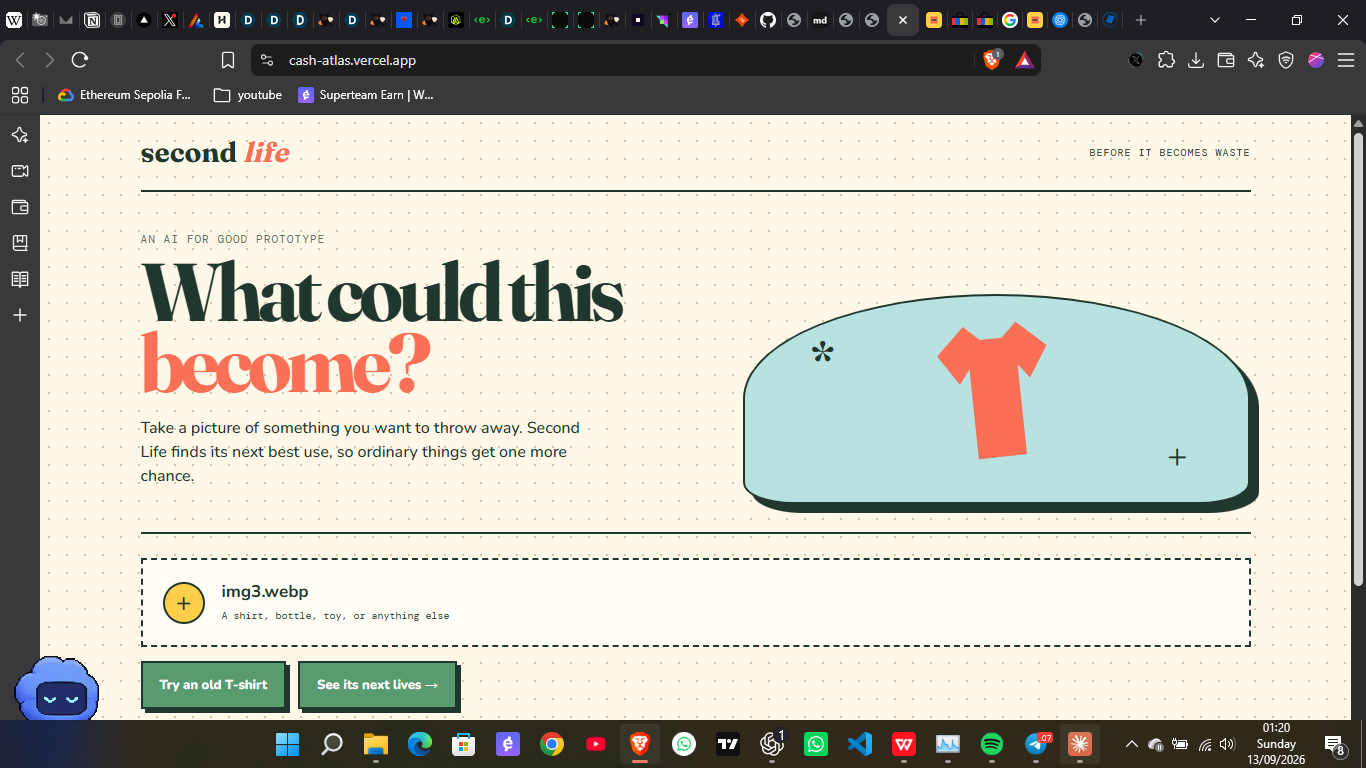
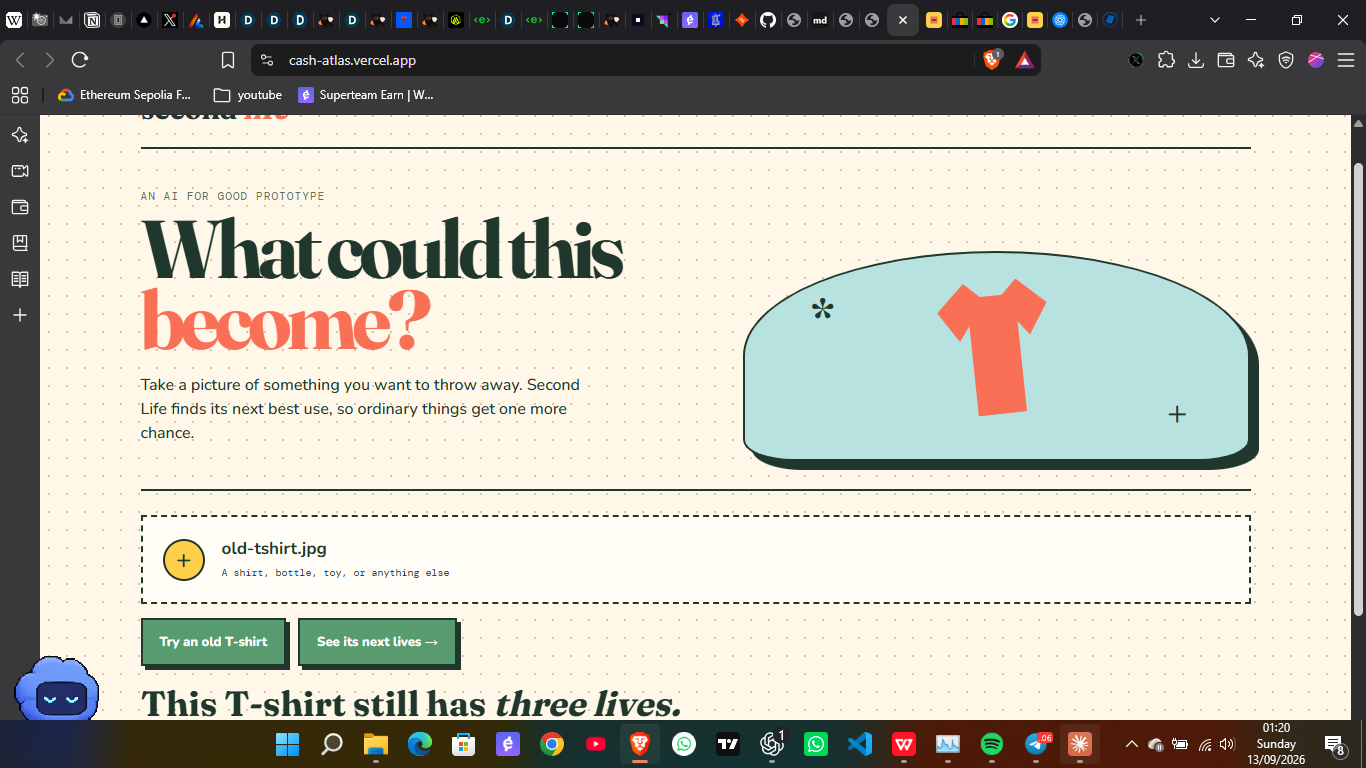
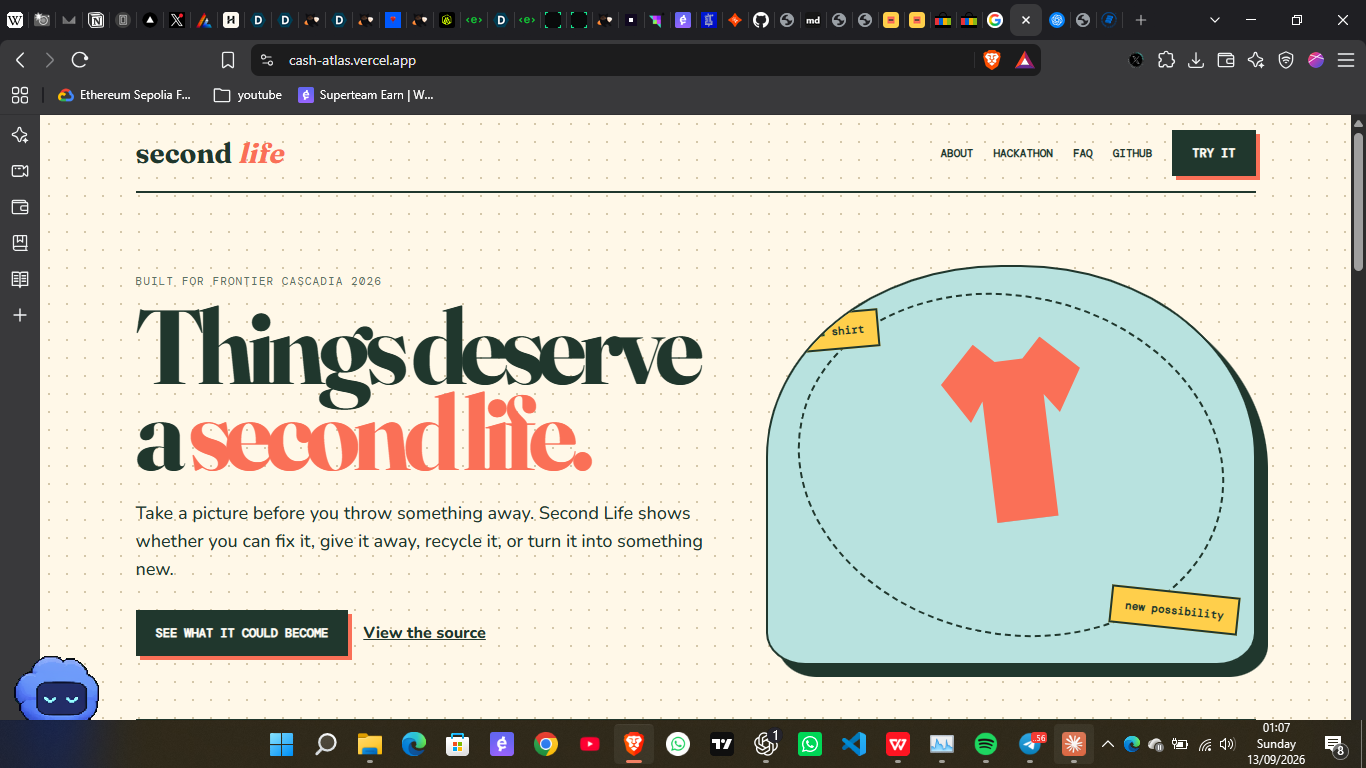
Second Life is an AI-powered assistant that helps people find another use for everyday objects before throwing them away.
Upload a photo of one object and Second Life uses AI vision to:
- Identify the object
- Estimate its likely material and visible condition
- Recommend the best next action and explain why
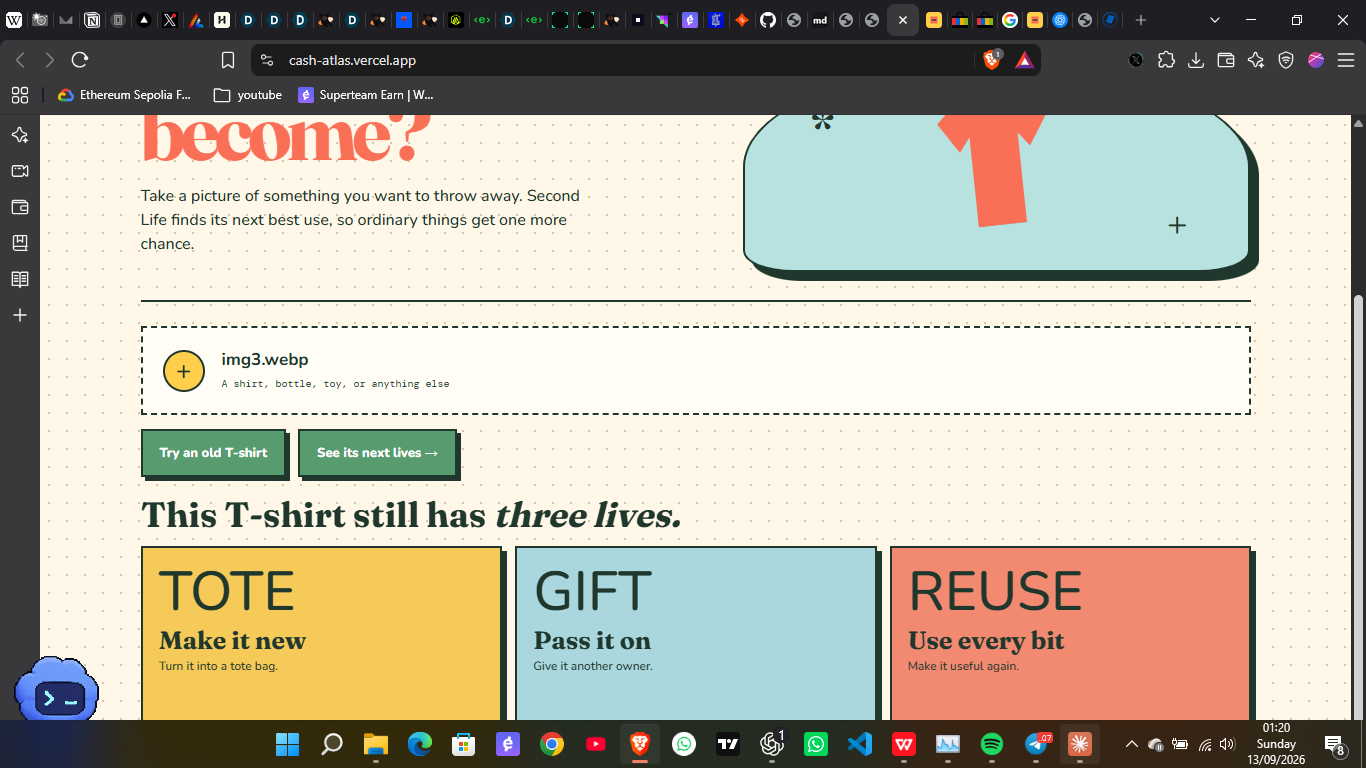
- Suggest three practical next lives
- Give simple steps the user can follow
- Provide safety and responsible-disposal guidance when needed
Depending on the object, those next lives could include repairing it, reusing it, giving it away, transforming it, or responsibly recycling it.
The goal is simple:
Take a picture. See the possibilities. Choose a better next life.
How we built it
Second Life is a web application with a lightweight frontend and a serverless AI backend.
When a user uploads an image, the image is resized before being sent to our backend.
The backend uses the OpenAI API, specifically the OpenAI Responses API with vision, to analyze the image.
We give the model instructions to examine what is actually visible and return structured information about:
- The object
- Likely material
- Visible condition
- Confidence
- Recommended next action
- Why that action makes sense
- Potential impact
- Safety information
- Three possible next lives with practical steps
Instead of returning a long block of AI-generated text, the model returns structured JSON. The frontend turns that structured response into the simple Second Life results interface.
The application is deployed using Vercel, with the OpenAI API call handled through a serverless function so the API key is never exposed in the browser.
Challenges we ran into
One of the biggest challenges was making the AI useful without making it sound more certain than it should be.
A single photograph cannot reliably tell us about hidden damage, the exact composition of every material, or whether a particular recycling service exists near the user.
Because of that, we designed the AI instructions to avoid inventing information it cannot determine from the image.
If something is uncertain, Second Life should communicate that uncertainty instead of presenting a guess as a fact.
Another challenge was consistency.
AI can naturally respond in many different formats, but the interface needs predictable information. We solved this by asking the OpenAI API for a structured response that the application can reliably turn into the same easy-to-understand experience.
Accomplishments that we're proud of
We're proud that Second Life became a working product rather than just an idea.
A user can upload a real photograph, have it analyzed through the OpenAI API, and receive object-specific actions they can actually follow.
We're also proud of how simple the interaction became.
There are no complicated forms or long questions before getting an answer.
Just:
Take a picture → Let AI understand it → Find its next life.
We also built safeguards into the AI workflow instead of assuming every model response is automatically correct.
What we learned
Building Second Life taught us that putting AI inside a product isn't enough.
The important questions are what the AI should do, what it should not claim to know, and how its output can become something genuinely useful to a person.
We learned more about working with the OpenAI API, multimodal AI and image understanding, structured AI responses, client-side image processing, serverless functions, and designing interfaces around uncertain model outputs.
Most importantly, we learned that a useful AI experience can start with a very simple interaction.
In this case, just one photo.
## What's next for Second Life
The next step is making Second Life more local and actionable.
Instead of only suggesting what someone could do, future versions could help them actually do it.
Second Life could use location-aware services to find nearby:
- Repair shops
- Donation centers
- Recycling programs
- Community reuse groups
- People or organizations that need the item
We also want users to be able to track the objects they've saved from becoming waste and see the environmental impact of those decisions over time.
Eventually, Second Life could become the step people take before throwing something away:
Before it becomes waste, see if it has another life.
Built With
- api
- artificial
- computer
- css3
- functions
- gpt-5.6
- html5
- intelligence
- javascript
- multimodal
- openai
- responses
- vercel
- vision
