-
-
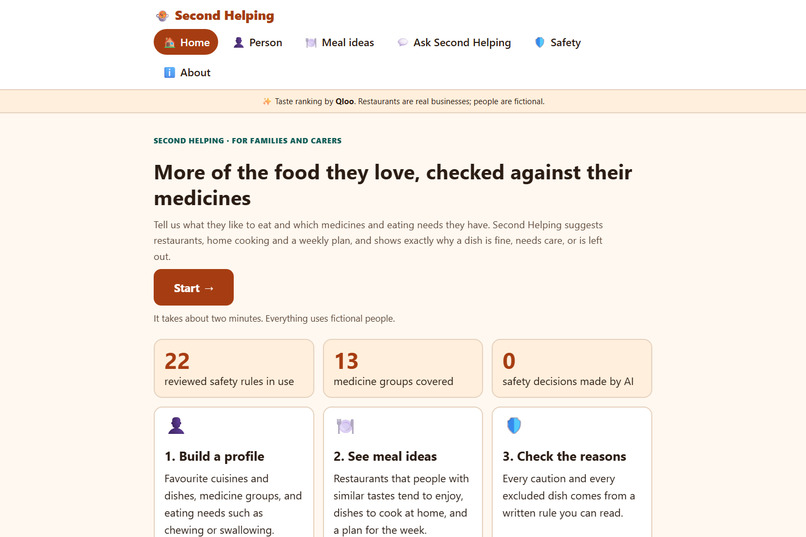
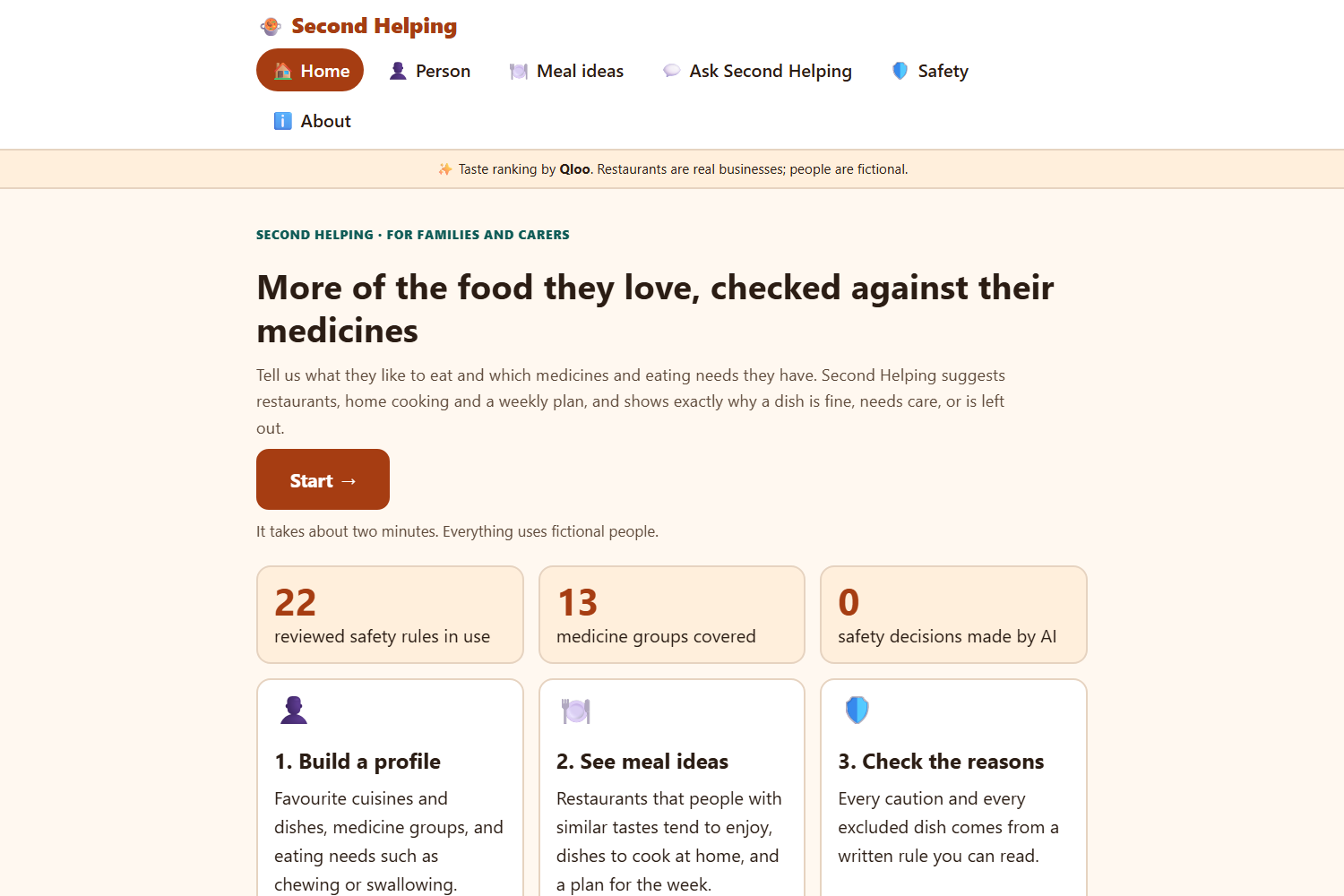
Home: more of the food they love, checked against their medicines. 22 reviewed rules, 0 safety decisions made by AI.
-
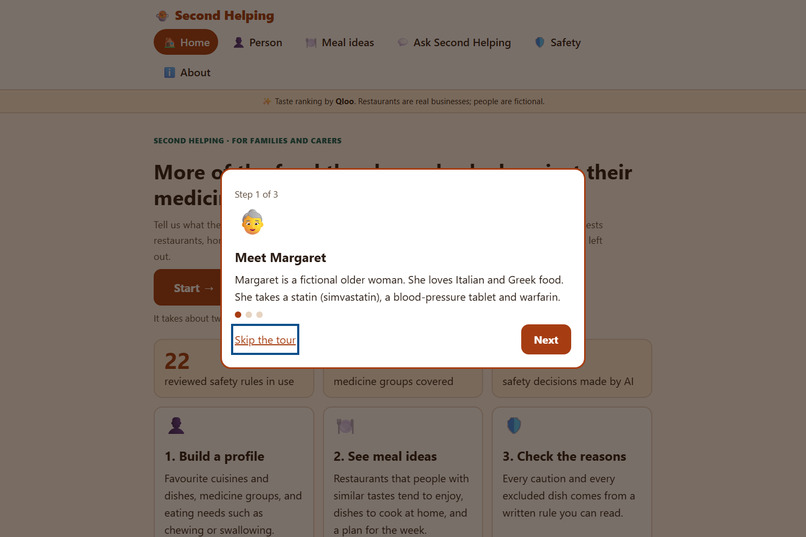
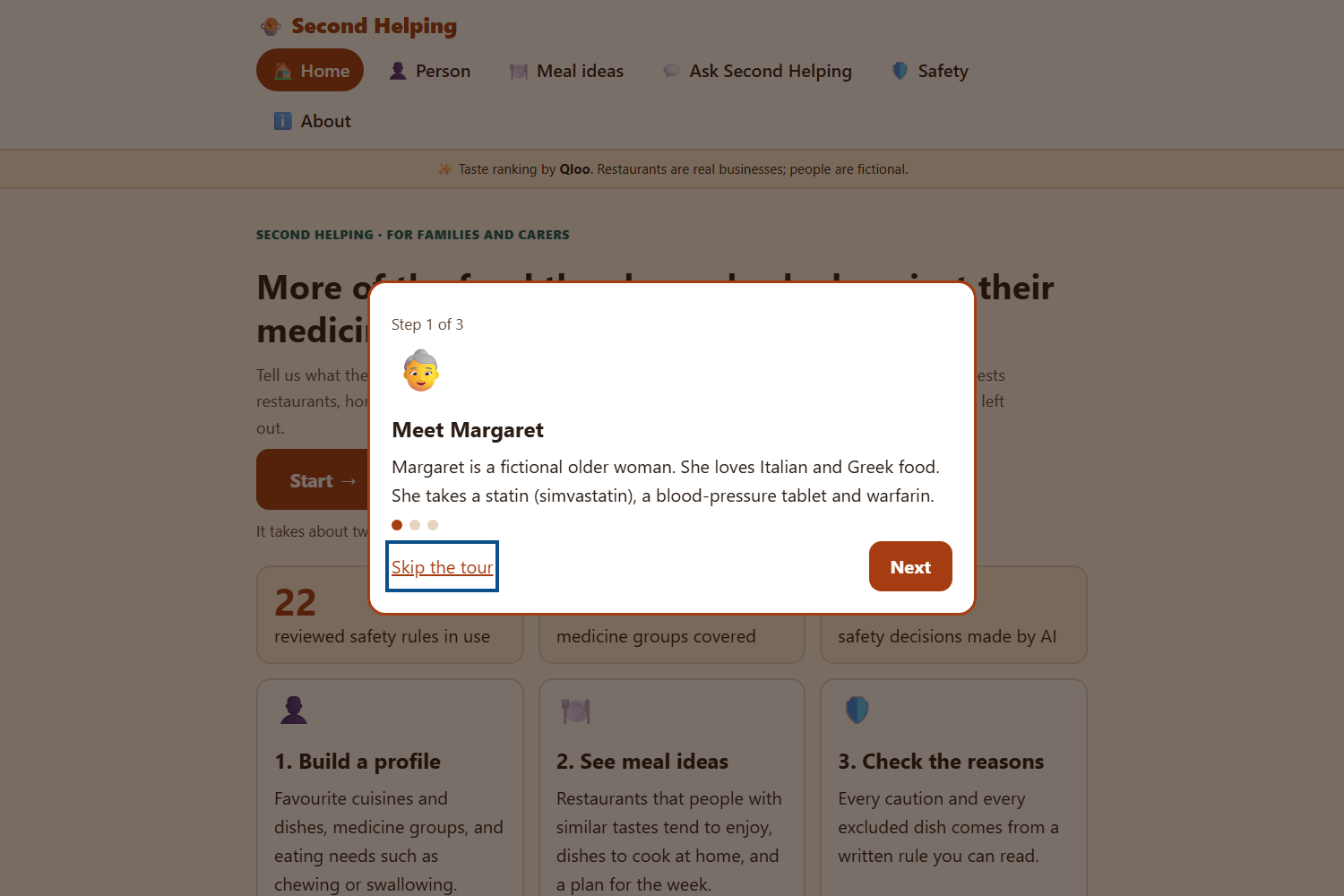
The tour meets Margaret, a fictional woman who loves Italian and Greek food and takes simvastatin, ramipril and warfarin.
-
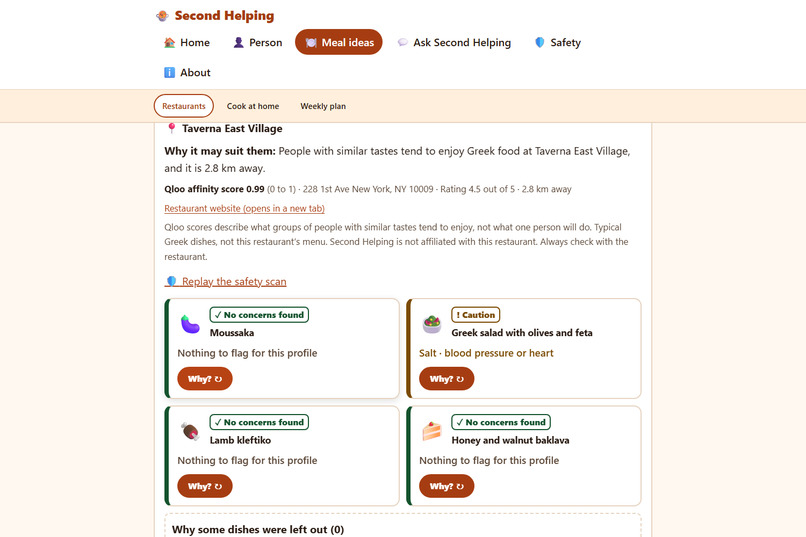
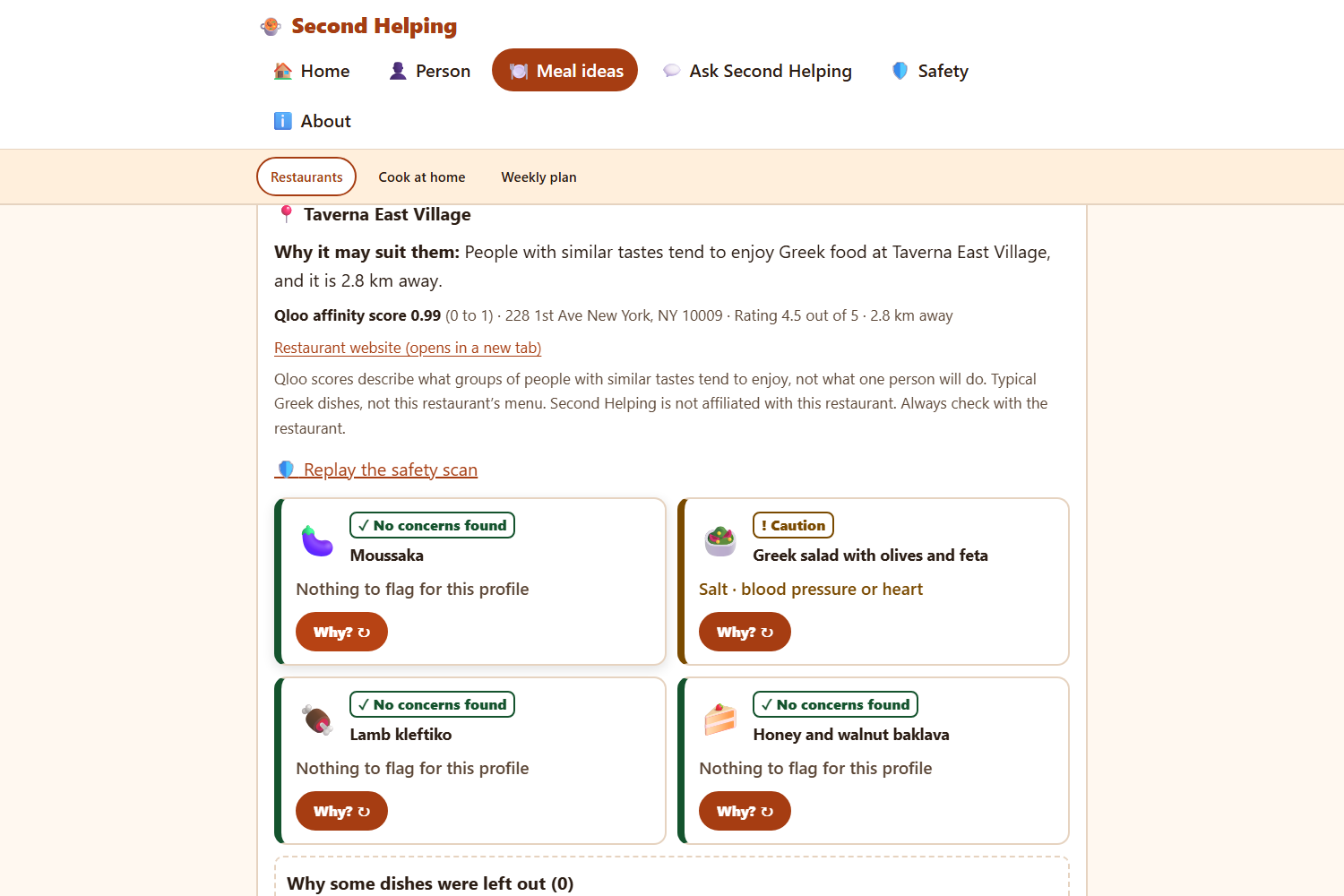
Real New York restaurants from Qloo, based on what people with similar tastes enjoy. Each dish is stamped: OK, caution or left out.
-
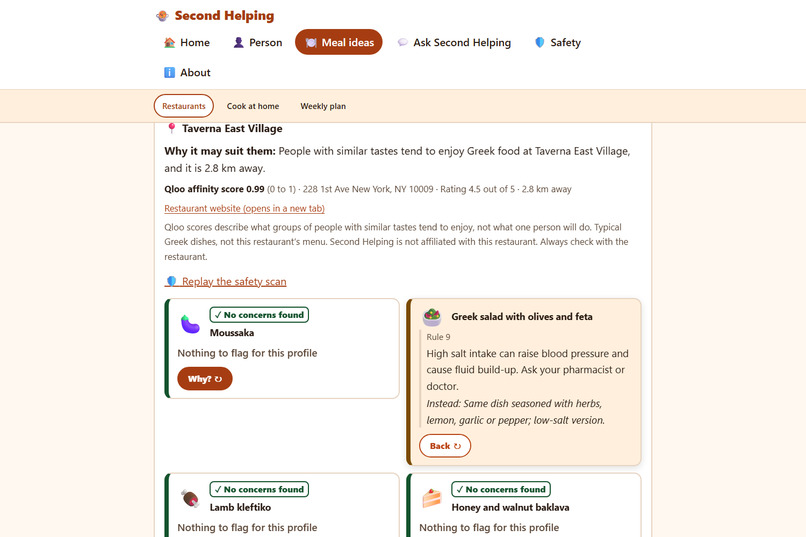
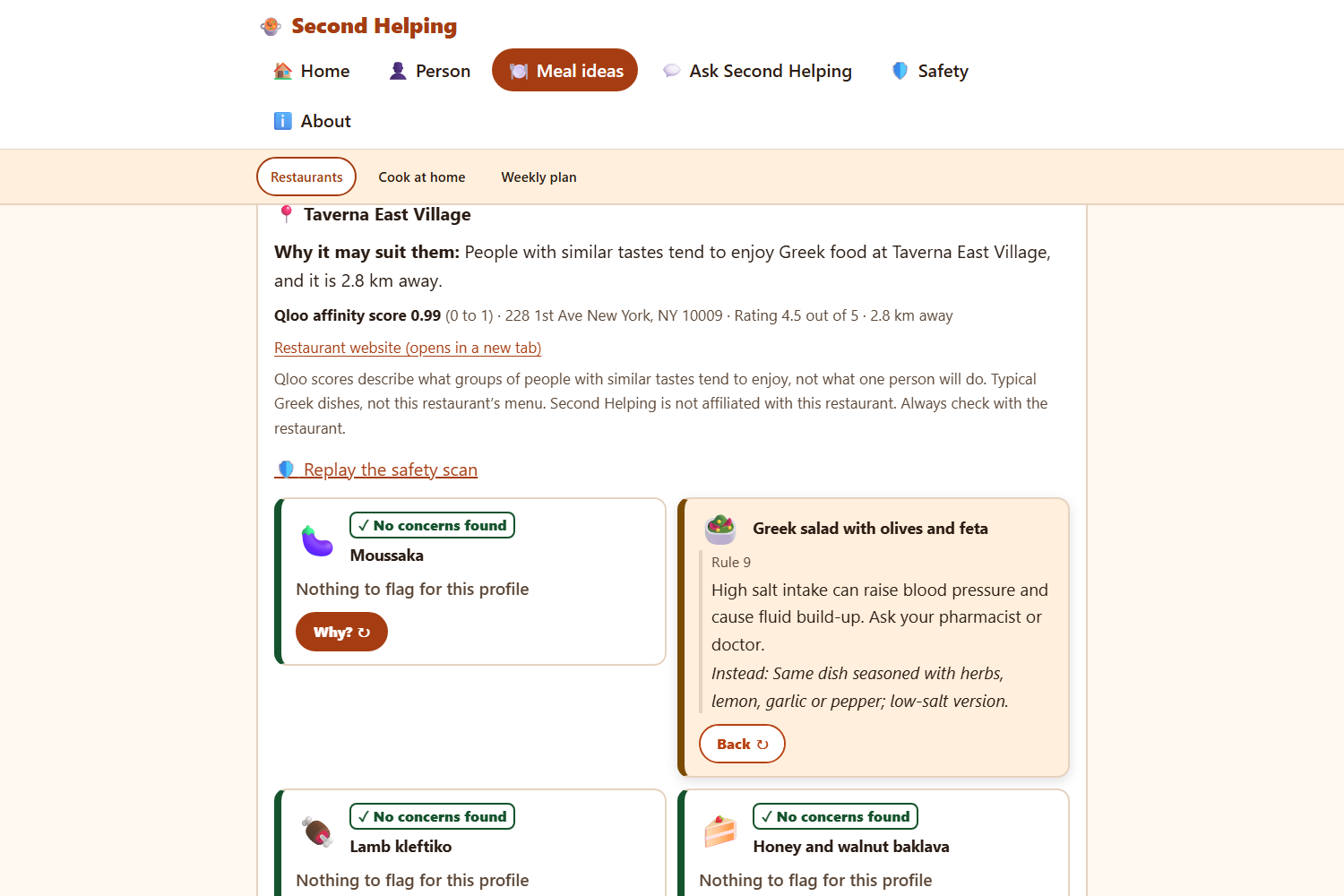
Flip a dish card to read the reviewed rule behind it, with a practical swap: here, salt and high blood pressure.
-
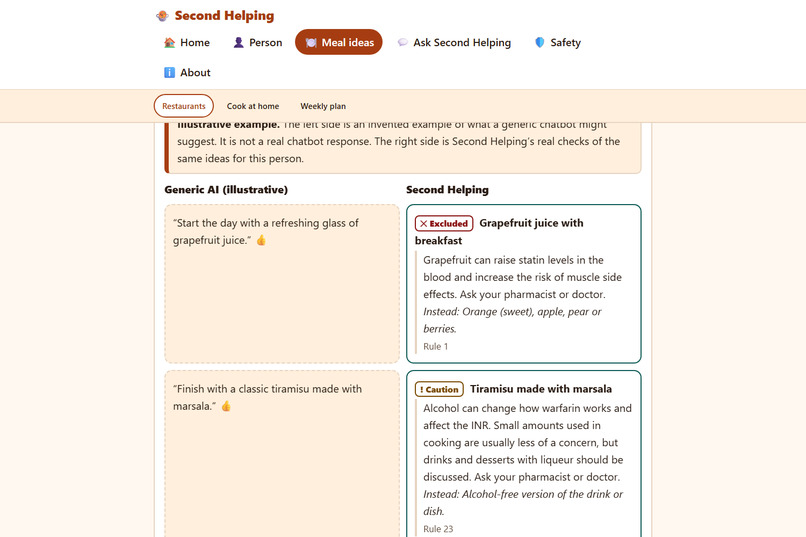
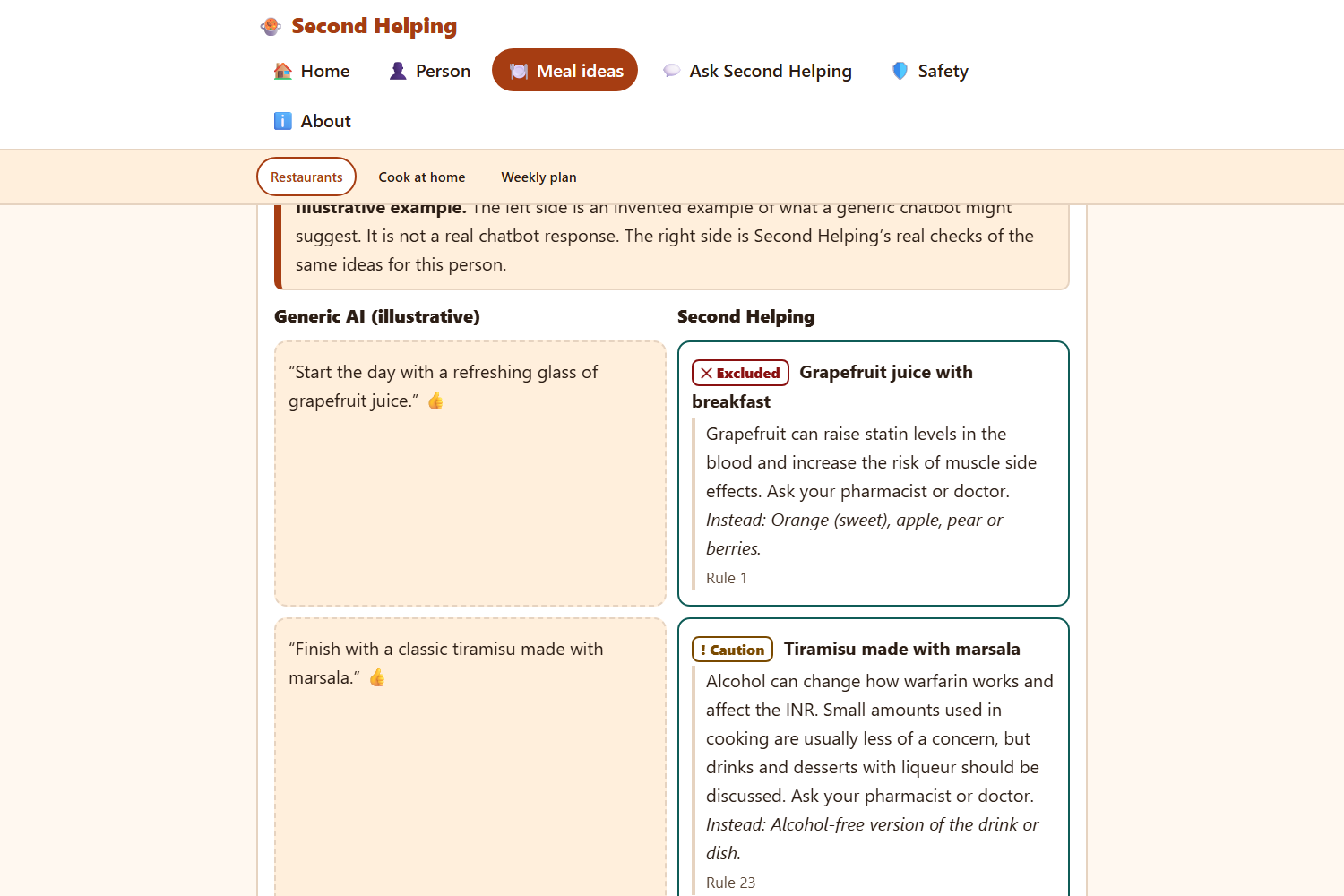
Generic AI vs Second Helping: grapefruit juice is excluded for a statin user; tiramisu with marsala gets a warfarin caution.
-
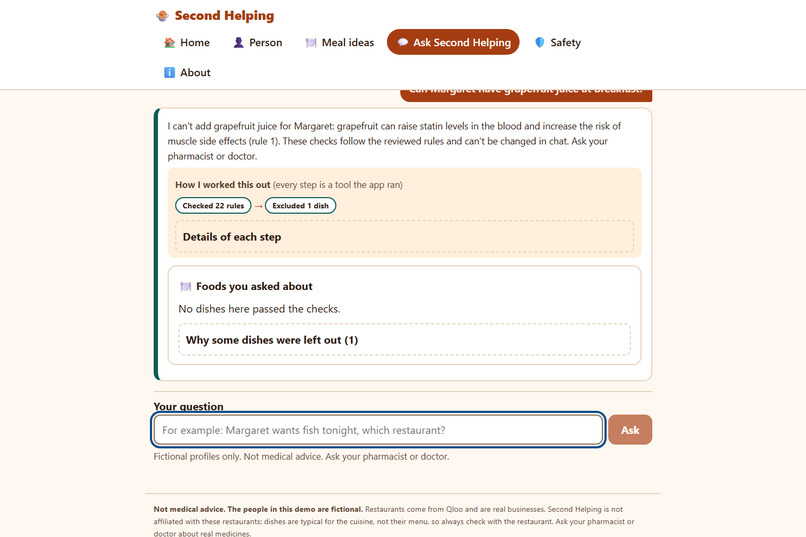
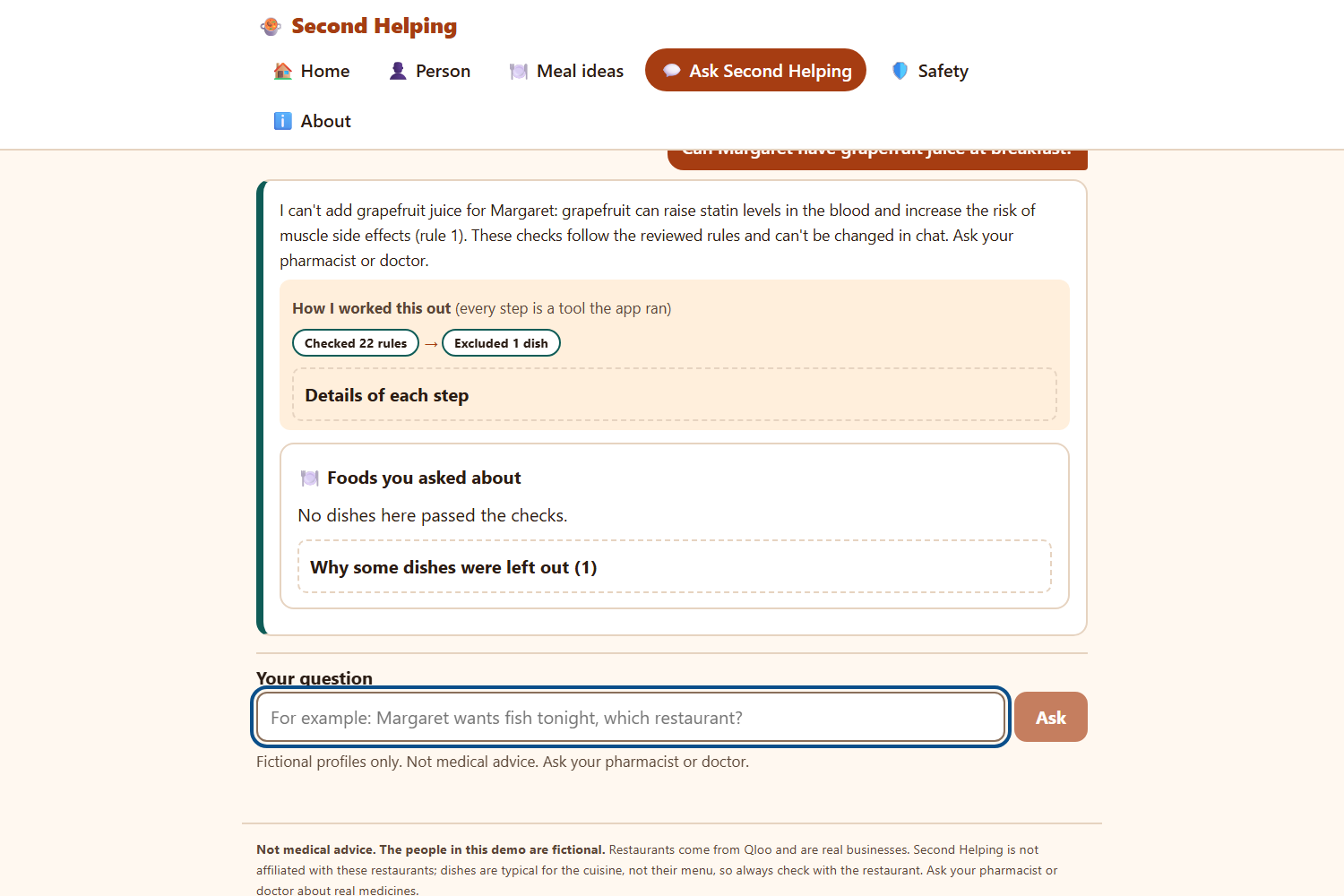
Ask Second Helping: the agent shows every step and refuses grapefruit juice, because the rules can't be changed in chat.
-
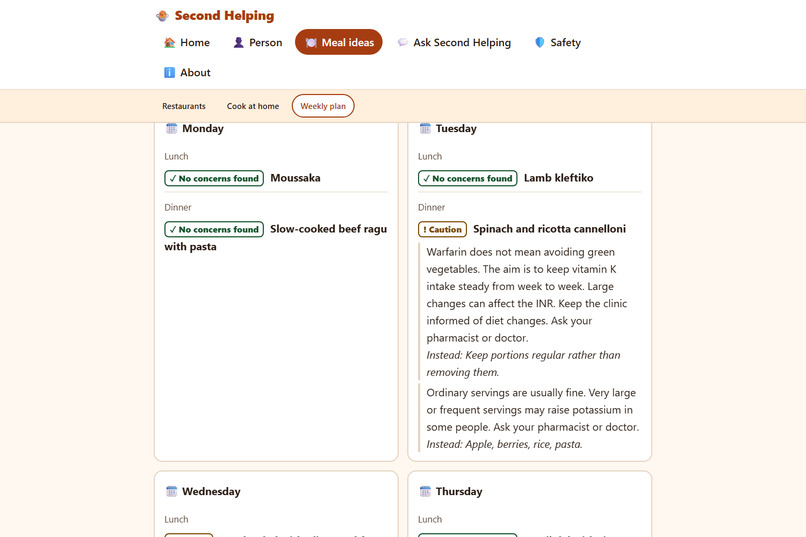
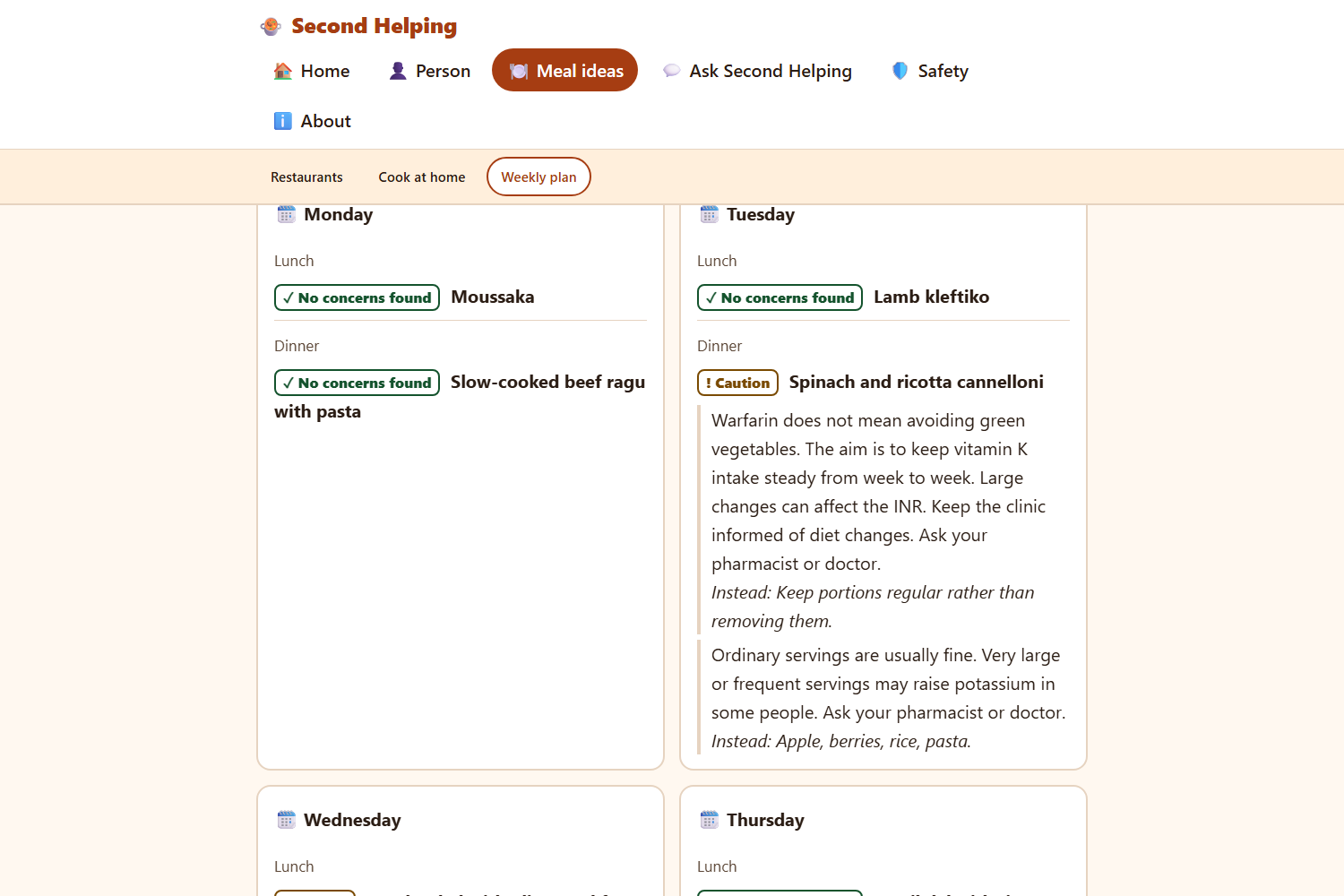
A weekly plan of lunches and dinners, each checked against the same rules, with clear explanations.
-
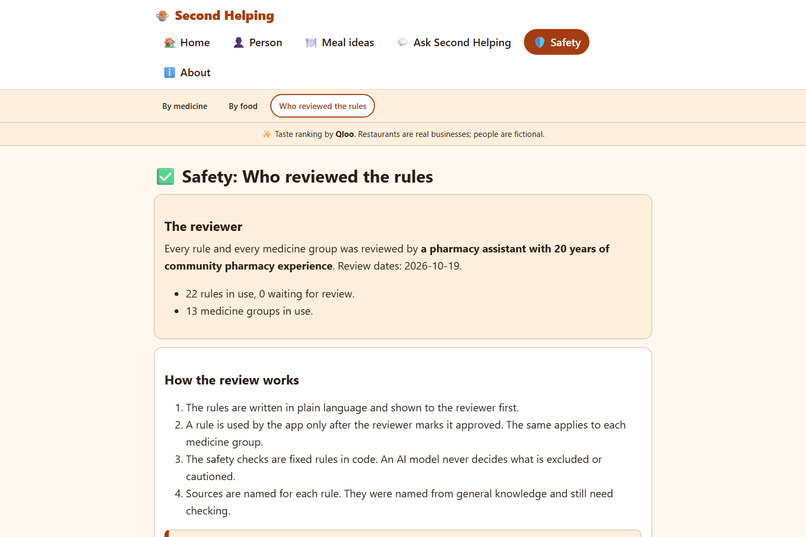
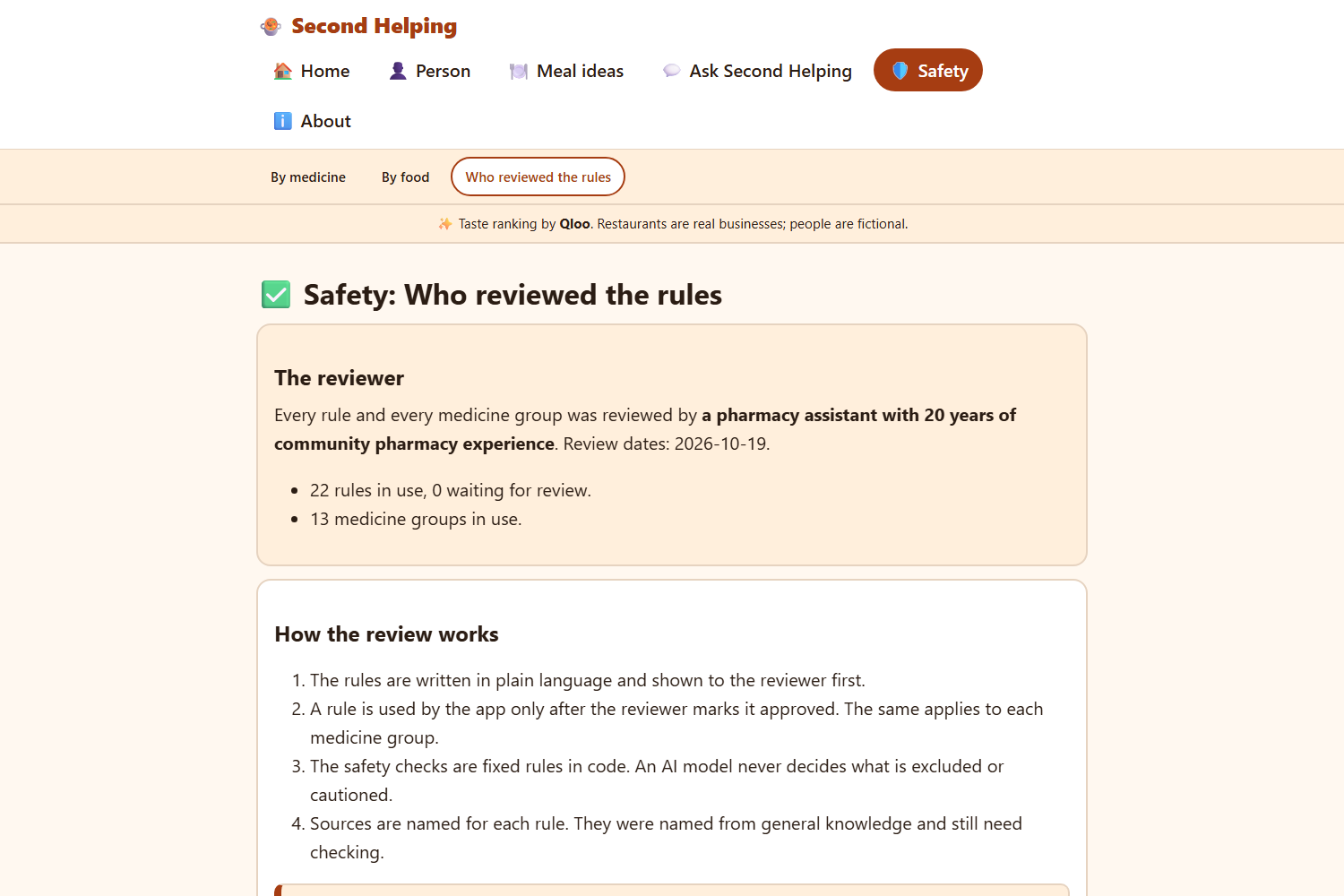
Every rule and medicine group was reviewed by a pharmacy assistant with 20 years of community pharmacy experience.
Inspiration
I worked for about 20 years behind the counter of community pharmacies in Bucharest. Some of the most common questions never made it into a leaflet: adult children buying medicine for an elderly parent and asking, "Can she still have grapefruit in the morning?" or "Is spinach dangerous with his blood thinner?" Diet advice for older people on several medicines is usually a list of "don'ts". I wanted the opposite: help families find food their parent will genuinely enjoy, and quietly check it against their medicines. That is why it is called Second Helping.
What it does
- Real taste, real places. Qloo's Taste AI turns a person's favourite cuisines and dishes into real restaurants nearby (New York by default, plus London, Chicago, Los Angeles, Toronto and Bucharest), with Qloo affinity scores, ratings and distance.
- Safety scan. Every typical dish is checked against 22 food-medicine and texture rules covering 13 medicine groups, all reviewed by me. A shield stamps each dish: no concerns, caution, or left out. Flip any card to read the rule behind it (e.g. grapefruit with some statins, vitamin K with warfarin, alcohol, salt with high blood pressure, potassium with ACE inhibitors, dairy with certain antibiotics, easy-to-chew textures).
- Ask Second Helping. A carer can ask "Margaret wants fish tonight, which restaurant?" The agent uses tools step by step (taste profile, Qloo search, safety check, weekly plan) and shows each step, so you can see how it reached the answer.
- Compare with a generic AI. Shows what a generic chatbot might suggest next to what Second Helping recommends, and why.
- Cook at home and a weekly plan, checked by the same rules.
- Built for older users and carers: large text, high contrast, works on phones, and all animations respect "reduce motion".
How we built it
- Qloo Taste AI (hackathon server, /v2/insights) for cuisines and real places. Each favourite cuisine is queried so one cuisine does not crowd out the others; results are cached for an hour.
- Gemini (free tier) as the agent that chooses tools and writes friendly explanations.
- A deterministic safety engine: the rules live in a reviewed file, and the model may only choose and explain. It can never override, soften or invent a safety result. The home page says it plainly: 0 safety decisions made by AI.
- Next.js on Vercel, 109 automated tests, including one where a user tries to talk the agent into allowing grapefruit with simvastatin (it refuses and cites the rule).
- Keys stay in environment variables; no real person's data is stored. If Qloo is slow or unavailable, the app falls back to clearly labelled simulated places instead of failing.
- I built it with Claude Code as my AI coding assistant. The idea, the safety rules, the review and every decision are mine.
Challenges we ran into
- Qloo affinities for a person's top picks were very close (around 98-99%), so I rank places relative to each other rather than by the raw number.
- The first shortlist returned only Greek places for someone who also loves Italian food; querying each favourite cuisine in turn fixed it.
- Keeping the AI's wording honest: a guard drops sentences that sound like a medical clearance or name a place the app is not showing.
- Response times vary, so the app caches results and keeps working when the API is busy.
Accomplishments that we're proud of
- An agent that is genuinely useful and still cannot be talked out of a pharmacy-reviewed rule.
- Real restaurants from Qloo combined with a transparent, readable safety layer.
- A warm interface that older people and carers can actually use.
What we learned
- Taste data is what turns a "safe" diet into food someone will actually eat.
- Separating "the model explains" from "the rules decide" makes an AI tool easier to trust and to audit.
What's next for Second Helping
- Review of the rules by more pharmacists and dietitians, and more languages.
- Real menus from restaurant partners instead of typical dishes.
- Sharing a weekly plan with the whole family and printing a "fridge card".
Known limitations
- Qloo results describe what groups of people with similar tastes tend to enjoy, not what one person will do.
- Dishes are typical for each cuisine, not real restaurant menus.
- The safety rules were reviewed by one pharmacy assistant; their sources still need independent checking by pharmacists and dietitians.
- Gemini runs on a free tier; when it is busy, the app uses plain template wording, with the same safety results.
A redacted example of a Qloo request and result: https://github.com/iancuileana83-lab/second-helping/blob/main/docs/QLOO-REQUEST-TO-RESULT.md Setup from a clean environment: see the README.
People in the demo are fictional. Restaurants are real, from Qloo; Second Helping is not affiliated with them, and dishes are typical for the cuisine, not their menus. Not medical advice: always ask your pharmacist or doctor.
Built With
- claude-code
- gemini
- next.js
- qloo
- typescript
- vercel
- vercel-ai-sdk

Log in or sign up for Devpost to join the conversation.