-
-
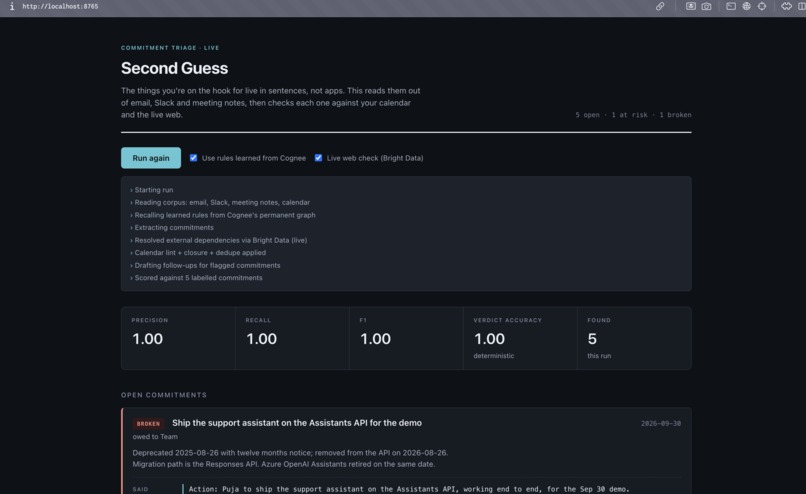
The result
-
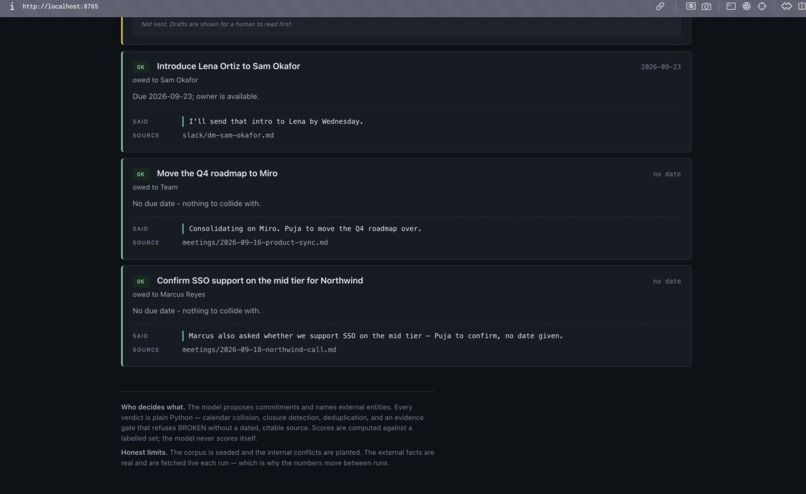
continuation of the result page
-
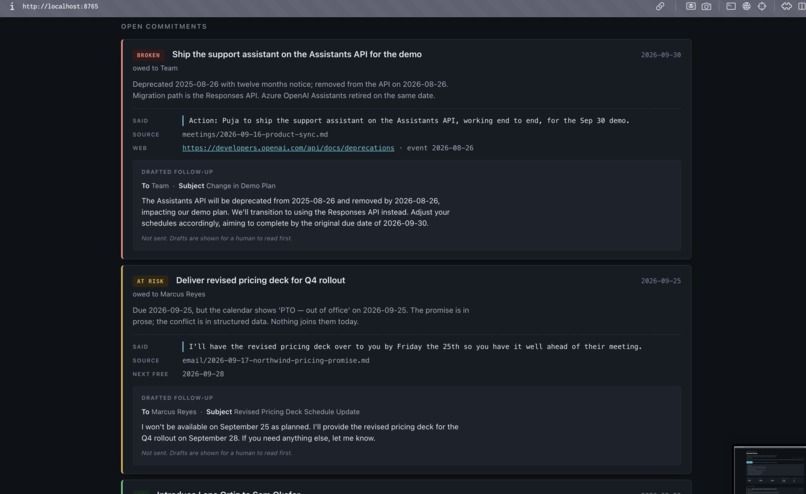
continuation of the result page
Inspiration
Every "personal brain" demo answers questions. None of them notice when the answer is wrong.
The things you're actually on the hook for don't live in any app, they live in sentences. "I'll have the pricing deck to you by Friday" is an email body. It is not a task, not a calendar event, not a ticket. No system owns it, so nothing tracks it, nothing reminds you, and nothing notices when you can't keep it.
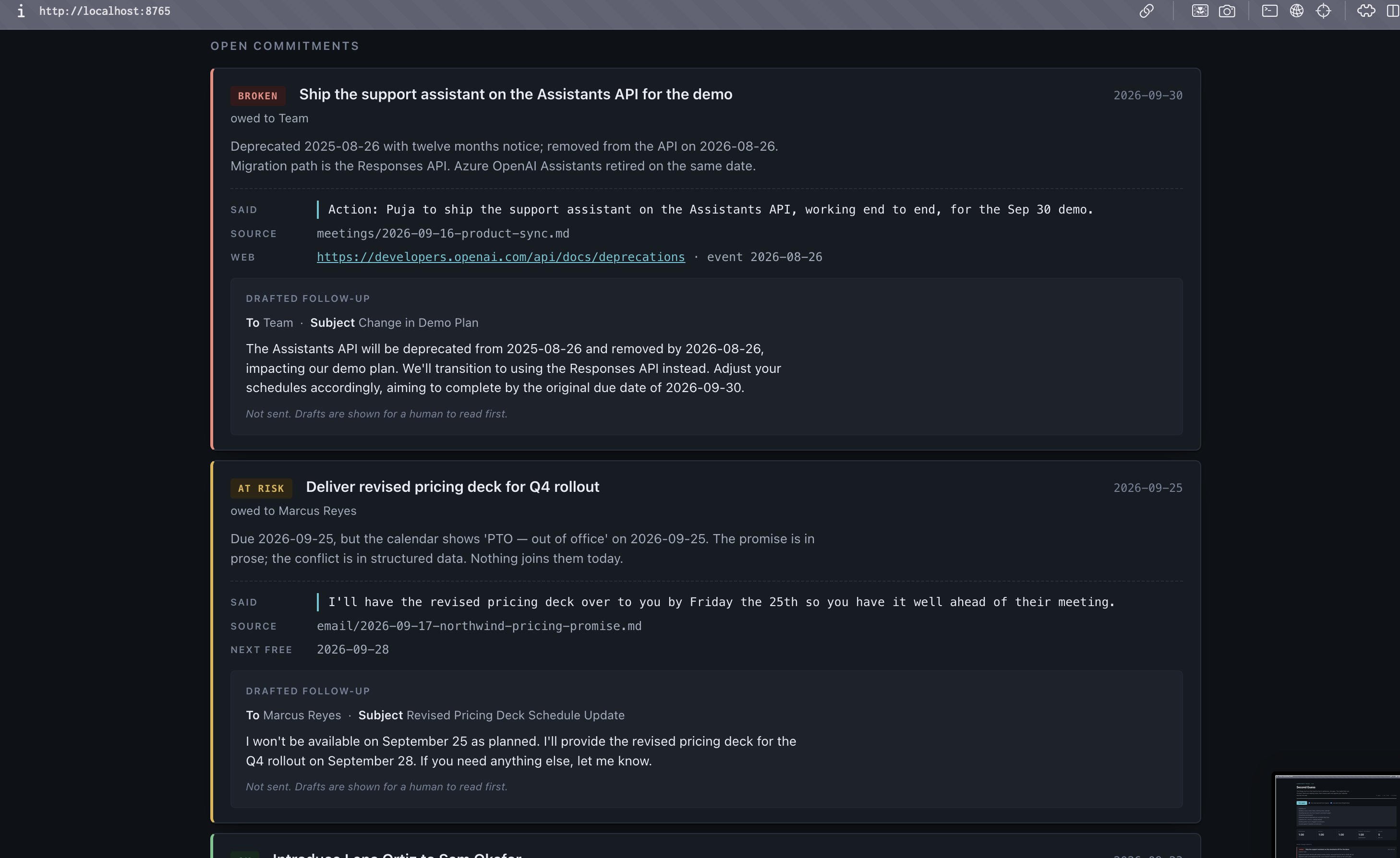
Two ways that goes wrong. Either you can't keep it, you promised Friday in prose and your calendar says you're on PTO Friday, and nothing joins those two facts because one is prose and one is structured. Or the world moved, you committed to building on an API that got sunset, and your notes are perfectly self-consistent and completely dead.
Either way you find out when the other person asks.
What it does
Point it at a corpus of email, Slack, meeting notes and a calendar. It:
- Extracts every commitment the owner made in prose, not action items assigned to other people, not hedges, not ones already delivered.
- Lints each one deterministically: does the due date collide with real unavailability? Did a later message in the same thread already close it?
- Resolves every commitment naming a company, product, API or public deadline against the live web, is the thing it depends on still there?
- Drafts the follow-up for anything flagged. Nothing is sent.
- Learns. Corrections are written to a permanent knowledge graph and read back on the next run, so a rule you teach once holds forever.
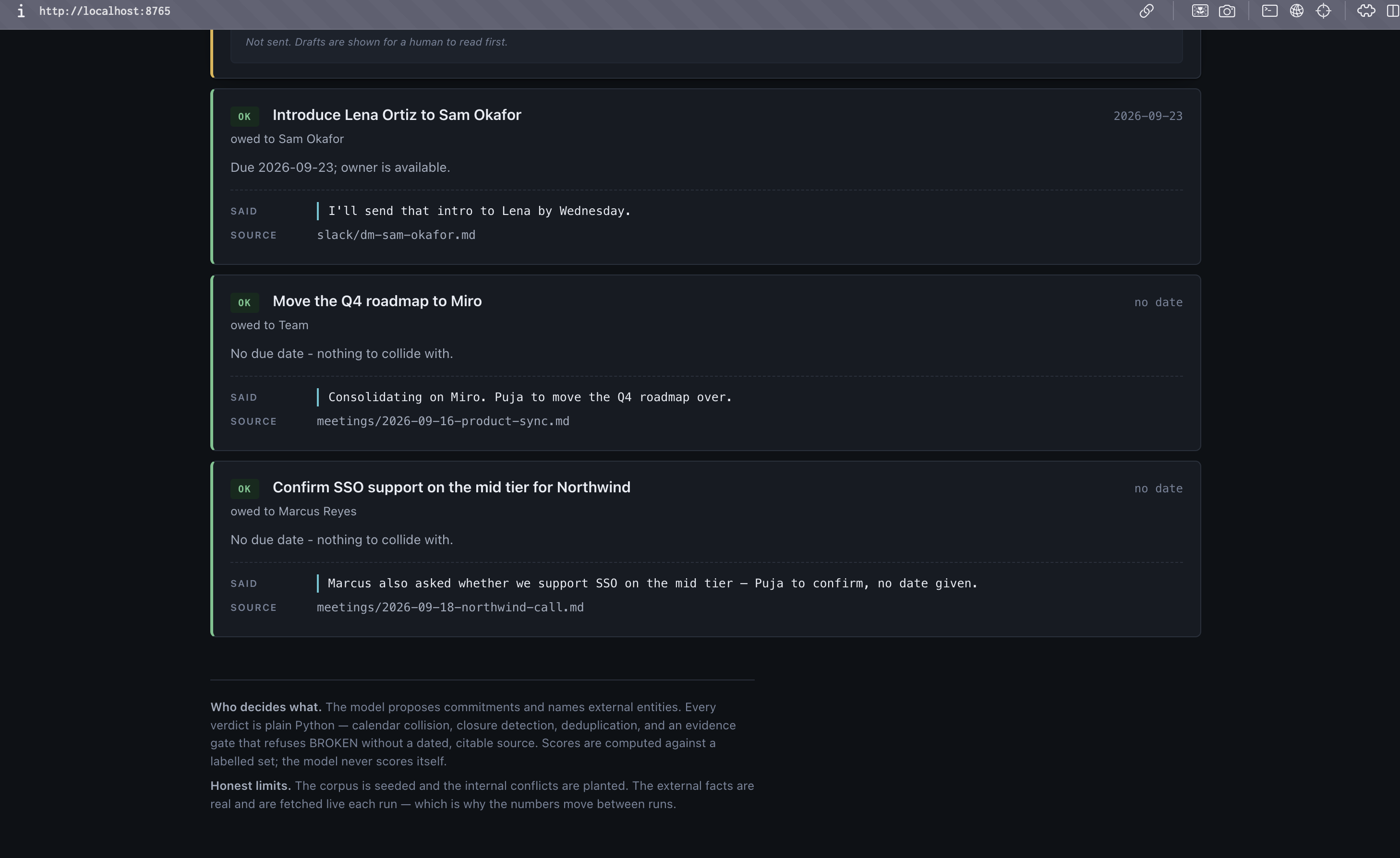
Three verdicts: BROKEN (undeliverable), AT_RISK (collides with your real availability), OK.
The OK case matters as much as the others. Miro is being acquired by Bending Spoons, a real external change the resolver finds and then deliberately ignores, because the product still runs. Changed is not broken. It is not an alarm machine.
The design rule
If a single app owns both sides of a fact, it's not our problem.
Calendars already reconcile calendar conflicts. Jira already tracks ticket state. We only take conflicts where the two sides live in different systems and at least one side is prose. That is the entire reason a knowledge graph is needed here: structured, synced data doesn't need one. Prose does.
How I built it
Cognee holds the permanent knowledge graph. The rules separating a real commitment from a hedge are not hardcoded in a prompt, they're written to the graph when the user corrects the system, and recalled into the next run. Pull Cognee out and the improved run degrades to the baseline. That is the test of whether a dependency is real.
Bright Data resolves external dependencies over MCP. Not one scripted lookup, it sweeps every commitment naming an external entity. It's the only component that can possibly know the Assistants API died, because no internal signal exists.
AWS Strands is the agent harness: extraction, entity naming, resolution and drafting, with the Bright Data MCP server attached as tools.
Docker sandboxes untrusted web content. A scraped page is attacker-controlled text heading into a model prompt, and the concrete attack on this product is a page asserting "the Assistants API was never deprecated", which would flip the headline verdict. Normalization runs in a throwaway container (no network, read-only, all capabilities dropped, nobody user, 256m memory, 64 pids) and a verdict whose source carried injection markers is downgraded in Python. The model gets no vote on whether it was manipulated.
Plain Python decides everything that matters: calendar collision, closure detection, deduplication across sources, an evidence gate that refuses BROKEN without a dated citable source, and the scoring itself. The model proposes; it never writes a verdict and never scores itself.
Challenges I ran into
Every one of these surfaced only by actually running the thing.
CACHE_BACKEND=filesystemkills Cognee on import. The docs sayfilesystem; the code accepts onlyredis|fs|tapes|sqlite|postgresand dies with a pydantic literal error before anything runs.- The local Cognee SDK needs its own LLM key. Going through the Cloud tenant instead runs extraction server-side and removes the dependency entirely.
- Strands streams model output to stdout by default, which silently corrupted every JSON file we redirected.
Agent(callback_handler=None)fixes it. - The same promise appears in a meeting note and the Slack message repeating it, so the model extracts both. Worse than double-counting: one copy resolved
BROKENwhile its twin still readOK. Deterministic dedupe merges on token overlap and keeps the most severe verdict. - The resolver marked a commitment
BROKENbecause it found nothing, absence of evidence read as evidence of absence. A false alarm on a healthy commitment is worse than a miss, soBROKENnow requires a source URL and an event date. - A learned rule in the graph wasn't enough. The model kept re-proposing a W-9 already confirmed received three lines down its own thread. Whether a thread confirms delivery is a fact about the document, not a judgement, so it moved out of the prompt into Python, where it holds every time instead of most of the time.
Accomplishments that we're proud of
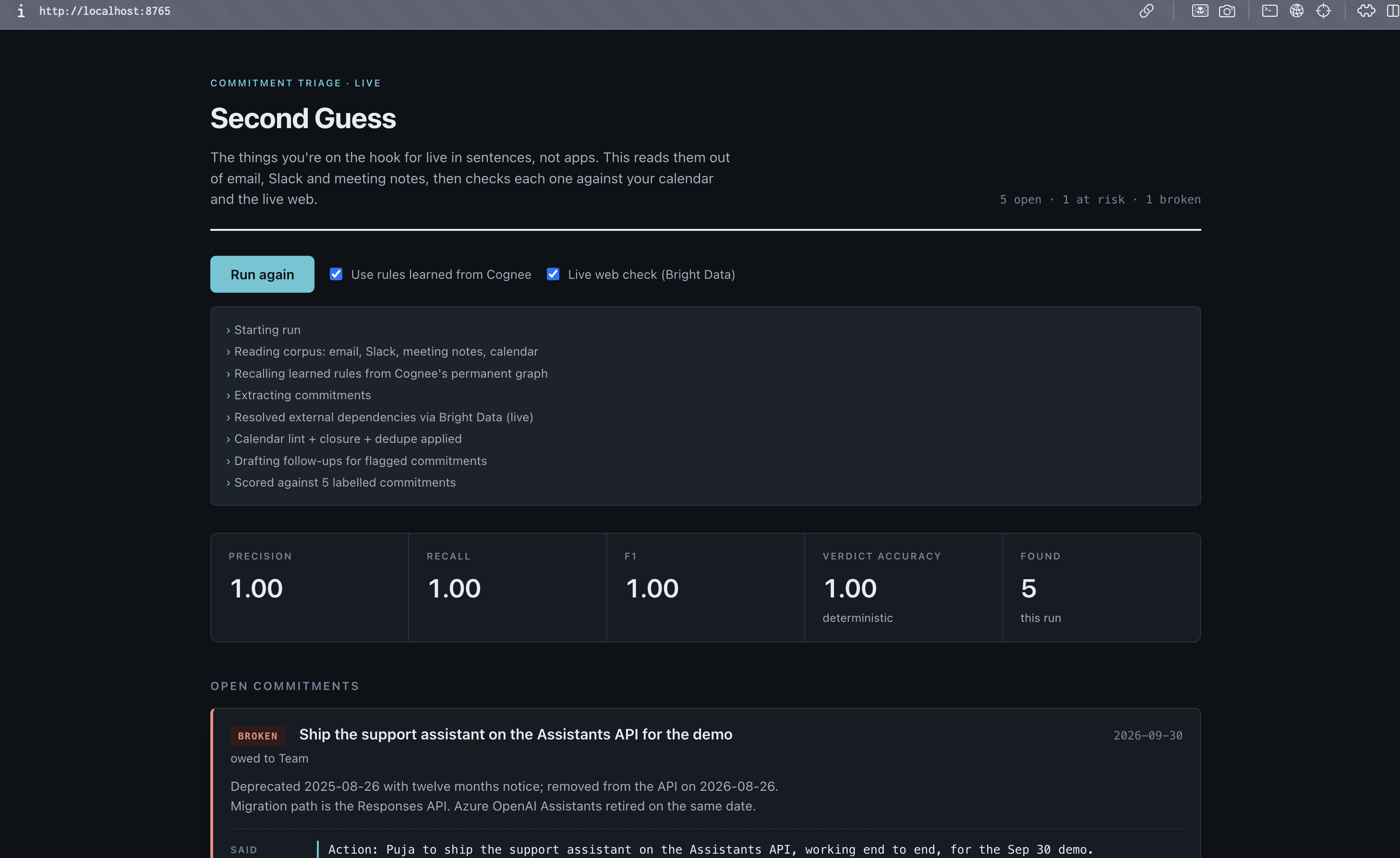
- A measured improvement loop, not an asserted one: F1 0.71 → 1.00 and verdict accuracy 1.00 against a hand-labelled set, computed by a scorer the model never touches.
- A live dashboard. Click Run and the real pipeline executes, extraction, Cognee recall, calendar lint, a live Bright Data search, drafts and the page renders whatever that run produced, including a bad one. No replayed fixtures.
- Every tool is load-bearing. We can name what breaks if you remove each one.
What we learned
Put the judgement in the model and the arithmetic in Python. Every time we moved a decision from a prompt into deterministic code, it got more reliable and more explainable at once and it became something we could measure rather than something we could only claim.
A corollary we didn't expect: a rule living in a knowledge graph is not the same as a rule being applied. Retrieval is not enforcement.
What's next for Second Guess
- Real inboxes instead of a seeded corpus.
- Session-to-permanent distillation, right now only the permanent graph is written.
- Crisper retrieval: the graph currently returns a synthesized blend rather than the exact corrections taught to it.
Honest limits
The corpus is seeded and the internal conflicts are planted. The external facts are real and fetched live at run time, the OpenAI Assistants API sunset of 2026-08-26 and the Bending Spoons acquisition of Miro both actually happened, which is also why the numbers move slightly between runs. F1 of 1.00 is five labelled commitments against ten decoys, not a benchmark.
Built With
- aws-strands-agents
- bright-data
- cognee
- docker
- html5
- javascript
- knowledge-graphs
- mcp
- openai
- python

Log in or sign up for Devpost to join the conversation.