-
-
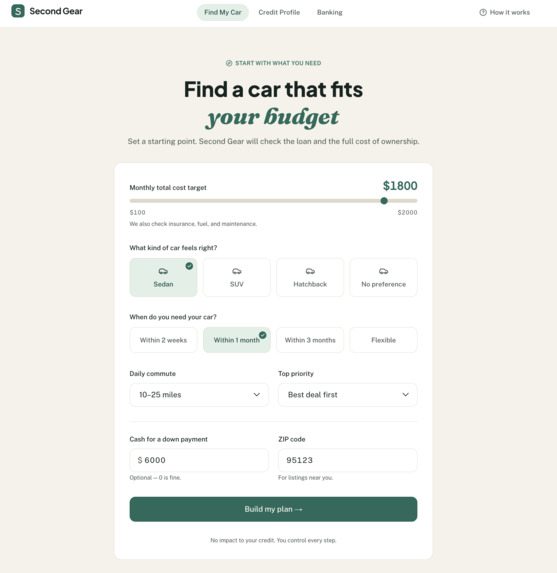
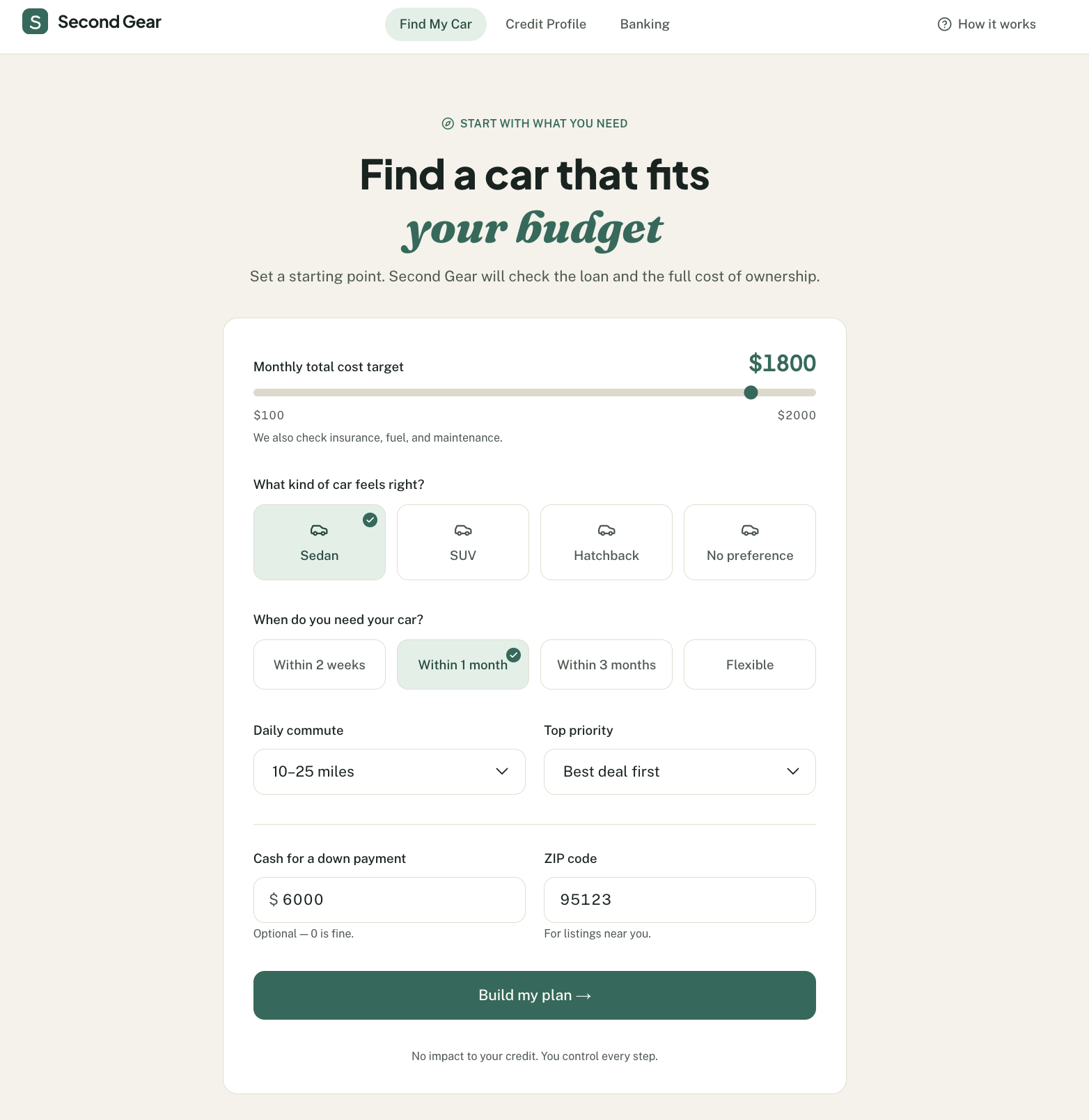
Set your budget, car preferences, & down payment. Second Gear builds a personalized car-buying plan based on your needs and ownership costs.
-
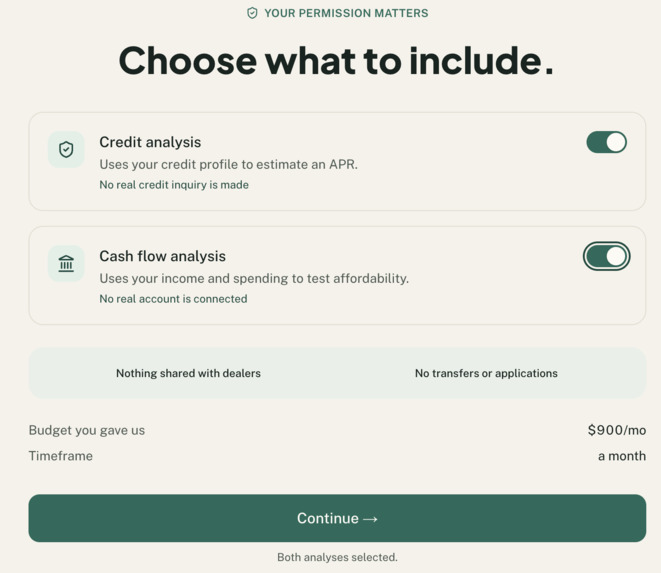
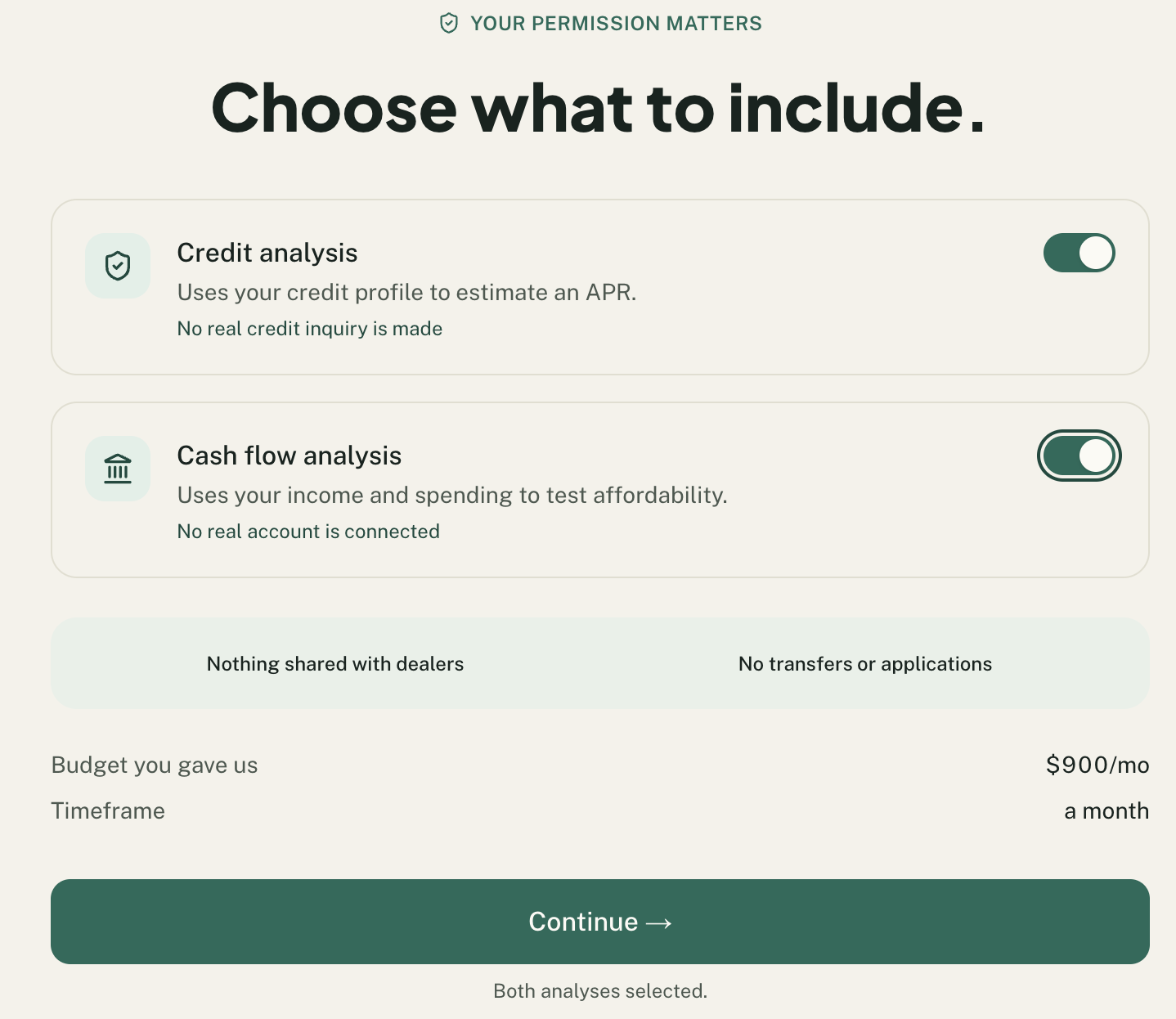
Second Gear uses simulated credit and cash flow data to estimate APR and affordability, with no real credit checks or bank connections.
-
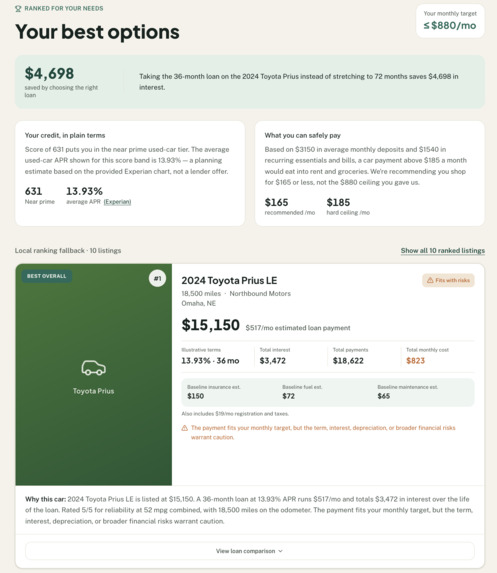
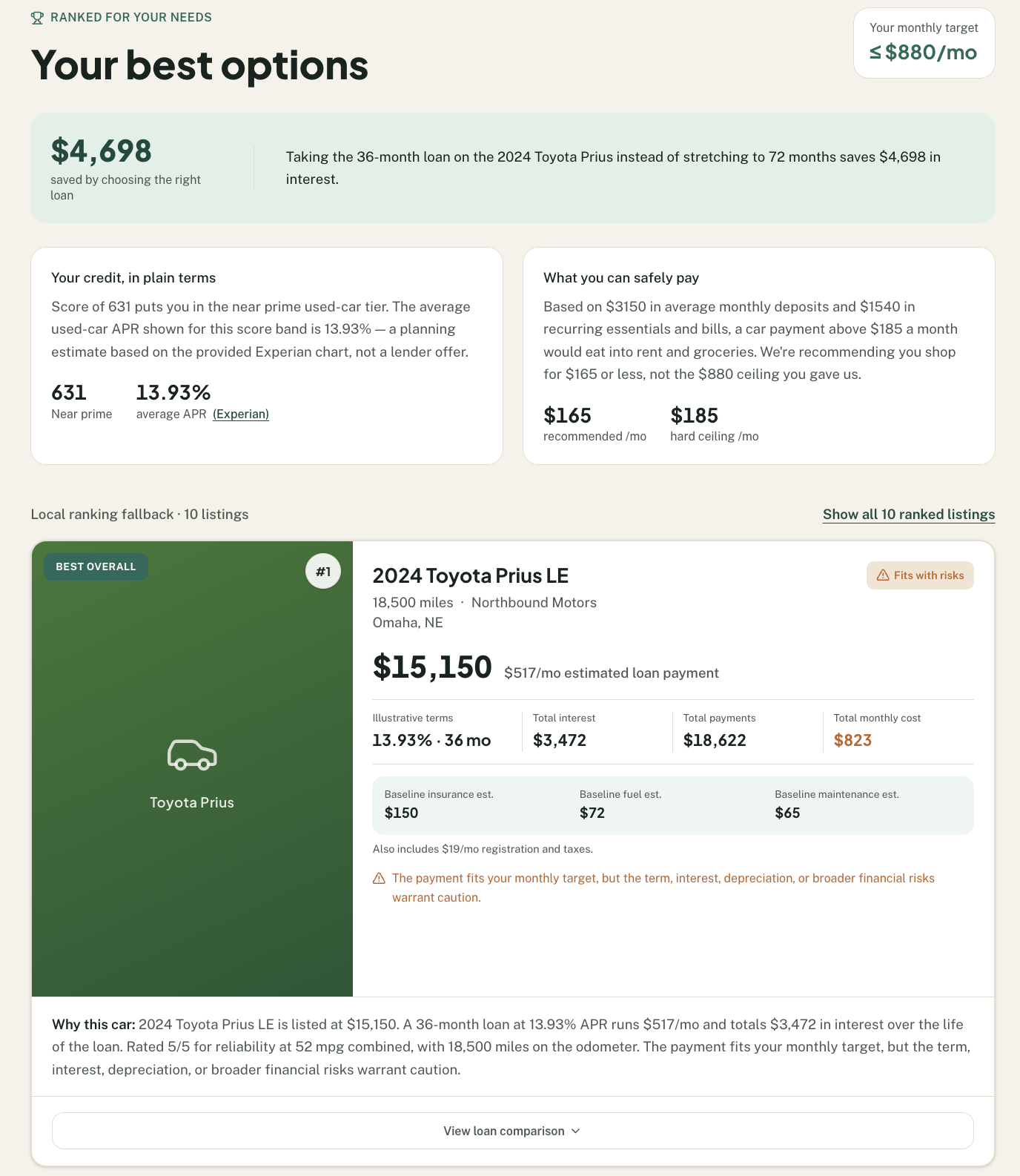
Ranks cars using your credit, cash flow, and preferences, showing true ownership costs, loan savings, and financial risks before you buy.
-
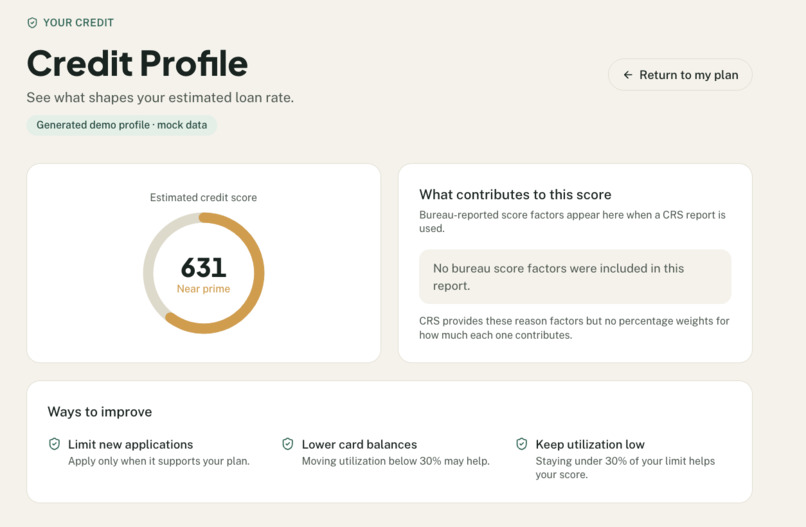
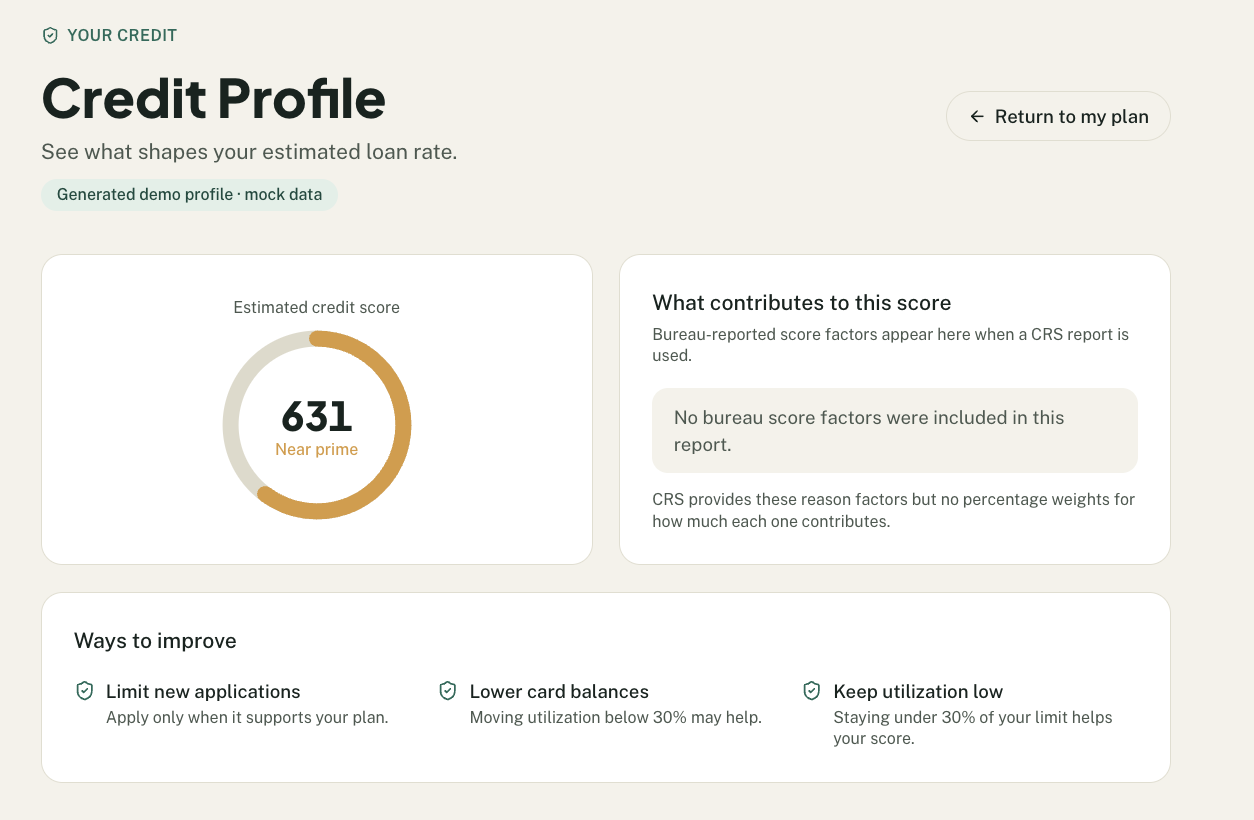
Using CRS Credit API, Second Gear analyzes your credit profile, estimates your loan rate, and provides tips to improve your credit score.
-
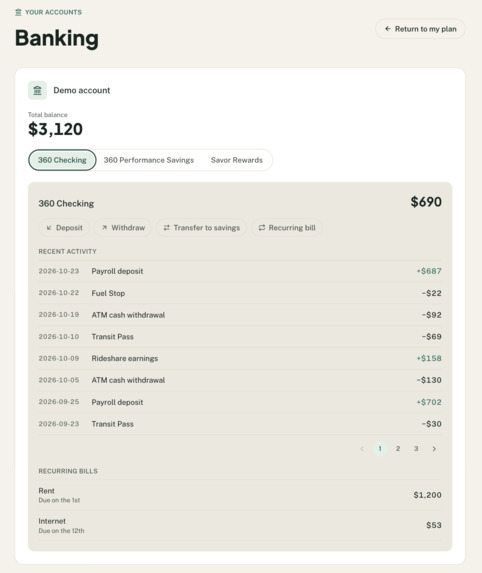
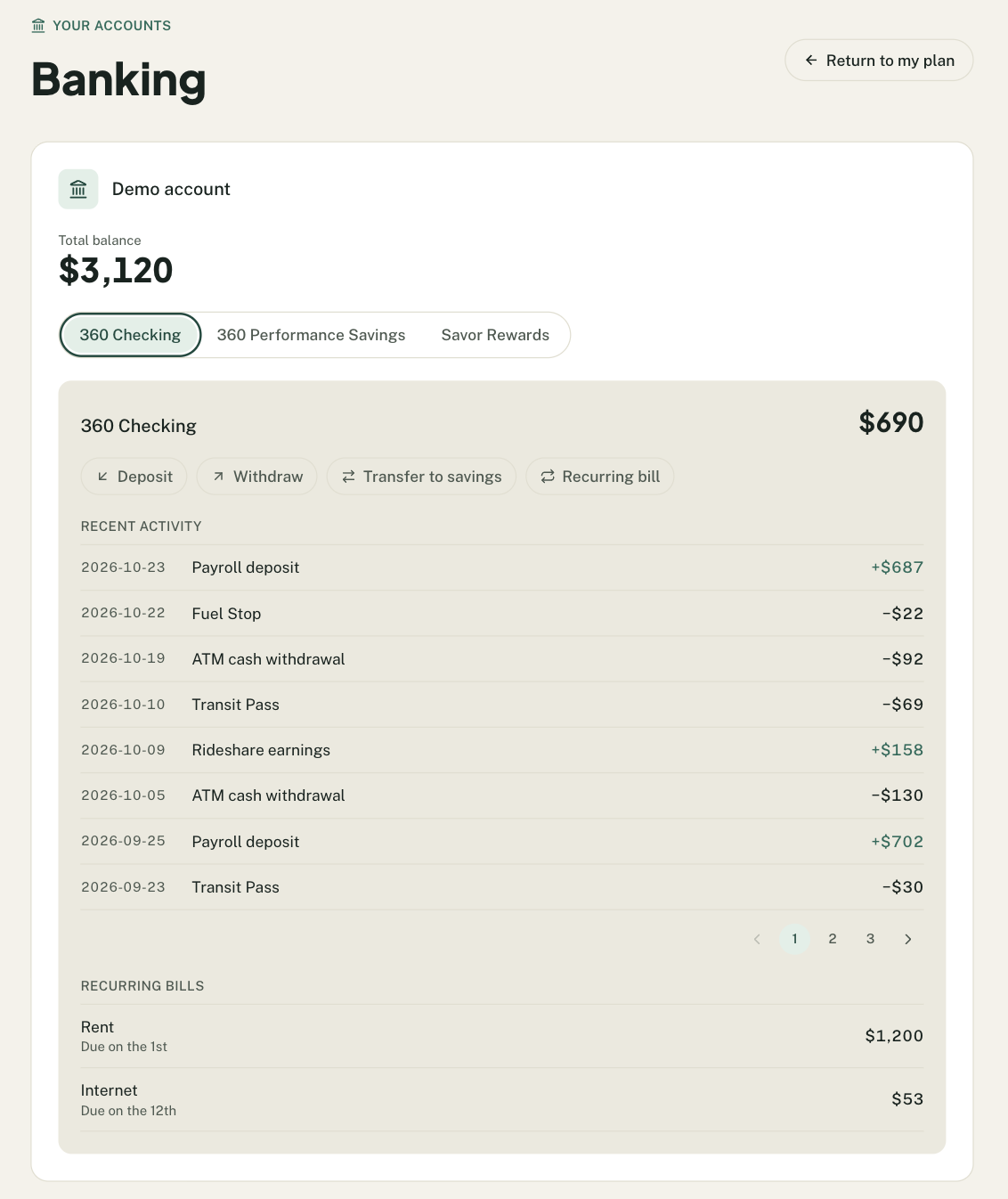
Using Capital One Nessie API to analyze demo bank balances, transactions, income, and recurring bills to estimate car affordability
-
Inspiration
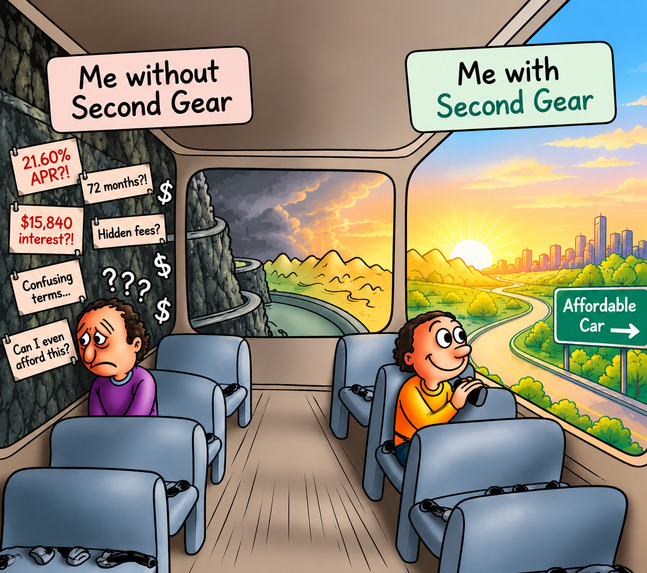
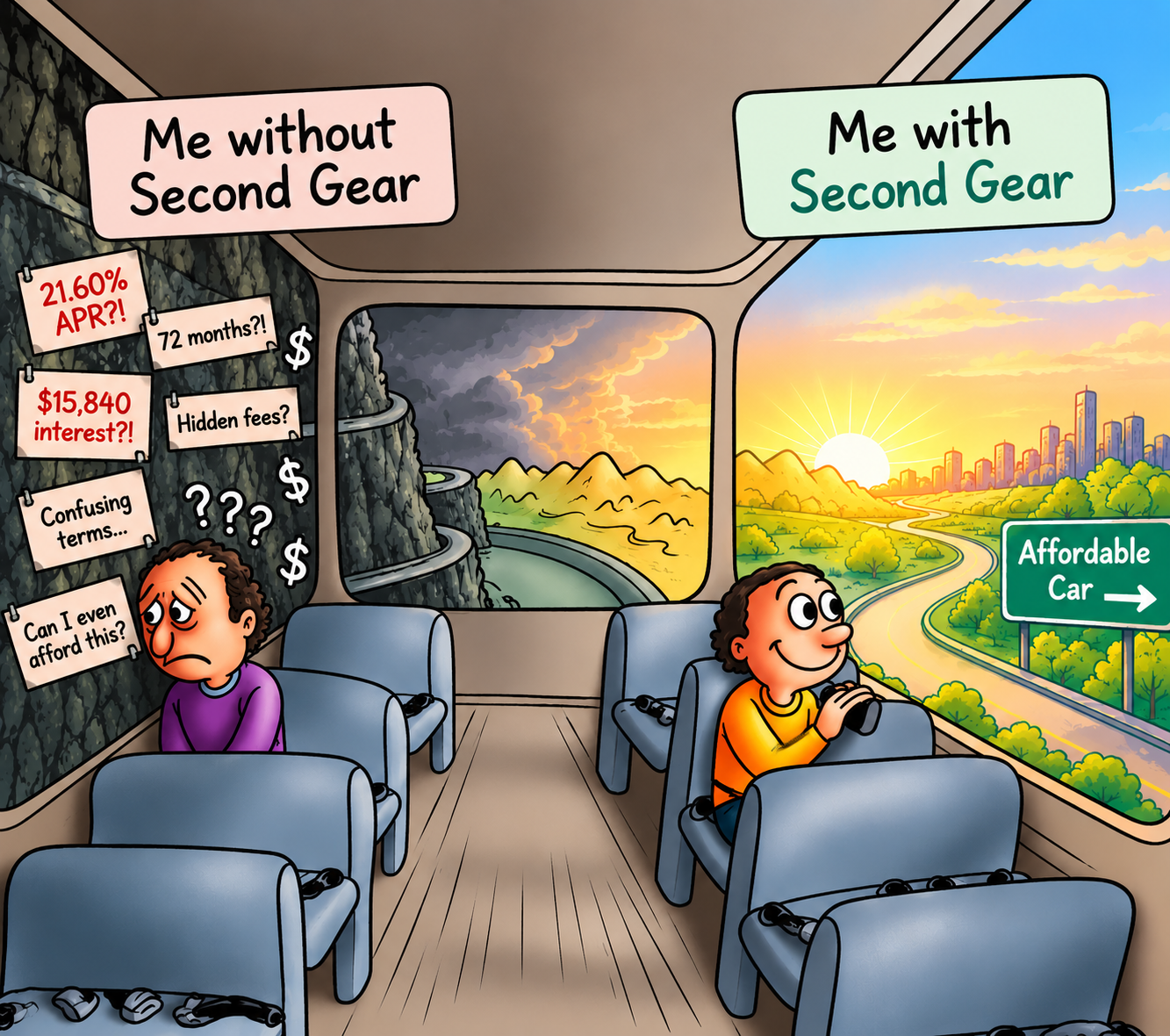
If you have little or bad credit, you pay almost twice as much interest on the exact same car, and record numbers of these buyers are falling behind.
Deep subprime borrowers averaged a 21.6% rate on used cars in Q3 2025, compared with 11.4% across all used-car loans [1,2]. That’s a big group: subprime borrowers made up 15.31% of all vehicle financing and 22.47% of used-vehicle financing in Q4 2025 [3]. And the share of subprime borrowers 60+ days behind on car payments hit 6.9% in January 2026, the highest Fitch has recorded since the early ’90s [4].
The root problem? Most of these buyers walk into a dealership without knowing their credit, what they can actually afford, or what the loan will really cost. The salesperson talks monthly payments, and six years of interest just kind of... disappears into the fine print.
So we built Second Gear: an AI agent on the buyer’s side that checks your credit, figures out what you can truly afford from your bank history, finds live used-car listings that fit, shows the true cost of each option, and tells you honestly whether to buy, wait, or walk away. Because everyone deserves a second chance to get moving again.
What it does
Second Gear is a personal financial and car-shopping copilot for people with little, or bad credit. You tell it what you need, approve a soft credit check, and it does the rest:
- Checks your credit with a soft pull (no hit to your score) and explains it in plain English: what’s helping and what’s hurting.
- Figures out what you can really afford from your actual bank history (income, bills, existing payments), not just the max a lender would approve.
- Searches live used-car listings near you, filtered to cars that is personalized to you.
- Shows the true cost of owning each car, not just the sticker price: loan interest, estimated insurance, gas, and depreciation, plus warnings if you’d end up owing more than the car is worth.
- Gives an honest verdict from a rule-based safety engine: Buy, Reconsider, Wait, or Do not buy. Yes, it’ll tell you not to buy a car if that’s the right call. Dealers and lenders have no reason to say that. We do.
- Hands you a dealer packet with your credit summary, max payment, target cars, and a walk-away price, so you negotiate from knowledge instead of pressure.
How we built it
Second Gear is a Next.js app (TypeScript) where the backend runs a pipeline of steps in order, and each sponsor tool has a clear job:
- Figma: wireframes for the UI and the full user workflow, so we knew every screen and step before writing any code. It made our lives a lot easier.
- CRS Credit API (sandbox): a soft credit pull for the buyer's profile, giving us their credit data and the factors behind their score. This is essential: without real credit data, the agent can't give personalized, realistic numbers.
- Capital One Nessie API: bank accounts, deposits, bills, and existing debts, used to calculate a monthly payment that fits the buyer's real cash flow. Also essential, since buying a car comes down to your income and cash flow. Without it, the agent has no way to know whether you can actually afford a car.
- Apify: live used-car listings, searched by ZIP code, radius, price, and mileage. The search filters are built dynamically from each buyer's preferences and financial limits. Our backend then validates, deduplicates, and filters the results down to cars that actually fit. This is also important because good advice has to point to real cars: without live listings, the agent could only talk about hypothetical cars and made-up prices. With them, every recommendation is a real car, at a real price, near the buyer, that they can go see today.
- Logic: all the math, including affordability, loan amortization, total interest, insurance and gas estimates, and negative equity, plus a rule-based safety engine that gives each car a verdict: Buy, Reconsider, Wait, or Do not buy.
- Bitdeer AI Model Studio: we use the GLM-5.3-Flash model as the main reasoning LLM for the whole project. It explains the credit report in plain English, ranks cars using structured output, and handles the what-if tool calls.
One rule we stuck to hard: the AI never does the math. LLMs make arithmetic mistakes, and a wrong loan number in a credit product is a big deal. We use code to calculate loan payments, interest, and affordability because financial decisions need accurate numbers. AI then takes those results and explains them in a way buyers can easily understand.
We also built in guardrails from the start: consent before any credit check, soft pulls only, no money moves without the user’s approval, every recommendation explained, and no protected characteristics used anywhere. The APRs in the demo are simulated and clearly labeled as estimates, not real rate offers.
Challenges we ran into
- Getting all the APIs to work together. CRS, Nessie, Apify, and Bitdeer each have their own data formats, response times, and quirks, and none of them were built to talk to each other. Every step depends on the one before it: the credit data sets the expected rate, the bank data sets the budget, and both shape the car search. One slow or failed call could break the whole chain, so we normalized everything into our own data format and added fallbacks at each step to keep the pipeline running end to end.
- Deciding when to say no. Figuring out how to confidently tell someone a car isn’t financially safe for them was harder than expected. We landed on a rule-based safety engine in code instead of letting the AI decide, so the logic is consistent and explainable.
- Keeping credit checks secure. A credit-report request is not just another API call. We had to consider explicit consent, token replay, unauthorized access, repeated requests, rate limiting, and potential vendor costs.
Accomplishments that we’re proud of
- An agent that will actually tell someone “don’t buy this” or “wait,” and explain why.
- A real end-to-end flow on live data: credit check → affordability → live listings → true cost → verdict → dealer packet.
- Putting a real number on the problem: about $9,800 saved on one car in our example.
- Designing for trust from day one, not as an afterthought.
- Building a structured recommendation layer where AI explanations are grounded in calculated numbers.
What we learned
- For people with little or bad credit, the loan is where the real money gets lost, not the sticker price.
- “What can I afford?” and “What will a lender approve?” are completely different questions, and most tools only answer the second one.
- Keeping the AI’s job narrow (explaining and ranking, not calculating) made the product way more reliable.
- Working as a team under a tight deadline taught us the importance of clear communication, staying focused on our assigned responsibilities, and managing our time strictly.
What’s next for Second Gear
- Real bank connections through a bank-account aggregation service, instead of mock data.
- Real lender rates, like credit union pre-approvals, instead of simulated APRs.
- A savings plan for the “Wait” verdict: set up a down-payment account and automatic transfers so “not yet” becomes an actual plan.
- Price-drop alerts on cars you’re watching.
Sources
Built With
- apify
- bitdeerai
- claude
- crs
- figma
- nessieapi
- next.js
- typescript


Log in or sign up for Devpost to join the conversation.