-
-
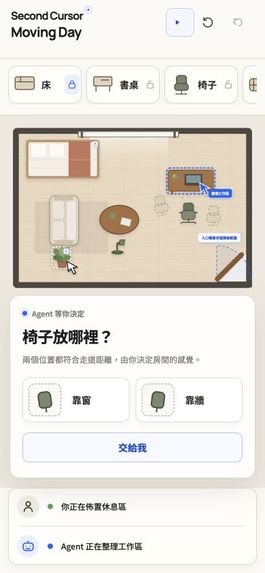
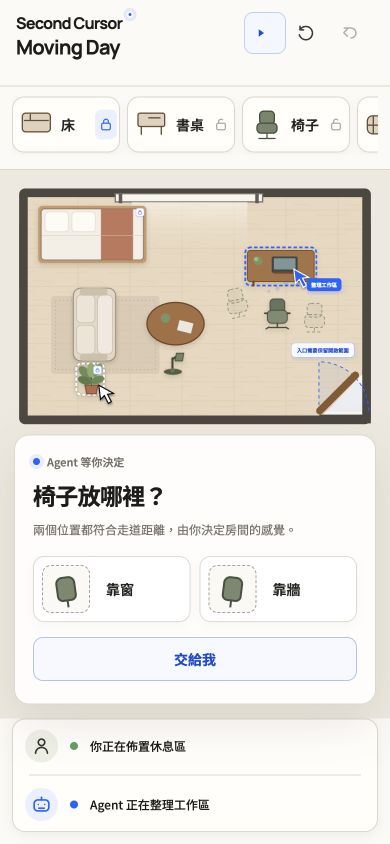
The Second Cursor interaction stays legible on mobile, including Agent status and human decisions.
-
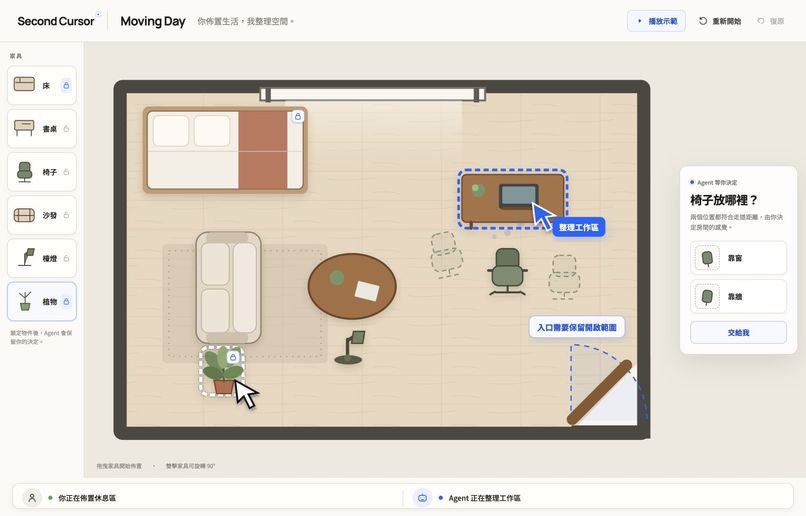
Human and Agent share one live room: visible intent, protected choices, and an explicit handoff.
-
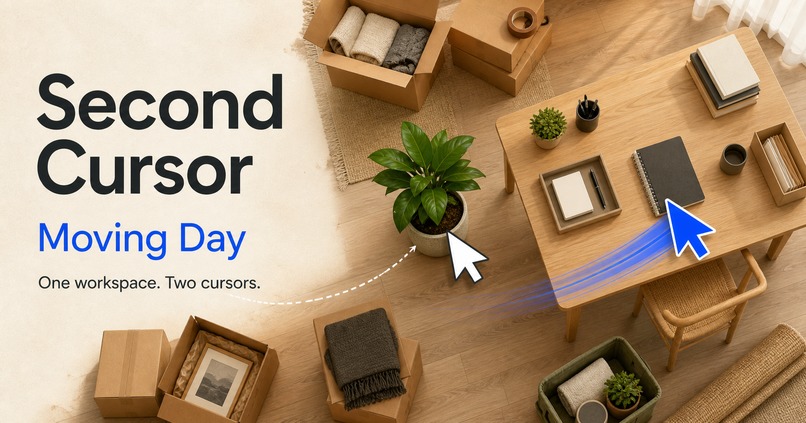
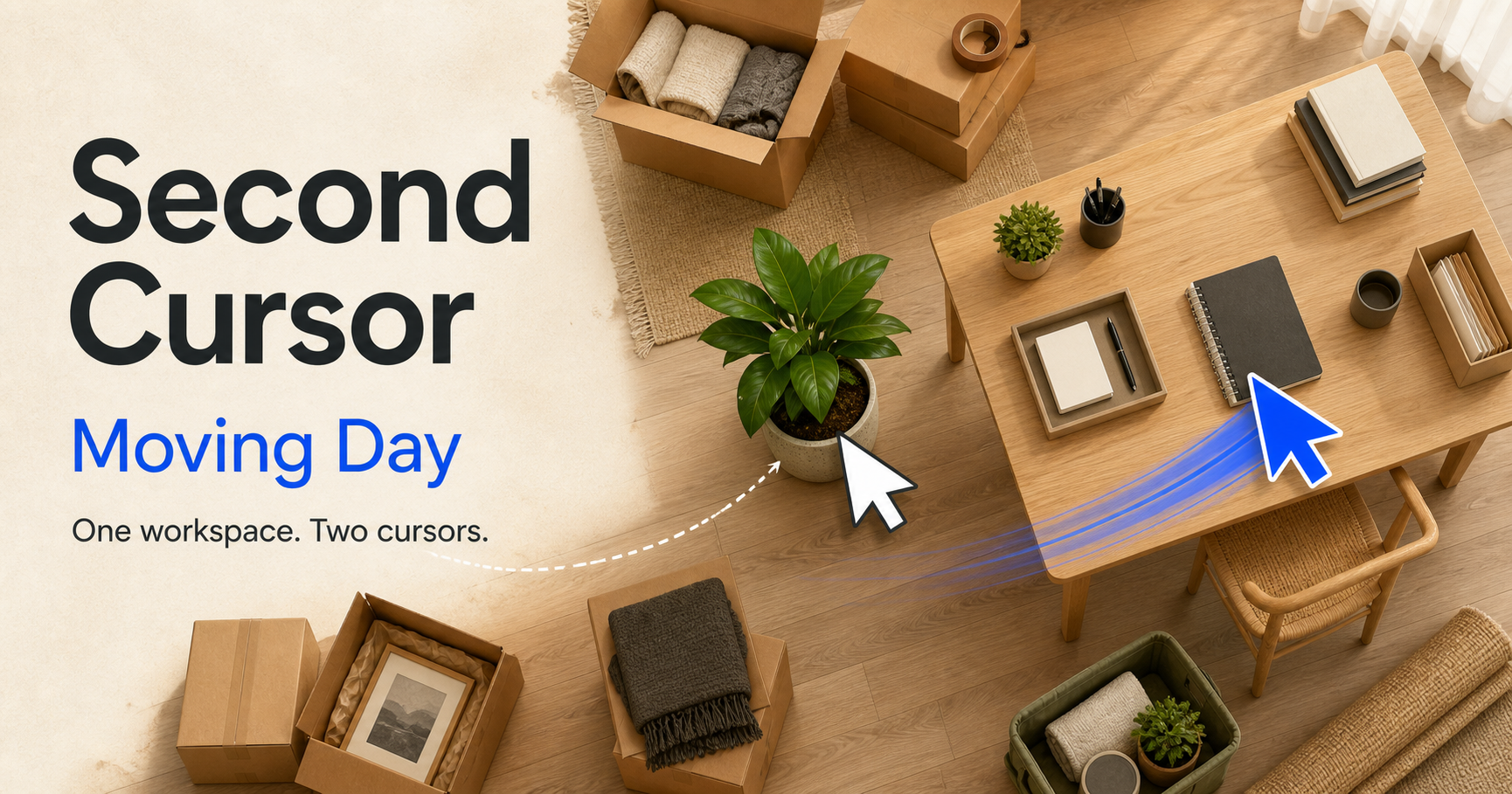
One workspace. Two cursors. A first step toward giving AI a visible hand on the web.
The web was built for one cursor
AI agents change that assumption. They introduce a second actor that can inspect, decide, and operate—but most interfaces still hide that work behind a chat box. We see the request and, later, the result. We do not see what the agent is targeting, what it is allowed to change, why it is waiting, or when control has returned to us.
Second Cursor is a first step toward giving AI a visible hand on the web.
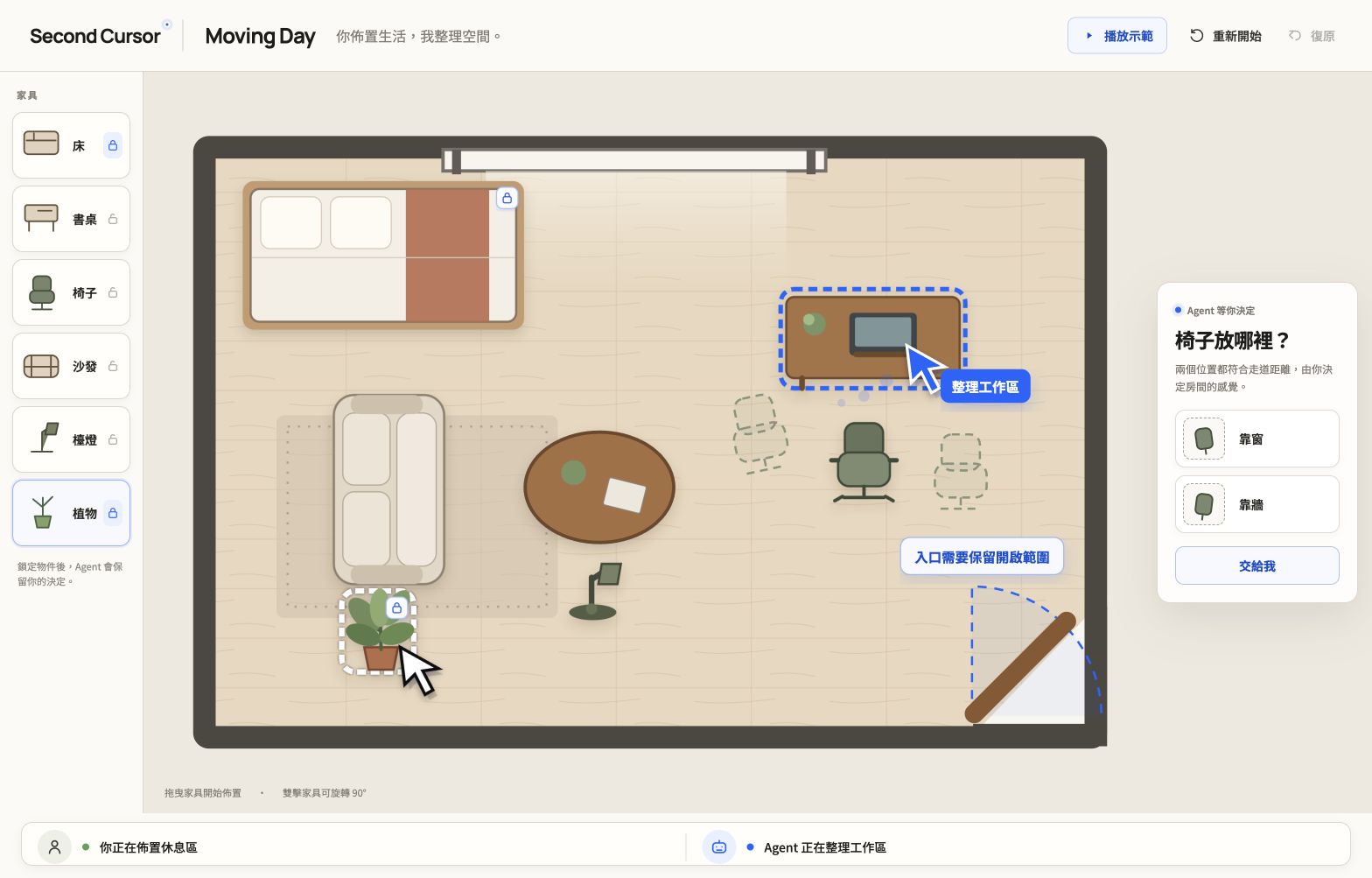
One workspace. Two cursors. The white cursor belongs to the human. The blue cursor belongs to the agent. Both work on the same live surface, and the interface makes collaboration legible: target, intent, progress, constraints, changes, and handoff.
Why a moving room?
Moving Day turns an abstract interaction model into something everyone understands. A person and an agent arrange a room together.
The agent can:
- inspect the live room and its constraints;
- point out a problem without changing anything;
- move or rotate unlocked furniture;
- ask the human to choose between equally valid options;
- finish with a visible summary of what changed.
Every operation happens through a structured WebMCP tool and appears directly in the interface. The blue cursor travels to the object it is about to affect and explains why.
Actionable transparency, not chain-of-thought
Second Cursor does not expose or imitate private model reasoning. It reveals the information a person needs to supervise real work: the agent's target, intended action, resulting change, active constraints, waiting state, and control handoff.
This is transparency at the interaction layer—the place where trust becomes a product behavior instead of a promise.
Human authority is built into the surface
The agent is capable, but it is not the owner.
Lock an object and the agent must preserve it. Grab an item during an operation and the agent yields. When two placements are both valid but depend on taste, the agent asks instead of guessing.
The human owns preference and final authority. The agent contributes attention, structured action, and speed.
Why WebMCP?
WebMCP lets a web page describe meaningful capabilities to compatible agents. That changes more than automation; it changes the basic grammar of the web. A page is no longer only a place where a person clicks. It can become a shared world where humans and agents act together.
Second Cursor uses six real tools registered through document.modelContext.registerTool(...): inspect_room, point_out_issue, move_item, rotate_item, request_choice, and finish_layout.
The tools use bounded JSON schemas, stable furniture IDs, live page state, human locks, room constraints, explicit handoffs, and abort signals. No proprietary server-side model is required: the intelligence comes from the visiting WebMCP-compatible agent, while the page supplies capabilities, constraints, and visible feedback.
What becomes possible
Traditional software gives one person one cursor. Second Cursor imagines software where an agent can guide you, work for you, or work beside you—without becoming an invisible operator.
The Moving Day prototype is intentionally simple, but the model can extend to design tools, spreadsheets, dashboards, editors, planning canvases, and any shared workspace where people need to understand and govern agent actions in real time.
Built and verified
The product is built with React, TypeScript, Vinext, Vite, and WebMCP, and hosted on ChatGPT Sites. It includes a scripted fallback so judges can experience the collaboration even when their current browser does not expose WebMCP.
OpenAI Codex supported product research, concept refinement, implementation, schema design, automated testing, browser QA, deployment, demo production, and submission packaging.
The public deployment was tested in ChatGPT's in-app browser: all six tools were discovered, and a live inspect_room call returned the current furniture, human locks, room bounds, and constraints. The automated suite passes 3/3 tests and the production build succeeds.
AI has entered the web. Second Cursor makes its hand visible—and keeps the human in control.
Built With
- chatgpt-sites
- openai-codex
- react
- typescript
- vinext
- vite
- vitest
- webmcp

Log in or sign up for Devpost to join the conversation.