Try it live: https://second-chance-k12-4d00.vercel.app (no accounts or PayPal login needed; everything runs on the PayPal sandbox, so no real money moves).
Code (MIT): https://github.com/k7bot/second-chance
Inspiration
Subscription businesses lose a large share of revenue to churn, and much of it is avoidable. Some subscribers leave because a card failed. Others just needed a break, or a cheaper plan. Most small merchants on PayPal Subscriptions have no retention tooling. A cancel is just a cancel, a failed payment is just an email from PayPal, and nobody follows up with a churned subscriber.
Second Chance started from that gap: give a PayPal Subscriptions merchant the same kind of save, recovery, and win-back flow larger billing platforms offer, without trapping anyone in a cancel flow.
The demo merchant is Brightside Yoga, a fictional studio running on the PayPal sandbox.
What it does
Second Chance listens to the merchant's PayPal subscription webhooks and adds a save flow to their cancel button. When a subscriber is about to leave, it:
- Picks one offer that fits the situation: pause, discount, downgrade, win-back, payment recovery, or a graceful goodbye.
- Writes a short, personal message for it.
- Applies the offer through the PayPal Subscriptions API: suspend/activate, revise to another plan, or a new subscription with a per-subscriber price override.
- Tracks the outcome from PayPal webhooks and reports MRR saved, save rate, and which offers work for which churn signal.
The four cases
- Payment failed (
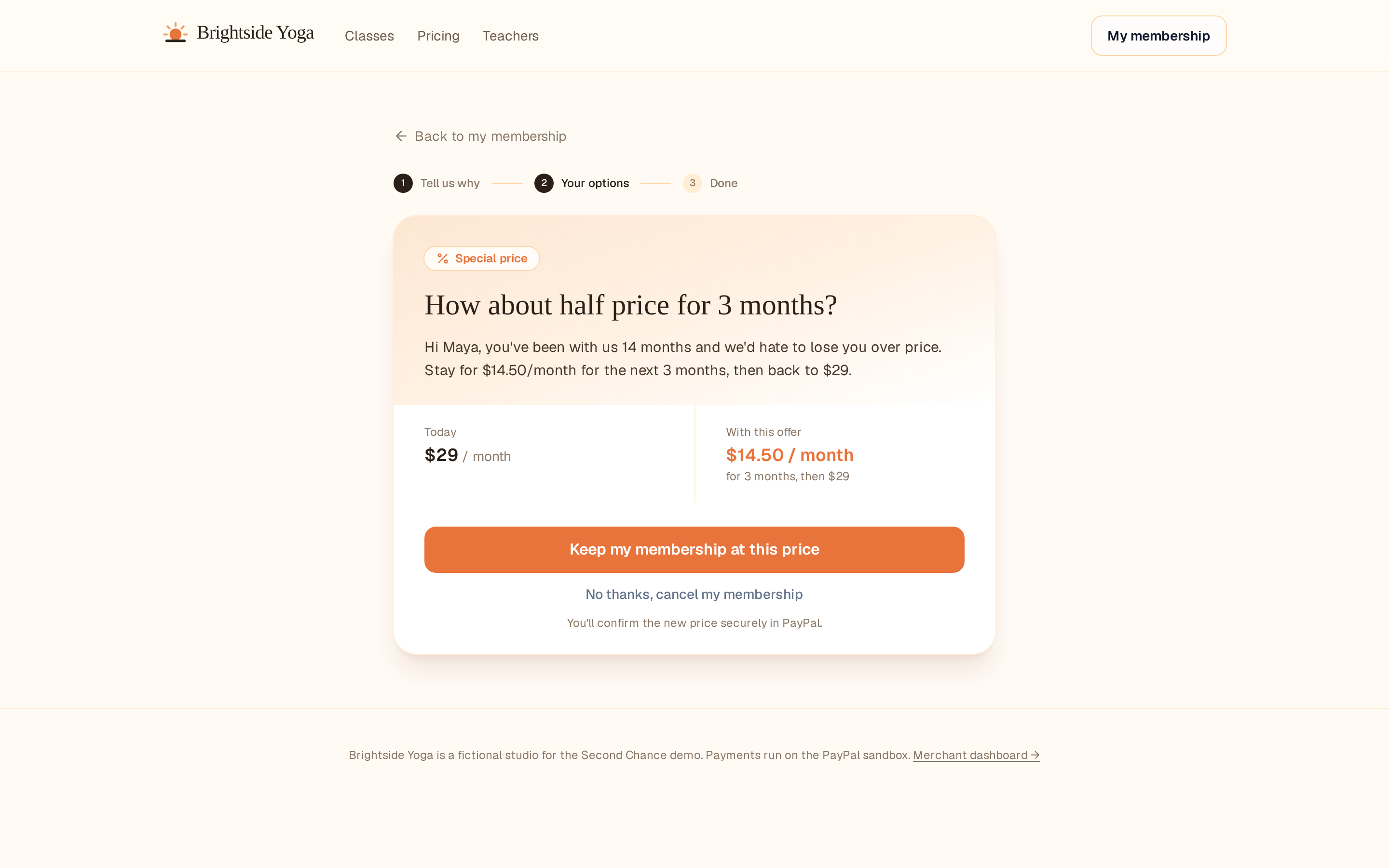
BILLING.SUBSCRIPTION.PAYMENT.FAILED). The member is marked at risk with a 7-day grace period and gets a recovery message.PAYMENT.SALE.COMPLETEDcloses it as saved. - Cancel on the merchant's site. The member picks a reason, then sees one offer. Pause suspends in PayPal (no extra consent). Discount revises to the Save50 plan. Downgrade revises to Lite. The buyer confirms those two in PayPal. They can also choose Cancel without an offer, so the flow never traps anyone. Declining cancels in PayPal.
- Subscription suspended (
BILLING.SUBSCRIPTION.SUSPENDED, not started by us). A come-back message; one tap calls PayPal/activate. - Cancelled inside PayPal (
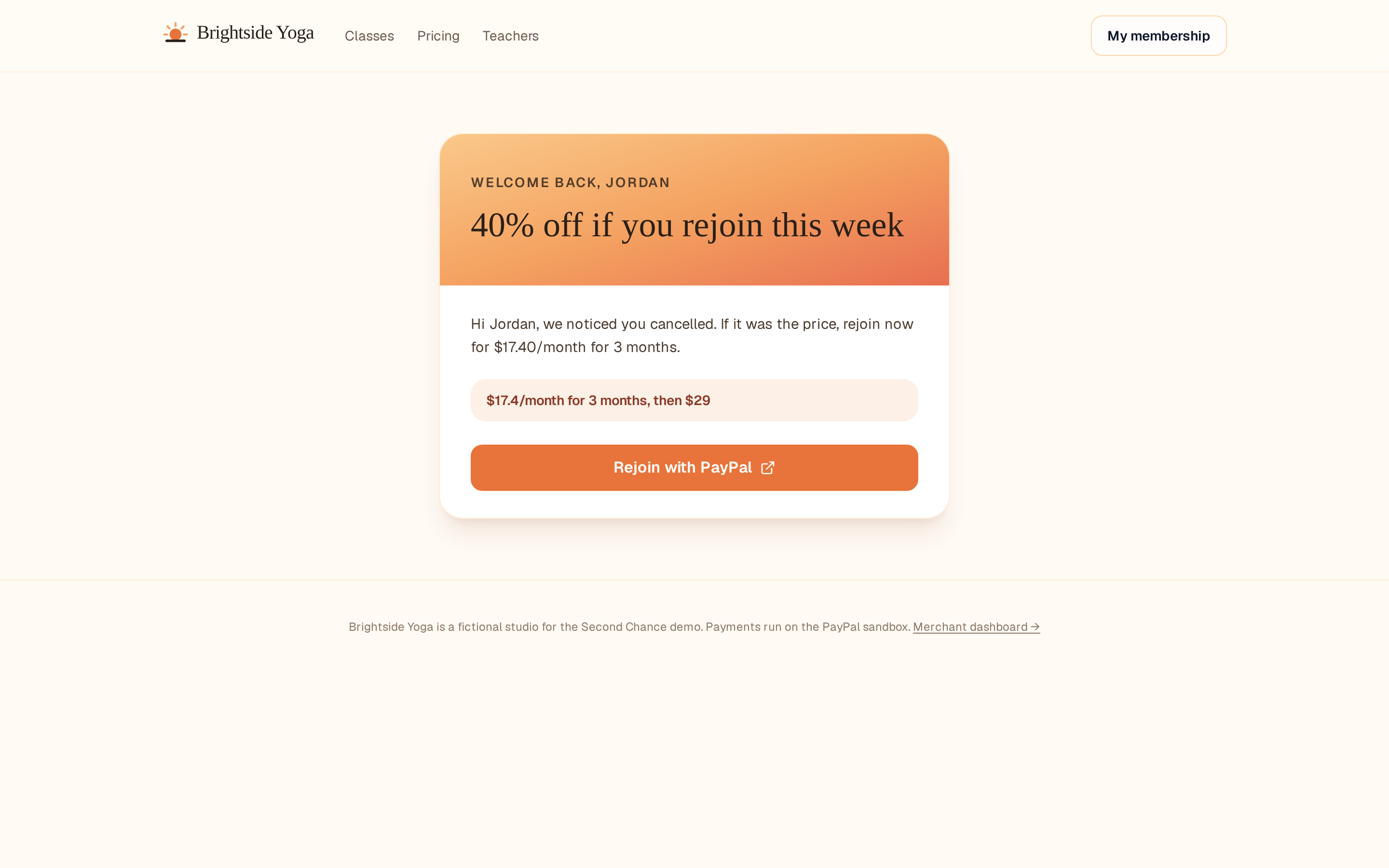
BILLING.SUBSCRIPTION.CANCELLED, not started by us). Win-back: a new subscription on the Win-back plan with the offer price as a plan override, sent as a one-tap approve link.
Paused subscriptions resume automatically. A daily Vercel Cron (/api/cron/resume, 10:00 UTC) reactivates every subscription whose pause has ended.
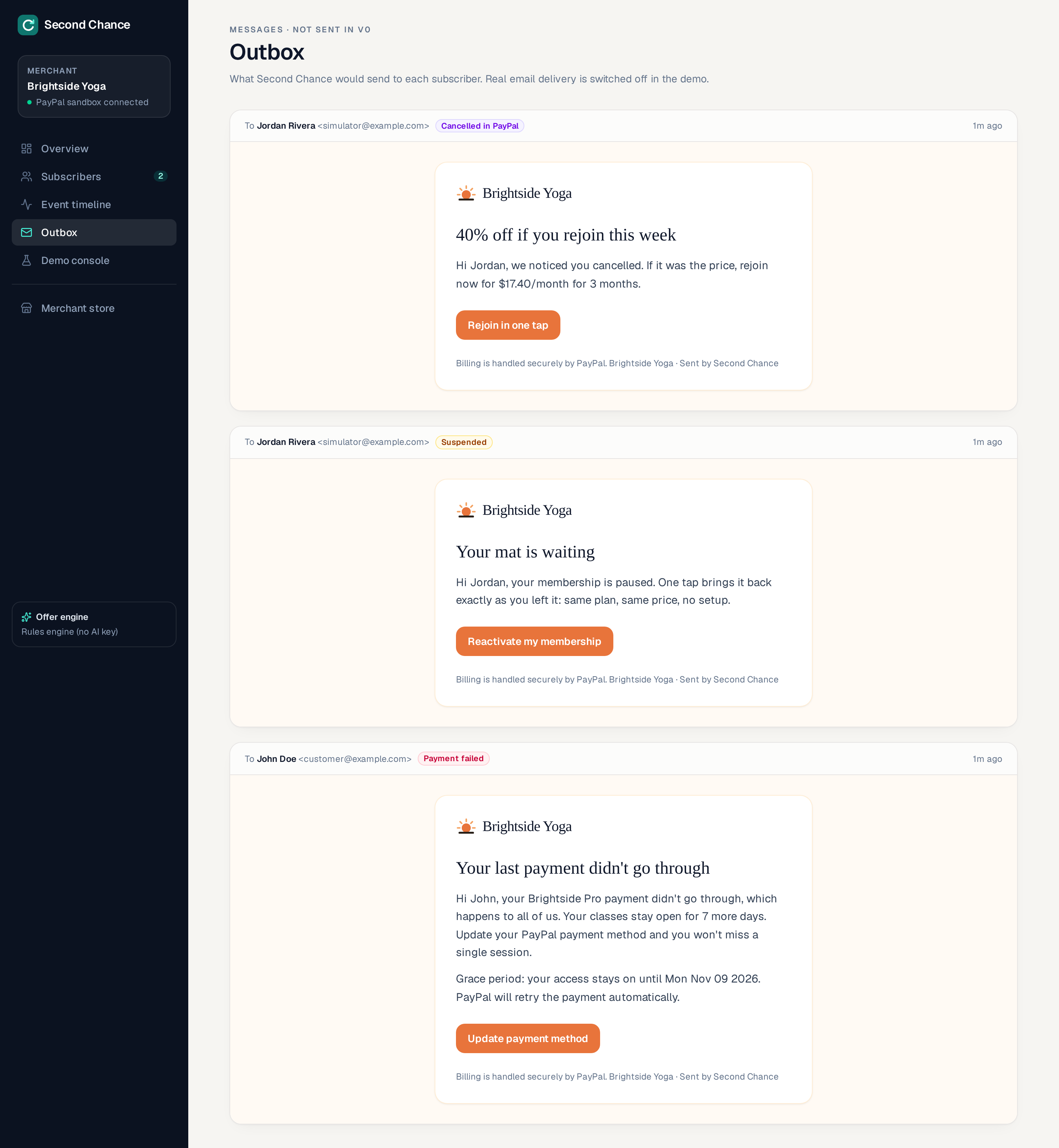
Real branded email is sent through Resend from [email protected]. Practice and placeholder members never get mail at fake addresses; judges can use Email this to me to see the real message.
How I built it
The product is one Next.js app on Vercel (Hobby), with Neon Postgres in production and embedded PGlite locally. Tables are created on first use.
PayPal (sandbox) APIs used:
POST /v1/oauth2/tokenfor client-credentials auth (the secret is read from the environment only)- JS SDK Buttons (
intent=subscription,vault=true) on the merchant store GET /v1/billing/subscriptions/{id}to sync status and reconcile after buyer consentPOST …/suspendandPOST …/activatefor pause offers, come-back reactivation, and auto-resumePOST …/revisefor discount (Save50 plan) and downgrade (Lite plan), with an approve link for buyer consentPOST …/cancelwhen the member declines every offerPOST /v1/billing/subscriptions(with aplanoverride) for win-back at a per-subscriber pricePOST /v1/notifications/verify-webhook-signatureso every webhook is verified before it is acted onPOST /v1/notifications/simulate-eventin the demo console, to fire real signed sandbox events
Webhooks are de-duplicated by event id. Unverified events are stored but never acted on. Status changes we caused ourselves are recorded and ignored.
AI:
- Model: Nebius AI Studio
Qwen/Qwen3-30B-A3B-Instruct-2507(LLM_PROVIDER=nebius) - Offer engine: the model picks the offer kind, price, duration, and message from the member's context (plan, tenure, payment history, cancel reason, trigger). Guardrails clamp the result: price never below 40% of list, discounts at most 6 months, pauses at most 3 months, and a per-trigger list of allowed offers.
- Any error or timeout falls back to a deterministic rules engine, so the app works with no AI key at all.
- "Ask the grid" (AG Grid AI Toolkit): merchants type plain English and the grid's filters, grouping, and sorting change to match.
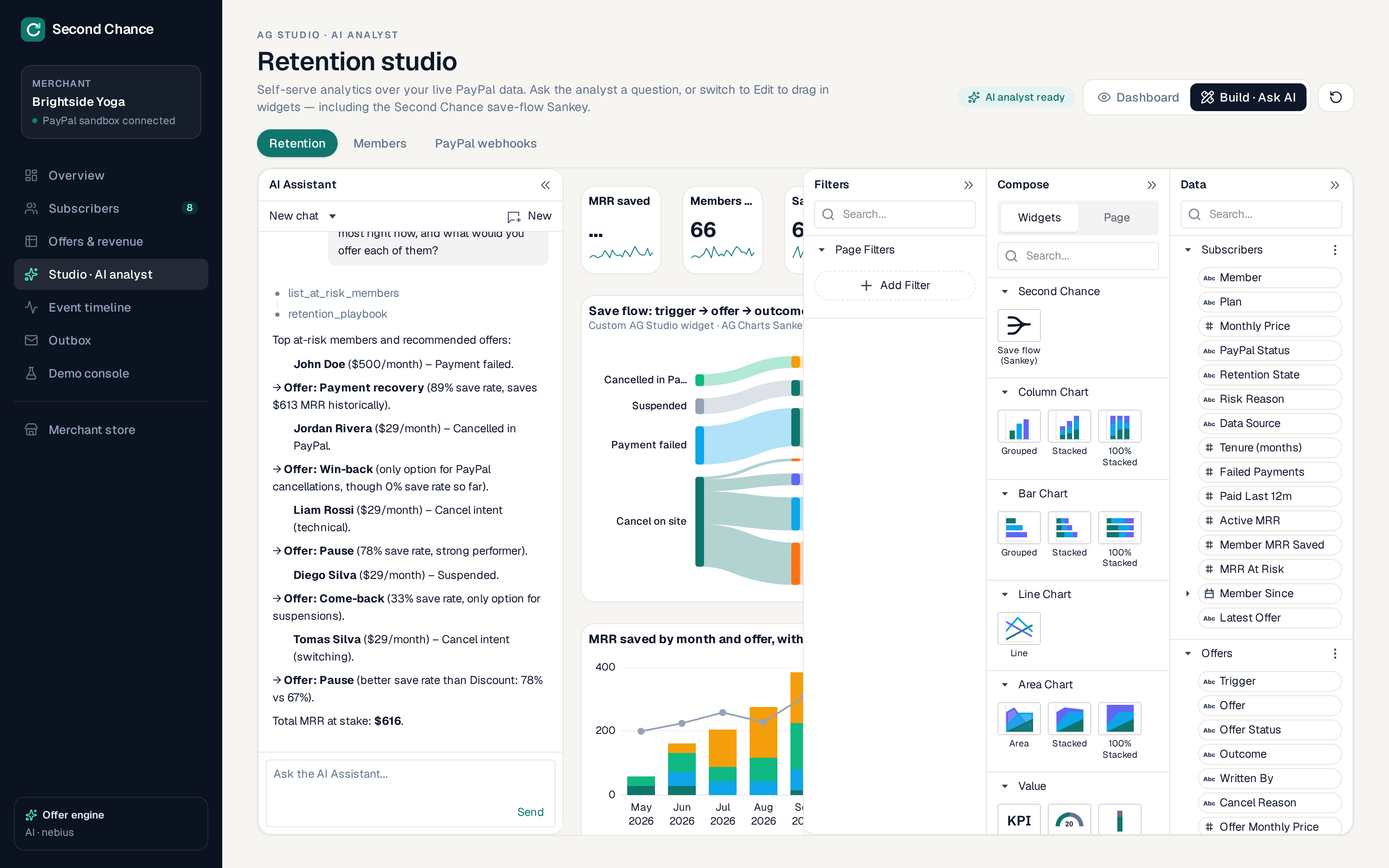
- AI analyst in AG Studio: an agent with two custom tools (
list_at_risk_members,retention_playbook). It answers questions such as "Who should I call today?"
Merchant dashboard (AG Grid, AG Charts, AG Studio):
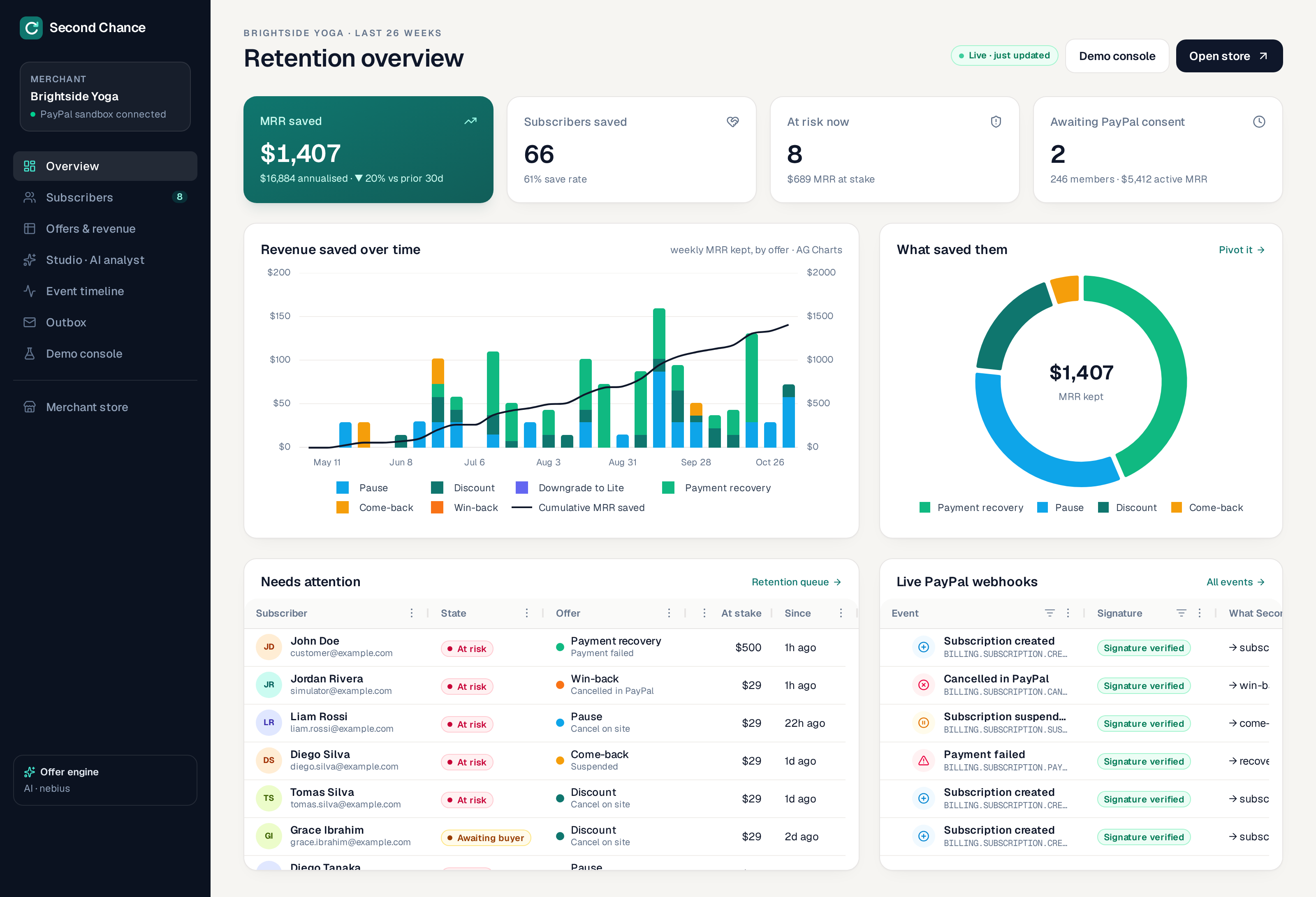
- Overview: AG Charts combo chart (stacked weekly MRR saved per offer plus a cumulative line) and a donut, plus two live compact grids
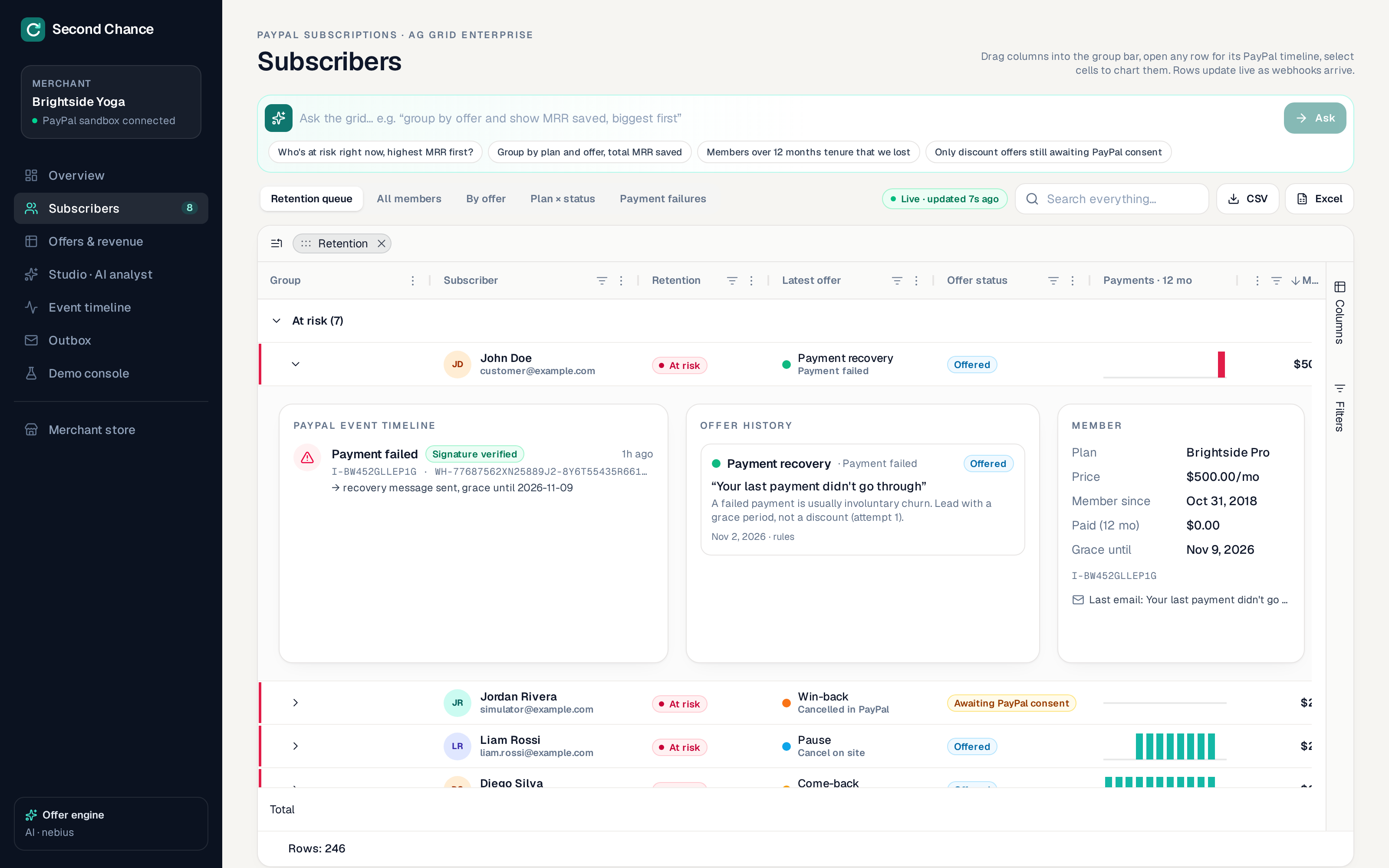
- Subscribers: AG Grid Enterprise with row grouping, saved views, master/detail (PayPal event timeline, offer history, member card), 12-month payment sparklines, set filters, export, and the AI Toolkit
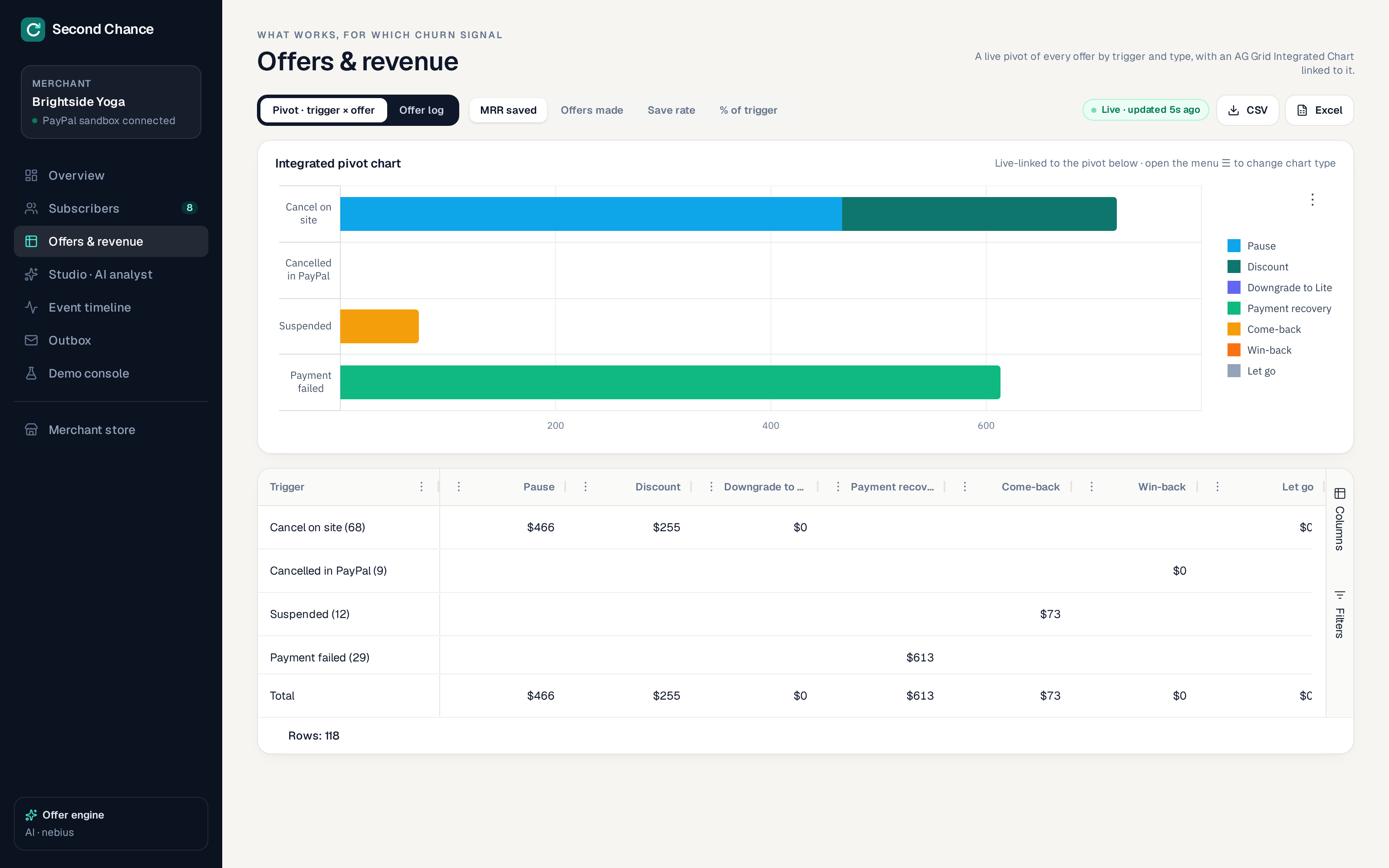
- Offers & revenue: pivot mode (trigger × offer) with switchable measures and a linked integrated pivot chart
- Event timeline: every PayPal webhook with signature status
- Studio: pages for Retention, Members, and PayPal webhooks, a custom Save-flow Sankey widget, and the AI analyst
Challenges I ran into
PayPal refuses a price override on the same plan (OVERRIDES_ON_SAME_PLAN_NOT_ALLOWED), so discounts revise to a separate Save50 plan. Revise is refused while a subscription is suspended. A revise that is still waiting for buyer consent makes /activate fail (422 SESSION_STATE_NOT_VALID), so the app refuses to pause while a revise is pending.
The PayPal JS SDK buttons render blank in headless screenshots, even though they work in a normal browser. Simulator events reuse one event id per type, so a repeat is de-duplicated; the demo console has a Replay action for that. Webhooks lag the API by about 10 to 20 seconds, so the UI trusts the API response and the demo outline waits for delivery off-camera.
The hosted demo is a public site with a paid AI key and real email, so it needed light per-visitor limits that fail open. Judges should not get blocked during normal use.
Accomplishments that I'm proud of
The four retention cases run end to end on the PayPal sandbox, with verified, de-duplicated webhooks. The save flow always leaves Cancel without an offer available, so it never feels like a trap.
The AI is clamped by guardrails and has a rules fallback, so a model timeout still produces a valid offer. The merchant side is a real triage workspace (grids, pivots, Studio, and an analyst that can answer who to call today), not only a storefront demo.
Judges can try the product without creating an account or logging into PayPal, including seeing a real branded email.
What I learned
PayPal Subscriptions already has the primitives for pause, revise, cancel, and a new subscription with a plan override. The hard part is sequencing those calls around buyer consent and ignoring echoes of your own webhook events.
Retention copy is only useful if the offer can actually be applied. That is why the engine is allowed to pick the message, but not to invent an offer the APIs and guardrails cannot honor.
What's next
- Connect to real merchants' PayPal accounts through PayPal partner onboarding, so any PayPal Subscriptions merchant can add Second Chance without code.
- Learn from outcomes: feed which offers saved which members back into the offer choice, per merchant.
- More channels for recovery messages (SMS, in-app) and a merchant-editable brand voice.
Built With
- ag-charts
- ag-grid
- ag-studio
- drizzle
- nebius
- neon
- next.js
- paypal
- paypal-subscriptions-api
- paypal-webhooks
- postgresql
- qwen
- resend
- typescript
- vercel
