-
-
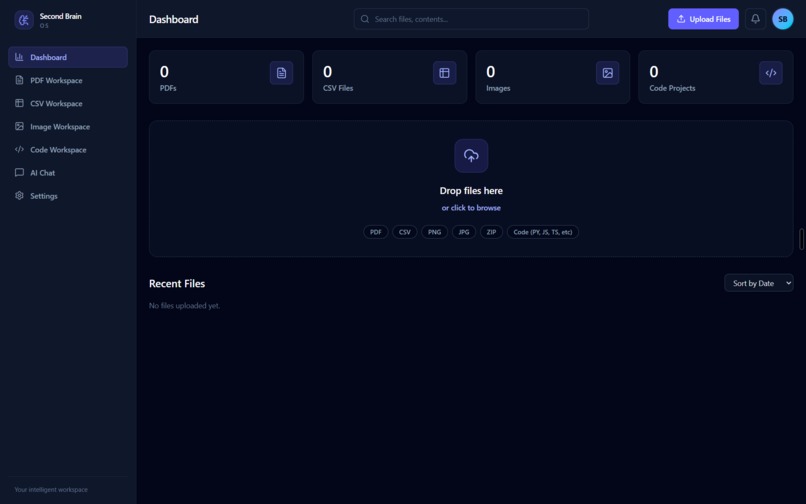
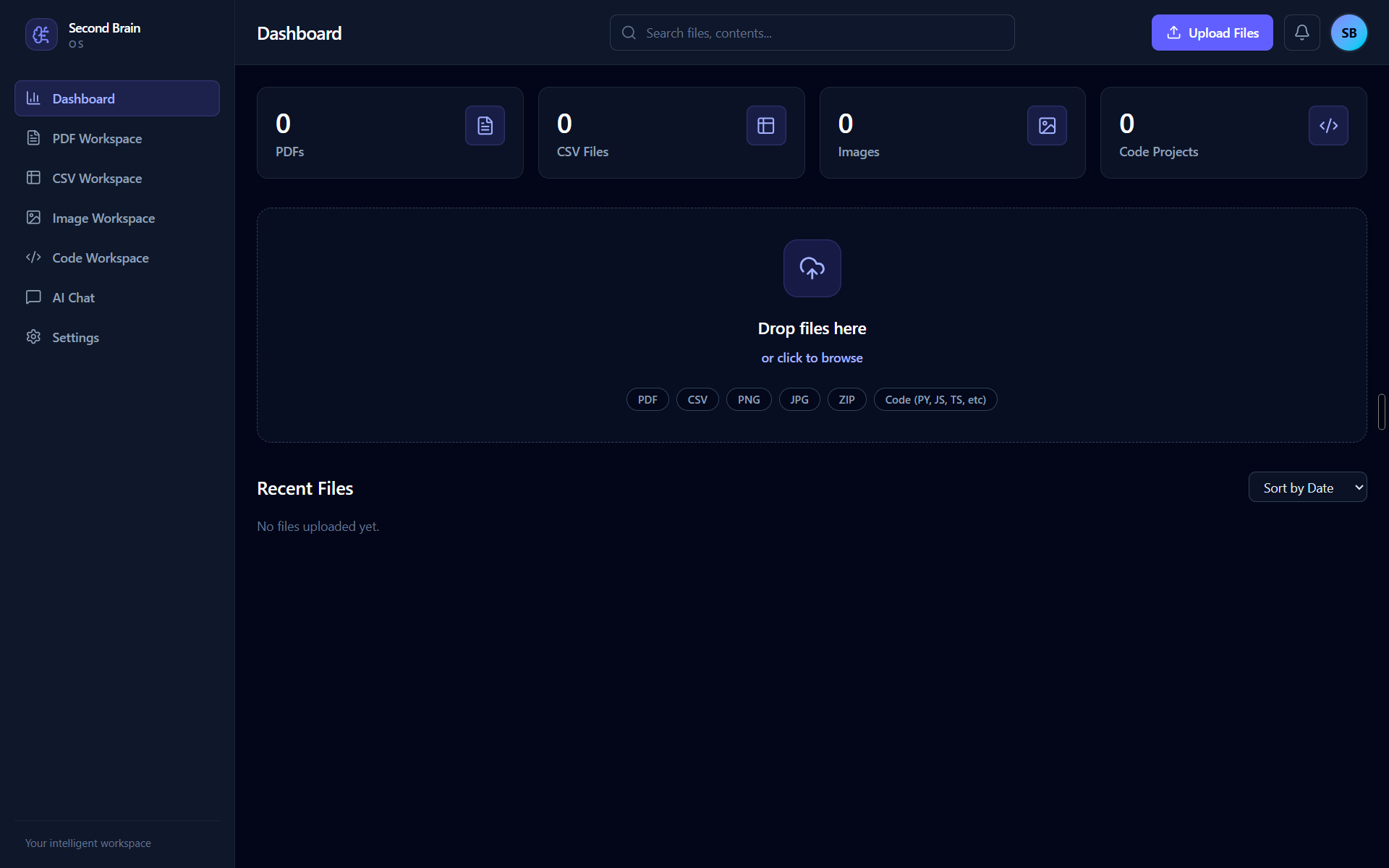
Dashboard
-
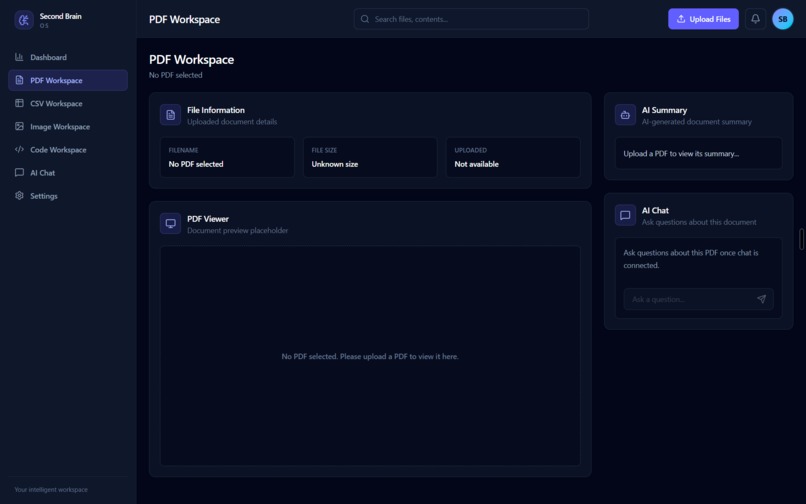
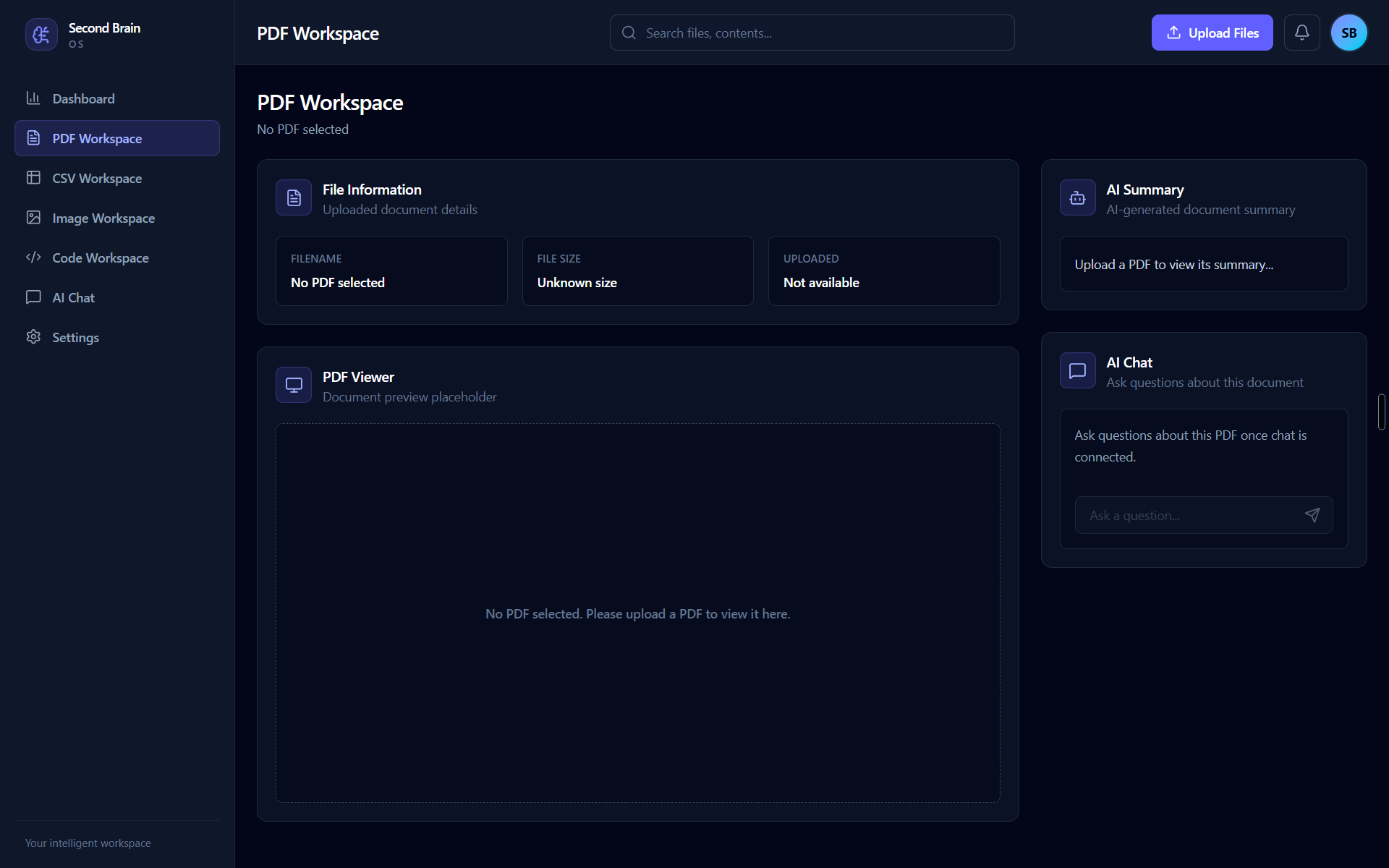
PDF Workspace
-
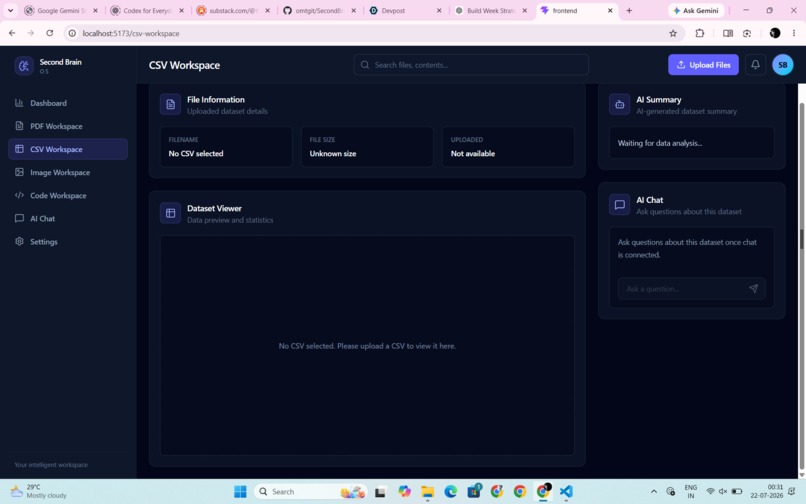
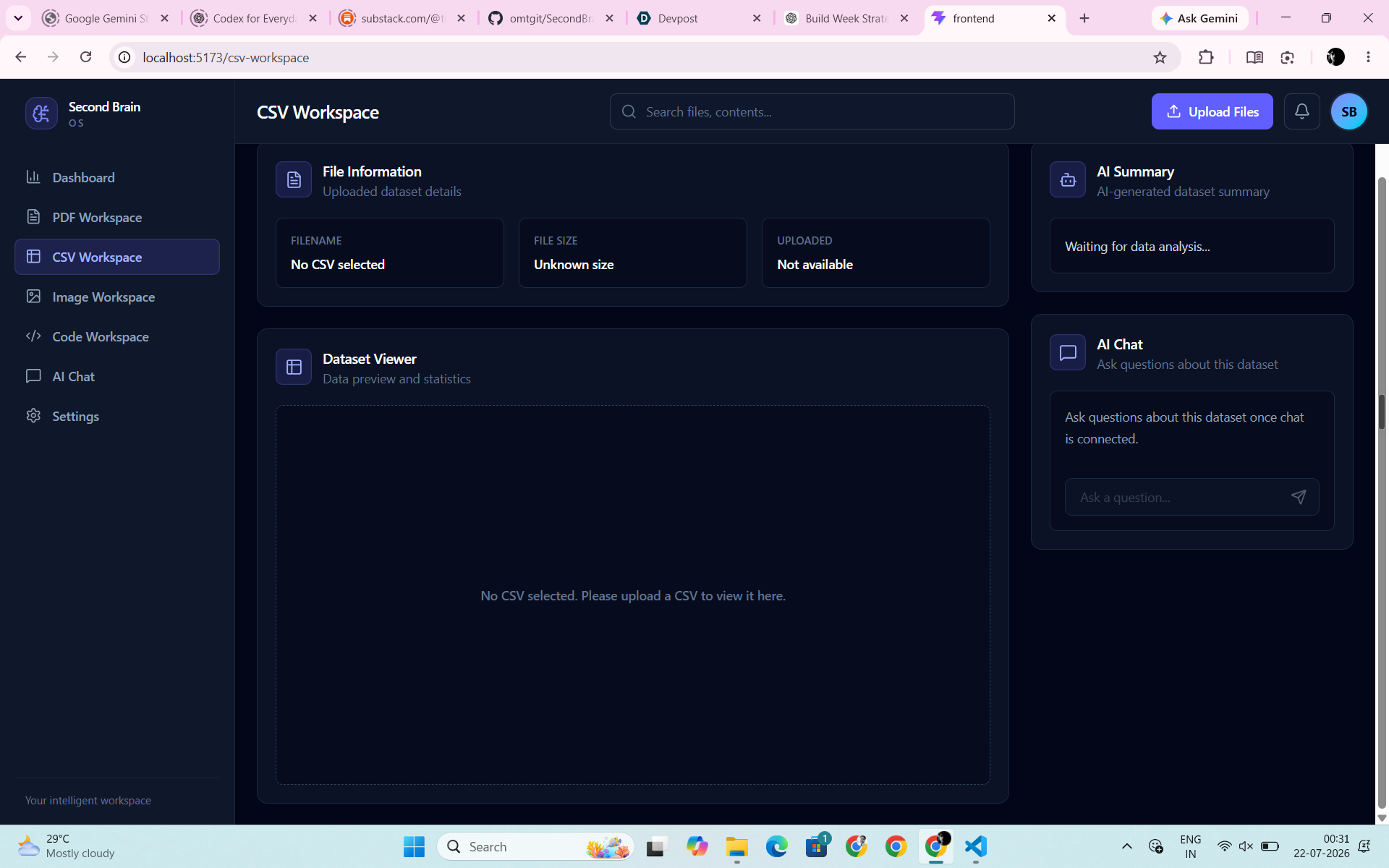
CSV Workspace
-
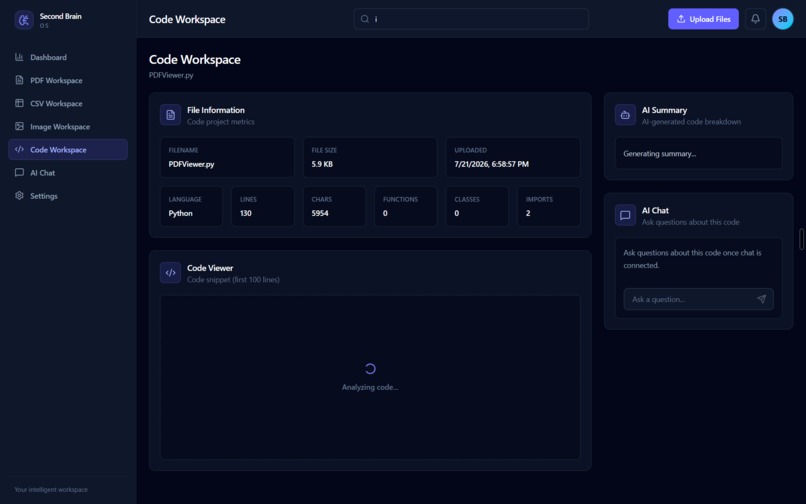
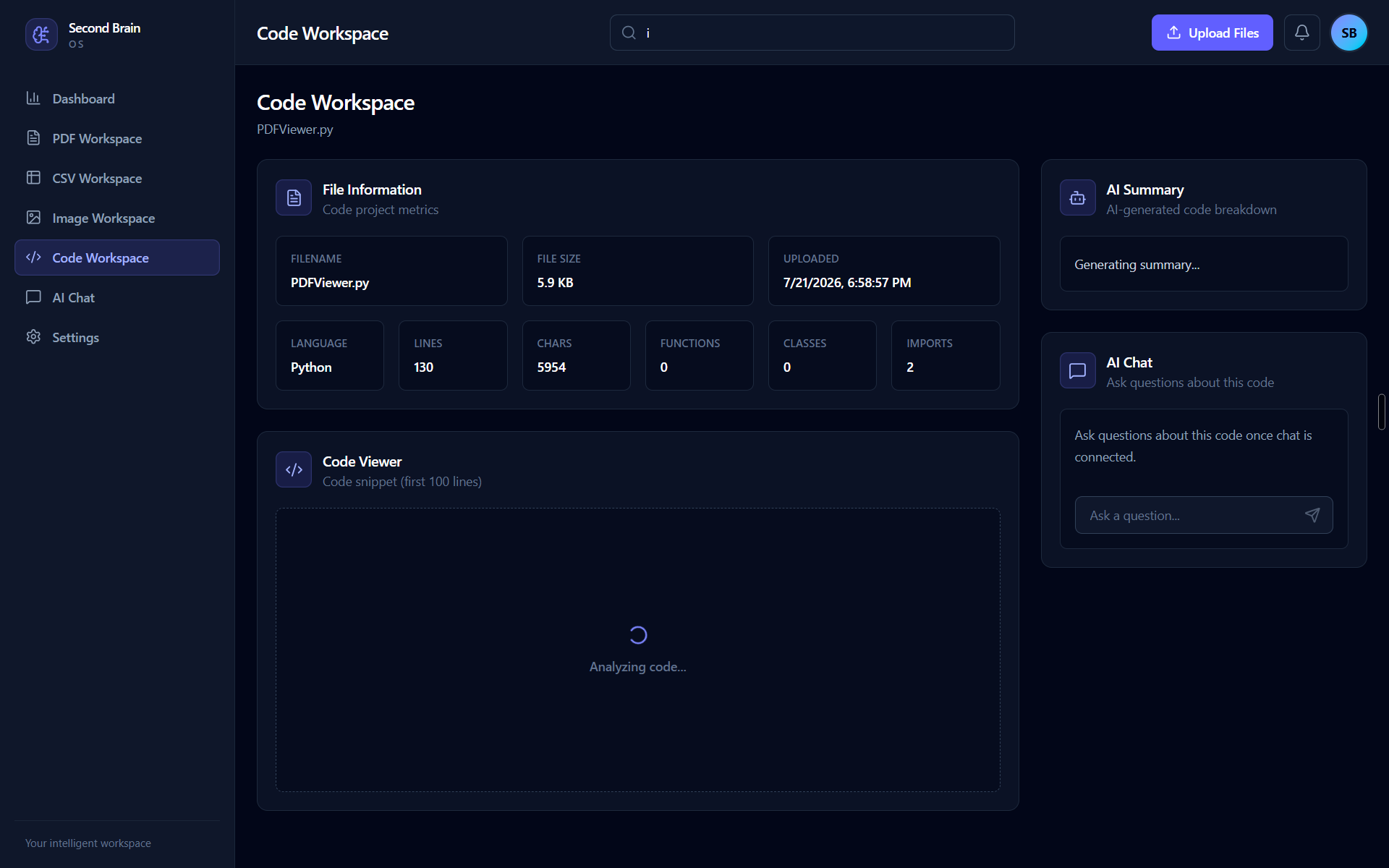
Code Workspace
-
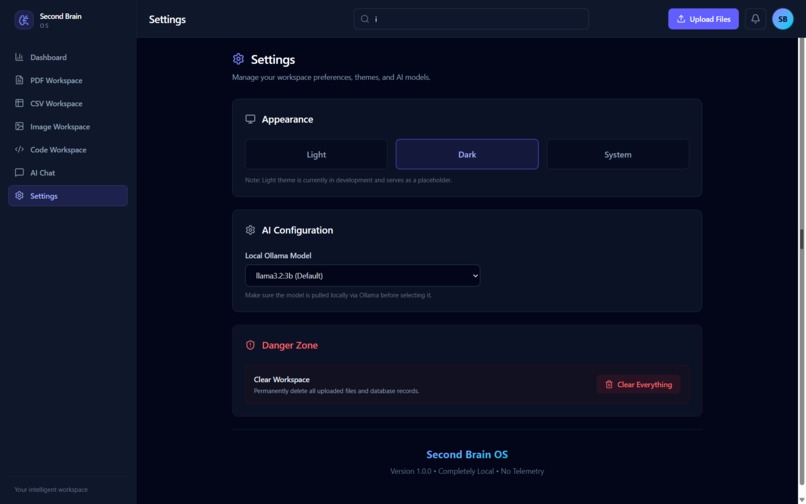
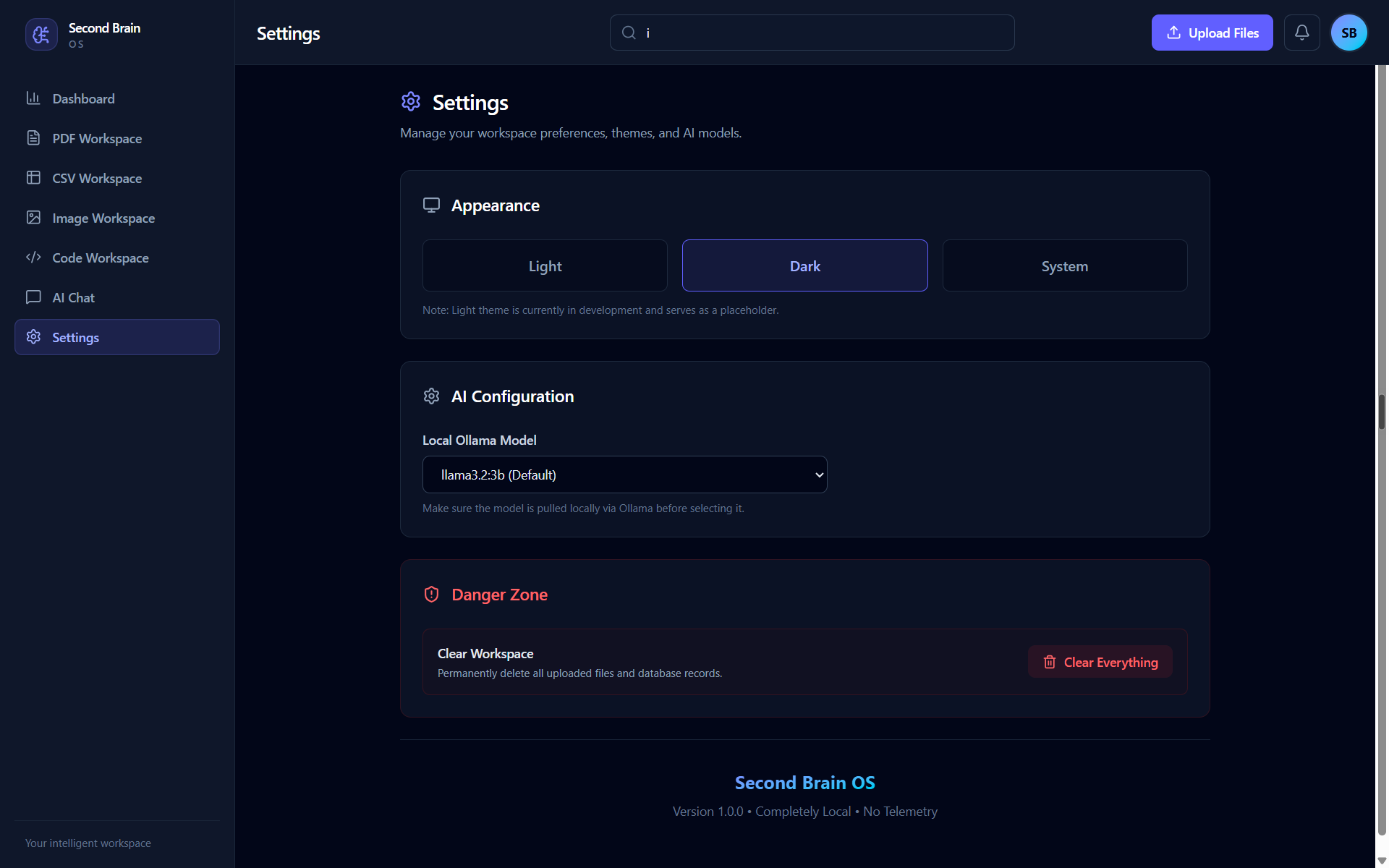
Settings
-
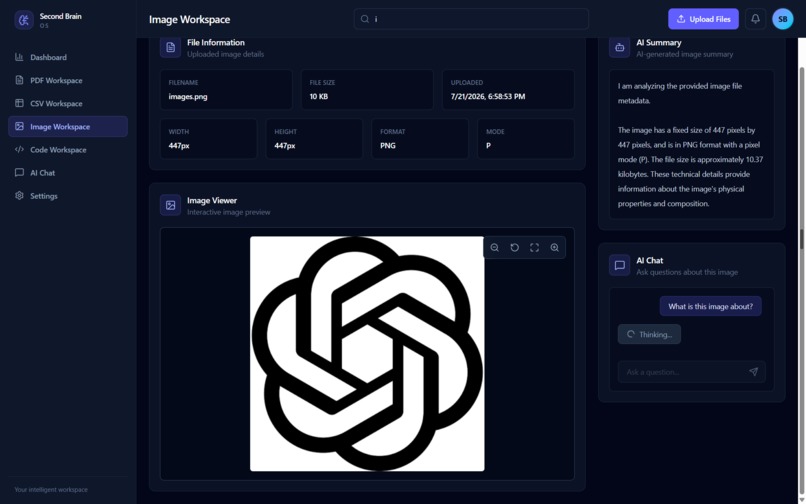
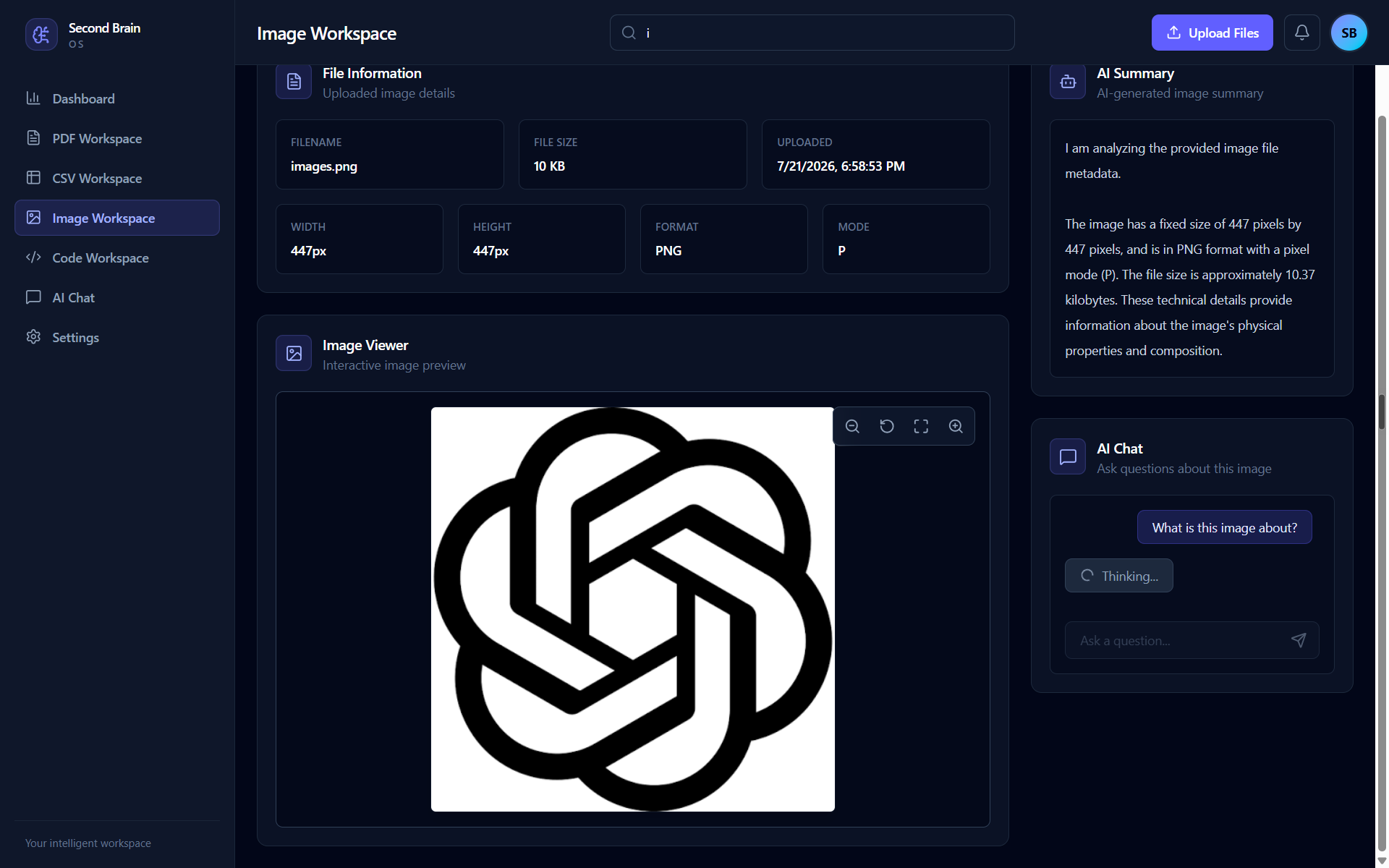
Image Workspace (in process)
-
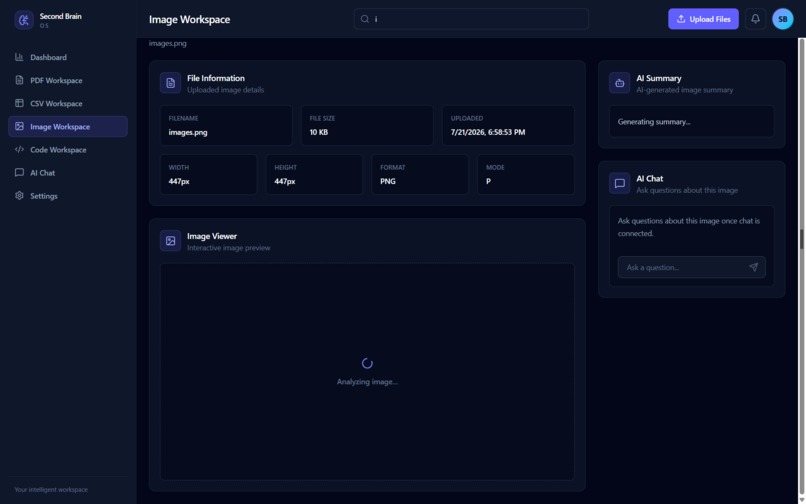
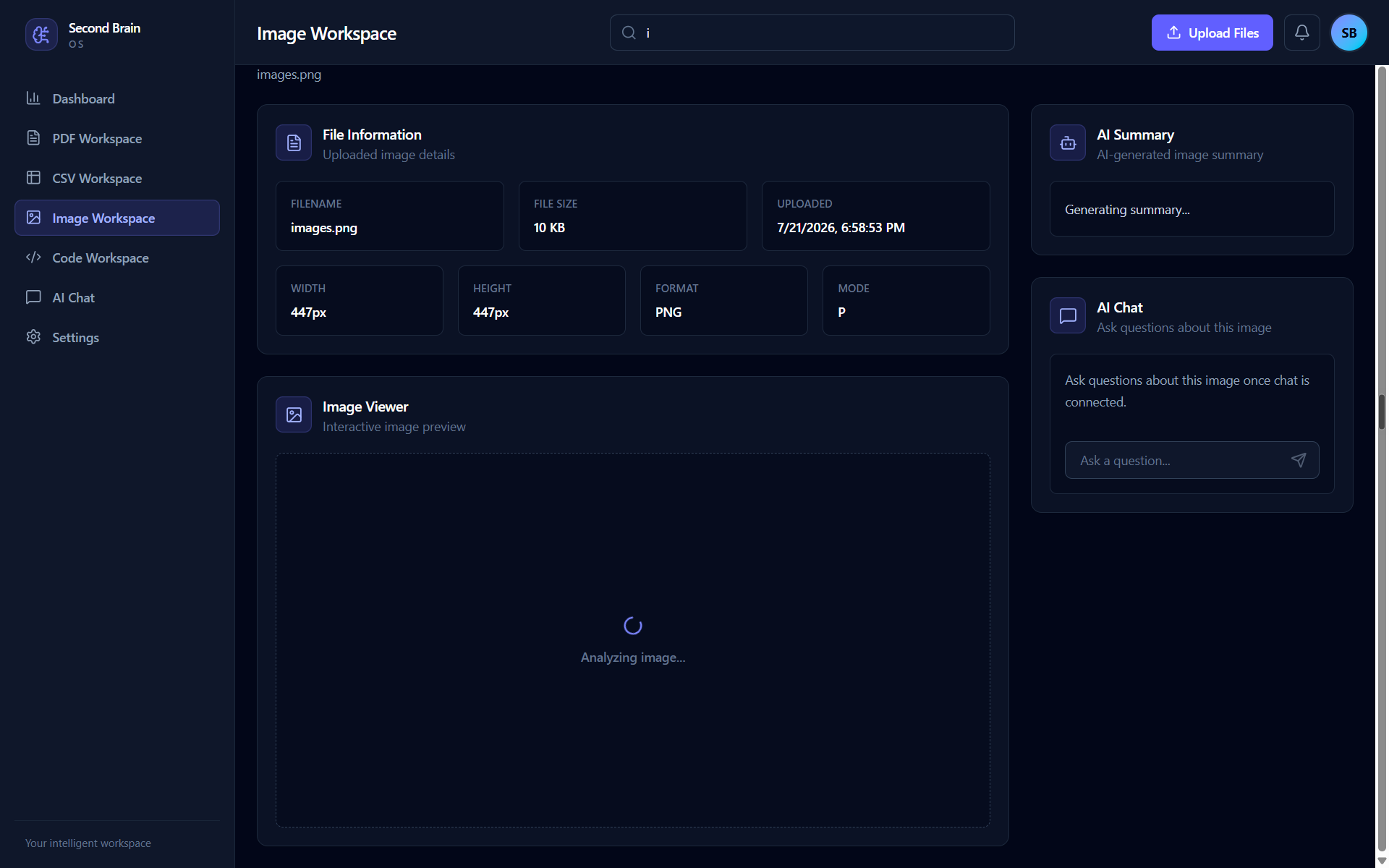
Image Workspace (loading uploaded file)
-
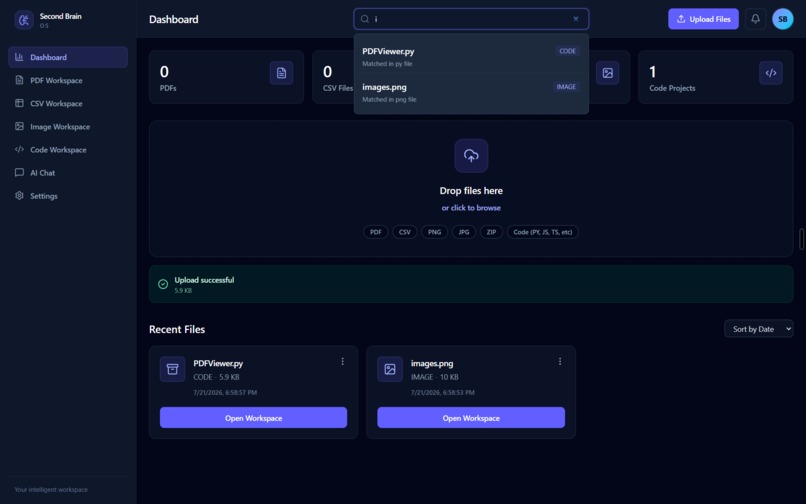
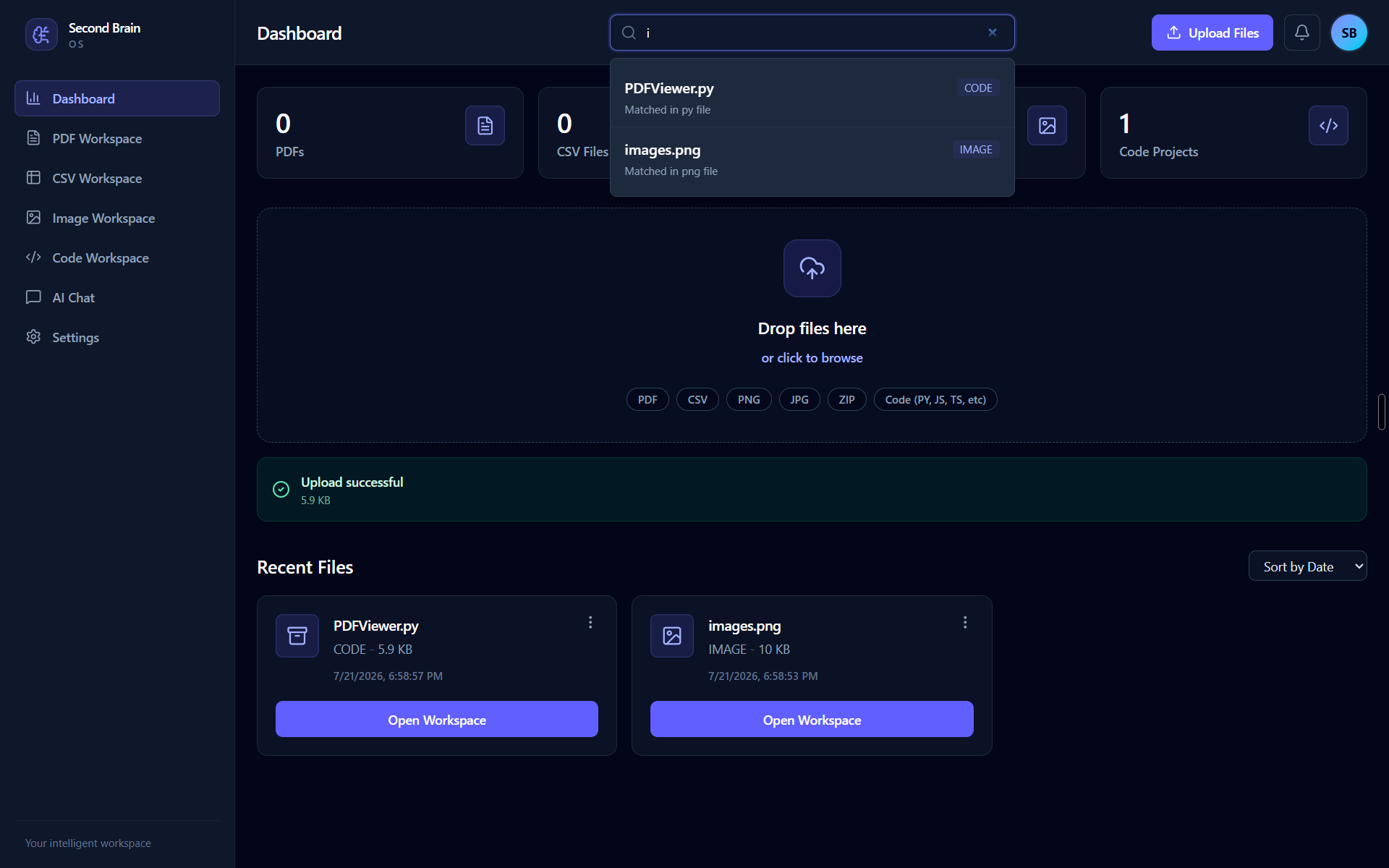
Universal Search Bar
-
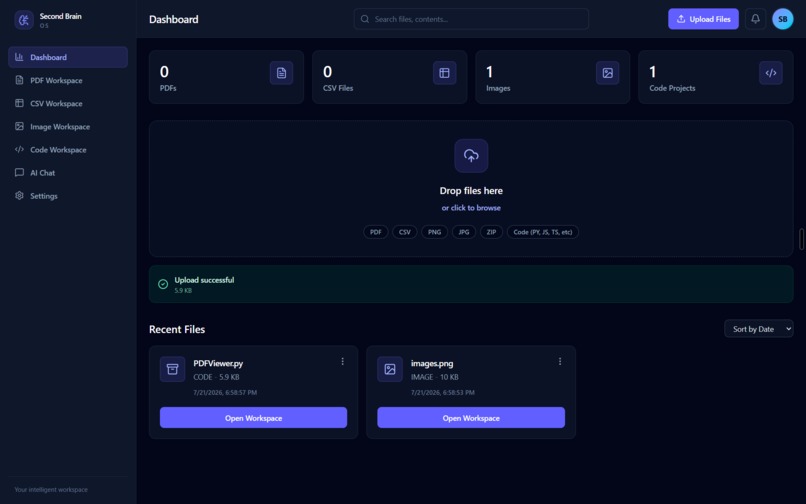
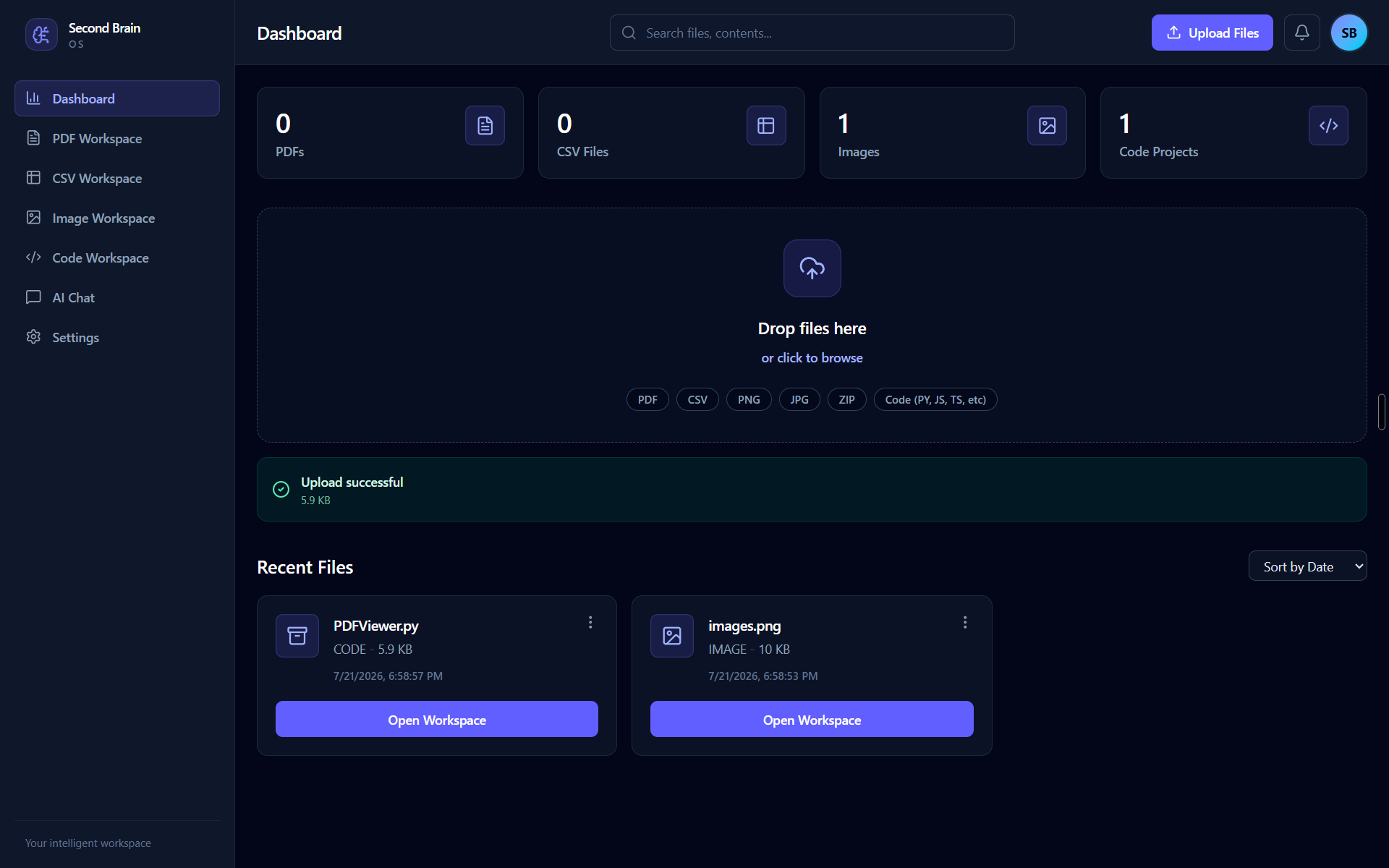
Dashboard (with uploaded files)
Inspiration
Managing information today is fragmented. PDFs are read in one app, datasets are analyzed in another, images require different tools, and source code lives elsewhere. Existing AI tools are often cloud-based, require paid APIs, or send user data to external servers.
I wanted to build a privacy-first, local AI workspace where users could upload different file types and instantly understand, summarize, search, and chat with them from a single interface.
That idea became "Second Brain OS".
What it does
Second Brain OS is a local AI-powered knowledge workspace built with React, FastAPI, SQLite, and Ollama.
The application provides dedicated workspaces for different file types:
PDF Workspace
- PDF Viewer
- AI Summary
- AI Chat
CSV Workspace
- Dataset Preview
- Dataset Statistics
- AI Summary
- AI Chat
Image Workspace
- Image Viewer
- Metadata
- AI Summary
- AI Chat
Code Workspace
- Source Code Viewer
- AI Code Analysis
- AI Chat
Additional features include:
- Global Search across uploaded files
- Upload History
- Duplicate File Detection
- Recent Files
- Settings Page
- Local SQLite storage
- Fully offline AI powered by Ollama
No external AI APIs are required.
How I built it
I built the frontend using React, Vite, Tailwind CSS, Axios, React Dropzone, and React PDF.
The backend is powered by FastAPI with a modular architecture consisting of separate routes and services for each workspace.
Files are processed using specialized libraries:
- PyMuPDF for PDF text extraction
- Pandas for CSV analysis
- Pillow for image processing
- Custom services for code analysis
For AI capabilities, I integrated Ollama running the Llama 3.2 (3B) model locally, enabling document summaries and AI chat completely offline.
SQLite is used to store upload history and workspace metadata.
Challenges I ran into
One of the biggest challenges was integrating multiple file types into a single application while keeping the architecture modular and maintainable.
I also spent considerable time solving issues related to:
- PDF.js worker compatibility
- React PDF rendering
- Upload routing
- Local file management
- AI response latency
- Backend route organization
- State management across workspaces
- SQLite integration
Designing a consistent experience across four different workspace types also required several UI iterations.
Accomplishments that I'm proud of
I'm proud that I successfully built:
- A complete multi-workspace AI platform
- Fully local AI using Ollama
- AI summaries for PDFs, CSV files, images, and source code
- AI chat for every supported workspace
- Persistent upload history
- Global search
- Modern responsive interface
- Clean and scalable backend architecture
Most importantly, the entire application works without relying on paid cloud AI APIs.
What I learned
This project helped me learn far more than simply integrating an AI model.
Throughout development I gained practical experience with:
- FastAPI backend development
- React application architecture
- File processing pipelines
- Local LLM integration
- SQLite databases
- Modular software design
- Prompt engineering
- Building user-friendly AI interfaces
I also learned how important privacy, extensibility, and maintainability are when designing AI-powered applications.
What's next for Second Brain OS
I plan to continue developing Second Brain OS by adding:
- Retrieval-Augmented Generation (RAG)
- Multi-document chat
- Semantic search
- OCR support for scanned documents
- Voice interaction
- Folder indexing
- Local embedding models
- Vector database support
- Plugin architecture
- Cross-document knowledge graphs
- Desktop application support using Electron
My long-term vision is to make Second Brain OS a powerful local-first AI operating system for personal knowledge management.


Log in or sign up for Devpost to join the conversation.