Inspiration
Traditional note-taking is fundamentally broken. Students and professionals spend countless hours capturing information into static documents, only to let them gather digital dust. This relies heavily on passive learning (re-reading text over and over), which cognitive science proves is highly inefficient.
I wanted to build something different. I was inspired to bridge the gap between static knowledge and active memory retention. Second Brain AI was built to instantly weaponize your text documents into a hyper-personalized, rigorous, and interactive active learning ecosystem.
What it does
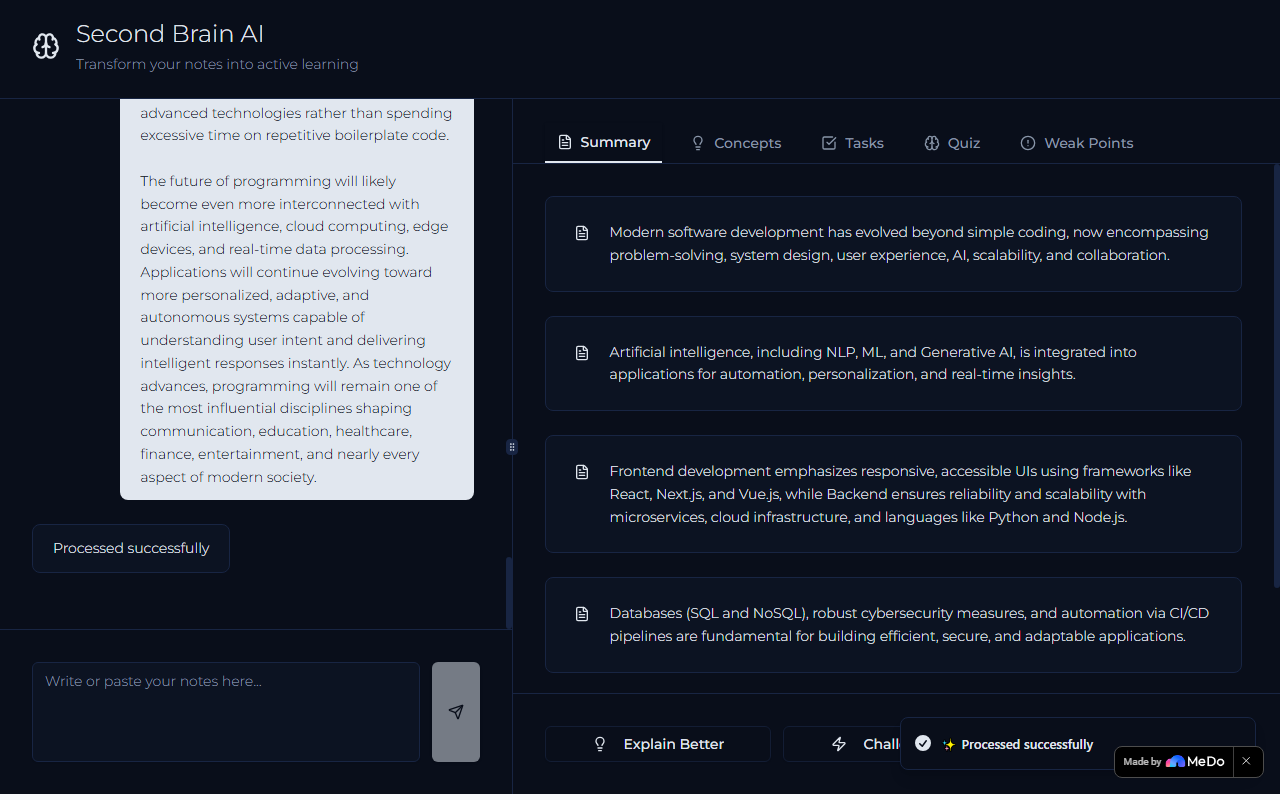
Second Brain AI is a modern web platform that doesn't just summarize your notes—it completely reorganizes them to force active engagement. By simply pasting a block of text, the app instantly generates five core learning modules:
- Summary: Distills complex topics into clean, highly readable architectural breakdowns.
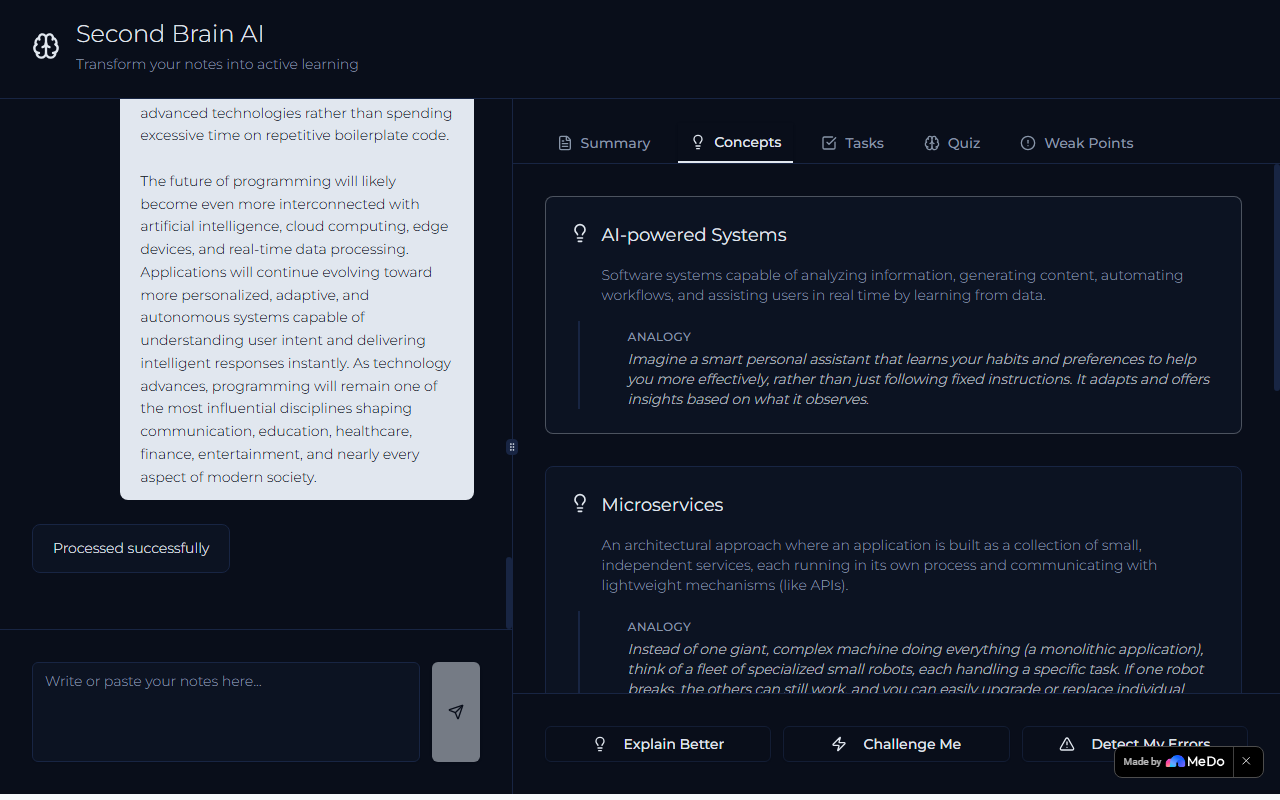
- Concepts: A custom glossary where each technical term is given a crystal-clear definition coupled with an intuitive real-world analogy to lock in conceptual understanding.
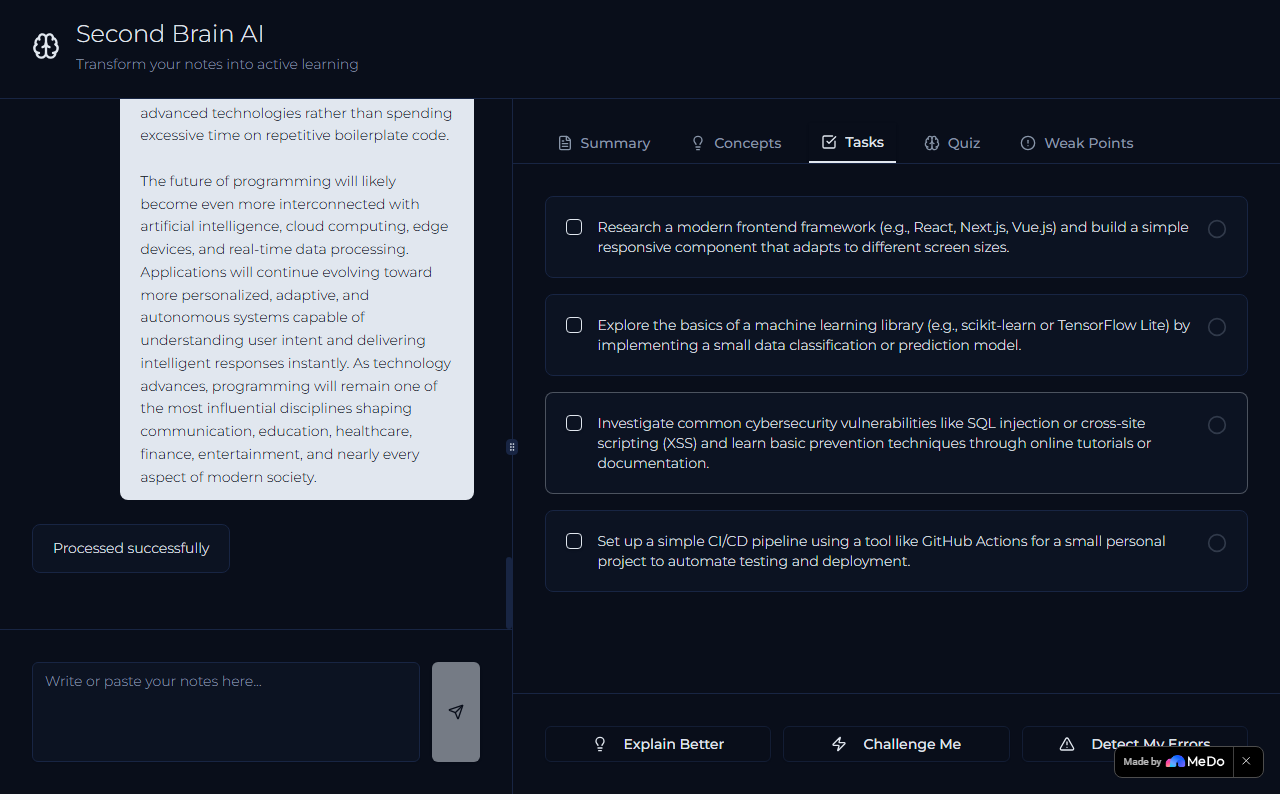
- Tasks: A set of tailored, step-by-step practical challenges designed to test how well you can apply the theory to real-world scenarios.
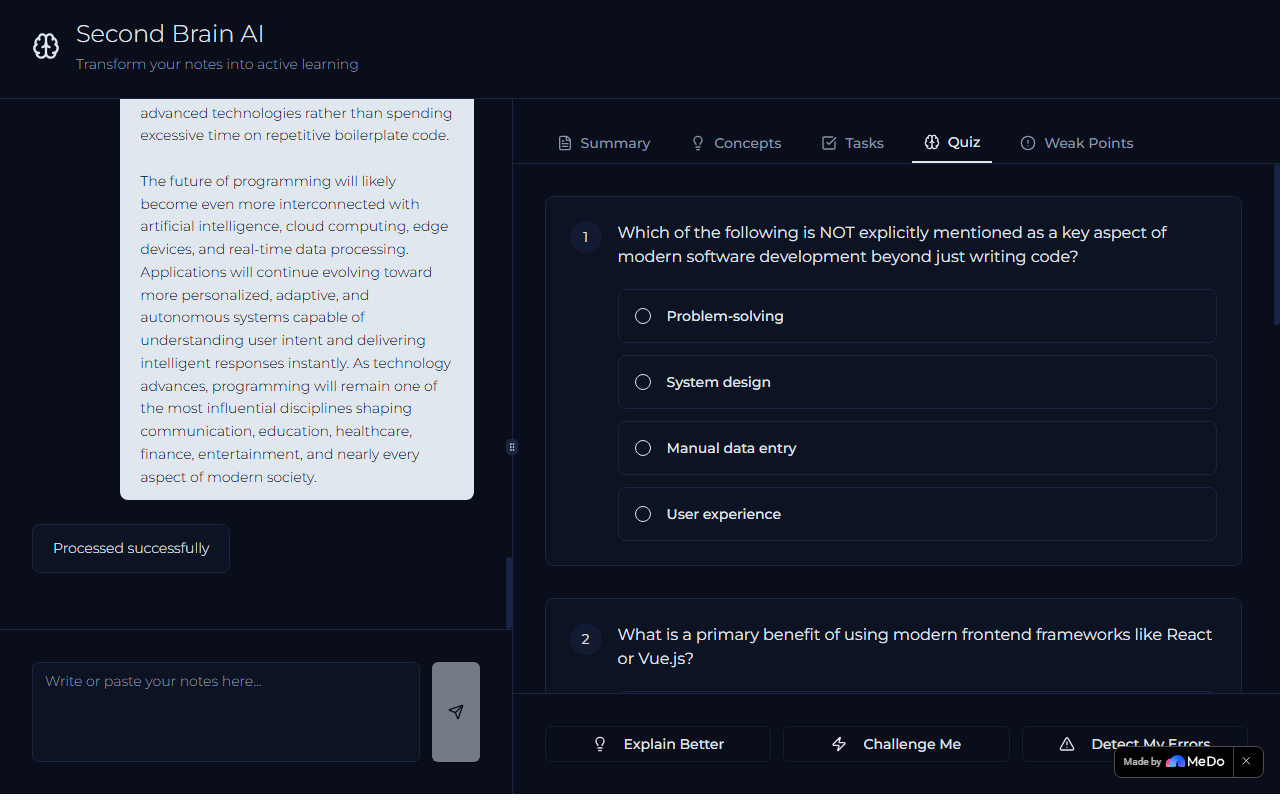
- Quiz: Fully dynamic, multi-question interactive assessments featuring immediate validation and rich explanations for every option.
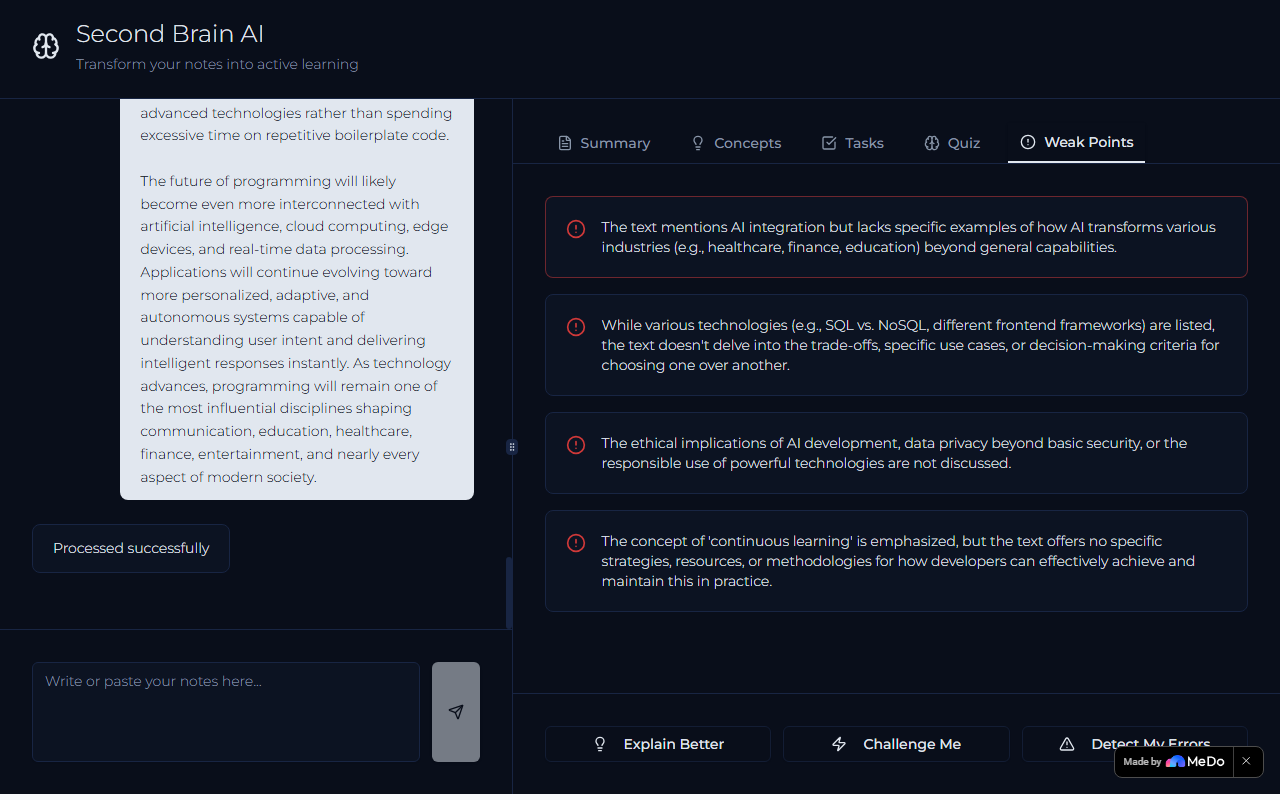
- Weak Points: An automated analytical diagnostic that scans your original material to identify potential gaps in knowledge, suggesting explicit pathways for deeper study.
How I built it
I built the platform utilizing a robust, ultra-fast tech stack meticulously scaffolded and accelerated by MeDo:
- Frontend Architecture: Developed using Next.js paired with TypeScript for rock-solid type safety and scalability, designed with a clean, high-performance, dark-mode-first interface using Tailwind CSS.
- AI Engine & Orchestration: Integrated directly with the Gemini API via backend API routes. I engineered tight structural system prompting to enforce the model to consistently output strict JSON schemas. This ensures that the generated analogies, multi-choice questions, and analytics parse perfectly into my frontend components without UI breaks.
Challenges I ran into
My biggest hurdle was preventing standard LLM conversational fluff and ensuring structural predictability. In early iterations, the AI would occasionally skip analogies or structure its quiz formats inconsistently. I overcame this by building heavily isolated asynchronous API routes, implementing strict string sanitization, and utilizing advanced prompt formatting techniques. Another challenge was fine-tuning the UI/UX so that switching between multiple data-heavy tabs felt intuitive, seamless, and lightning-fast.
Accomplishments that I'm proud of
- Going from an ambitious conceptual idea to a fully functioning, high-fidelity production app completely on my own in record time, using MeDo for sprint planning, architecture, and core codebase generations.
- Crafting a reliable backend prompt ecosystem that handles wildly diverse text inputs—from microservices architecture to cybersecurity protocols—and successfully generates highly accurate real-world analogies every single time.
- Building a beautiful, minimalist, and responsive "Apple-style" dashboard layout that keeps users entirely focused on the content they are studying.
What I learned
Building Second Brain AI gave me deep insights into building deterministic software behavior using non-deterministic AI models. I learned the immense value of rigid schema enforcement on AI outputs. Furthermore, working hand-in-hand with MeDo completely shifted my perspective on development speed, showing me how structured AI assistance can effortlessly streamline complex project planning and boilerplate setup.
What's next for Second Brain AI
I plan on turning Second Brain AI into a comprehensive workspace. My roadmap includes:
- Multi-document vector search engines (RAG) allowing users to upload entire PDFs or textbook chapters.
- Spaced-repetition flashcards synced directly with user-discovered Weak Points.
- An advanced progress dashboard with custom analytics to track learning growth over time.
Built With
- gemini-api
- medo
- next.js
- node.js
- tailwind-css
- typescript

Log in or sign up for Devpost to join the conversation.