Second Brain: A Knowledge Graph for ADHD Minds
Inspiration
Our project was born from a deeply personal challenge. Both my teammate Abdulrhman and I have ADHD, and we've struggled with the misconception that ADHD simply means "an inability to focus." The truth is far more complex.
People with ADHD don't lack the ability to focus - in fact, we can sometimes hyper-focus. What we actually struggle with is a prefrontal cortex that doesn't function in the typical way. This brain region usually acts as a filter, helping most people prioritize information and manage attention. For us, this filter operates differently, leaving us constantly overwhelmed by a flood of ideas, emotions, and information. Abdulrhman made a critical observation about his study habits. He would often feel like he had studied for hours, only to realize he had actually managed just 15 minutes of effective learning time. The rest was lost to distractions, thought tangents, and the mental exhaustion that comes from trying to organize too much information simultaneously. He suggested I try tracking my study time, and the results were transformative - my grades jumped from Cs and Ds to consistent As and A+s. But we still faced a fundamental mismatch between available tools and our cognitive styles.
Research consistently shows that ADHD brains exhibit distinctive neural connectivity patterns. According to studies published in journals like Frontiers in Human Neuroscience and NeuroImage, ADHD is associated with altered connectivity in the default mode network (DMN) and task-positive networks, resulting in non-linear, associative thinking patterns. Dr. Russell Barkley's research highlights that ADHD involves differences in executive function that affect how information is organized and processed. A 2019 study in Nature Scientific Reports demonstrated that ADHD minds often excel at divergent thinking—generating creative connections across seemingly unrelated domains—but traditional productivity tools enforce rigid, hierarchical structures that actively work against these natural thought patterns.
While neurotypical individuals might benefit from linear outlines and strict categorization, these same systems can create cognitive friction for those with ADHD. Dr. Ned Hallowell, a leading ADHD researcher, describes ADHD thinking as "having a Ferrari engine with bicycle brakes"—powerful, associative, and connection-driven, but challenging to channel through conventional organizational systems.
We envisioned a tool that would leverage these cognitive differences as strengths rather than limitations. Second Brain doesn't just track time—it helps visualize knowledge in a way that mirrors how ADHD minds naturally think: through networks, associations, and interconnected concepts rather than linear sequences. This approach aligns with research on cognitive mapping showing that externally representing internal thought networks reduces cognitive load and enhances learning outcomes for individuals with ADHD.
What it does
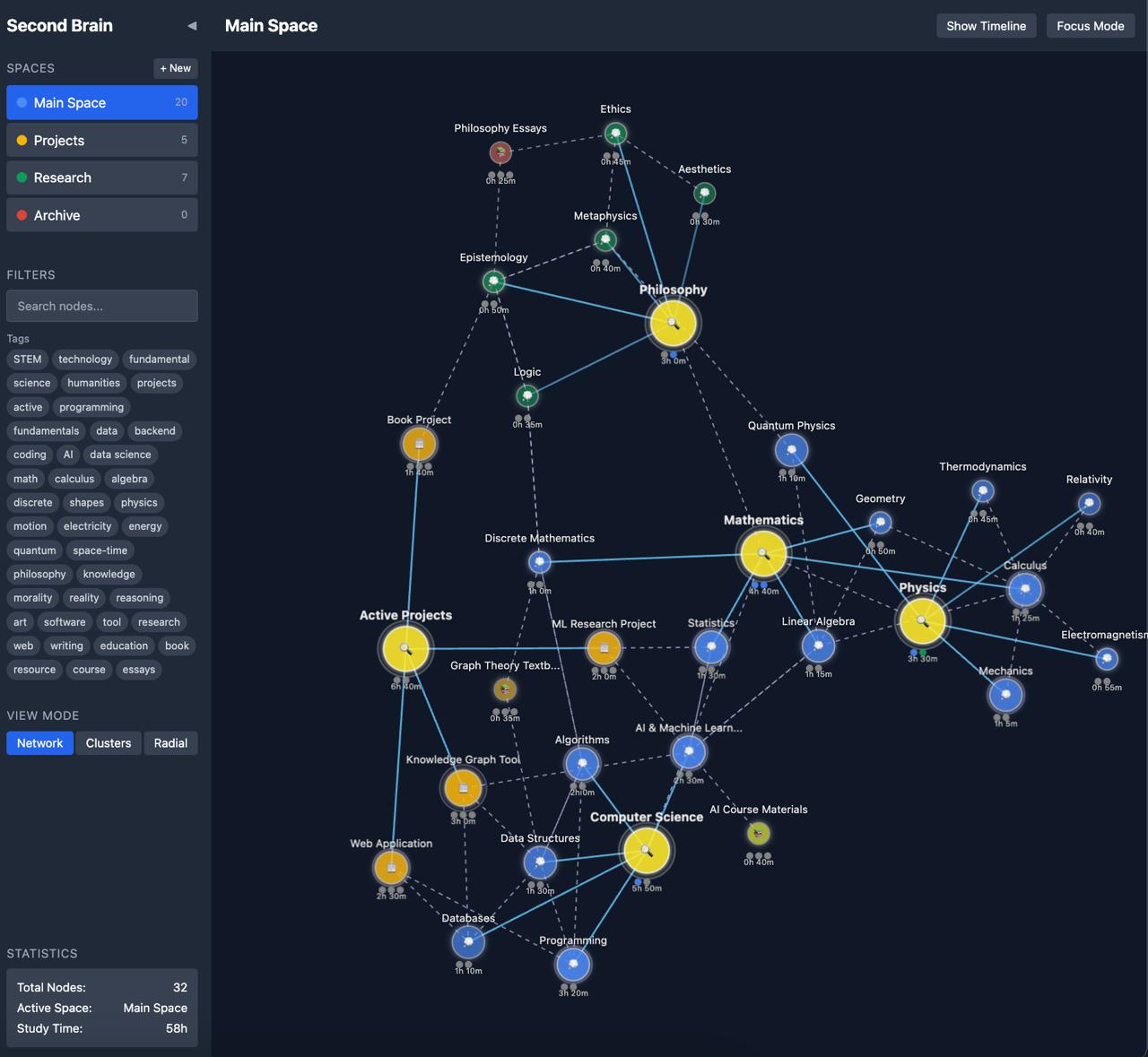
Second Brain is a dynamic knowledge management system specifically designed for neurodivergent thinking patterns. It creates an interactive, visual graph of your knowledge where:
- Concepts become nodes that can be organized hierarchically but also connected across different domains.
- Connections between ideas are visually represented, helping users see relationships that traditional note-taking systems might miss.
- Time tracking is seamlessly integrated, showing not just how long you've engaged with a topic, but how that engagement has evolved over time.
- Multiple visualization modes (network, cluster, radial) accommodate different ways of thinking about your knowledge.
- Color coding and visual cues help manage information overwhelm by providing instant context.
- Timeline feature addresses time blindness by visualizing your learning journey and engagement patterns.
For ADHD minds that struggle with traditional knowledge organization systems, Second Brain offers a way to externalize the rich, interconnected thought patterns we naturally experience, making them easier to navigate, expand, and share.
How we built it
We built Second Brain as a React application with a focus on powerful visualization capabilities: Core visualization engine: We used D3.js to create the force-directed graph that forms the heart of the application, allowing for dynamic, physics-based layouts that feel intuitive and responsive.
Data modeling: We designed a flexible data structure that supports both hierarchical organization (for traditional categorization) and network-based connections (for ADHD-friendly associative thinking).
UI/UX design: We created a dark-themed interface to reduce visual strain during extended sessions, with careful attention to color contrast and visual hierarchy.
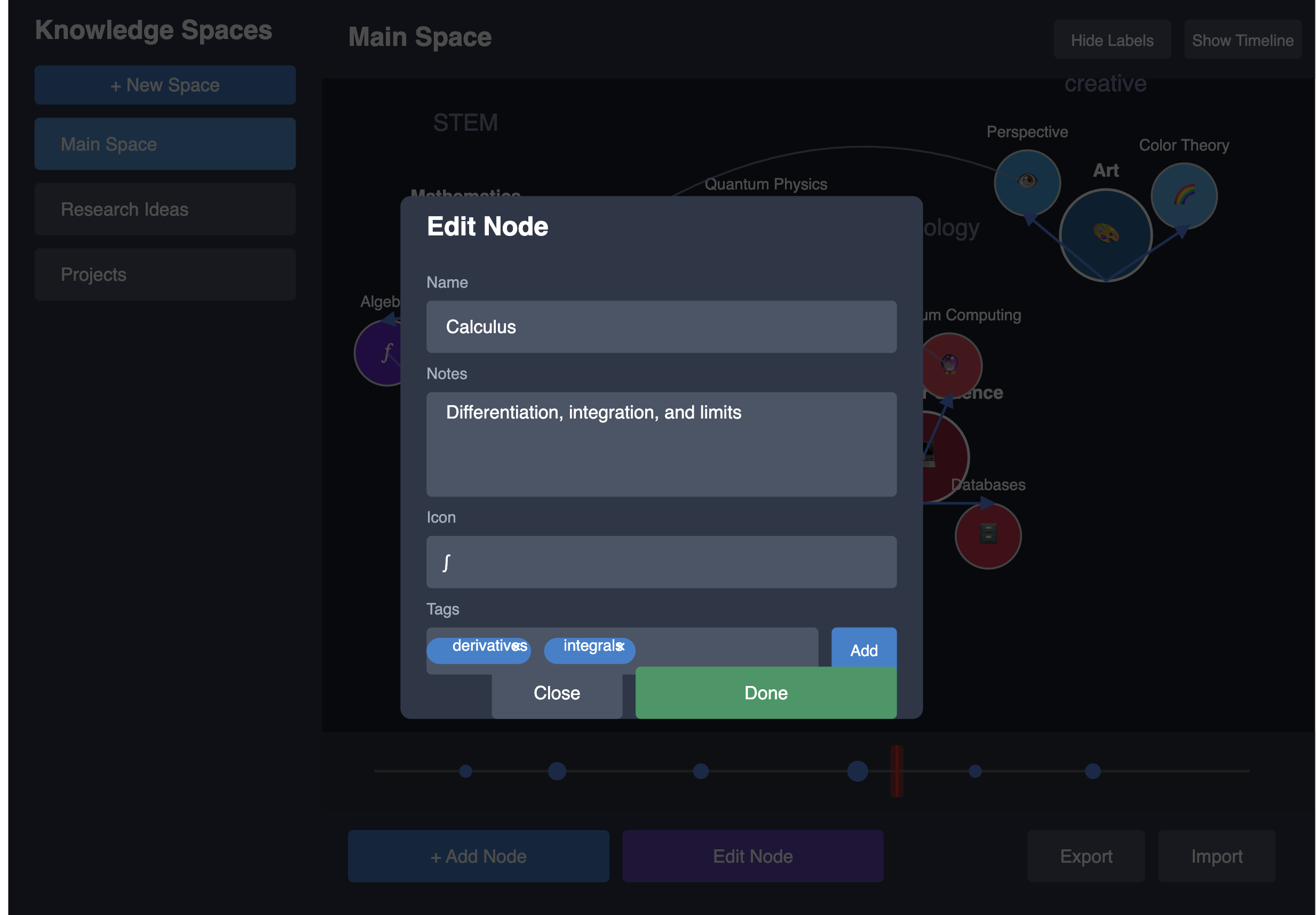
Interaction design: We implemented multiple interaction modes including dragging, zooming, filtering, and timeline navigation to give users many ways to explore their knowledge landscape.
Time tracking system: We built a comprehensive system for recording and visualizing time spent on different topics, with an emphasis on making patterns visible rather than just counting minutes.
Challenges and Solutions
In developing Second Brain, we encountered technical hurdles that led to innovative solutions: Visualization complexity: Creating an interface that represents rich knowledge networks without overwhelming users required balancing visual density with clarity. We solved this by implementing adaptive visibility controls and multiple view modes that filter information based on relevance. Performance engineering: We optimized our D3.js implementation with efficient data structures and rendering techniques, allowing smooth interaction even with hundreds of interconnected nodes.
Intuitive knowledge mapping: Rather than seeing ADHD's non-linear thinking as a challenge, we embraced it as a design principle, creating flexible connection mechanisms that allow for association-based organization that feels natural to neurodivergent users. Meaningful time visualization: We developed a timeline view that emphasizes patterns and insights rather than raw productivity metrics, transforming time tracking from a potential source of stress into a tool for self-understanding.
Accomplishments that we're proud of
Despite these challenges, we achieved several breakthroughs we're particularly proud of:
- Creating a tool that actually works with ADHD brains rather than forcing us to adapt to neurotypical organizational patterns
- Developing a visualization system that genuinely represents the richness of interconnected thinking that is often a strength of ADHD minds
- Building a time-tracking approach that doesn't feel punitive but instead helps users understand and leverage their natural attention patterns
- Designing an interface that reduces overwhelm while still presenting complex information
- Translating our personal experiences with ADHD into concrete features that can help others with similar challenges
- Seeing real-world impact as early testers reported significant improvements in their learning outcomes and reduced anxiety around knowledge management
What we learned
This project has been a profound learning journey, both technically and personally: Technical skills: We deepened our understanding of D3.js, React performance optimization, and interaction design for complex data visualization.
- ADHD insights: We gained clearer insights into how our own minds work and how to build tools that accommodate rather than fight against our natural thinking patterns.
- User research: We learned that many productivity tools inadvertently create friction for neurodivergent users by imposing rigid organizational structures.
- The power of externalization: We discovered how powerful it can be to externalize the mental models in our heads, making them tangible and manipulable.
- Accessibility considerations: We gained a deeper appreciation for how digital tools can either create or remove barriers for different neurotypes.
- The importance of time awareness: We learned that improving time awareness without inducing anxiety is crucial for ADHD productivity.
What's next for Second Brain
We're just getting started with Second Brain, and our roadmap includes:
- Collaboration features: Enabling shared knowledge graphs for teams, study groups, and classrooms
- AI integration: Implementing machine learning to suggest connections between concepts that users might not have considered
- Import capabilities: Building tools to import notes from popular systems like Obsidian, Notion, and Evernote
- Spaced repetition: Integrating learning science principles to help users review concepts at optimal intervals
- Mobile companion: Developing a mobile app for on-the-go capture of ideas and time tracking
- Expanded analytics: Creating more insights about learning patterns, productive times, and knowledge growth
- API development: Enabling integration with other productivity and learning tools Our vision is to create not just a tool, but an ecosystem that helps neurodivergent minds harness their unique strengths while navigating a world often designed for neurotypical thinking patterns.
About the project
Second Brain emerged from our personal struggles with ADHD and the frustration of tools that didn't match how our minds naturally work. The common misconception is that people with ADHD can't focus, but the reality is more nuanced - we don't have the same filtering mechanisms that most people do. Without these filters, we're constantly bombarded by ideas, emotions, and sensory input that others might automatically prioritize or dismiss.
When Abdulrhman suggested tracking my study time, it was a revelation. I discovered vast gaps between my perception of time spent studying and reality. With proper tracking and organization, my academic performance transformed from barely passing to excelling. But traditional time trackers and note-taking apps never felt right. They were too linear, too rigid. Our ADHD minds think in networks, associations, and connections - jumping from one idea to another in ways that make perfect sense to us but don't translate well to bullet points or folders. Second Brain visualizes knowledge the way we naturally think about it - as an interconnected web where everything relates to everything else. It helps address time blindness (losing track of how long we've been doing something) and overwhelming information flow by externalizing our mental landscape into something we can see, interact with, and share.
This project isn't just about productivity - it's about embracing neurodiversity and creating tools that work with our minds rather than against them. For those of us who feel constantly overwhelmed by the richness of our own thoughts, Second Brain offers a way to transform what can feel like chaos into beautiful, navigable complexity.
Built With
- algorithms
- api
- babel
- css
- d3.js
- es6+
- export/import
- force-directed
- graph
- javascript
- json
- local
- lodash
- node.js
- react.js
- rendering
- storage
- svg
- tailwind
- webpack
