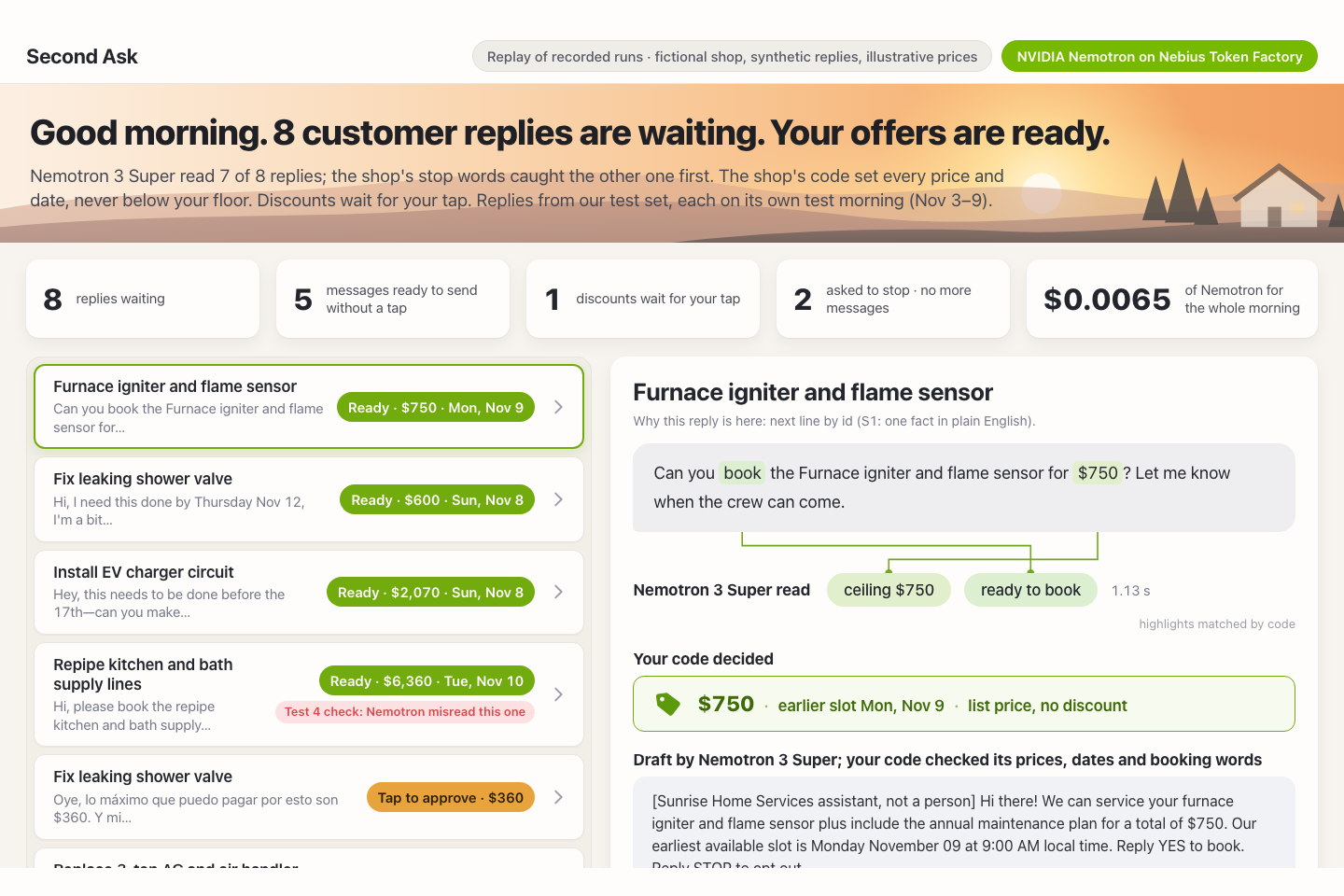
Second Ask is a follow-up assistant for home-service shops. Customers answer estimates in the evening, in any words and sometimes in Spanish: "no ridge vent, done by Tuesday, not over $2,750", "my landlord has to agree first", "please don't contact me again". By morning, the shop's stop-word check and NVIDIA Nemotron 3 Super on Nebius Token Factory have read every reply, the shop's own code has turned each one into an offer or a stop, and the owner only has to look at the discounts.
Demo (a replay of recorded runs, synthetic replies, no live model calls): https://second-ask.retailbox-automation.com/?r=devpost-nebius
Video (2:23): https://youtu.be/JFwXhn1dC90
What it does
For each customer reply:
- A stop request ends the conversation in code, before any model call, when it uses the usual stop words.
- Nemotron 3 Super reads the reply into a few facts: the most the customer will pay, optional items they don't want, a deadline, a wait, someone else who must agree, a request to stop, ready to book.
- The shop's code turns those facts into the offer: price from the shop's menu and never below the owner's floor, the earliest open day (the message says so when it is after the customer's deadline), a check-back date, or no message.
- Nemotron 3 Super writes the message around that offer. The code checks every dollar amount, percent, date, weekday, month and day-count in the text, and any claim that the job is already booked; a text that does not match is replaced by the code's template.
- A price below the list waits for the owner's one tap. Quiet hours, Florida's three-a-day cap and the disclosure that it is an assistant are enforced in code. When the customer says yes, Nemotron 3 Super books the job with a tool loop (tested offline; not part of the recorded runs).
If the customer stays silent, the code alone decides the follow-up.
A recorded morning, on Token Factory (the first run after our last code change, kept as it came out): 8 replies (7 read by Nemotron, 1 ended by the code's stop words), 6 offers ready, 1 of them a discount waiting for the owner's tap, 2 stop requests honoured, $0.0065 of Nemotron and 15.6 seconds of model time in all. One of the eight is a reply Nemotron misread in our test: it took a price the customer repeated as their limit. This morning it read that reply right. When it does misread that way, the price falls below the list and the code holds the offer for the owner's tap. On another reply this morning it read a repeated list price ($750) as the customer's limit; that price was already the list, so the offer did not change.
Why the code decides the price
We tested that four times and wrote each test down before running it.
- Tests 1 and 3 (test 2 stopped at its own gate before its main run): Nemotron chose the shop's next move in a simulator with 200 customers, against a rulebook we wrote. It never clearly beat the rulebook: our first design came out $181 per customer behind [-$319, -$65], Super on its own showed no clear difference, and rules first with Nemotron only where the rules didn't know came out $71 behind [-$159, -$9]. So the money decisions went back into code.
- Test 4: Nemotron only reads. On 600 synthetic replies frozen before the run, the shop sent the same offer as a perfect read on 99.0 % of replies with Nemotron 3 Super reading and 99.33 % with a rulebook hardened on the same writer's replies. Verdict: no clear difference (paired difference -0.33 points [-1.33, +0.67]; the rule needed +10). On those replies, 48 asked the shop to stop: the rulebook missed 2 and Nemotron Super missed none. The replies are generated, so the count shows the kind of miss a rulebook makes and says nothing about the rate in a real inbox.
- Other sizes on the same 600 replies, for reference: Ultra 100.0 %, Super-VL 99.83 %, Lightning 96.17 % (Lightning missed 10 of the 48 stops).
How we built it
- Every model call goes to Nebius Token Factory through one client with a hard spend cap in code (the console has none).
- The reader is the one frozen for test 4: same prompt, same settings, and a test checks that the live app feeds it byte-identical input on all 600 test lines.
- The offer code (
second_read/offer.py) is shared by both readers in test 4 and by the app, so a difference in the offer can only come from reading. - Pre-registration: each test's manifest or freeze (code hashes, decision rule, budget) was committed and pushed before the run. Test 4's freeze is commit 9502754, pushed before its 600 test replies were generated.
- Test data is synthetic and written by models that are not NVIDIA (DeepSeek-V4-Flash wrote the replies, Qwen3-235B checked them blind), so Nemotron never grades itself.
- Spend: everything this entry ran on Token Factory, platform spikes and the four tests included, came to about $10.75 (the four tests alone, with their smokes and prompt work, about $10.2); the recorded morning cost $0.0065 of that.
What didn't work, and limitations
- When Nemotron chose the moves (tests 1 and 3), it never clearly beat a rulebook we wrote knowing the simulator: two designs came out behind, and the other sizes showed no clear difference.
- Test 4 cannot separate the readers: both are near the ceiling on these replies, and the rulebook was tuned on 200 replies from the same writer. Real customer replies are the open test.
- Nemotron's own misses in test 4: 4 times it took a price the customer repeated as their limit, once it missed a dropped item, once it read "a couple months or so" as 2 weeks.
- The recorded morning uses 8 test replies picked by a rule in code (one Nemotron miss, one rulebook miss, one stop request without the word "stop", the rest by id across all reply types). The shop is made up.
- The compliance rules are applied conservatively and are not legal advice.
Every test number above is in the repository: RESULTS.md (all four tests, with intervals and limitations), data/second_read/ (test 4), demo/data/read_first_morning.json (the morning). The total spend comes from our client's spend ledger.
Built With
- cloudflare-pages
- deepseek
- nebius-token-factory
- nemotron-lightning
- nemotron-super
- nemotron-super-vl
- nemotron-ultra
- nvidia-nemotron
- pytest
- python
- qwen3
