The $50K Typo
We are AI researchers from LG Electronics who spent two years working alongside hardware engineers. We watched brilliant teams design complex circuit boards, only to see their work fail in production because of "trivial" inconsistencies—a voltage value in a PDF datasheet that didn't match the schematic, or a Build of Materials (BOM) that wasn't updated after a design change.
In hardware, these aren't just bugs; they are re-spins. A single re-spin caused by a missed conflict costs more than $50K and delays product launches by weeks. We realized that existing PLM tools (like Teamcenter) only store files; they don't understand them.
What We Built
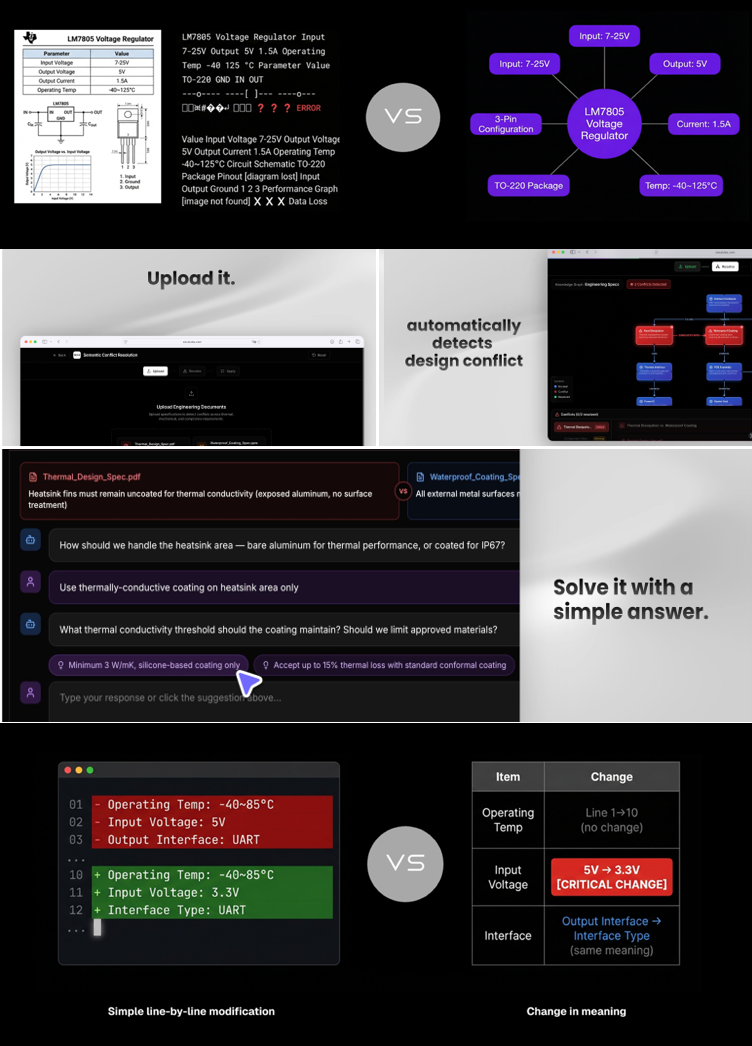
We built SECA, an AI agent that automatically cross-checks hardware design files. Unlike generic text comparison tools, SECA understands the semantic relationships between signal voltages, component specifications, and firmware requirements. It acts as an automated reviewer that flags conflicts the moment a design file changes.
Challenges & Execution
The biggest technical challenge was data heterogeneity. Hardware data lives in disconnected silos: unstructured PDF datasheets, structured Excel BOMs, and proprietary CAD formats. To solve this, we pivoted from a broad data approach to a domain-specific solution. We built a system that ingests these diverse formats and maps them into a unified knowledge graph. We validated this through 100 customer interviews and 5 parallel PoCs.
Current Status
Today, SECA is live in production. It is currently being used by ~400 engineers at LG Electronics across 200,000+ active product lines, where it has already caught ~700 conflicts that would have otherwise required manual review or caused production failures.
Built With
- amazon-web-services
- crewai
- docker
- gemini
- gpt
- neo4j
- next.js
- python
- search
- snowflake


Log in or sign up for Devpost to join the conversation.