-
-
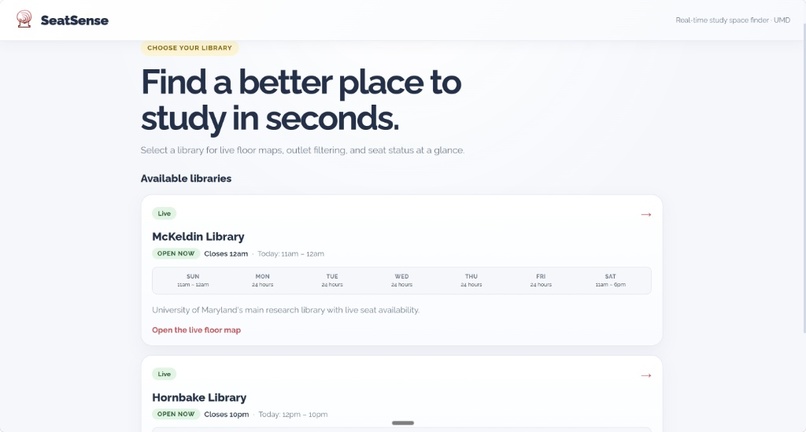
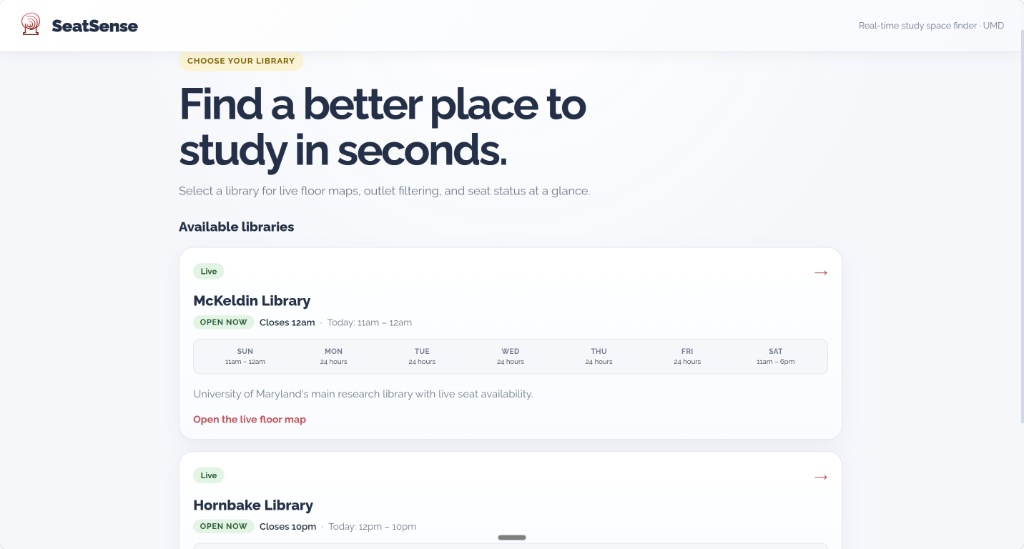
Landing page
-
-
-
-
-
-
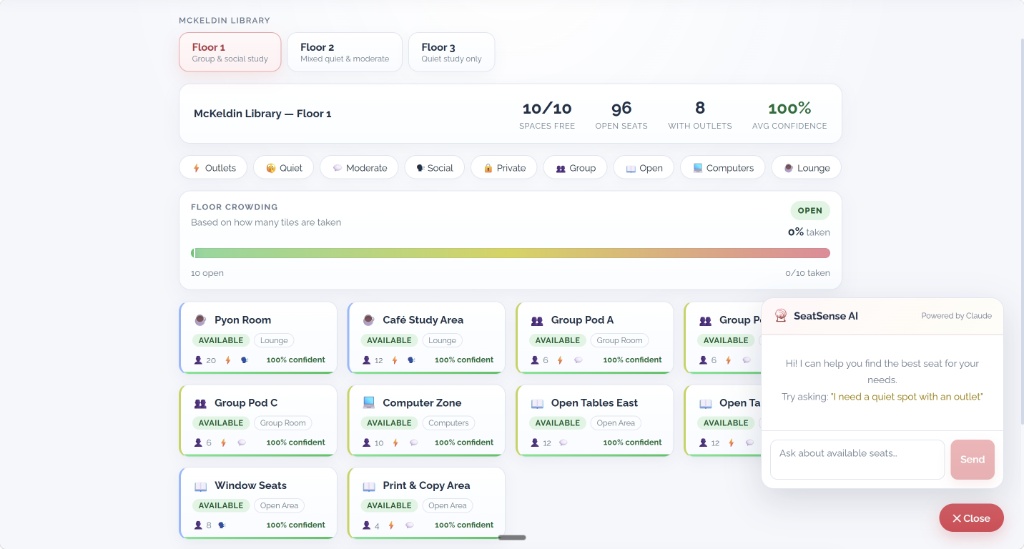
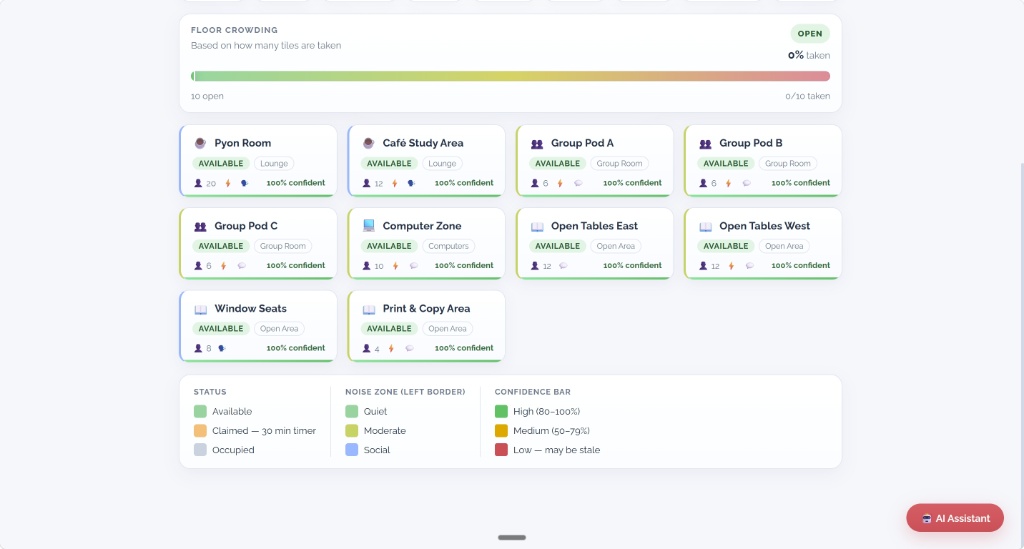
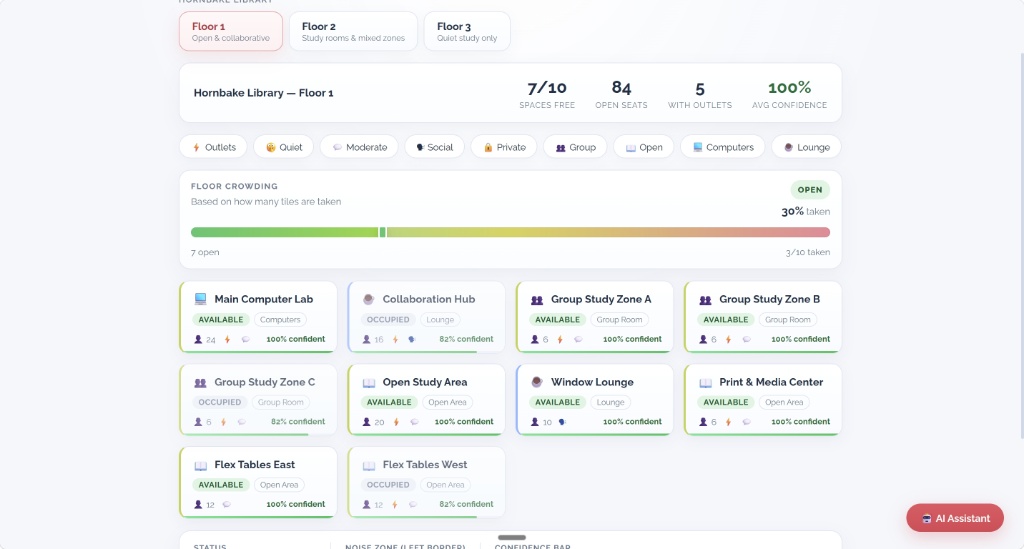
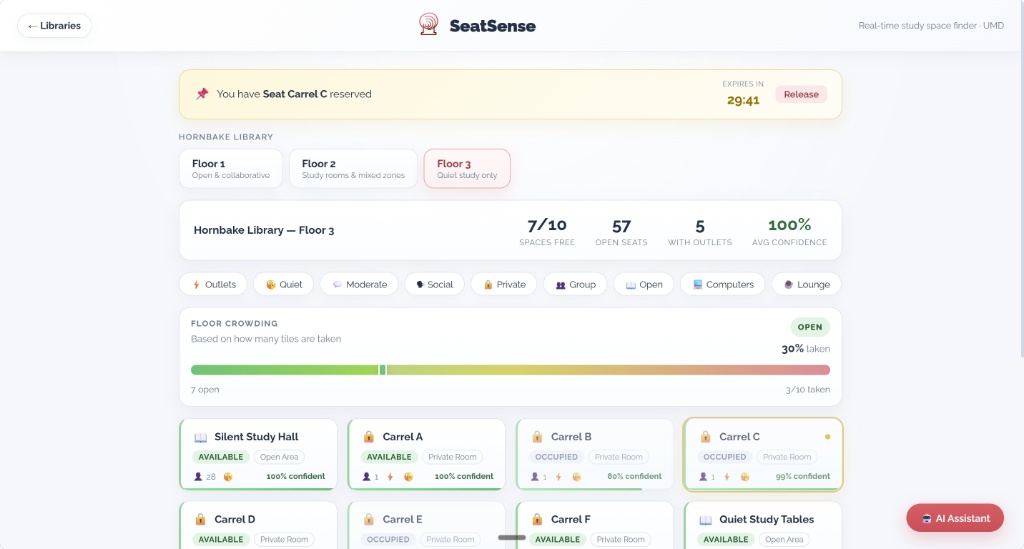
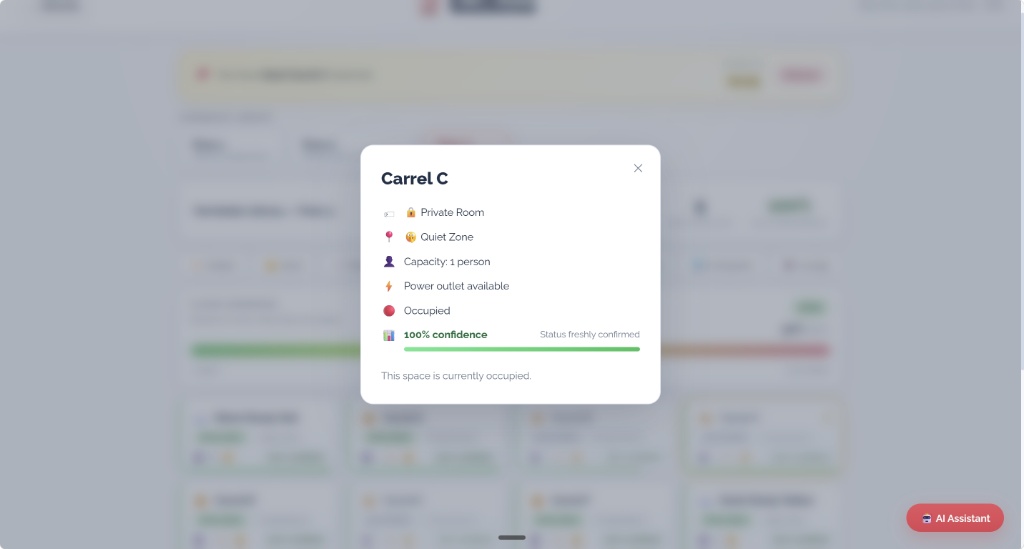
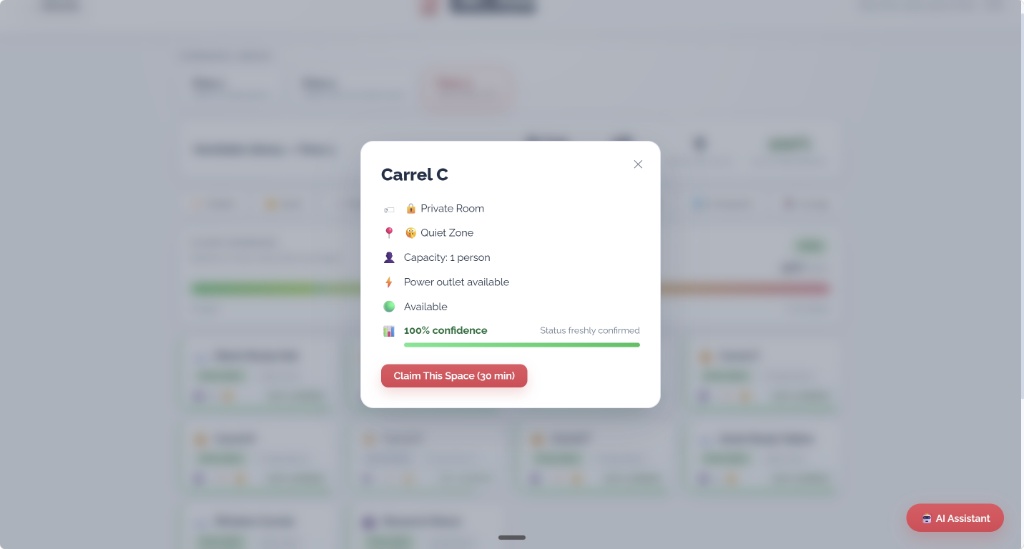
The inspiration for SeatSense came from the "McKeldin Marathon"—the frustrating experience of hiking up four flights of stairs only to find every single desk occupied and every outlet claimed. We realized that while UMD provides world-class study spaces, students lack a real-time "operating system" to navigate them. We wanted to eliminate the guesswork and physical fatigue of finding a place to work, allowing students to focus on what actually matters: their education.
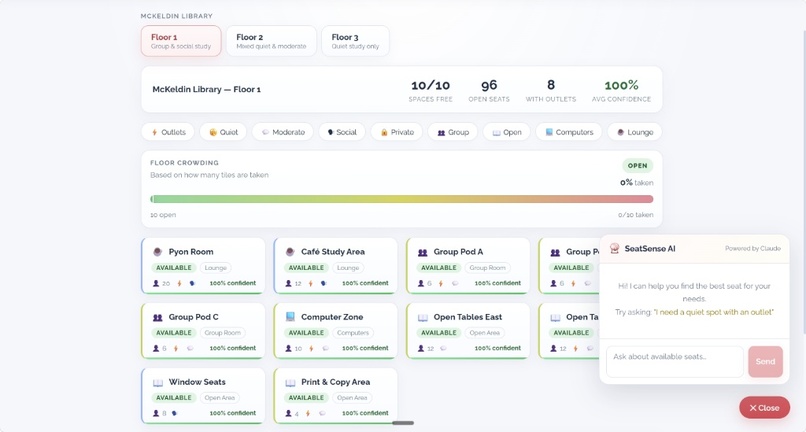
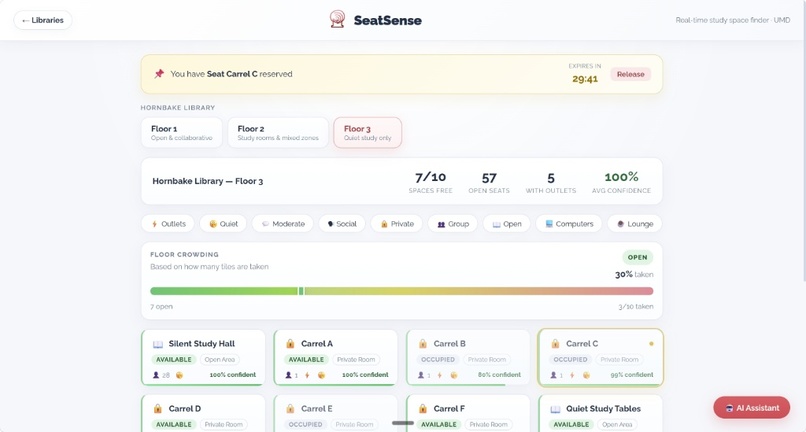
SeatSense is a real-time study space management platform that provides live floor maps, outlet filtering, and seat status at a glance.
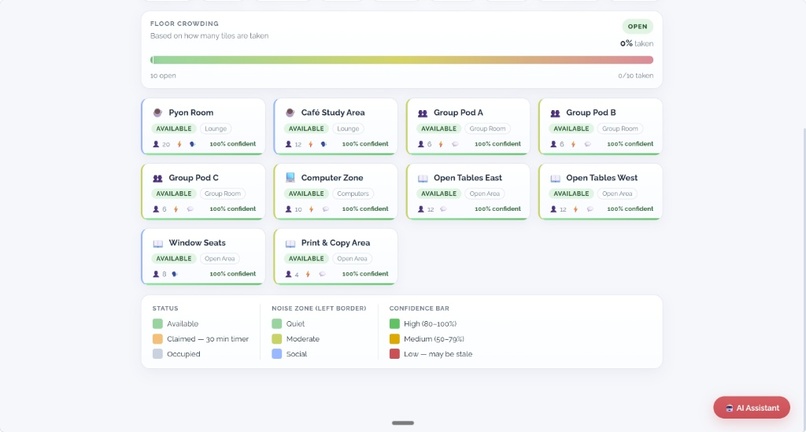
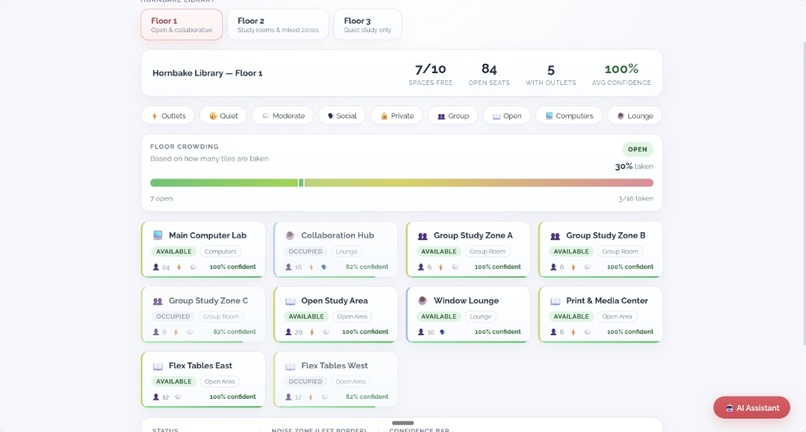
Live Occupancy: Users can see exactly how many seats and outlets are available on any given floor at McKeldin or Hornbake.
Zone Intelligence: Floors are categorized by "Noise Zones" (Quiet, Moderate, Social) so students can find an environment that matches their current task.
SeatSense AI: A conversational assistant powered by Google technology that allows users to find spots using natural language, such as "Find me a quiet spot with an outlet."
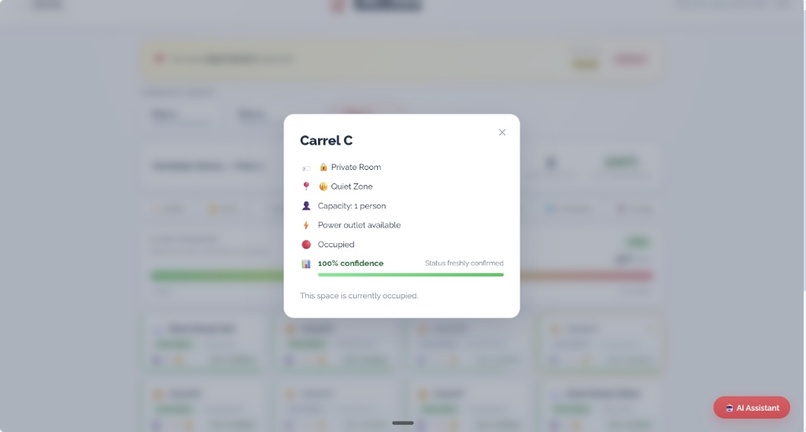
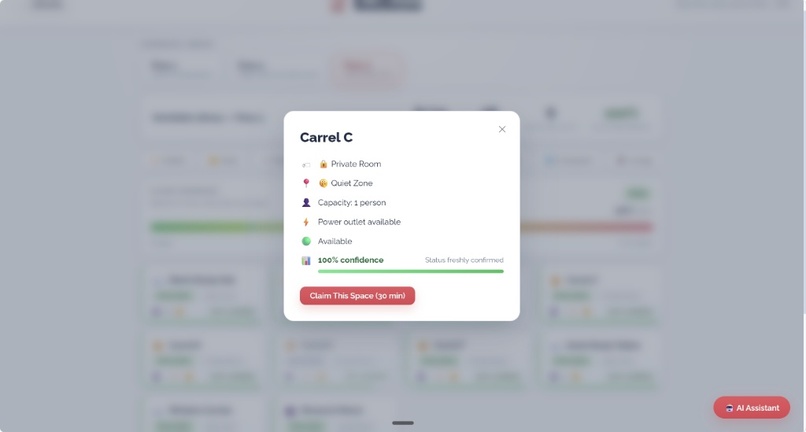
Temporary Reservations: A "Claim" feature allows students to hold a spot for 30 minutes while they walk to the library, preventing "seat poaching."
The project was built using a modern full-stack approach with a focus on real-time data synchronization:Frontend: Developed with React and Tailwind CSS for a responsive, clean UI.Backend & AI: We integrated Google Cloud natural language models to power the SeatSense AI assistant.Data Modeling: We used a confidence-scoring algorithm to verify data freshness. If $n$ represents the number of recent user check-ins and $t$ is the time since the last update, our confidence $C$ is calculated as:$$C = \frac{n}{1 + e^{k(t - t_0)}}$$where $k$ and $t_0$ are constants tuned to peak library hours. This ensures users always know how "stale" or "fresh" a seat status is.
One of our biggest hurdles was the "Concurrency Problem", ensuring that two students didn't try to claim the same carrel at the same microsecond. We had to implement a robust locking mechanism in our database to handle high-traffic periods. Additionally, designing a UI that could display high-density information (outlets, noise, confidence, capacity) without feeling cluttered took several iterations and user-testing sessions.
We are incredibly proud of the SeatSense AI integration. Moving beyond simple buttons and filters to a conversational interface makes the app feel like a personal concierge rather than just a spreadsheet. We are also proud of our "Confidence Bar" logic, which brings transparency to the "live" data, a feature we haven't seen in existing campus apps.
This hackathon was a deep dive into User Experience (UX) for high-stress environments. We learned that when a student is stressed during finals, every extra click feels like a burden. This led us to simplify our flow down to the "One-Tap Claim." Technically, we gained significant experience in integrating Google's AI tools into a live React environment and managing real-time state transitions.
The next step for SeatSense is hardware integration. We envision using low-cost IoT pressure sensors or infrared sensors under desks to automate the "Occupied" status, removing the need for manual check-ins. We also hope to expand to more UMD locations, such as the STAMP Student Union and the Iribe Center, eventually creating a university-wide "Smart Campus" map.
Built With
- css
- gemeni
- raleway
- react
- sql
- supabase
- typescript
- vite

Log in or sign up for Devpost to join the conversation.