-
-
SeatSafe: Buy and resell tickets without getting scammed or price-gouged.
-
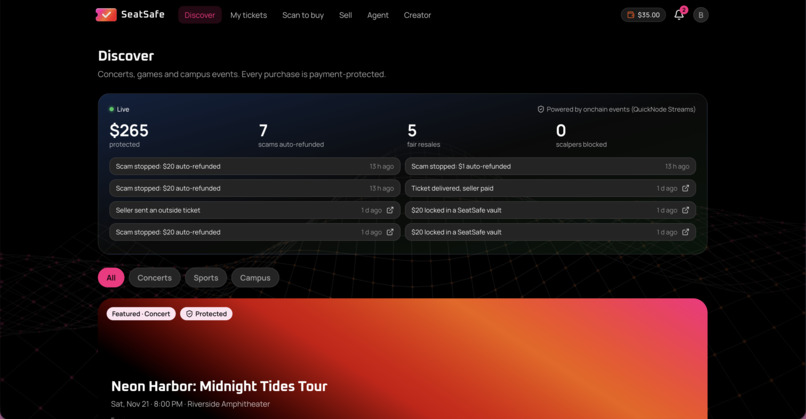
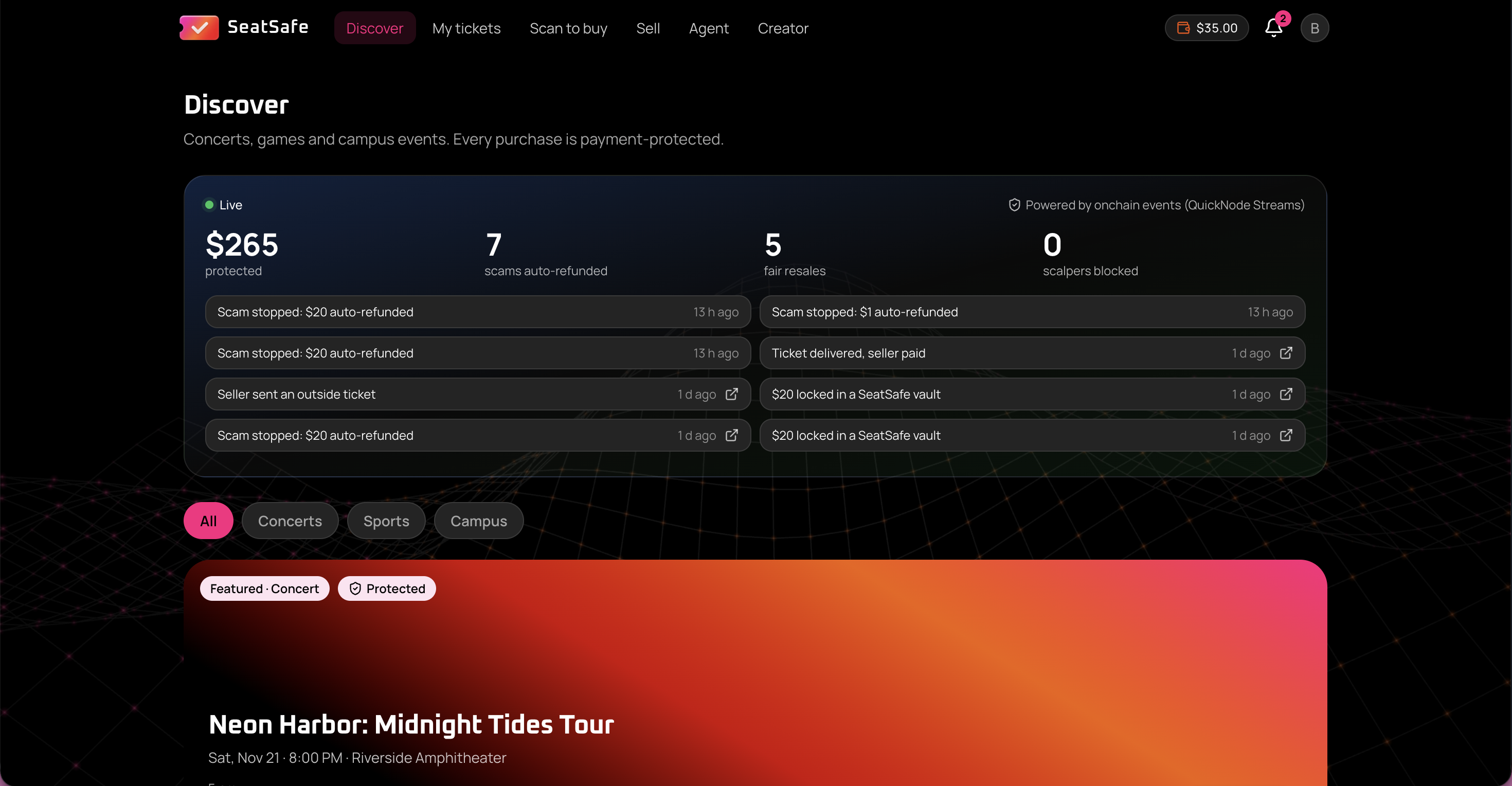
Landing page to discover events and tickets
-
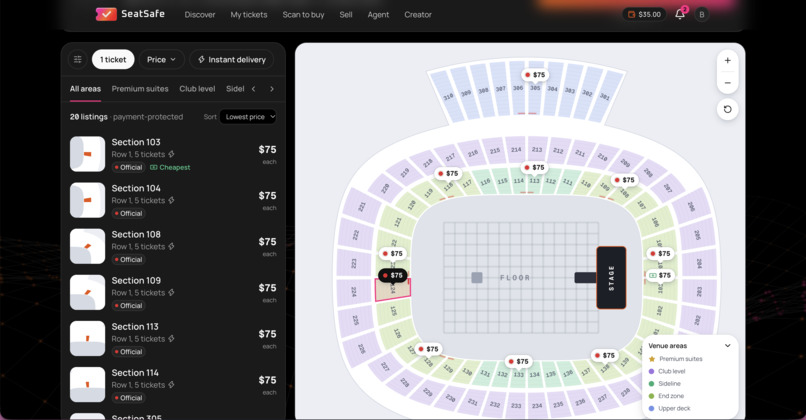
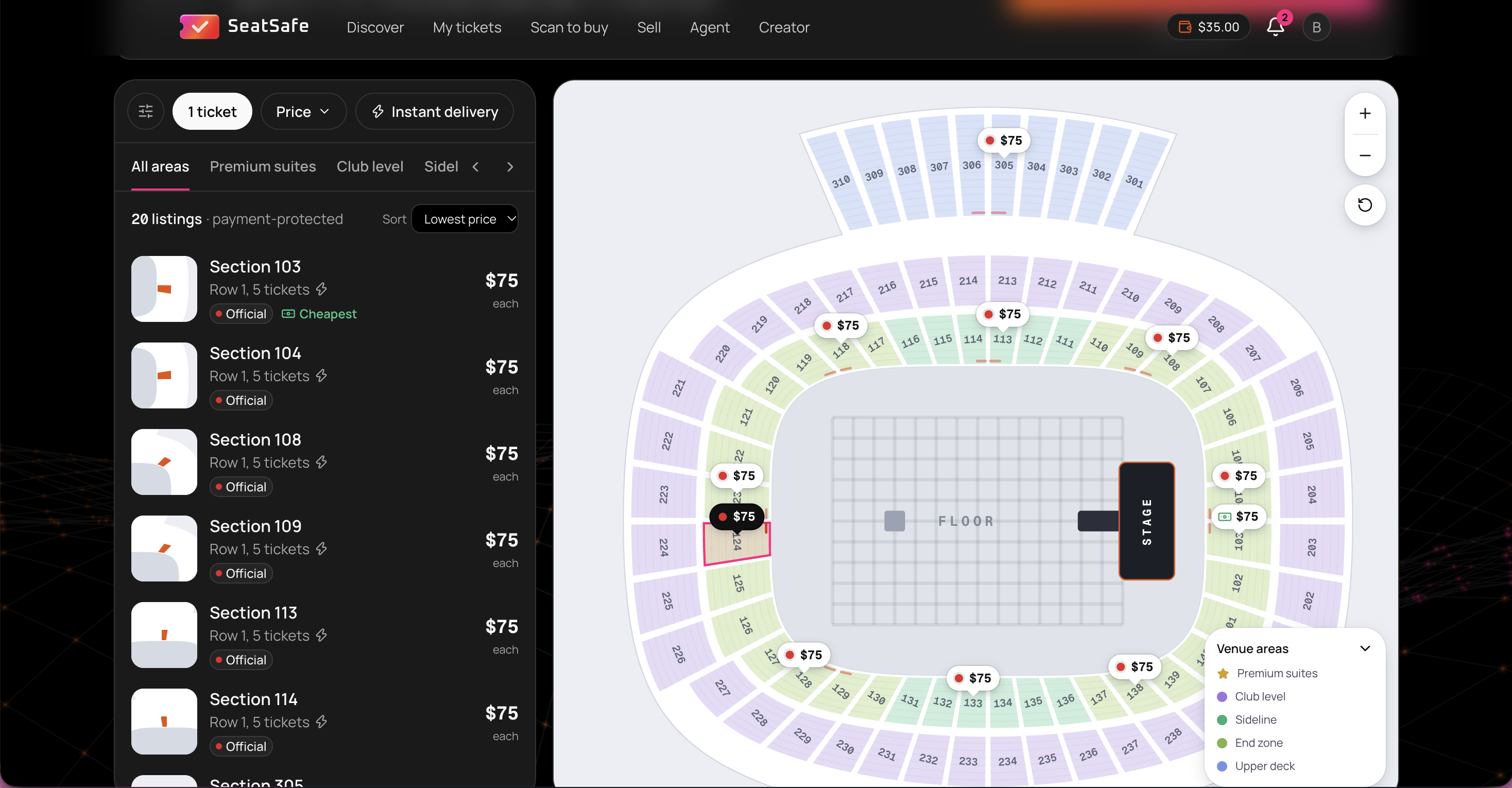
Seat and ticket selection
-
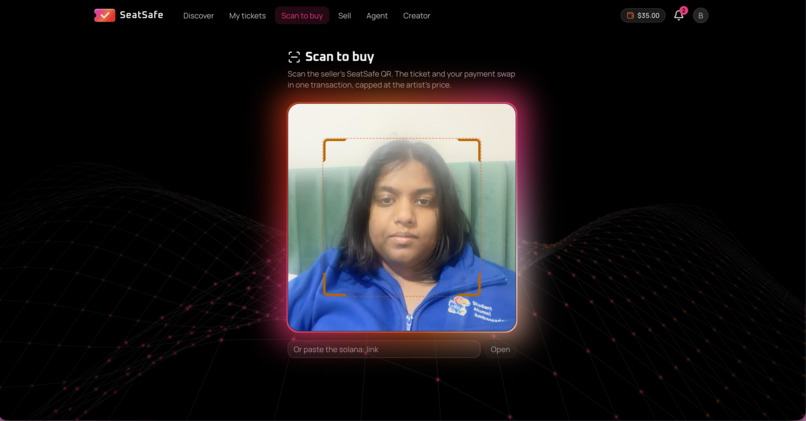
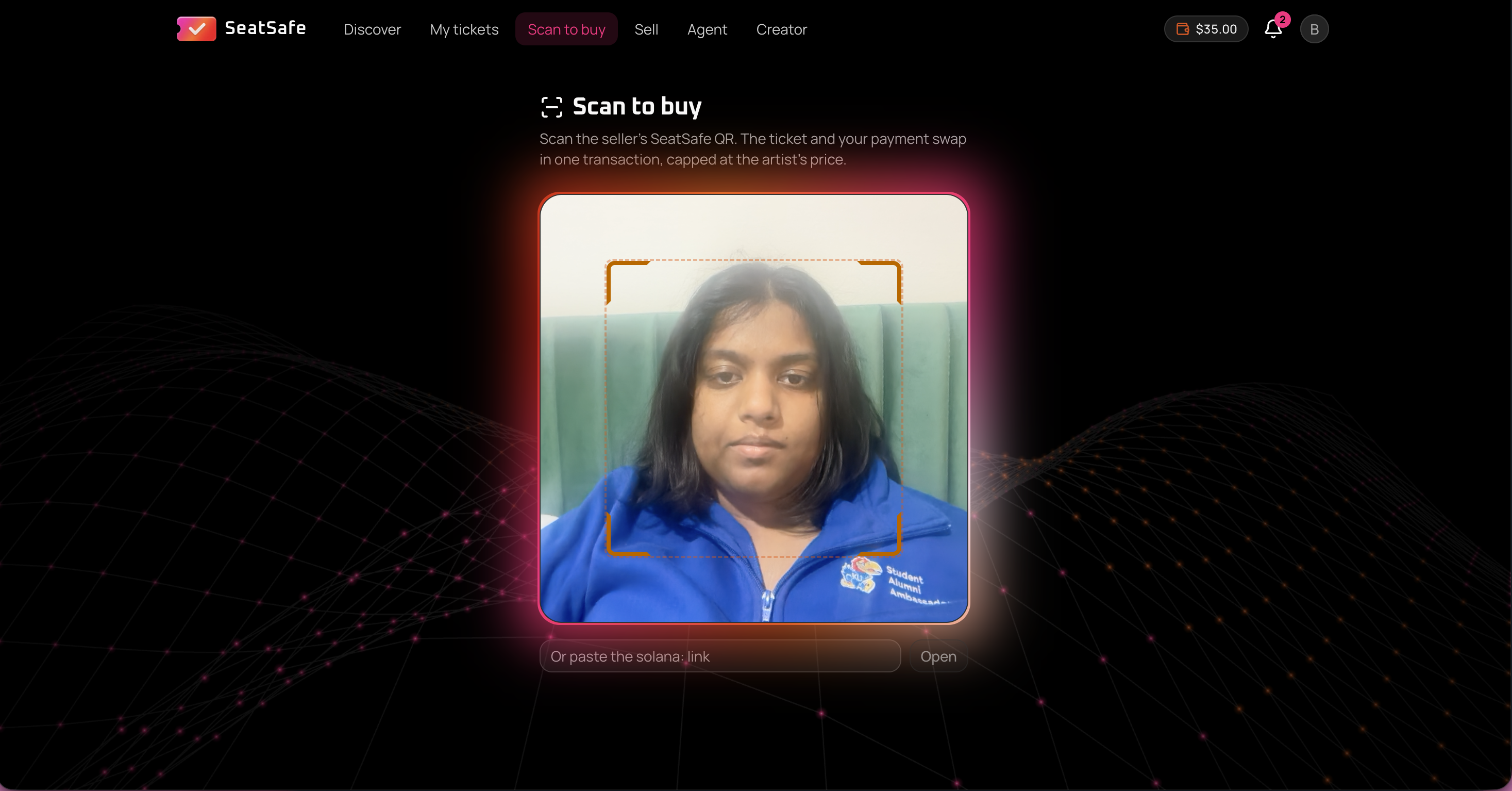
Scan a ticket to resell or buy!
-
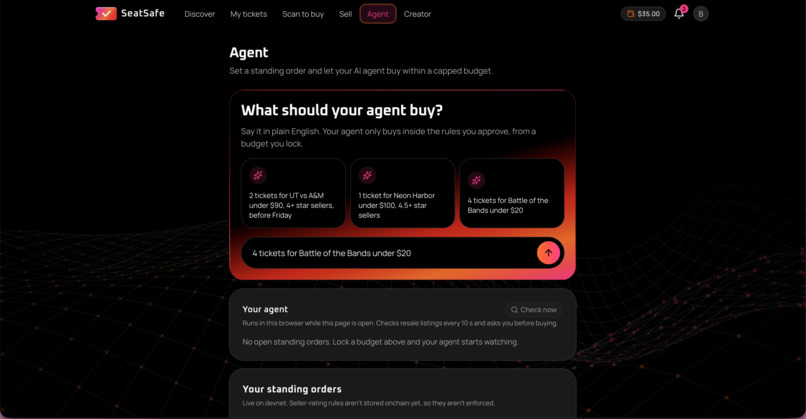
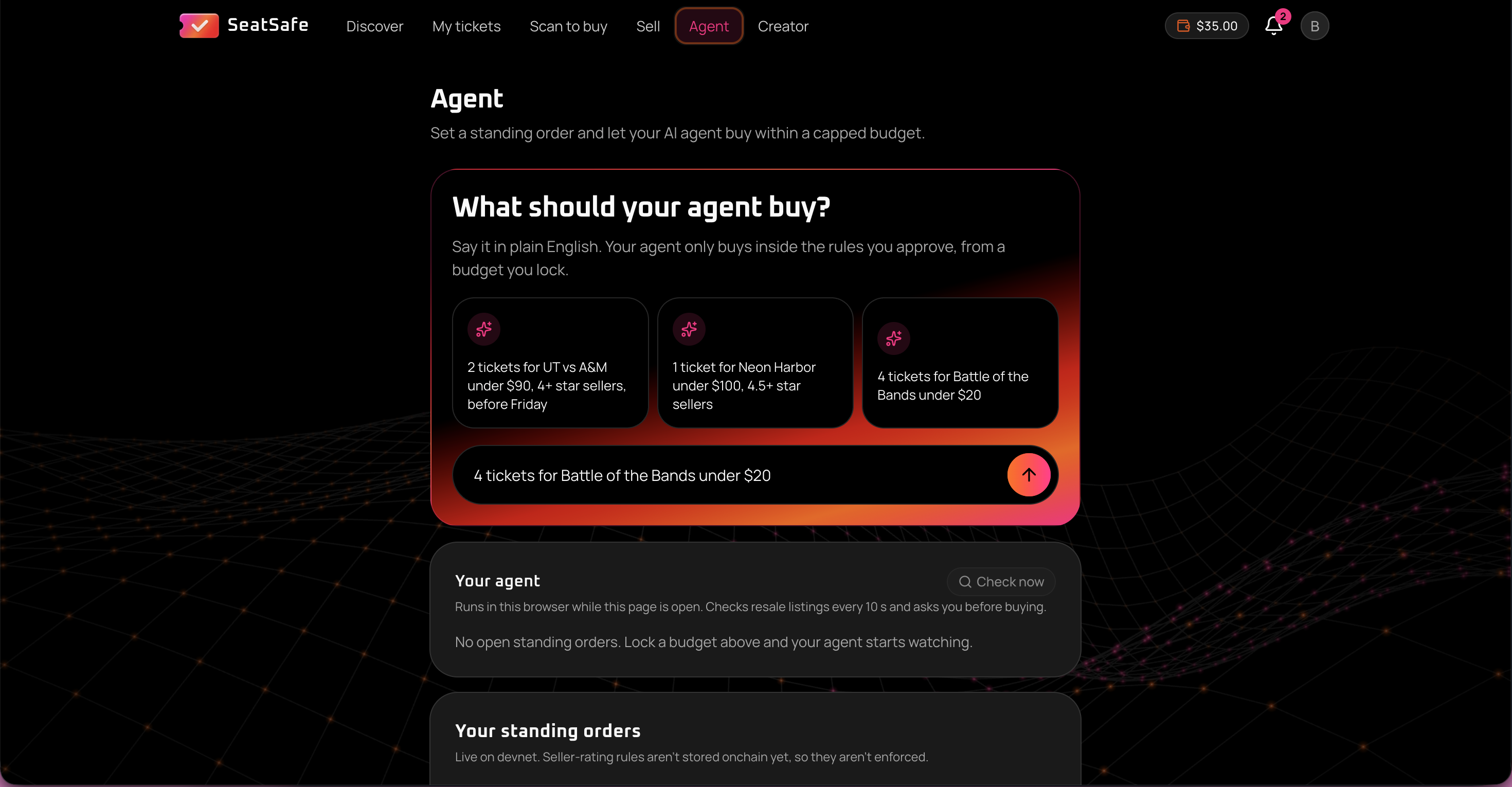
Let your agent handle the tedious work of buying a ticket
-
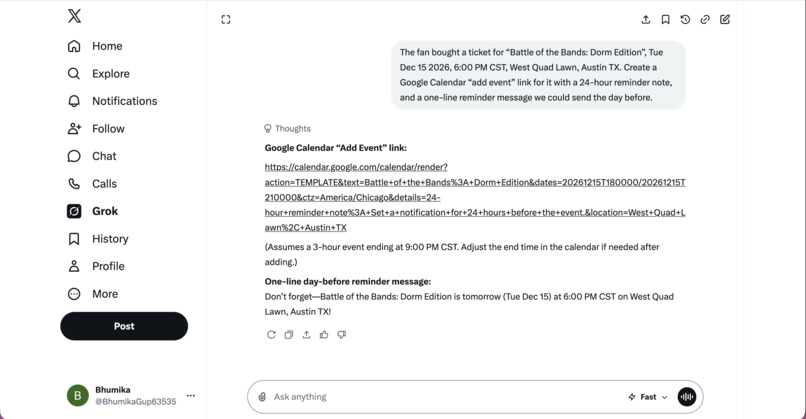
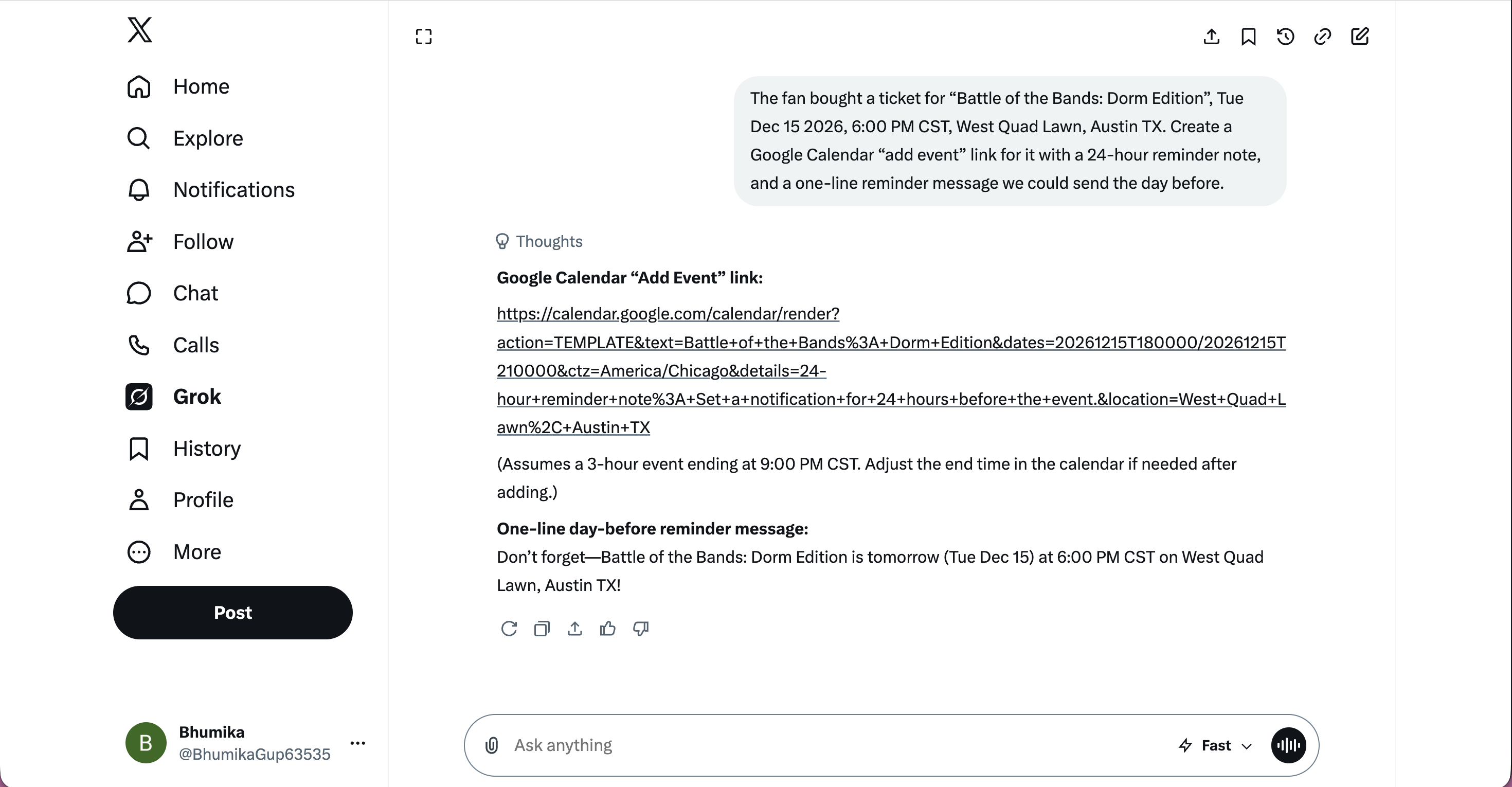
grok can put the ticket in your calender
Inspiration
Every one of us has seen it in a group chat: "2 tickets, $80, Venmo me." Sometimes the ticket never comes. Global ticket fraud costs an estimated $1.3B a year, and 31% of 18–24-year-old gig-goers have bought a fake ticket. say they've bought a fake ticket. At the 2026 World Cup, fans flew in from other countries and were left outside stadiums because resale tickets never transferred.
The other half of the problem is scalping: tickets resold at several times face value while the artist earns nothing. We asked a simple question: what if your money only moved when the ticket did, and the rules were enforced by code instead of a company's promise?
What it does
SeatSafe is a ticketing app on Solana where buying and reselling is safe for everyone, and the crypto is invisible.
- 3D stadium seat picker: hover stands to see prices, glide in, see the real view from your seat, and buy with just an email login. No wallet setup, no gas, prices in dollars.
- Scalper-proof resale: every SeatSafe ticket is a frozen Token-2022 token that only our program can move. Resell above the artist's cap and the program rejects it. At or below the cap, the ticket and payment swap in one transaction, and the artist earns a royalty.
- Scam-proof escrow for outside tickets: buying a Ticketmaster or AXS ticket from a stranger? Your money waits in a vault on Solana, not with the seller. If they never deliver, you're refunded automatically. If you go silent after receiving it, the seller is paid automatically. It protects both sides.
- Sell in person: at the gate, the seller shows a Solana Pay QR code; the buyer scans it and the swap happens instantly.
- Live everything: order tracking, "your ticket sold" / "your refund is back" notifications, and a live protection ticker, pushed from onchain events through QuickNode Streams.
- Proof before you pay:
/verifyand our Grok concierge on X check a listing on the blockchain, not on a website that could be faked. - After you buy: add to calendar, one-tap "can't go? resell", a rotating-QR gate pass, and AI standing orders that buy within a capped budget.
How we built it
- Solana program (Anchor, Rust): 19 instructions covering events, primary sales, capped resale, atomic swaps, escrow with deadlines and disputes, and AI standing orders, with 24 tests. When a ticket is resold at price with royalty rate and SeatSafe fee, the buyer's payment splits in a single instruction:
$$\text{seller} = p\,(1 - r - f), \qquad \text{artist} = p\,r, \qquad \text{SeatSafe} = p\,f$$
- Tickets that can't escape the rules: each ticket is its own Token-2022 mint with the DefaultAccountState = Frozen extension, and the freeze authority is a program PDA. Holders can't transfer tickets directly, so the only way to sell is through our capped swap.
- Gasless UX: Privy gives every user an embedded Solana wallet from an email or Google login. A relayer co-signs every transaction as fee payer, after checking it against an allowlist, so users hold 0 SOL.
- Solana Pay: a transaction-request endpoint builds the same atomic swap for whoever scans the QR, pre-signed by the relayer.
- Real-time data: a QuickNode Stream on Solana devnet filters for our program's transactions and posts them to our webhook, which decodes Anchor events into Supabase. Supabase Realtime pushes them to the tracker, notifications and the ticker within seconds.
- Frontend: Next.js, TypeScript, Tailwind, Three.js (React Three Fiber) for the 3D stadium, and Motion for animations. Deployed on Vercel.
- AI: an LLM turns plain-English requests ("2 tickets under $90") into standing orders; Grok on X acts as a trust checker and resale concierge.
Challenges we ran into
- Making the price cap truly unbreakable. NFT royalties and caps are usually optional: anyone can sell the token on another marketplace. We designed tickets as frozen Token-2022 accounts that only the program can thaw and move, and wrote a test proving a direct transfer fails.
- The outside-ticket oracle problem. A blockchain can't see whether a Ticketmaster transfer happened. Instead of pretending it could, we built escrow that's honest about it: deadlines anyone can trigger, automatic refunds, auto-release if the buyer goes silent, and disputes.
- Gasless signing order. Our relayer normally signs after the user. Solana Pay needs the opposite, so we added a narrowly scoped exception to the relay policy without weakening its other checks.
- Production surprises: a server/client import clash broke the build when two branches merged, and a missing environment variable made every API route return 500. We restructured the code so one missing setting can never take down unrelated routes.
- Devnet reality: slow RPC confirmations made our seed script hang, faucets rate-limited us, and Anchor 1.x's default test validator failed before any test ran. We added per-transaction logging, timeouts and retries, and switched the test runner to the legacy validator.
- Even Grok didn't trust us at first. Asked about our brand-new site, Grok warned it looked like a scam. That was exactly our point: trust has to come from onchain data, so we built
/verifyto check accounts on Solana.
Accomplishments that we're proud of
- Every core flow runs end to end on Solana devnet with real transactions: buy, blocked scalper, atomic resale, scam auto-refund, and in-person Solana Pay. Users never hold SOL.
- A price cap that can't be bypassed, and escrow that protects both buyer and seller without trusting us: no admin can withdraw user funds.
- Onchain events reach the UI through QuickNode in about 1–4 seconds, with no polling.
- A consumer experience that feels like a mainstream ticket app, from a 3D stadium to email login, with the blockchain doing the hard work underneath.
What we learned
- Token Extensions are powerful for real-world rules. Freezing accounts by default turned "please respect the cap" into "you can't break the cap."
- Good crypto UX is mostly invisible infrastructure: embedded wallets, a relayer and dollar prices mattered more to the experience than any single feature.
- Be honest about what's trustless. SeatSafe's own tickets are fully trustless; outside tickets are trust-minimized, and saying so clearly made the design better.
- Real-time onchain data needs care: idempotent webhooks, forward-only state changes, and reconciliation for missed events.
- Shipping a full product in one week across four people taught us to agree on interfaces first (shared types and hooks) and to build on mock data until the real pieces landed.
What's next for SeatSafe
- Mainnet launch with the same program, starting with campus events and local artists who want fair resale and royalties.
- A card onramp so fans without USDC can pay with a card or Apple Pay.
- Partner integrations to verify outside-ticket transfers automatically instead of relying on buyer confirmation.
- Organizer escrow: hold part of primary revenue until the event happens, and refund every fan automatically if it's cancelled.
- A dispute panel of verified fans instead of a single arbiter, plus reminders and resale offers over email, Slack and Discord for student organizations.
- Buy and resell tickets right from X with Bankr. At UBC we met the Bankr team and saw their X extension. We'd love to integrate it so fans can buy or resell a SeatSafe ticket directly from a post on X, with the same price cap and escrow protection, and our Grok concierge verifying the listing onchain in the same thread.
Built With
- anchor
- elevenlabs
- framer-motion
- grok
- mocha
- next.js
- node.js
- postgresql
- privy
- quicknode
- react
- react-three-fiber
- rust
- shadcn-ui
- solana
- solana-pay
- solana-web3.js
- supabase
- tailwindcss
- three.js
- token-2022
- typescript
- usdc
- vercel
- xai
