Inspiration
Seating charts are a two-player game we've been forcing one player to play alone. The host holds the social knowledge — who divorced whom, which cousins feud, who must flank the grandmother. But turning that knowledge into a valid arrangement of 24 people across 5 tables is a constraint-satisfaction puzzle that shifts every time an RSVP lands. That second half is exactly what agents are good at and humans hate. WebMCP is the missing contract that lets each player play their half on the same board.
What it does
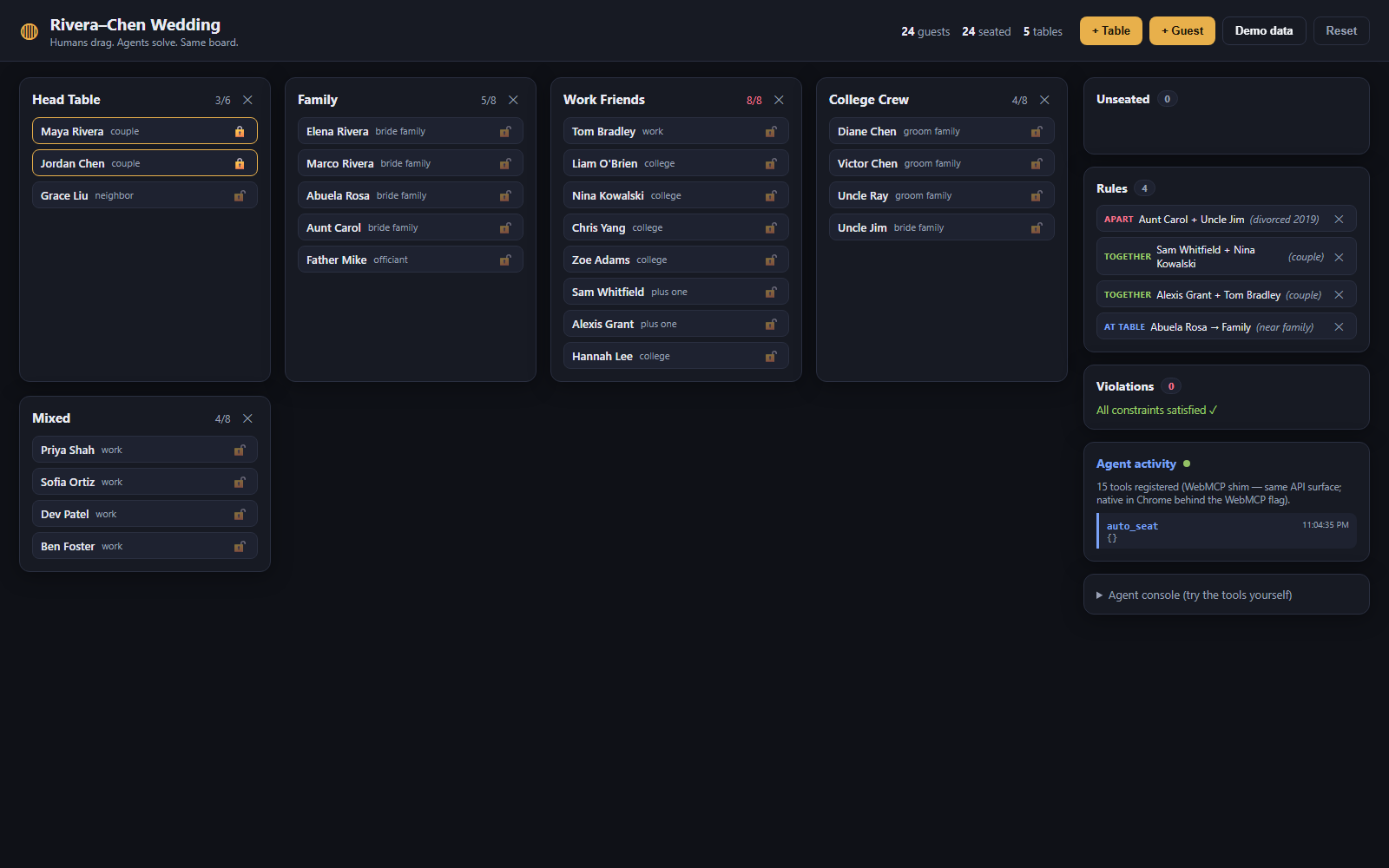
SeatCraft is an event seating planner with two first-class users:
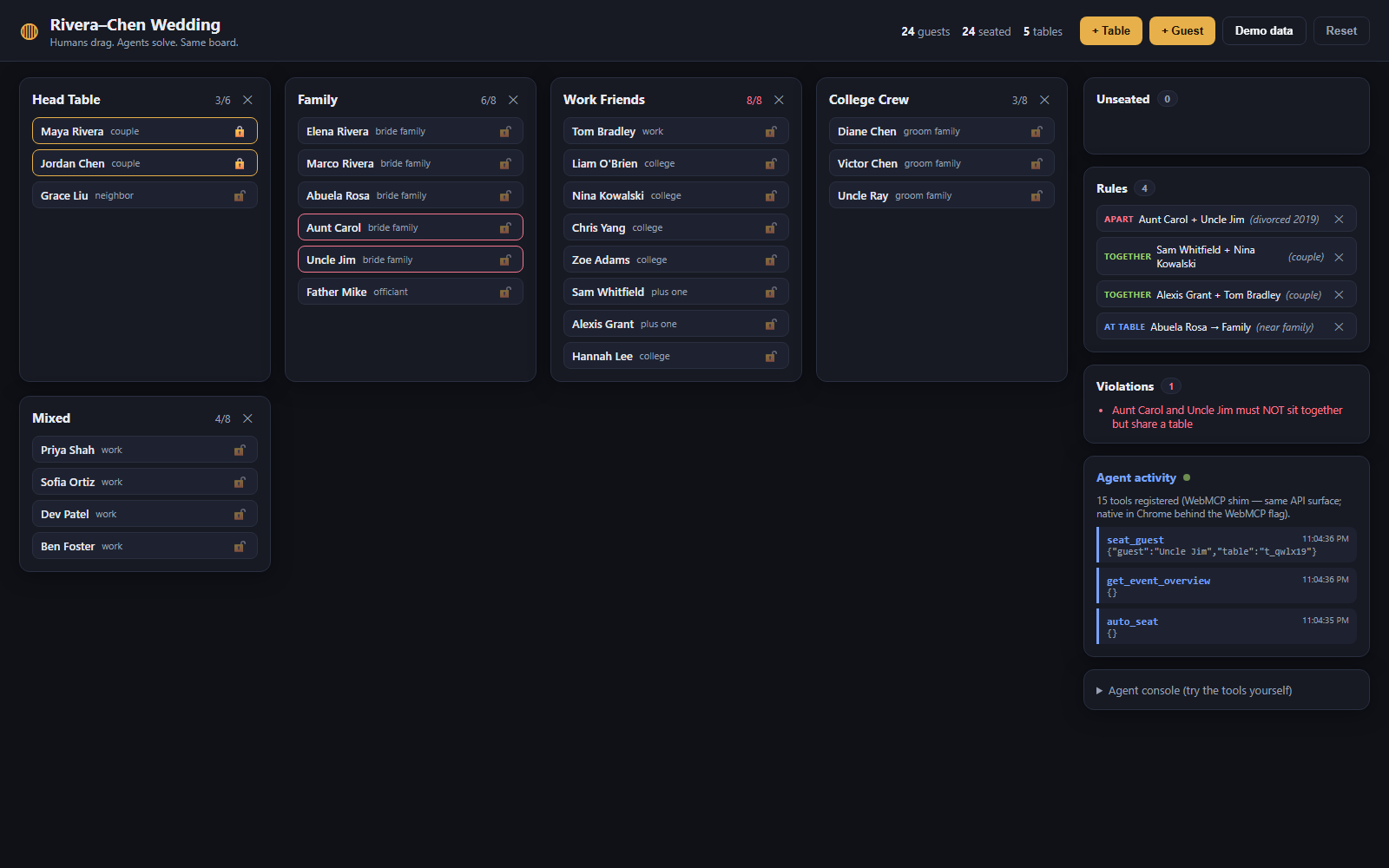
- The host drags guests between tables, locks non-negotiable seats (the couple sits at the head table, period), and states messy truths as rules: Aunt Carol and Uncle Jim — apart (divorced 2019).
- The agent works through 15 WebMCP tools registered on
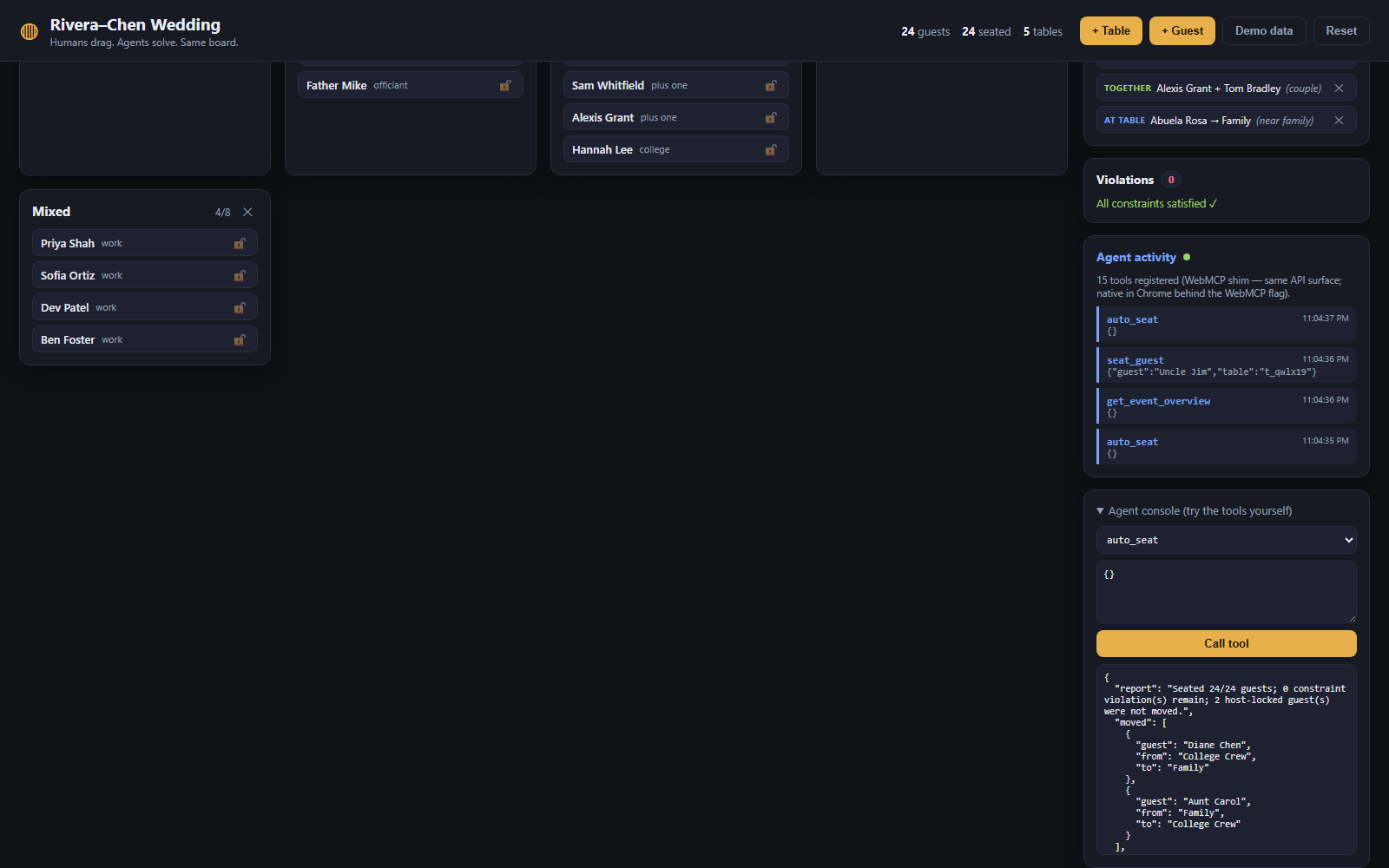
navigator.modelContext: guest/table CRUD, seating moves, a three-type constraint system (together/apart/at_table, each with a human-readable note), a violations reporter, andauto_seat— a solver that honors every rule and never moves a host-locked guest.
The collaboration is bidirectional and honest: every agent tool call streams into an on-page Agent Activity feed so the host always sees what the agent did, and every mutating tool returns the resulting violation list so the agent always knows the consequence of its action. When the agent tries to move a locked seat, it's refused with a message telling it to ask the host. The human always wins.
How we built it
Deliberately zero-dependency: vanilla JS, no build step, no backend — a static page hosted on GitHub Pages. Four modules share one state store (localStorage-persisted, pub/sub): the human UI (drag/drop, locks, rule chips, violation badges), the WebMCP tool surface, a constraint solver (union-find clustering of must-sit-together pairs, group-affinity greedy fill, pairwise-swap repair), and the shared model. A human drag and an agent seat_guest call are literally the same mutation with a different source tag — that's the whole thesis in one line of code.
Tools register on the browser's native navigator.modelContext when present (Chrome's WebMCP for testing flag today); otherwise a small spec-shaped shim provides the identical API, so extension bridges and the built-in Agent Console drive the same surface native browsers will.
Challenges we ran into
Making the solver's output socially plausible, not just constraint-valid — early versions satisfied every rule while exiling one work friend to the family table. Fixes: seat bonded clusters first, fill remaining guests in group-sorted order with a same-group affinity score, then swap-repair. Also: tool ergonomics for conversational agents — every guest/table parameter accepts ids or names (including unique partial names), because an agent relaying "keep Priya away from Dev" shouldn't juggle opaque ids.
What we learned
The interesting design surface of WebMCP isn't exposing actions — it's exposing boundaries. The lock system (agent-proof seats) and violations-in-every-response did more for human-agent collaboration than any additional tool would have. Agent-readable refusals are a feature, not an error.
What's next for SeatCraft
Per-seat placement with adjacency rules, multi-event templates, exportable place cards, and native testing as Chrome's flag rolls toward stable in Q4 2026.
Built with AI assistance (Claude); human-reviewed and submitted by Jimmy Cappucci.

Log in or sign up for Devpost to join the conversation.