What if the people we see online are real, but the attention they create is not?
Inspiration - Why We Started Imagine opening a social media app. You see hundreds of accounts sharing the same message. They like the same posts and support the same ideas. It looks like many people agree. But what if these accounts are working together to make something look more popular than it really is? And what if some of these accounts belong to real people, not bots? This question made us think. We are Balım, a high school student, and Ömer, a university student from Türkiye. We both believe that technology should help people and solve real problems. We started working on a project called MÜHÜR, which means "Seal" in Turkish. We wanted to explore a simple but important idea: Being a real person does not always mean acting honestly online. Today, fake accounts, online scams, and misleading information make it harder to trust what we see. AI can also make fake online activity more difficult to recognize. We wanted to help create a safer internet without asking people to share more private information than necessary. That is how our project, SEAL, began.
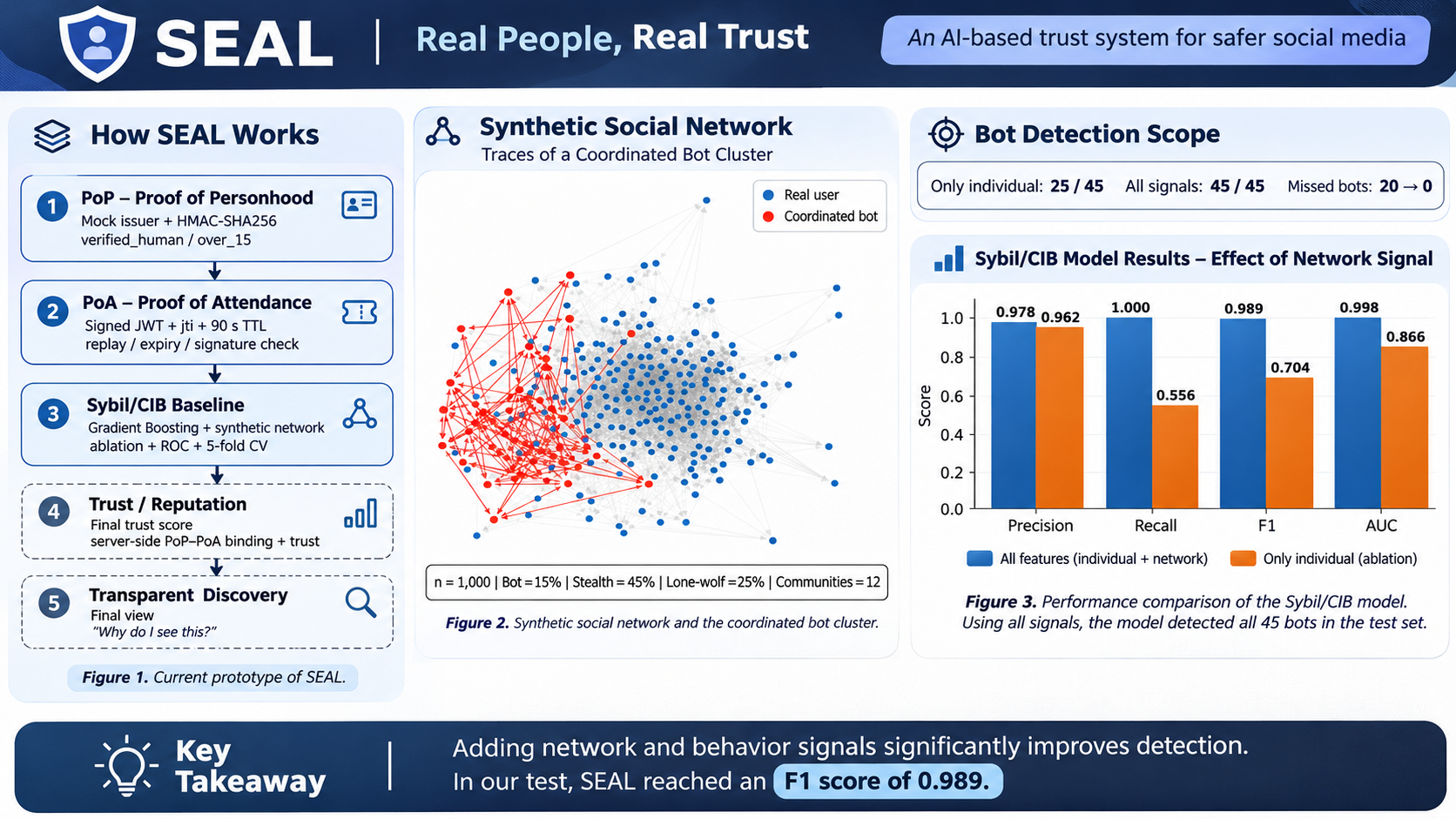
What Is SEAL? SEAL is an AI-based digital trust system. It brings together three important ideas.
Proof of Personhood — Is This a Real Person? Our first goal is to check if an account belongs to a unique person while protecting personal information. We created a test system that uses a simulated identity provider. It produces a digital proof without storing the original identity number. This is a prototype, not a real government identity verification service.
Proof of Attendance - Was This Person Really There? Imagine joining a science event, a conference, or a hackathon. How can you prove that you attended without sharing too much information? SEAL uses short-lived digital check-in tokens. These tokens are protected with digital signatures and can only be used once. We built and tested this system to help prevent fake or repeated check-ins.
AI Detection - Is This Activity Natural? This is one of our favorite parts of the project. Instead of looking at only one account, our AI model also studies how accounts connect and behave together. For example, different accounts may look normal on their own. But when we study their connections, we may find unusual patterns. Our goal is to identify possible groups of fake or coordinated accounts, not to judge people only because they are active online.
How We Built It We developed SEAL using Python, FastAPI, React, JavaScript, scikit-learn, and NetworkX. We built a backend for digital identity and event checks. We also created a web interface to show example users and trust information. For the AI part, we generated a test social network with 1,000 simulated accounts, including 150 coordinated bot accounts. Then we trained a Gradient Boosting model to study account features and network patterns. In our controlled test, the model reached an F1 score of 0.989.We also compared two approaches. When we used only individual account information, the model found 25 out of 45 simulated bots in the test set. When we added network and behavior signals, it found all 45. These results are from our own simulated data. We still need to test the model with independent, real-world data. We also built security tests and a basic trust score system. Our AI model and the web interface are not yet fully connected in one live system.
Challenges We Faced One of our biggest challenges was finding a balance between privacy and security. We wanted to check if a user was real, but we did not want a system that collects unnecessary personal information. Another challenge was testing our AI without access to real social media data. We solved this by creating a simulated social network. This helped us test our ideas, but it also showed us that good results in a simulation do not always mean the same results in the real world. We also learned that a group of people acting together is not always doing something wrong. That is why we want SEAL to explain risks instead of automatically making decisions about users.
What We Learned Working on SEAL taught us much more than coding. We learned about digital identity, cybersecurity, machine learning, privacy, and teamwork. We also learned how important it is to test our ideas and explain our results clearly. As a high school student and a university student, we brought different experiences to the same project. Working together helped us understand the problem from more than one point of view. Our biggest lesson was simple: Technology should not only be smart. It should also be fair, safe, and easy to understand.
What's Next? We want to connect our AI model directly to the web interface, test it with more realistic data, and improve our security system. We also want to make the results easier to understand, so users can see why a certain activity may be risky. Our long-term dream is to make SEAL useful for social media platforms, online communities, and digital events. We know that we still have work to do. But we believe this is a meaningful first step.
Our Mission We do not want an internet where everyone must give away their personal information to be trusted. We want an internet where people can feel safer, where digital trust is more transparent, and where fake activity is harder to hide. Because being a real person is only the beginning. What matters is also how we act. Built by Balım Yabacı & Ömer Tuğrul Bayram — Türkiye.
Built With
- fastapi
- github
- javascript
- machine-learning
- networkx
- numpy
- pydantic
- pyjwt
- pytest
- python
- react
- scikit-learn
- sqlite
- vite
