-
-
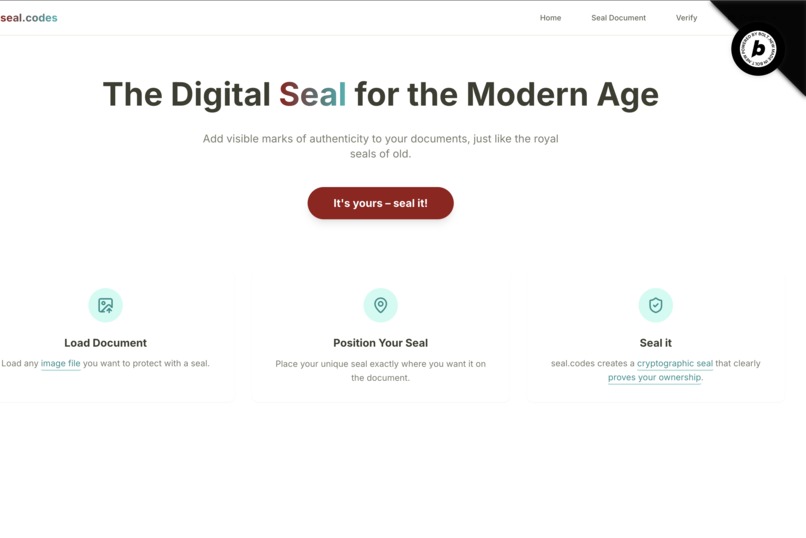
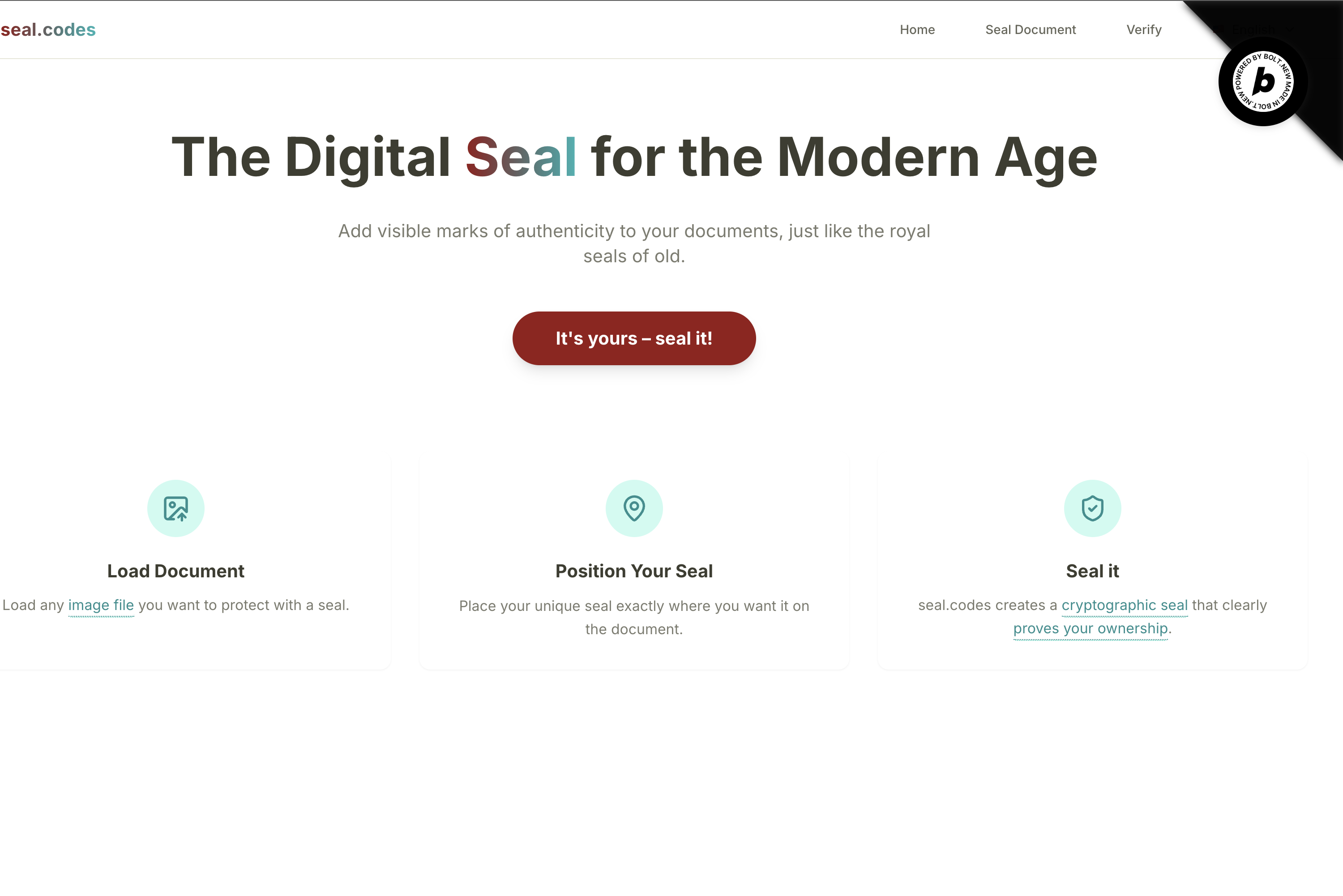
Screenshot: Home page with interactive FAQ – UX is not about fancy animations
-
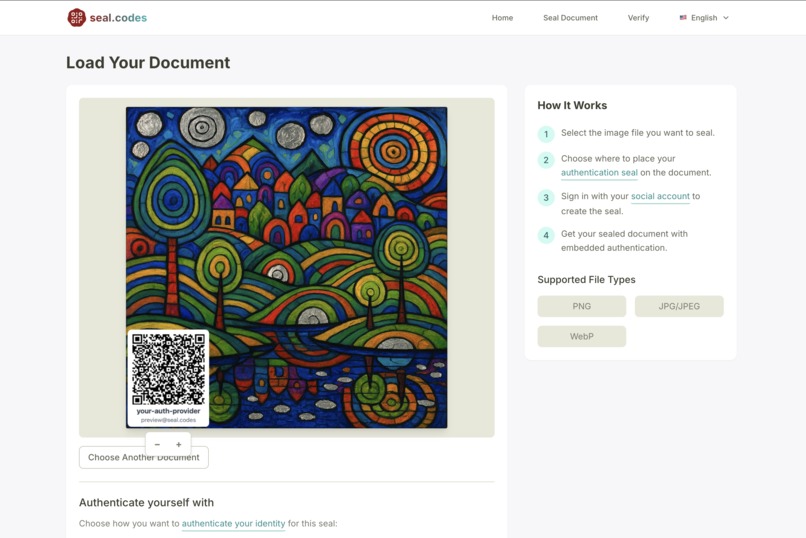
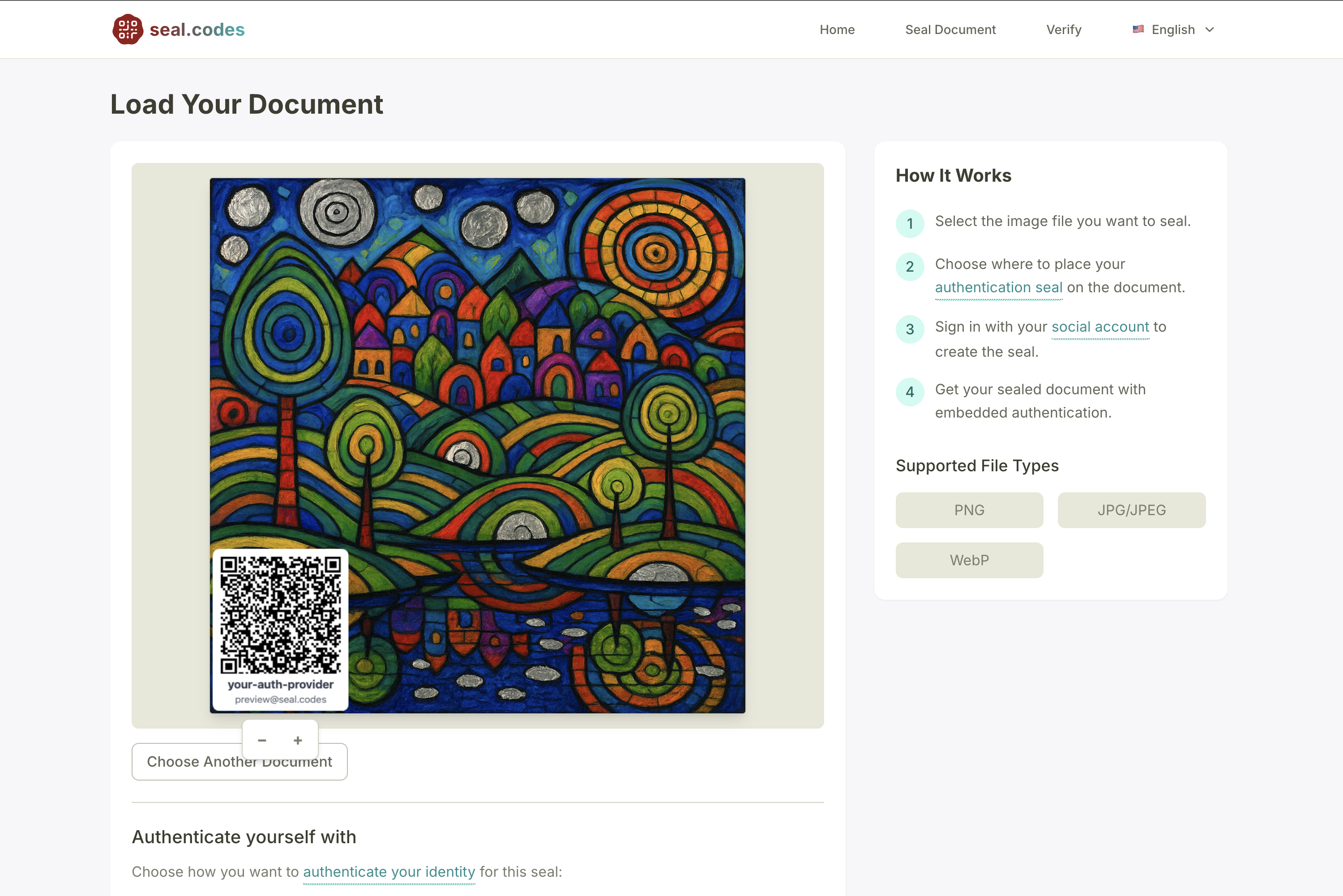
Screenshot: Pick the spot for your seal
-
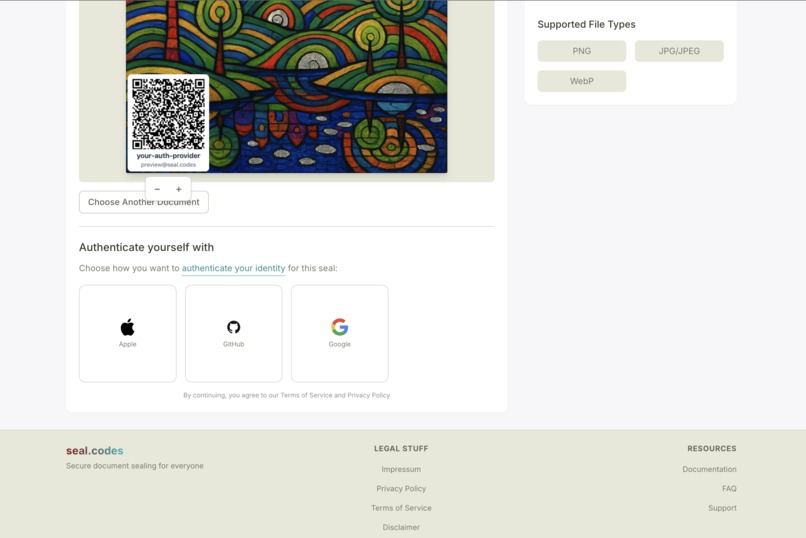
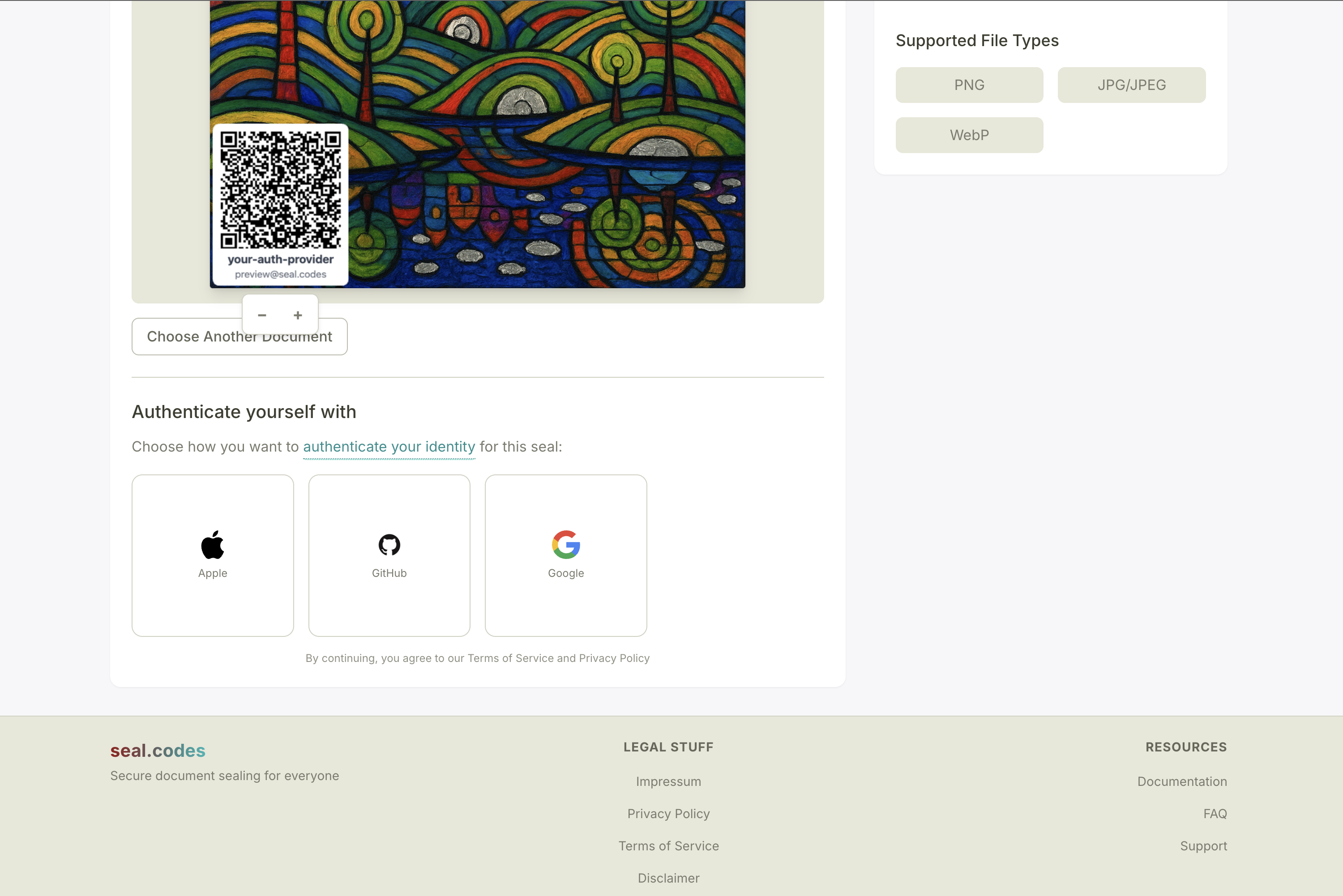
Screenshot: Authorize with social providers. More to be added soon
-
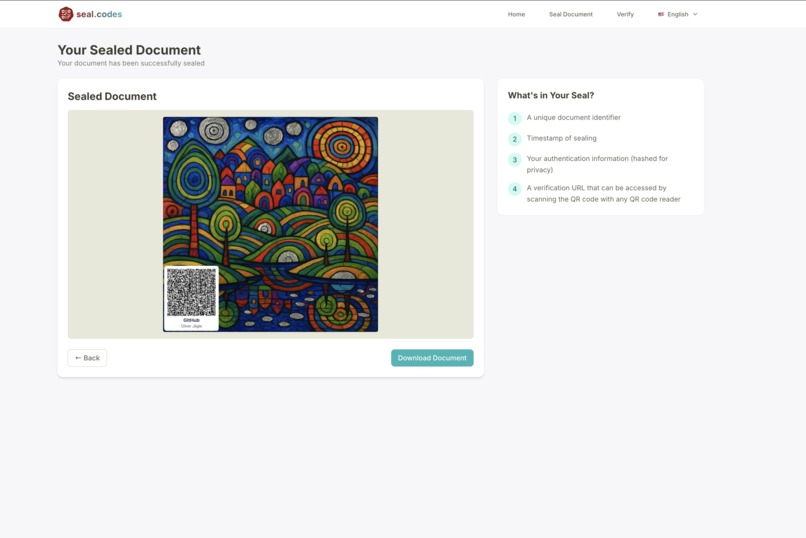
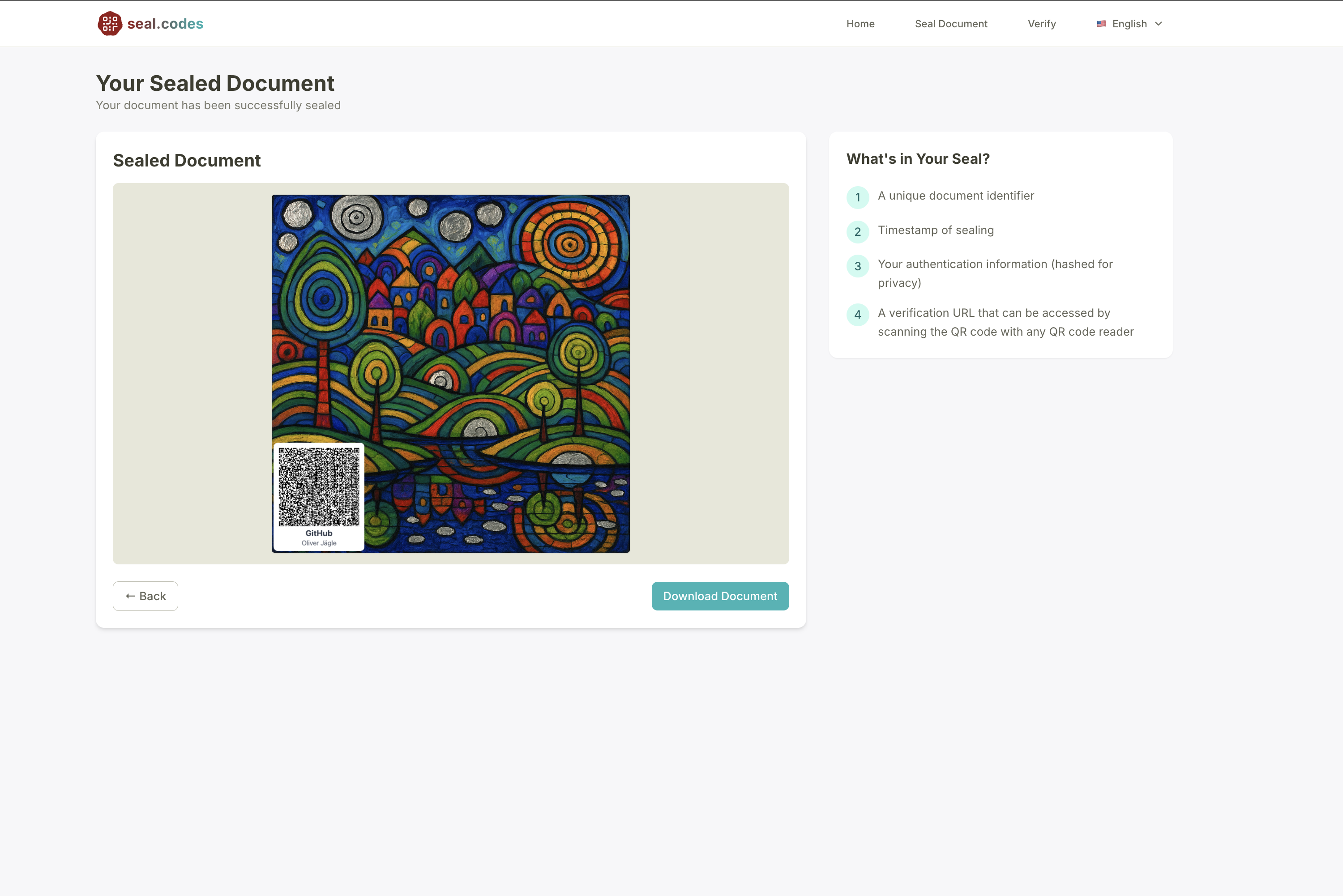
Screenshot: A sealed document
-
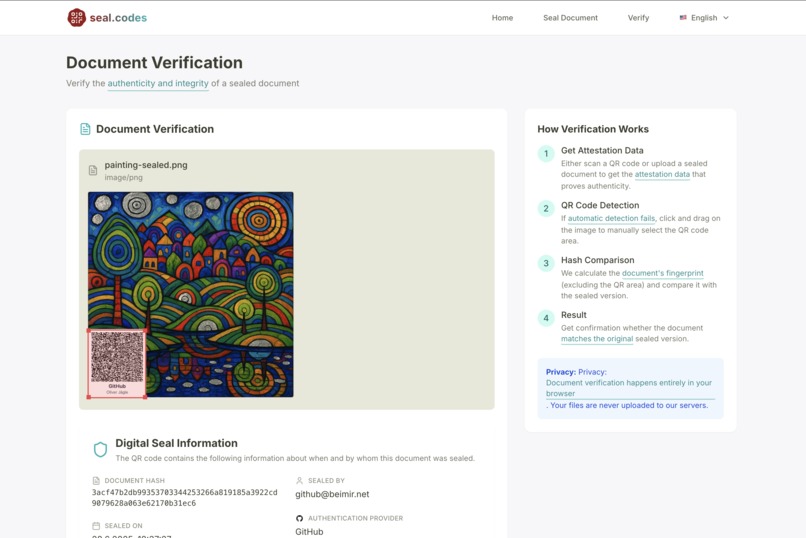
Screenshot: A scanned QR code
-
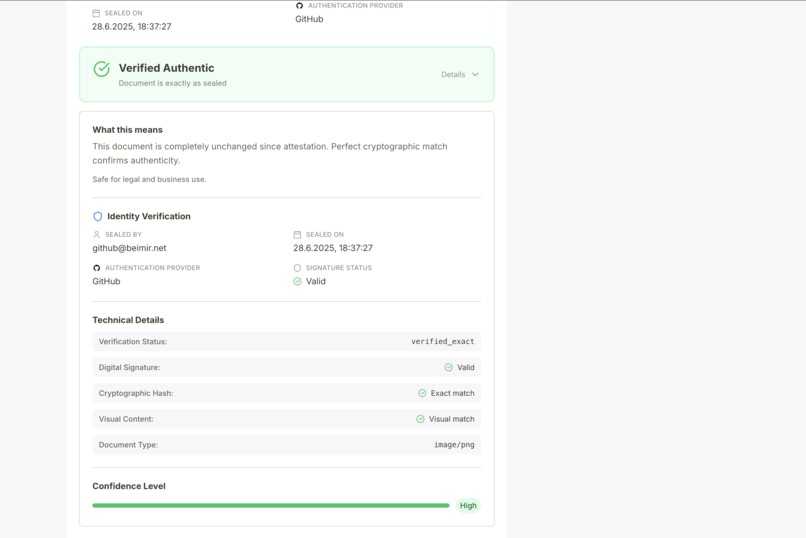
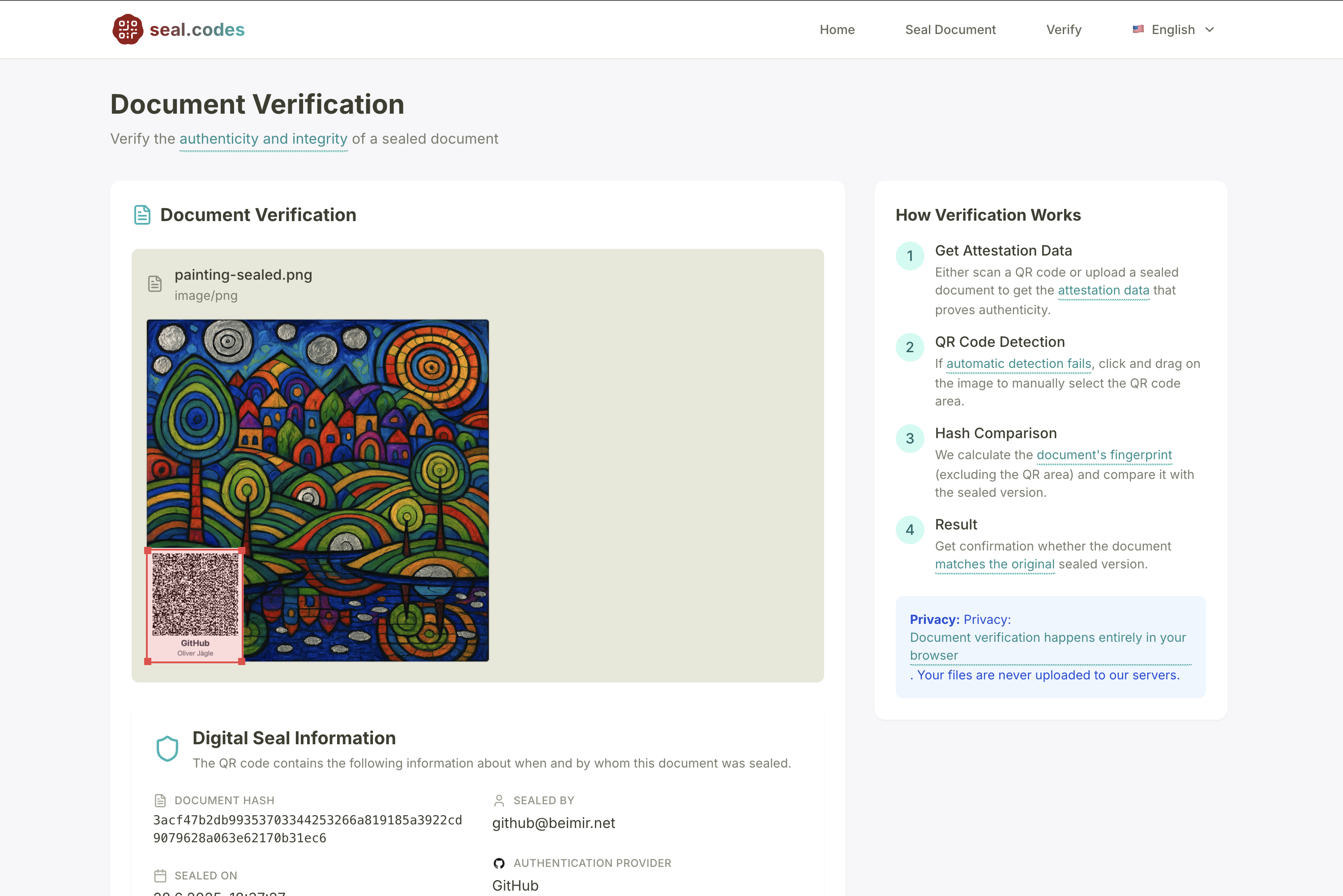
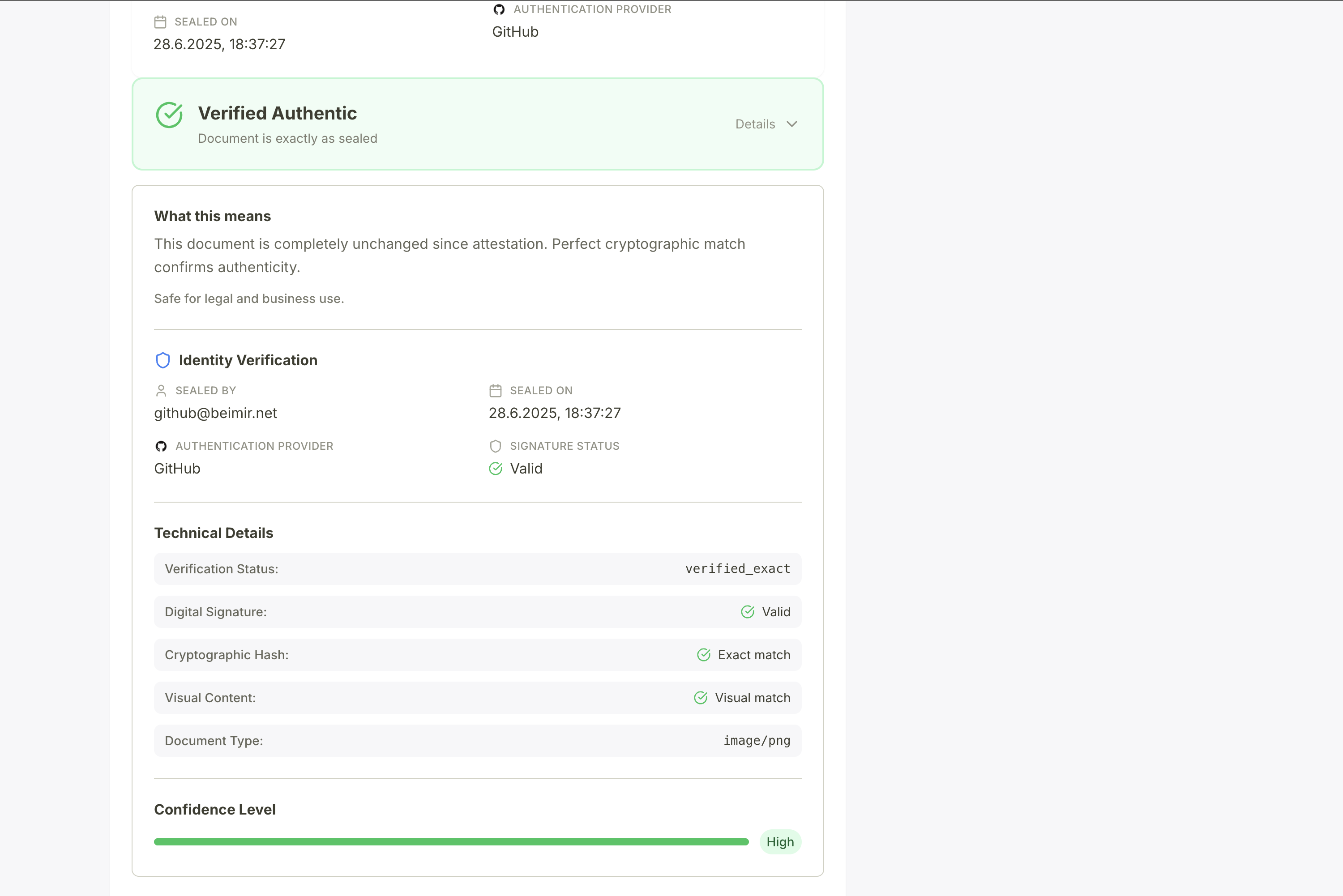
Screenshot: A verified seal
-
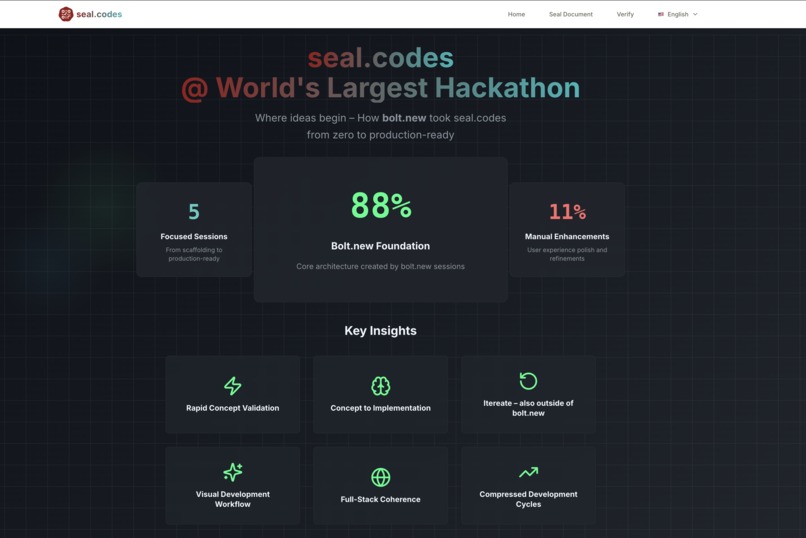
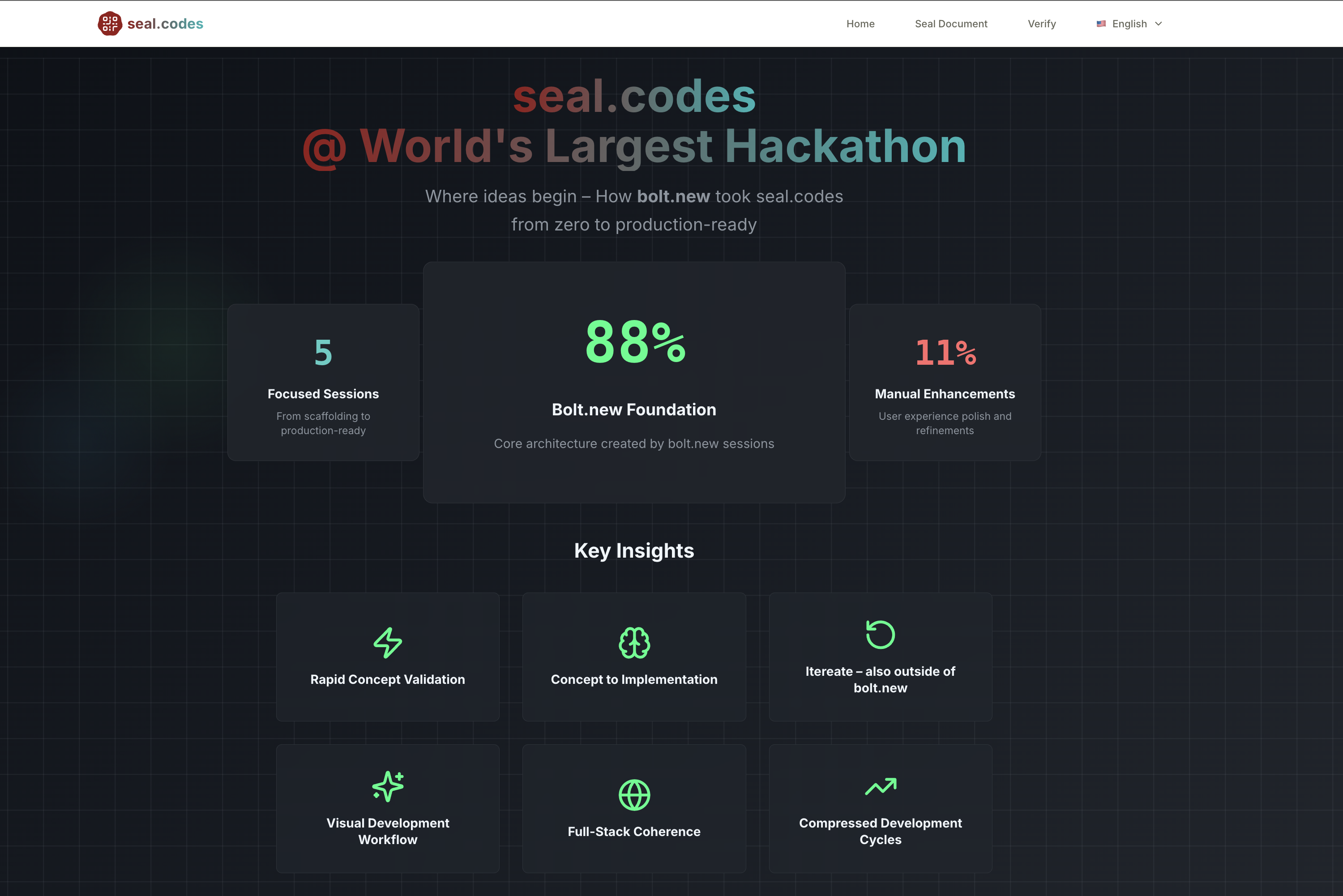
Screenshot: /hackathon route, transparently explaining how this was crafted
🚨 TL;DR - Don't Just Click Forward!
This is NOT yet another AI-programmed social network. This is genuine innovation that was only possible with Bolt.new.
Why you should read this entire submission:
- 🎯 Solves a Real Unsolved Problem: Digital document authenticity crisis that affects millions of creators, students, and businesses daily
- ⚡ Vibe Development + Responsible Engineering: 88% AI-generated across 5 systematic Bolt.new sessions with proper architecture, testing, and documentation
- 📊 Most Transparent Bolt.new Showcase: Interactive development timeline at seal.codes/hackathon - probably the most detailed demonstration of how Bolt.new was actually used
🎯 Live App: https://seal.codes
🎬 Videos
Inspiration
When the bolt.new hackathon was announced with the requirement to build something NEW, I considered this a real challenge. Almost all software has already been built. The world doesn't need another todo app, another social network clone, another e-commerce platform.
But while thinking hard about it, this sparked the actual idea: What is actually "genuinely new"? What is "authentic"? How can we prove who invented something? What bout fakes?
The idea crystallized around a simple observation: since ancient times, humans have used visible marks of authenticity—royal seals pressed into wax—to establish trust in documents. These seals instantly communicated who stood behind a document and protected against unauthorized modifications.
Why don't we have something equivalent for digital documents? Not complex cryptographic signatures that remain invisible and technical, but something as immediately recognizable as those ancient seals.
What it does
seal.codes creates QR code attestations that serve as digital seals, connecting content to established online identities while keeping the process simple enough for everyday use.
Unlike traditional digital signatures that remain invisible and technical, seal.codes creates a prominent visual element that says, "This is mine. I created this." And like ancient seals that could be verified by examining their unique patterns, our QR codes can be easily scanned to verify authenticity.
Key features:
- Document Sealing: QR codes embedded directly into documents (PDFs, images)
- Social Identity Verification: Links to Google, GitHub, and other social accounts
- Privacy-First: Documents never leave your device - only hashes are processed
- Multi-Format Support: Works with PDFs, images, and other document types
- Offline Verification: QR codes contain complete verification data
How we built it - 5 Sessions with Bolt.new
This project demonstrates the power of AI-assisted development across 5 focused sessions:
- Session 1 (bolt.new/~/sb1-7w1m5ev4): Foundation Architecture - 5,400 LOC
- Session 2 (bolt.new/~/github-fcwyoakc): Verification System - 3,000 LOC
- Session 3 (bolt.new/~/github-1wmgcyef): Authentication & Backend - 3,700 LOC
- Session 4 (bolt.new/~/github-1quaqfgb): Signature Verification - 860 LOC
- Session 5 (bolt.new/~/github-s54ozznb): UI Polishing - 370 LOC
Remark: The preview in bolt.new will work, but the backend interaction fails due to OAuth configuration which we needed to change. Use the production ready app from seal.codes to seal a document. Upload and offline verification (which will fail due to the missing backend communication) will work 🧐
Total: 13,330 lines of production-ready code, 88% AI-generated
Tech Stack: Vue 3 + TypeScript for the frontend, Supabase for authentication and database, modern web architecture with Tailwind CSS and Vite.
Challenges we ran into
The biggest technical challenge was implementing format-specific document embedding while maintaining document integrity:
- Image Processing: Created an "exclusion zone" approach with deterministic modification and metadata storage
- Hash Consistency: Ensuring hash calculation remains consistent between signing and verification across different document formats
- Multi-layered Verification: Implementing both cryptographic hashes (SHA-256) for exact verification and perceptual hashes for resilience against compression
Accomplishments that we're proud of
- Genuine Innovation: Built something truly NEW - not another iteration of existing ideas
- 88% AI-Generated Architecture: Demonstrated advanced use of Bolt.new across systematic development sessions
- Interactive Showcase: Created seal.codes/hackathon with real-time development metrics and timeline visualization
- Production-Ready: 13,330 lines of code with comprehensive error handling, testing, and documentation
- Supabase Integration: Scalable architecture designed to handle millions of document attestations
What we learned
This hackathon didn't just kick the tires technically—it got our minds spinning into a direction we'd never ventured before. The challenge wasn't just building software—it was identifying a problem space that hadn't been adequately addressed and developing a solution that bridges ancient concepts (seals, attestation) with modern technology.
Bolt.new enabled this conceptual leap by removing the technical barriers that would typically prevent a very small team / solo developer from attempting such an ambitious project. When technical implementation barriers are lowered, more energy can be devoted to solving genuinely novel problems.
What's next for seal.codes
Depending on the world wide adoption ;)
- Format Expansion: Support for more document types and embedding techniques
- More and Stronger Identity Providers: Government-issued digital IDs (like German Bund-ID), professional credentials
- Mobile App: Native mobile application for quick document sealing and verification
- Blockchain Integration: Optional blockchain anchoring for additional immutability guarantees
- Enterprise Integration: API for businesses to integrate document sealing into their workflows
Demo: seal.codes | Development Story: seal.codes/hackathon
Thanks for reading down to here! And yes, of course this text was also co-created with AI – but it's as much our's as the software we create with AI
Built With
- bolt.new
- sli.dev
- supabase
- tailwind-css
- typescript
- vite
- vue-3


Log in or sign up for Devpost to join the conversation.