-
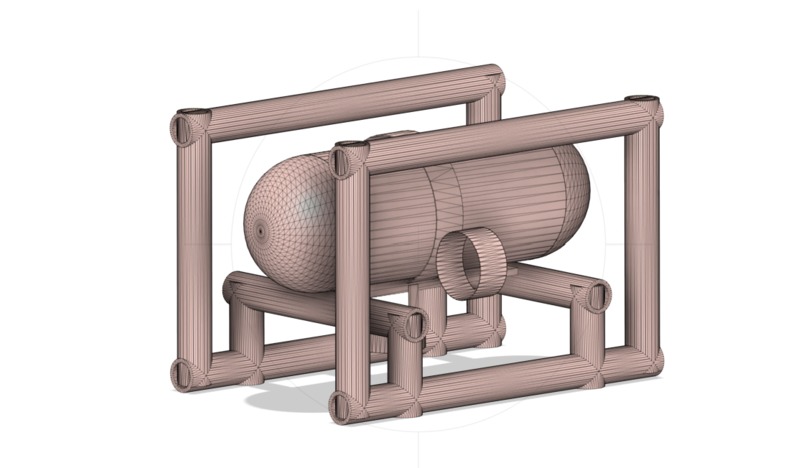
basic prototype structure.

Inspiration
Underwater wireless communication is unreliable due to signal attenuation, latency, and limited bandwidth. Professional ROVs solve this with tethered systems. SEAHAWK was inspired by this real-world approach—to build a reliable, low-cost underwater control and video system that works where wireless fails.
What it does
SEAHAWK is a tethered underwater ROV control system that uses an Ethernet cable for stable motor control and unused cable pairs for real-time FPV video transmission. It provides reliable forward, reverse, and vertical movement with live visual feedback, independent of depth or water conditions. How we built it
The system is built using an Arduino Mega and an L298N motor driver controlling four 12V DC motors—two for forward/reverse thrust and two for vertical up/down motion. A turbidity sensor monitors water clarity, while an FPV camera sends live video through unused twisted pairs in the Ethernet tether. The firmware uses PWM motor control and modular logic for stable and responsive underwater operation. Challenges we ran into
Managing electrical noise between high-current motors and analog video lines was a major challenge. Power distribution for 12V motors and logic stability, maintaining clear video over long cables, and achieving balanced thrust underwater required careful tuning and testing. Accomplishments that we're proud of
-Achieved stable underwater control without any wireless communication
-Integrated control, sensing, and live video in a single tether
-Built a scalable architecture inspired by industrial ROV systems
-Demonstrated real-world underwater robotics principles with low-cost hardware. What we learned
We learned how underwater physics directly affects communication choices, how to control multi-motor thrust systems using H-bridge drivers, and how to design reliable embedded systems that prioritize stability, safety, and scalability. What's next for SEAHAWK-Underwater ROV control system
Future plans include digital video over Ethernet, depth and pressure sensor integration, autonomous stabilization, improved tether management, and upgrading to fiber-optic communication for long-range missions.
Built With
- arduino
- c
- c++
- cad
- electronics
- html
- javascript

