-
-
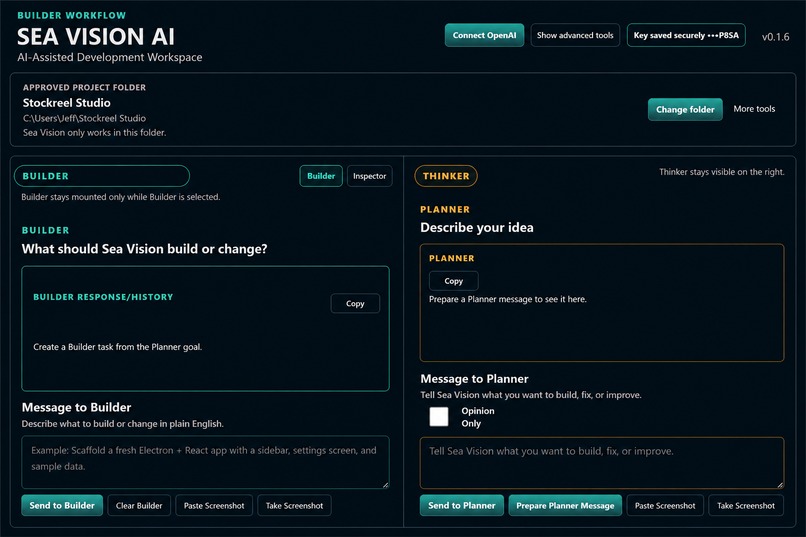
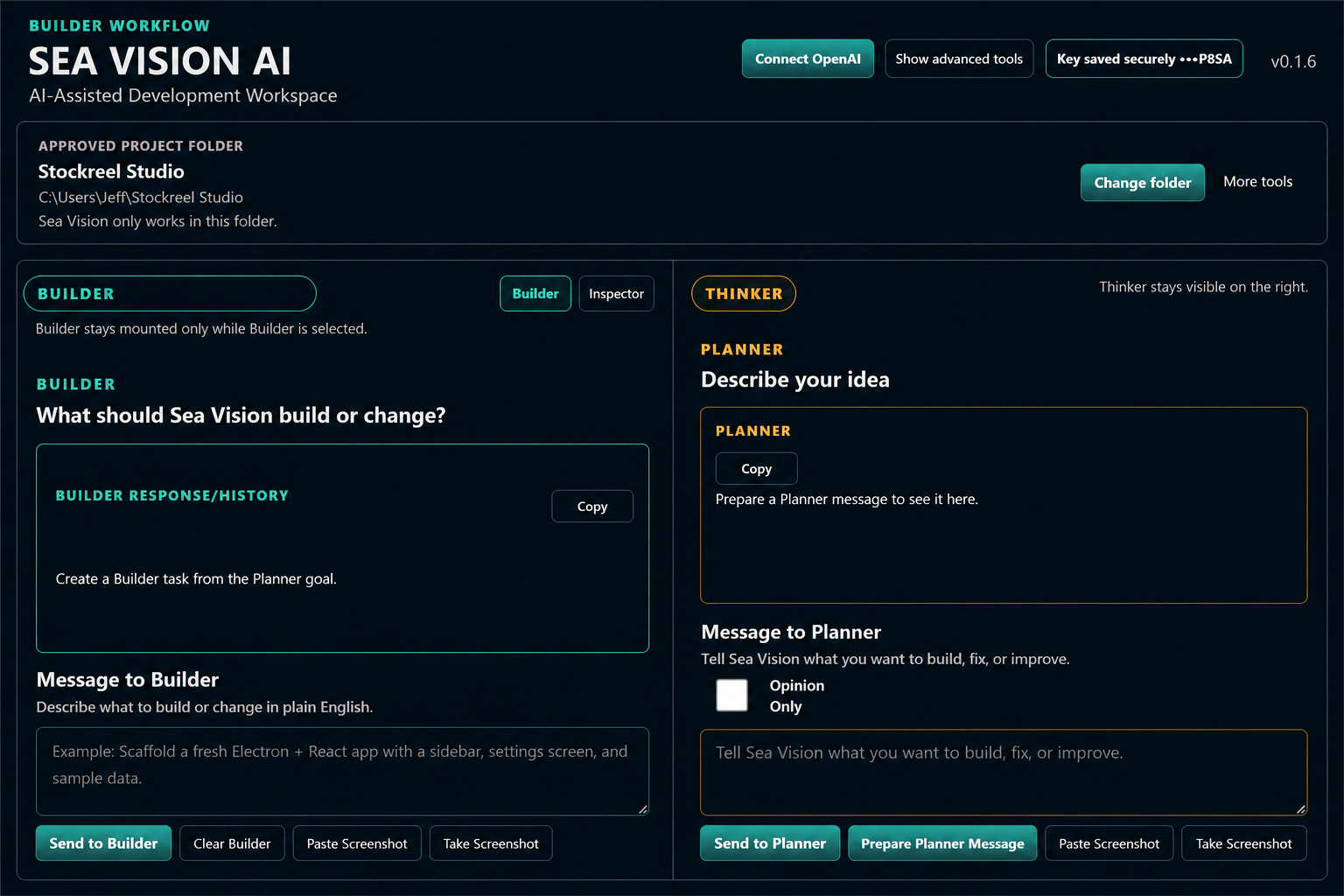
Sea Vision AI workspace showing the Inspector, Builder, and Thinker workflow for AI-assisted software development.
Inspiration I am not a software developer in the traditional sense. I still cannot sit down and write an application in a programming language. What I can do is design software, solve problems, and guide AI toward the result I want.
Over the past year I discovered that AI has made software creation possible for people like me. Using AI, persistence, and thousands of iterations, I built and published my first application, Data Levee, to the Microsoft Store.
While building that application I noticed something that became impossible to ignore.
AI could generate code, but as a non-programmer I often had no reliable way to know whether a change was actually correct, safe, or solving the real problem. I found myself spending more time verifying AI than asking it to write code.
That experience inspired Sea Vision.
Rather than creating another coding assistant, I wanted to build a system where AI helps supervise AI.
What it does Sea Vision AI is an AI-assisted software development workspace designed to help people build and modify applications with greater understanding, confidence, and safety.
Instead of relying on a single AI, Sea Vision assigns specialized roles throughout the development process.
Inspector investigates the approved project workspace, gathers evidence, and understands the existing code before changes are proposed.
Builder uses that information to create a targeted implementation plan or code change instead of making blind edits.
Before any modification can be applied, Thinker independently reviews the proposal, looking for mistakes, unnecessary changes, unintended consequences, and opportunities for improvement. Only after this independent review can a change be accepted and applied.
Sea Vision is designed to help developers—and especially people who are not professional programmers—work with AI more confidently by making the development process transparent, reviewable, and easier to understand.
Unlike traditional AI coding assistants that focus primarily on generating code, Sea Vision focuses on investigating first, building second, and verifying before applying changes. The goal is not just faster software development, but more reliable and understandable AI-assisted development.
How we built it Sea Vision AI was built through an AI-assisted development process that combines human direction with multiple OpenAI tools.
I am not a traditional software developer, and I cannot write application code from memory. Instead, I designed the product, defined the behavior I wanted, tested every feature, and continuously guided the AI through thousands of iterations until the software behaved as intended.
ChatGPT served as my reasoning and design partner, helping me think through architecture, debugging strategies, user experience, and product decisions. During OpenAI Build Week, I used Codex with GPT-5.6 to implement and refine new functionality for the project.
Sea Vision itself is built using modern web technologies including Electron, React, and TypeScript. Throughout development, every change was tested repeatedly, refined through real-world use, and improved based on practical experience rather than simply accepting the AI's first answer.
The result is a project that reflects a collaborative workflow between human judgment and AI capabilities. Rather than replacing human decision-making, AI accelerated implementation while I remained responsible for defining the goals, evaluating results, identifying problems, and directing the project toward the final outcome.
Challenges we ran into One of the biggest challenges was discovering that generating code is often the easiest part of AI-assisted development. The harder problem is determining whether the generated solution is actually correct.
As the project grew, I encountered situations where AI would confidently propose changes that solved the wrong problem, misunderstood the existing codebase, or introduced unintended side effects. As someone who is not a traditional programmer, I needed a better way to verify AI-generated changes instead of simply trusting the first answer.
That realization shaped the architecture of Sea Vision. Rather than relying on a single AI to investigate, implement, and validate its own work, I separated those responsibilities into specialized roles. Inspector gathers evidence, Builder proposes solutions, and Thinker independently reviews those proposals before changes are applied.
Another challenge was building a development workflow that remained understandable to non-programmers. Throughout the project I continually simplified the user experience while improving the reliability of the underlying AI systems.
Developing Sea Vision required thousands of iterations, extensive debugging, and continuous refinement. Every challenge helped shape the application's core philosophy: AI should not only generate code—it should also help explain, verify, and improve it before changes are accepted.
Accomplishments that we're proud of One of the accomplishments I am most proud of is building a sophisticated AI development environment as someone who is not a traditional programmer.
Sea Vision successfully separates the software development process into specialized AI roles that investigate, build, and independently review changes before they are applied. That architecture grew out of real experience building AI-assisted software and represents the core vision of the project.
I am also proud that the ideas behind Sea Vision were inspired by successfully developing and publishing my first application, Data Levee, to the Microsoft Store. That experience demonstrated that AI-assisted development could make software creation accessible to people without traditional programming backgrounds, and it inspired me to build a better development environment for the next generation of AI-assisted creators.
Most importantly, I am proud that Sea Vision is being designed to make AI-assisted software development more understandable, transparent, and approachable for people who have ideas but do not have years of programming experience.
What we learned Building Sea Vision AI taught me that creating software with AI is about much more than generating code. The most difficult part is understanding the problem, verifying that a proposed solution is actually correct, and making changes with confidence.
As someone who is not a traditional programmer, I learned that human judgment remains essential throughout the development process. AI can generate solutions quickly, but it still requires someone to define the goals, recognize when something is wrong, test the results, and keep refining the solution until it behaves as intended.
I also learned that AI-assisted development becomes much more reliable when different AI systems are given specialized responsibilities instead of asking a single AI to perform every task. That insight became the foundation of Sea Vision's architecture.
Perhaps the biggest lesson was personal. Building and publishing software is no longer limited to people who can write code from memory. With persistence, critical thinking, and the right AI tools, people with ideas can actively participate in creating real software. My hope is that Sea Vision helps make that process safer, more understandable, and more accessible for others.
What's next for Sea Vision AI The next step for Sea Vision AI is to make the experience simpler, more automatic, and easier for non-programmers to use without needing to understand technical development workflows.
I plan to continue improving the coordination between Inspector, Builder, and Thinker so they can investigate problems, propose changes, review risks, and guide the user through the process with less manual prompting.
Another major goal is to strengthen reliability. That includes better validation, clearer explanations, safer application of changes, and stronger recovery when an AI response is incomplete or incorrect.
Over time, I want Sea Vision to become more than an AI coding tool. I want it to become a guided software-building environment that helps people move from an idea to a working application with greater confidence and understanding.
The long-term vision is to make AI-assisted software creation accessible to people who may never learn to write code, but who can still think clearly, make decisions, test results, and direct AI toward a meaningful product.
Built With
- codex
- css
- electron
- html
- javascript
- node.js
- openai-api
- react
- typescript
- vite

Log in or sign up for Devpost to join the conversation.