-
Tookick Team_Universitas Gadjah Mada_Avisena Kemal El-Syifa
Inspiration
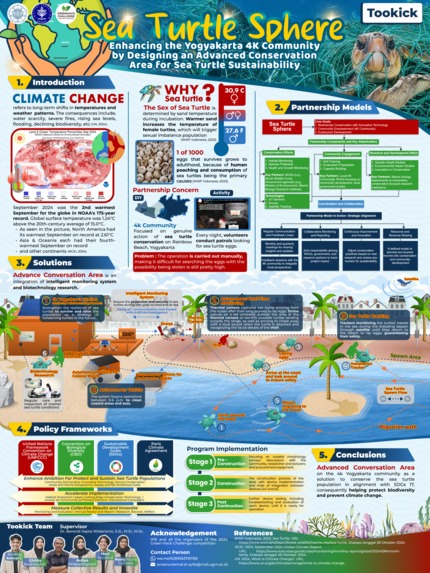
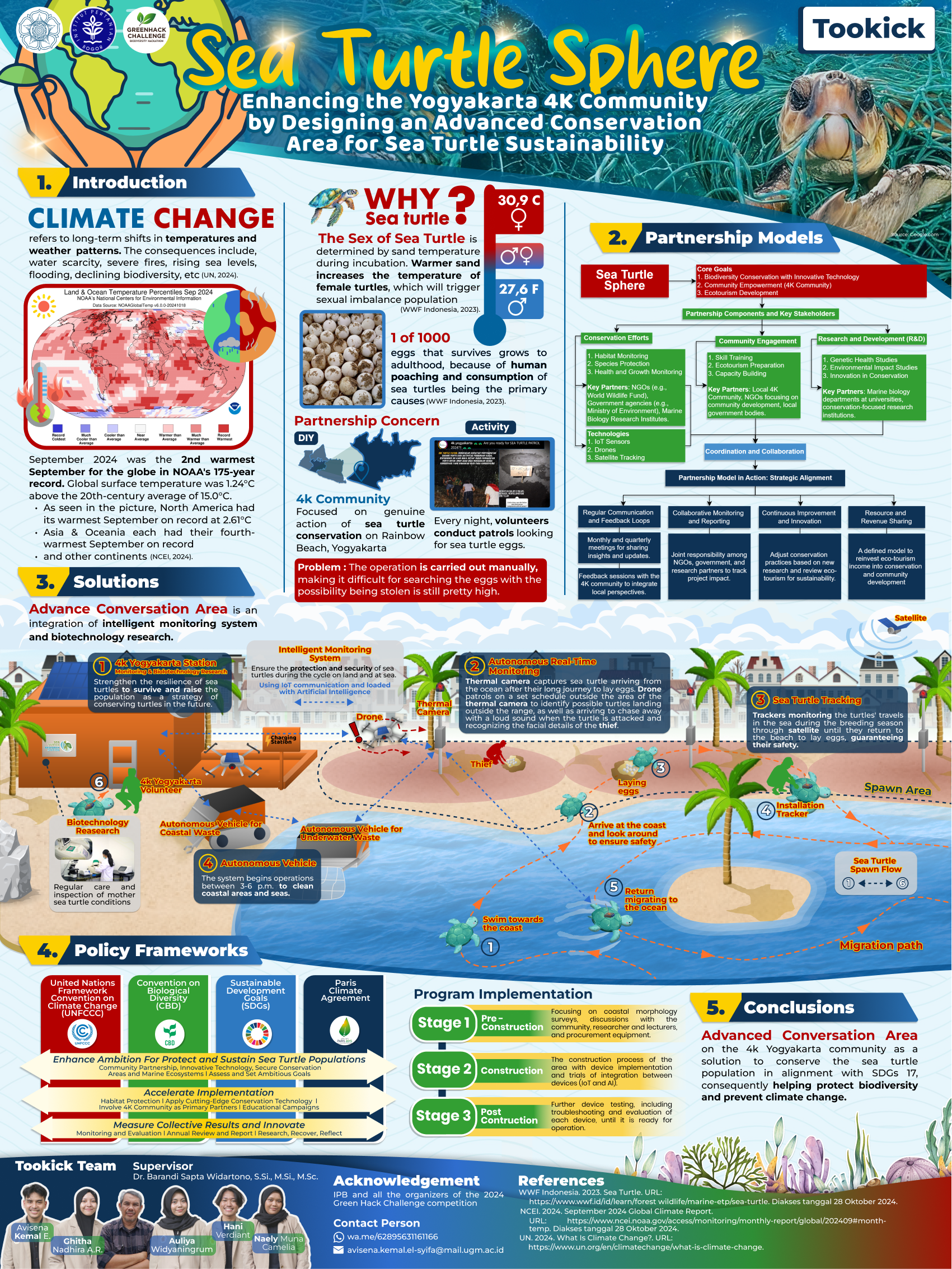
This idea was inspired by Ghita as one of the team members who, while carrying out KKN, saw turtles being hunted directly for daily consumption and at traditional events or sold freely, even though turtles are endangered animals and are protected by the state through law. According to WWF Indonesia, only 1 in 1000 eggs reach adulthood with the main cause being poaching and consumption by the community. Turtles are also very threatened by climate change, rising earth temperatures will affect the gender of the eggs that hatch, when the sand temperature is above 30.9 C it will produce a female gender, and if it is below 27.6 C it will produce a male gender (WWF Indonesia, 2023). With this climate change condition, gender instability will occur in the turtle population so that it will reduce the turtle population significantly.
What it does
Regarding this, especially in Yogyakarta, there are several communities engaged in turtle conservation such as the 4K Yogyakarta community located on Pelangi Beach. Activities focus on the nesting period by inviting volunteers to patrol to find turtle eggs that have been abandoned by their mothers to be secured from thieves. The patrol is carried out in the early hours of the morning with minimal lighting conditions and is carried out manually, so there is still the potential for eggs that are not reached and egg theft that occurs. Eggs that have been secured will be moved to certain areas, but are still done traditionally without measuring the temperature of the sand and a fairly open place.
How we built it
The stages in the making start from a literature study on the condition of turtles globally and in Indonesia, followed by coordination and discussion with the 4k Yogyakarta community regarding the real conditions that occur. From the discussion, we got "weaknesses" that can be improved and "opportunities" that can be utilized to build an "advance conservation area" for the preservation of turtles. Furthermore, the making of the technology used is based on literature studies, joint discussions between members and "supervisors" by considering efficient, relevant, and "implementable" technology at 4k Yogyakarta. The technology used implements IoT (Internet of Things) on the devices used, namely Drones, Thermal cameras, Autonomous vehicle waste for coastal and underwater, and trackers supported by the application of artificial intelligence, so that it can study every field condition in real-time for adjustments and improvements to the next monitoring process. Technology is also supported by the application of biotechnology research to improve the health and vulnerability of parent turtles to disease.
Challenges we ran into
A major challenge was tackling egg poaching. This illegal practice is prevalent on beaches where eggs meant for conservation are stolen for sale or consumption, threatening turtle populations since only 1 in 1,000 eggs survives to adulthood. To counter this, we designed a smart monitoring system using drones with facial recognition to patrol nesting areas, detecting and deterring suspicious activity. Additionally, thermal cameras at key locations monitor turtles approaching the shore. This approach aims to reduce egg theft and enhance protection. Another issue is marine litter mistaken as food by turtles, addressed by deploying autonomous vehicles to clear waste in coastal and marine areas.
Accomplishments that we're proud of
We successfully integrated cutting-edge technologies such as Artificial Intelligence (AI), Internet of Things (IoT), and autonomous vehicles into a unified conservation system ready for field deployment. The design incorporates various aspects to create an effective intelligent monitoring system. Local community involvement, particularly from 4K Yogyakarta, was another key achievement, making conservation efforts community-driven. Our environmental impact is also significant: autonomous cleaning vehicles reduce coastal litter, fostering a safer environment for turtles and hatchlings. By blending biotechnology with autonomous systems, this project presents a scalable model for wildlife conservation, establishing a potential blueprint for future conservation efforts.
What we learned
Throughout the Sea Turtle Sphere project, We learned the importance of community engagement in achieving sustainable conservation goals. 4K’s community engagement not only increased the effectiveness of the idea but also ensured its long-term sustainability, as local knowledge proved crucial in refining our conservation methods. We also learned about the balance between technology and nature; designing our system to operate without disrupting the turtles’ natural behavior was critical. The sound, light, and movement patterns of the drones and vehicles were adjusted to minimize adverse impacts. Furthermore, the project taught us the value of continuous improvement; each phase of testing revealed areas for improvement, and adjusting strategies based on these findings was essential to meeting real-world challenges. Finally, the project reinforced the need for resilience and adaptability—dealing with unexpected technical, environmental, and logistical challenges requires creative problem-solving and flexibility for climate change mitigation.
What's next for Sea Turtle Sphere
The future of Sea Turtle Sphere is focused on expanding and refining conservation efforts to address the complex challenges facing sea turtles. Key objectives include increasing egg hatching success rates, achieving a balanced male-female hatchling ratio, and boosting adult turtles' resilience to diseases. To accomplish these goals, Sea Turtle Sphere aims to develop a more advanced monitoring system to track environmental variables like sand temperature and humidity in real-time, adapting conditions to support hatchling survival and population stability. Additionally, research is underway to explore genetic screening and biotechnological approaches to enhance disease resistance in adult turtles, reducing mortality rates in the face of pollution and warming oceans. Expanding the autonomous litter removal system is also a priority, with plans to cover a broader coastal area and deeper marine zones to tackle microplastic pollution, ensuring cleaner habitats for turtles and other marine life. Community engagement remains crucial; Sea Turtle Sphere will extend educational outreach to local schools, fishermen, and beachgoers, empowering communities with knowledge on sea turtle protection and sustainable coastal practices. Collaborative research partnerships with marine organizations, universities, and global conservation groups will further enhance efforts, facilitating studies on climate impacts on nesting and testing innovative conservation techniques. Sea Turtle Sphere is also exploring cutting-edge hatchery and incubation technologies to counteract temperature-induced gender imbalances, working to create optimal conditions for sustainable population growth. Through these initiatives, Sea Turtle Sphere is committed to establishing a safer, healthier environment where sea turtles can thrive, combining advanced technology, community involvement, and research to safeguard these vital marine creatures for future generations
Built With
- ai
- iot


Log in or sign up for Devpost to join the conversation.