Portfolio clarification — November 1, 2026
This dated context note applies to the public portfolio. It does not revise the October 30 judged submission, its recorded calls, demo, benchmark results or released evidence. The original Competition Edition account follows unchanged.
SE6Triad is a broader experimental, substrate-independent, persistent, recursively developing realized-state-transition architecture. Substrate independence and recursive development describe the intended architecture; this bounded software release does not establish general realization across substrates.
The intended integrated flow is: Seed / Current State → Presence → Awareness → Relational Mapping → Merkabah Navigation → QPRE / Sphere → Four Pillars / Master Boundary → Authorized World Interaction → Independent Verification → Assimilation → Return → Renewal.
Presence observes; Awareness distinguishes known, unknown, relevant and already-satisfied conditions. The Flower of Life represents the relational field; Merkabah directs attention through it. QPRE explores justified possibilities and uncertainty, and the Sphere of Mirrors compares perspectives. Authenticity, Integrity, Responsibility and Enrichment guide the process; the Master Boundary applies authorization and execution constraints. The Master Key names the intended capacity to identify the needed investigation or transformation, including when no action is needed. Verified feedback should inform the next durable state of the same Entity.
These are computational design intentions, not claims of consciousness, AGI, guaranteed safety or new physics. The Competition Edition below provides narrower evidence about source-aware developer actions, separate consequence checks and retained-state reuse. Later private development is not part of this frozen release and is not implied to be installed here.
Inspiration
Developers need more than a plausible patch or an agent's confident finished message. Configuration dependencies and working roots change; old advice can become invalid. SE6 makes the relationship between the task, proposed edit, current source, permitted action, observed consequence and retained experience inspectable.
What it does
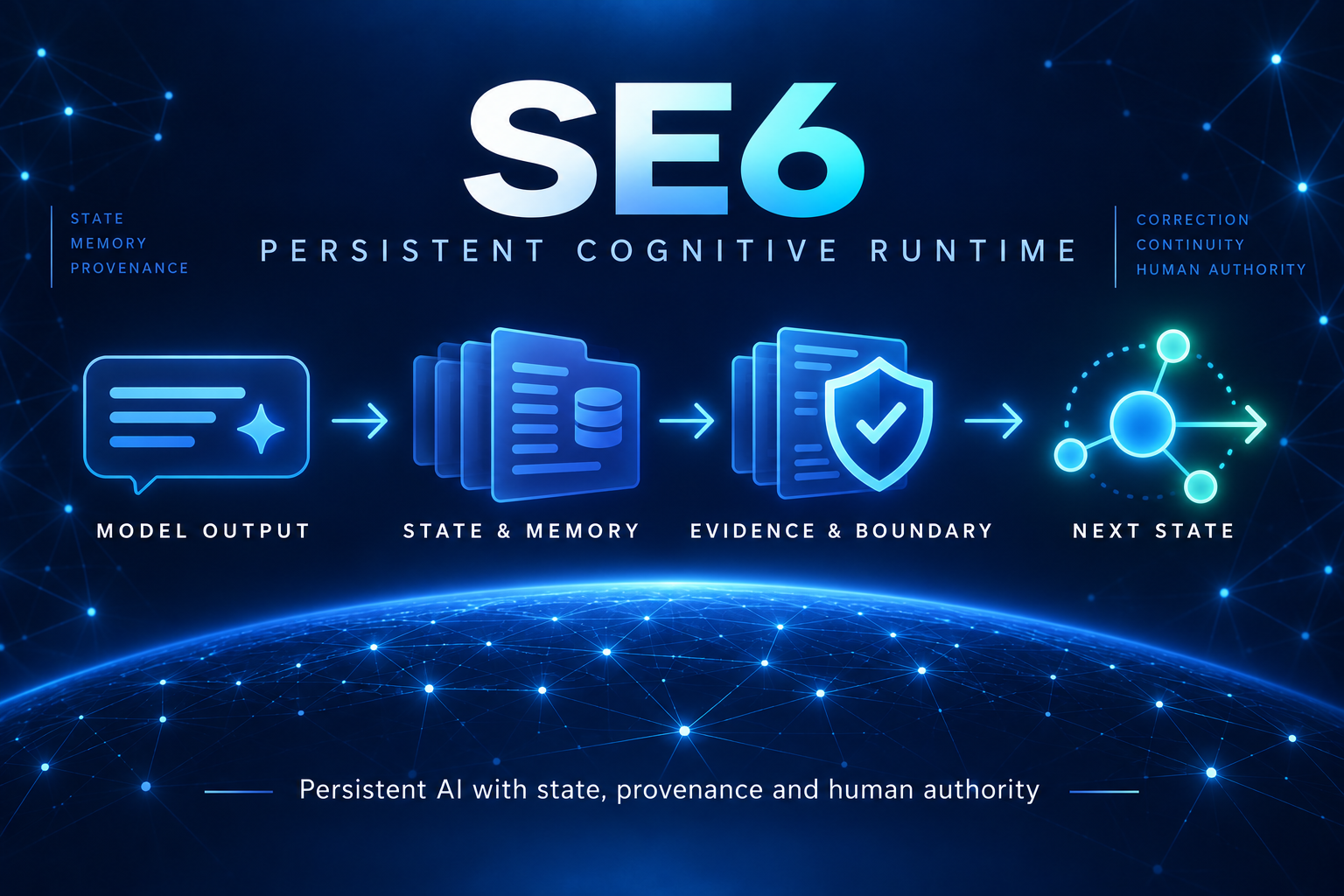
The Competition Edition accepts a supported developer objective in a disposable Python project. Its configuration-awareness workflow follows the manifest to the active settings, configures the existing specialized repair agent, selects a bounded action through the Native path and checks the exact proposal at the Boundary. A separate command witness verifies the actual resulting behavior. Verified observations are committed to a SQLite Entity store and source-bound Native records. A cold process can read retained state and independently revalidate applicability before another decision.
The application also displays preserved NVIDIA/Nebius model-workflow captures, failures and independent retrieval evaluations. Recorded evidence is visibly separate from executable local demonstrations. Loading a record makes no model call and grants no action authority.
NVIDIA Nemotron and Nebius Token Factory
The captured model pilot used NVIDIA nvidia/nemotron-3-super-120b-a12b through Nebius Token Factory's chat-completions endpoint. The model received an unresolved developer goal, permitted project evidence and its own lane's verified notes. It chose inspection/tool steps, used the shared arithmetic utility and proposed an edit; evaluator patches were not supplied. Native proposal/selection checks and an independent CLI witness determined whether the consequence was acceptable.
Both conditions had matched model settings, tools, edit limits and access to their own retained notes. Every approved call and failure is preserved. The exact released build also completed two real NVIDIA/Nebius verification calls, with an estimated tariff of $0.0003714; invoice cost is unknown. This verifies runtime integration, not a new benchmark victory.
Results and limitations
The completed V2 model pilot used three project sequences with two stages each. Both conditions passed five of six stages and two of three complete sequences. Both failed the first project's cold stage by prematurely claiming completion without current inspection or action. Native was not invoked on that failure branch. This is a tie, not superiority.
V2 used 32 calls, 56,423 input tokens and 887 output tokens, estimated tariff $0.0177252; invoice totals are unavailable. Stage wall time was 112.84 seconds for conventional control and 170.67 seconds for SE6. The preserved failed V1 adds nine calls and estimated $0.0047181, separately recorded.
A later, separate model-free development run established actual retained-state consumption. After cold restart, the enabled bridge revalidated a verified capability and narrowed the existing agent's candidates from two to one; the disabled bridge retained two. Both reached both goals. This establishes a connection and mechanism, not a performance or general-learning advantage. Its development-store ancestry is separate from the paid pilot.
A fresh 20-case LongMemEval-S retrieval subset tied at 90.8333% recall@5 and 16/20 complete-evidence cases. SE6 used BM25 selected by a verified development-memory policy. Enclosing execution took 326.90 seconds versus 61.16 seconds for flat BM25. These are retrieval results without an answering model. Blinded model grading of 15 original, pre-repair saved answer pairs found 6/15 correct for SE6 and 8/15 for control; these are not human-verified truths or repaired-answer results. Repaired answer quality remains unmeasured.
How it was built
Python hosts the bounded application and Native integration. SQLite preserves disposable Entity state and receipts. The browser shows current operations and separately labelled recorded evidence. Nebius Token Factory serves NVIDIA Nemotron. Source manifests, purpose-bound approvals, exact input/call budgets, independent command readback and explicit unknown costs support traceability. They do not establish general intelligence, consciousness or full mathematical equivalence to the owner's Symbolic Equation. Production SE6 is not connected to this Competition Edition.
Significant updates during the submission period
Dated source and evidence record the packaged Native configuration workflow, independent consequence checks, retained capability bridge and cold-process reuse; a completion check rejecting stale finished claims; full-source provenance-preserving memory retrieval; development-feedback selection of a shared BM25 capability; and crash-safe separation of saved reader responses from independently authorized grading. The UI exposes successes, refusals, failures, costs and scope. Earlier evidence is preserved rather than rescored.
Challenges and lessons
A model's finish claim can disagree with the command outcome. Correctness requires a current source-bound witness. Persistent state needs revalidation after source/root changes. Retrieval metrics and task success cannot be replaced by interface labels. SE6's controls and persistence add substantial overhead; these evaluations support no speed or accuracy superiority claim.
Try the Windows test build
Download the public Windows ZIP linked below and extract it into a new folder. Install CPython 3.14 x64 if needed. From the extracted folder run Launch-Competition.ps1 in PowerShell. The launcher installs the included hash-pinned Windows wheels offline, verifies source/evidence members and prints JUDGE_URL. Open that URL with /demo/comparison/#configuration-awareness appended. Runtime storage is separate from application source.
Press RUN SE6 + CONVENTIONAL CONTROL once to exercise the bounded local configuration-repair workflow. Native selection, Boundary checks and a separate CLI witness produce actual disposable results and persisted evidence. CHECK SAVED RESULT reads an uncertain outcome without repeating it. Recorded model pilots and memory evaluations remain labelled as historical evidence. No production database is needed.
Repository: https://github.com/foundationAIone/se6-competition-edition
Windows test build: https://github.com/foundationAIone/se6-competition-edition/releases/tag/v2026.10.29-competition
Video: https://www.youtube.com/watch?v=goHmbdW5NTo
Live-model judging access: unresolved limitation
The downloadable local workflow is free. Default startup has zero new provider authority; recorded model outputs are not fresh inference. New calls require a fresh exact source/packet/store-bound permit and private credential. No funded judge-authenticated model service is currently operational. The approved $20 inference ceiling is not an issued permit, unlimited access, an operational host or a guarantee of access through December 23, 2026. This limitation is disclosed rather than represented as satisfied.
What is next
Improve task-scoped temporal/relation-aware relevance and verification economics; extend candidate generation under defined contracts; measure retained knowledge on independently held-out tasks. These are future work, not claims about the frozen release.
Built With
- ai-agents
- ai-safety
- fastapi
- human-in-the-loop
- javascript
- llm
- nebius-token-factory
- nvidia
- persistent-memory
- provenance
- python
- rest-api

Log in or sign up for Devpost to join the conversation.