-
-

app-icon
-
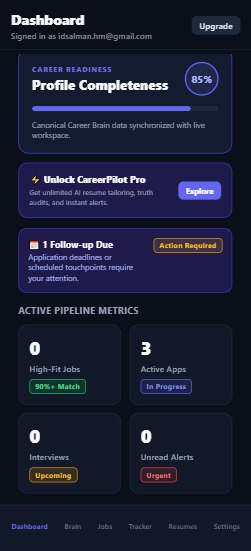
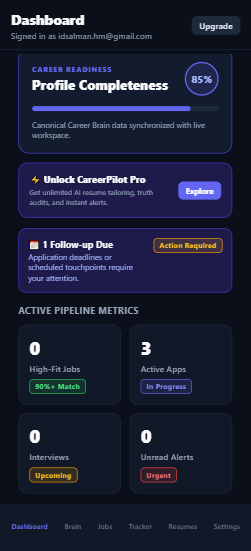
dashboard
-
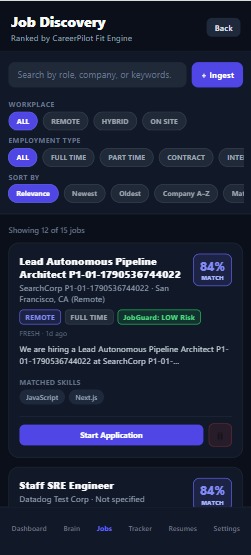
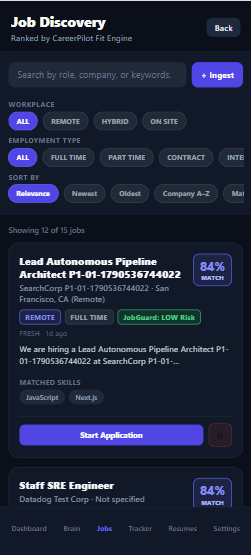
jobs-screen
-
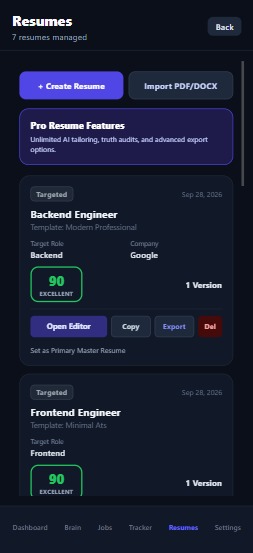
resume-screen
-
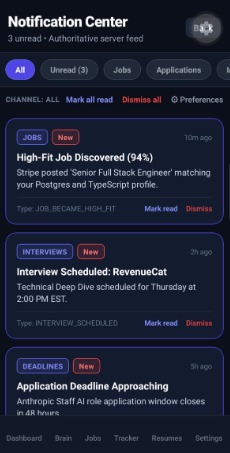
notification-screen
-
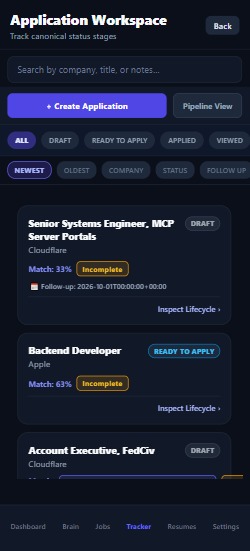
application-screen
-
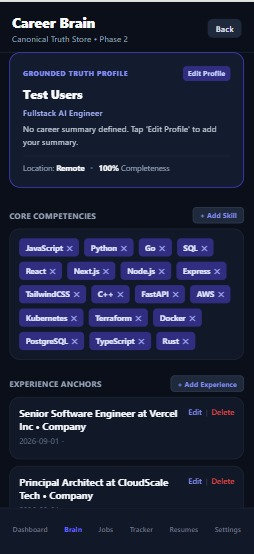
brain-screen
-
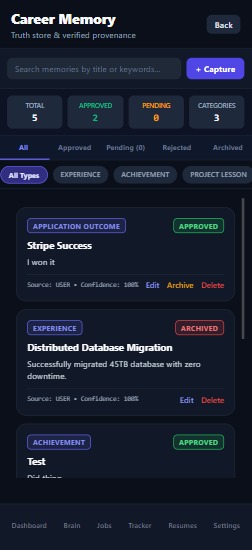
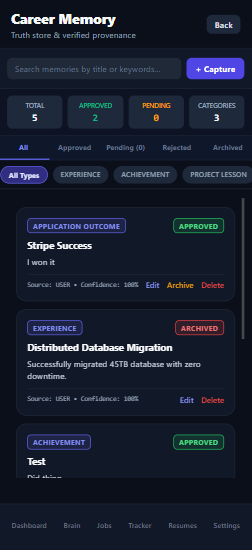
momery-screen
-
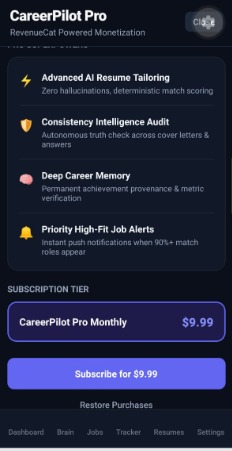
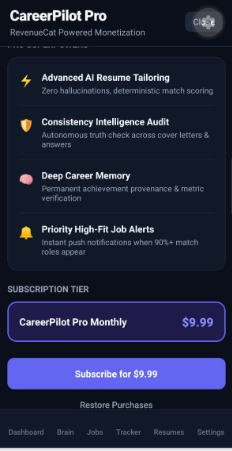
revenuecat-paywall
-
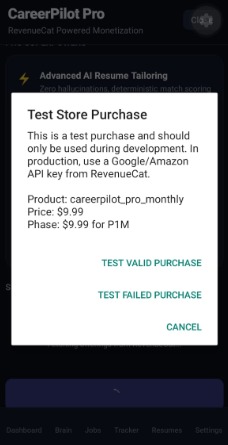
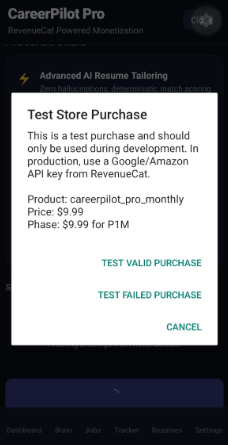
revenuecat-test-purchase
-
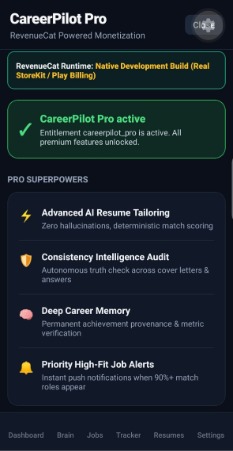
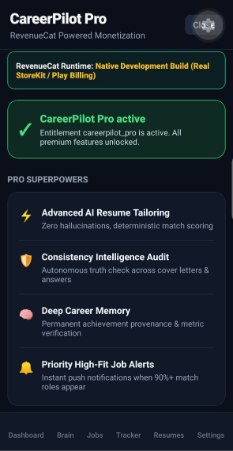
revenuecat-pro-active

CareerPilot AI — The AI Career Operating System
The Problem
A modern job search is scattered across job boards, resumes, spreadsheets, application trackers, documents, notes, email, and personal reminders. Important career information gets repeated, forgotten, or disconnected from the decisions people need to make.
CareerPilot AI was built to turn that fragmented process into one connected career workspace.
The Solution
CareerPilot AI is a mobile-first AI career operating system that connects the major stages of the job-search journey:
Career Brain → Job Discovery → Job Fit & Risk → Resume & Application → Application Tracking → Follow-ups → Career Memory
Instead of treating a resume, a job listing, an application, and a career note as separate pieces of information, CareerPilot keeps them connected through persistent career data, evidence, provenance, and application context.
What CareerPilot AI Does
🧠 Career Brain
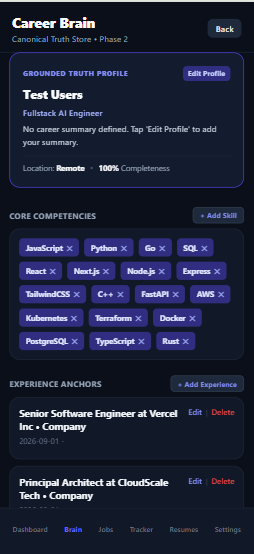
Career Brain acts as the foundation of the system. It brings together a user's profile, experience, education, skills, projects, certifications, and supporting evidence.
The goal is to give every downstream career workflow a consistent source of truth.
🔎 Job Intelligence
CareerPilot can ingest real job listings and help users understand them through:
- Job fit and Match Intelligence
- Position and requirement analysis
- JobGuard risk signals
- Search, filtering, sorting, and pagination
The idea is not simply to collect jobs, but to help users understand which opportunities deserve attention.
📄 Resume Workspace
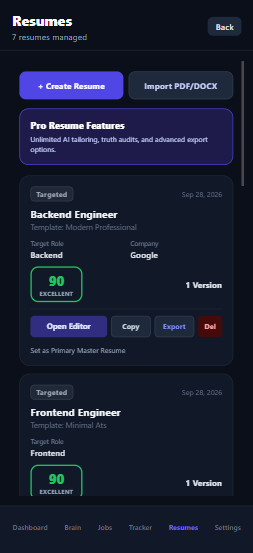
Users can create and edit resumes, maintain persistent resume data, and import existing PDF or DOCX documents.
Imported information can be reviewed before being merged into the Career Brain, keeping the user's career profile connected to the documents they already have.
CareerPilot also supports resume export workflows for PDF and DOCX.
📋 Application Workspace
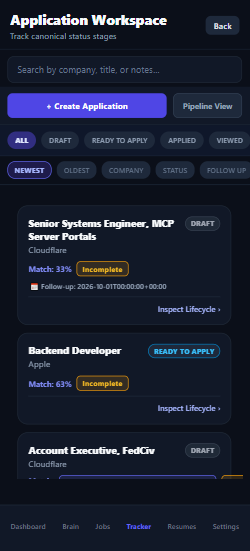
The Application Tracker connects job opportunities with application records and application-package information.
Users can create and manage applications, update stages, review application details, link resumes, and keep application history organized in one place.
🧠 Career Memory
Career Memory stores useful career context such as achievements, experiences, project lessons, interview lessons, preferences, application outcomes, reusable stories, skill context, career goals, and general notes.
This gives the system persistent context instead of treating every interaction as a fresh conversation.
🛡️ Evidence & Provenance
CareerPilot treats evidence as a first-class part of career data.
Evidence records can be linked to authoritative career entities such as experience, education, projects, achievements, certifications, and skills. Parent ownership and tenant isolation are enforced so evidence cannot simply be attached to another user's career data.
This provides a foundation for distinguishing supported information from information that still needs verification.
🔔 Notifications
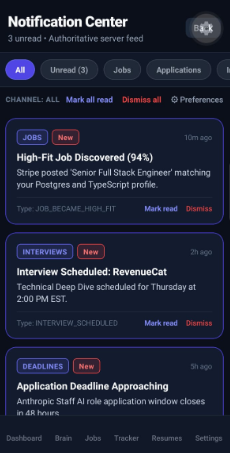
The notification system connects job matches, application activity, interviews, deadlines, career signals, and system events.
Users can filter notifications, mark them read, dismiss them, and configure notification preferences.
💳 RevenueCat
CareerPilot includes an optional Pro subscription layer powered by RevenueCat.
The mobile implementation uses the RevenueCat SDK for the purchase and entitlement flow, with development/testing supported through RevenueCat's Test Store environment.
The application never treats a local button press as proof of a purchase: premium state is derived from RevenueCat customer and entitlement information.
How I Built It
CareerPilot uses a full-stack architecture with:
- React Native and Expo for the mobile application
- Next.js and TypeScript for the web application and API layer
- Supabase PostgreSQL for persistent application data
- Supabase Auth and Row-Level Security for authentication and tenant isolation
- AWS Bedrock / Amazon Nova for AI-assisted career workflows
- RevenueCat for subscription and entitlement management
- Zod and typed API contracts for validation
- Automated testing across the mobile and web codebases
A key design principle was to separate deterministic logic from AI generation.
Identity, IDs, database ownership, validation, matching logic, filtering, provenance, and security should remain deterministic. AI is used where language generation and reasoning assistance are valuable.
Engineering Challenges
One of the hardest parts was keeping mobile and web behavior aligned while ensuring that the mobile application used real persistent backend state rather than local demo state.
The project went through repeated forensic audits focused on:
- server-issued identifiers
- authenticated API requests
- database persistence
- cross-tenant isolation
- real CRUD operations
- error versus empty-state behavior
- cross-screen synchronization
- import/merge workflows
- file export
- stale-request protection
- mobile/web contract parity
Another important challenge was preventing a successful-looking UI from masking a failed backend request. CareerPilot therefore uses explicit loading, success, empty, and error states and avoids silently converting real API failures into fake or empty data.
What I Learned
Building CareerPilot taught me that a complete product is not just a collection of screens.
The difficult part is the connection between them:
identity → data → API contract → database → persistence → UI state → reload → another feature
A feature is only truly finished when that entire chain works.
I also learned to treat provenance and security as product functionality rather than infrastructure that can be added later.
Current Result
CareerPilot AI is a working, mobile-first career operating system with real authentication, persistent data, job intelligence, application workflows, resume management, Career Brain, Career Memory, evidence linkage, notifications, and RevenueCat-powered monetization.
The application has been tested through the web runtime, Expo Go, and a native development build, with real-user authentication and persistent backend workflows.
The project is submitted through the Next Gen path and includes an open-source repository and testing instructions for evaluation.
Built With
- amazon-web-services
- artificial-inteligence
- bedrock
- career-technology
- css
- development
- expo.io
- form
- hook
- mobile
- native
- next.js
- node.js
- postgresql
- react
- revenuecat
- shadcn/ui
- supabase
- tailwind
- typescript
- vitest
- zod


Log in or sign up for Devpost to join the conversation.