Inspiration
In the post-industrial world, we need an “epistemological break” for the financial sector, economy, and humanity. Thus we need to rethink and rebuild economic and financial systems from a profit-oriented to a sustainability-oriented approach.
In neo-economics, energy transition and multi-agent autonomous systems (e.g. robots, autonomous vehicles, smart factories, etc.) will play a key role. As part of our RoboFi project, we aim to demonstrate the possibility of building a digital trustless environment that will allow the economic interaction between robots in the process of creating sustainable value that integrates the economic, environmental, social, and governance (EESG) dimensions of sustainability.
The current project describes one of the applications of Robonomics for building Decentralized Finance (DeFi) and Regenerative Finance (ReFi) infrastructure for economic interaction between service robots without intermediaries. Thus, RoboFi combines the concepts of Robotics, DeFi and ReFi.
RoboFi = short from Robo[tics] + [De]Fi + [Re]Fi
By "robots" here we mean a broad class of energy machines (electric vehicles, energy storage systems, UAVs, and even power plants) that convert energy (clean/green electricity or hydrogen) into work to create new sustainable value.
Initially, we started RoboFi as an internal R&D project (formerly named Robocharge [https://youtu.be/3wBk2hODqkw]) to find solutions for trustless and secure P2P economic interactions (value transfer) between machines (M2M) and humans (H2M).
Also, this project is an evolutionary development of the Electrodo project, with which our team was the winner of the European research grant program from Eureka (GlobalStars-Singapore Call): “Achieving sustainable living for residents of public housing in Singapore”. Today together with our Singaporean partners under this Eureka program we develop a platform for sustainable living in public housing (HDB) in Singapore. The goal of this project is to educate and motivate HDB tenants for sustainable living behavior by using Clean energy traceability and Sustainable living gamification through “Clean Energy Credits”. Clean Energy Credits are used to offset a tenant's carbon footprint and energy bill payments during energy consumption, e.g. when charging an electric car. For this project, we provide blockchain-enabled decentralized infrastructure for clean energy asset tokenization, management, and payments.
Testing of this RoboFi is carried out as part of a joint R&D project with the Singapore Institute of Technology (SIT). We use the SIT's solar power plant testbed (more details in the project materials) to get data about green (solar) energy generation.
Developing this project, we are inspired by the idea of contributing to building the P2P neo-economy by using Web3 technologies in Singapore. We have plans to further scale this project with the participation of research institutions and industrial enterprises in Singapore.
What it does
In the RoboFi robotic economy ecosystem, there are two service robots: Robot Werther and Robot Alice that provide various commercial services for humans and other robots: last-mile delivery services, retail services, repair services, charging services, etc.
One of the robots, Robot Werther (mobile charging station) provides mobile charging services to other robots, or people to charge electric cars and devices. Robot Werther can get (consume) electricity from its own solar panel (clean energy source) or an electrical grid (energy mix from renewable and non-renewable energy sources). In addition to its main job, the Robot Werther participates in a Sustainable environmental program and receives I-RECs and/or carbon credits equal to the amount of carbon reduction as a result of generating clean electricity (reward for positive environmental impact). Robot Werther also provides brokerage services for the purchase and sale of carbon credits.
Not all robots are as lucky as Robot Werther - not everyone has their own solar power plant with clean energy. An example is Robot Alice - a last-mile delivery provider. Robot Alice is charged from the common electrical grid of the RoboFi ecosystem using an energy mix that may include both renewable and non-renewable energy sources. Robot Alice, at the same time, strives to create Public Goods and Sustainable Value by providing delivery service with a positive environmental impact on external ecosystems (the environment and communities of robots and people). For this purpose, Robot Alice can use carbon credits to offset carbon emissions and reduce its carbon footprint.
The following describes a typical weekday in the robot economy.
Robot Werther buys carbon credits through the Carbon market based on the Toucan protocol. Together with the carbon credits received from the Sustainable environmental program, this total amount of carbon credits from a brokerage account; Robot Werther registers a brokerage account on the sustainable asset exchange RoboFi SDEX. RoboFi SDEX is an exchange where carbon credits as well as other types of sustainable assets are traded as tokenized assets. Robot Werther places an order to sell carbon credits on RoboFi SDEX; Robot Alice registers a user account and connects to the RoboFi SDEX; Robot Alice calculates the carbon footprint of delivery service to determine the number of carbon credits required for offsetting; Robot Alice finds and chooses specific carbon credits from Robot Werther offered for sale; Robot Alice pays and buys the required amount of carbon credits; Robot Alice retires carbon credits, offsetting carbon emissions and reducing carbon footprint; Robot Alice provides a last-mile delivery service with net-zero carbon emissions.
Finally, Robot Alice discloses in its RoboESG report (carbon retirement certificate) that delivery service is categorized as a sustainable product, thus confirming the creation of Sustainable Value (Sustainable Public Goods).
How we built it
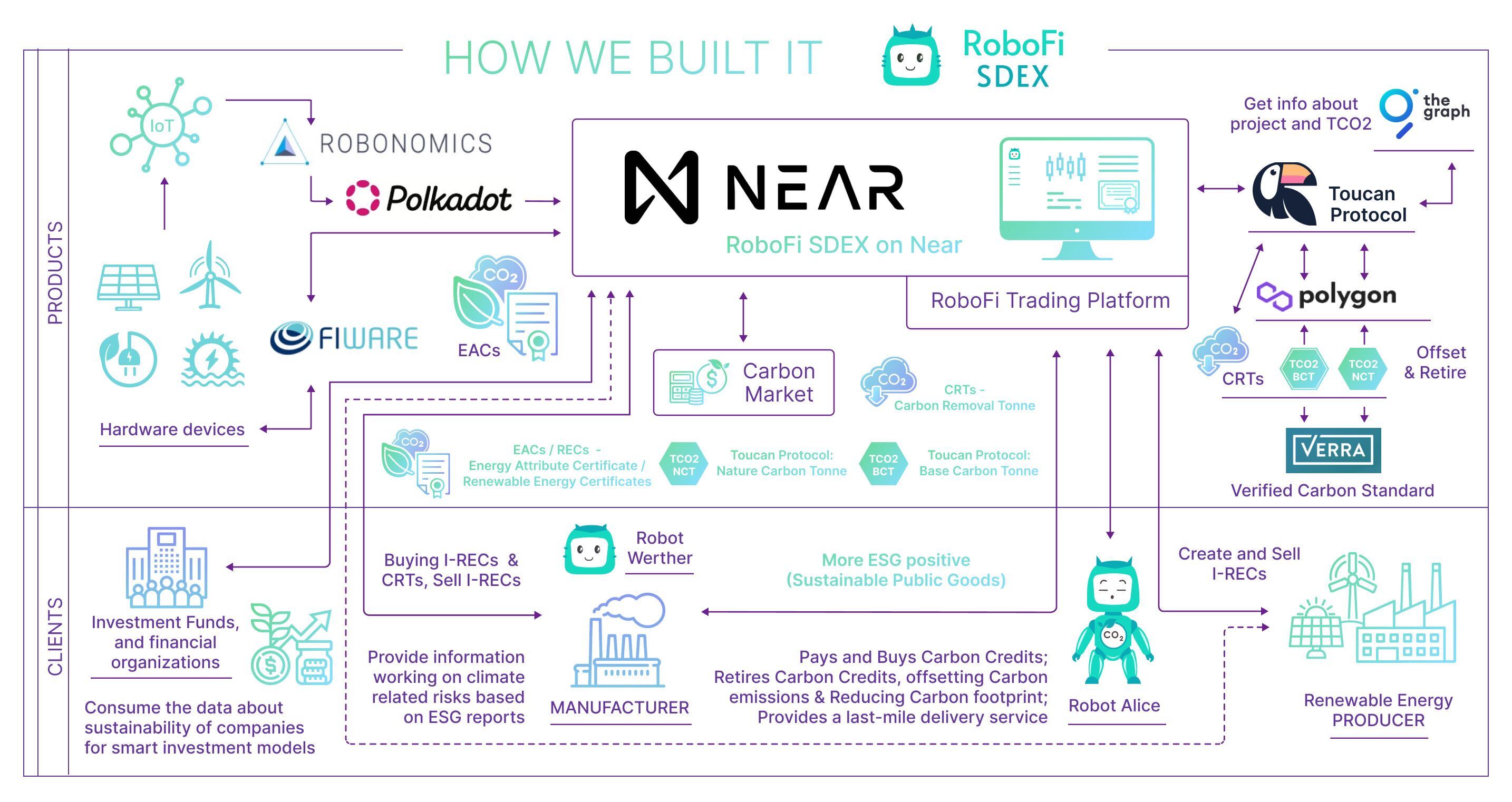
Applications consist of a few different parts - marketplace frontend and backend, and smart contracts. The main logic depends on smart contracts and working with a native Near wallet. All functionalities work with native Near token, and all payment operations inside the marketplace are based on it. Another part is the integration of NEAR marketplace with the Toucan protocol (Polygon based) - to do this we used the Toucan-SDK library and subgraph to make it work together with the NEAR marketplace and exchange data.
Challenges we ran into
Connecting NEAR and Toucan protocol was the most challenging part we had to work on. Connections between different blockchains are usually not an easy task and it takes a lot of effort to investigate different approaches. One of the technical problems was using Toucan-SDK in NEAR marketplace. The library which we were using (toucan-SDK) was in the development stage and not tested, for now, so we faced a lot of challenges and had to modify the library for our needs. Also, one more complicated thing was to design logic on how to map information about carbon credits in NEAR and Toucan protocol and to make the economic model of the whole system sustainable.
Accomplishments that we're proud of
We demonstrated that NEAR technology is a very good choice for complex solutions which may require connecting different technologies from the blockchain world together and proving that your ideas could be implemented as real-life blockchain solutions. Also, we are proud that we designed and implemented a solution that improves the whole carbon market industry and makes a positive impact on the world ecology model. We consider it an achievement that our solution can now work with a custom blockchain protocol based on Polygon (Toucan protocol). Which in turn makes it possible to interact with the centralized registry of carbon credits Verra. The user does not leave the NEAR ecosystem and has a wide range of sustainable development tools. Especially if the user is a robot ))
What we learned
We discovered a lot of technical things and had a chance to work with different approaches. Previously we used Rust for smart contracts for our marketplace, but this time we decided to use JS NEAR SDK for writing smart contracts. In general, the idea is the same but it is always interesting to play with different technologies. Also working with Toucan protocol is a good experience for us. Learned a lot of things about the world carbon market and its structure. It was also very interesting to implement the interaction between the protocol running on Polygon and the NEAR network.
What's next for RoboFi SDEX
The idea of RoboFi SDEX is to build a liquidity aggregator and ESG asset broker for the Voluntary Carbon Market with further scaling to other markets and segments of Green Finance.
In Singapore, our team is a member of the EcoLabs ecosystem (Singapore's National Centre of Innovation for Energy, a joint initiative of Nanyang Technological University, Enterprise Singapore, and the Sustainable Energy Association Singapore). RoboFi SDEX project is a part of Electrodo platform and supported by EcoLabs in R&D and commercialization journey.
Our project roadmap includes:
- advanced integration of SDEX.Electrodo (NEAR-based application) with Toucan Protocol (Polygon-based application);
- integration RoboFi SDEX with the Singapore Carbon Exchange to connect with an additional source of carbon liquidity;
- piloting RoboFi SDEX within the EcoLabs ecosystem together with our partners;
- piloting RoboFi SDEX with the participation of research institutions and transportation companies in Singapore.
Built With
- fiware-orion
- near-protocol
- nestjs
- oracle-cloud
- polygon
- postgresql
- python
- react
- thegraph
- toucan-protocol
- typescript


Log in or sign up for Devpost to join the conversation.