-
-

SCTR - landing page
-
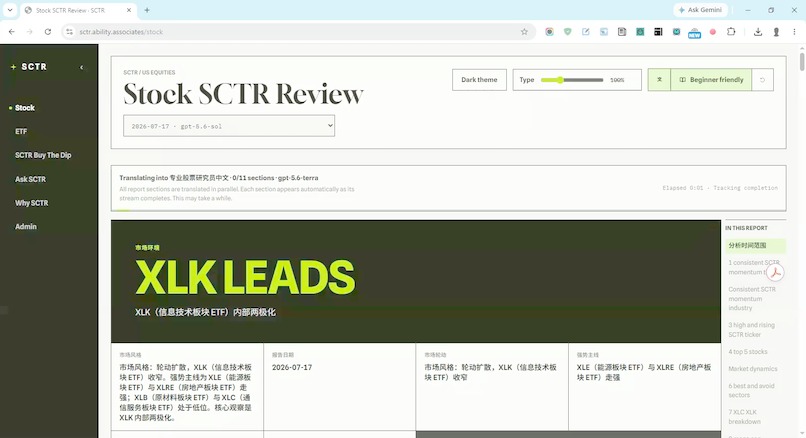
SCTR - primary peer relative ranking page - light
-
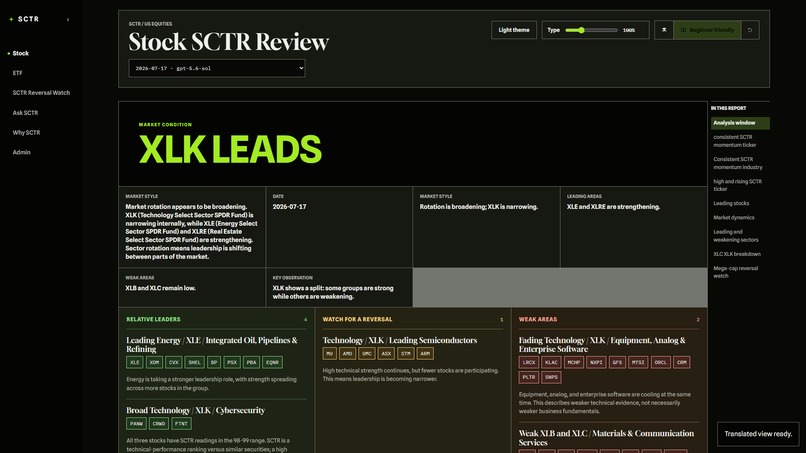
SCTR - primary peer relative ranking page - dark
-
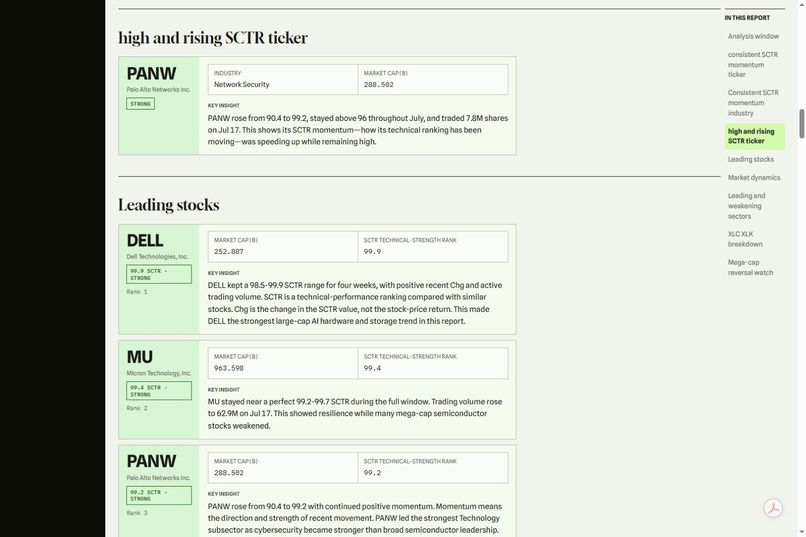
SCTR - detailed analysis page
-
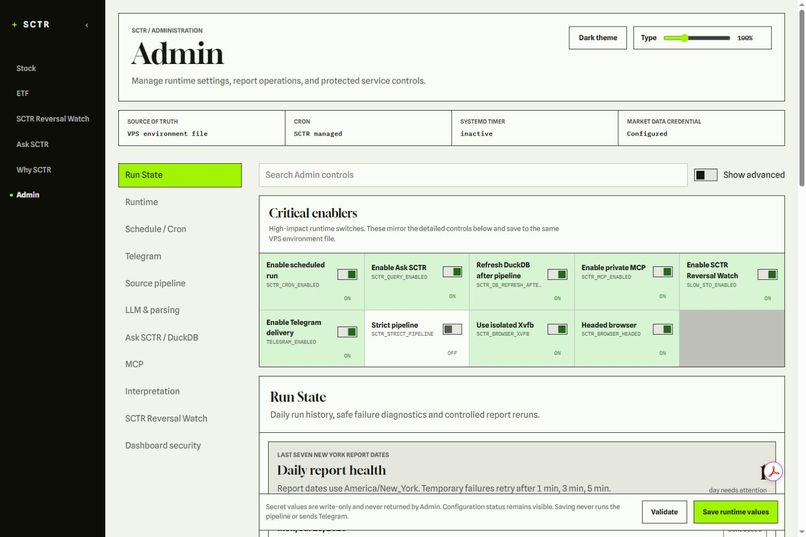
SCTR - admin
-
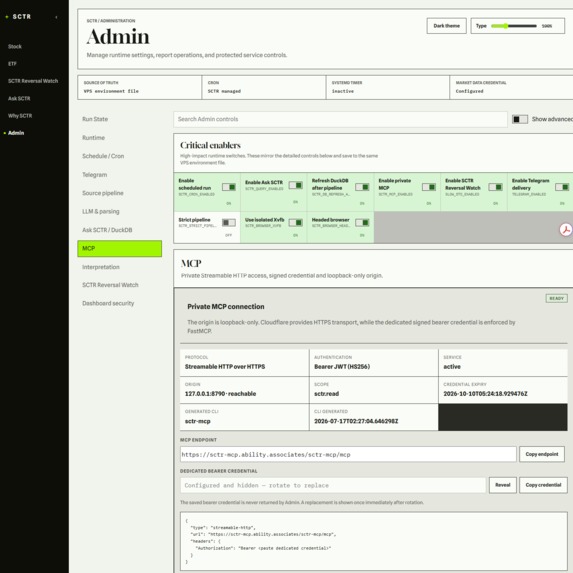
SCTR - MCP/CLI
-
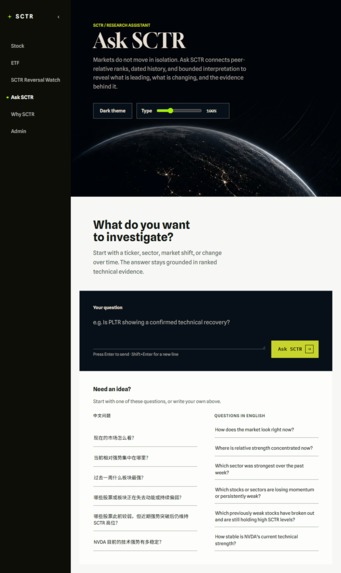
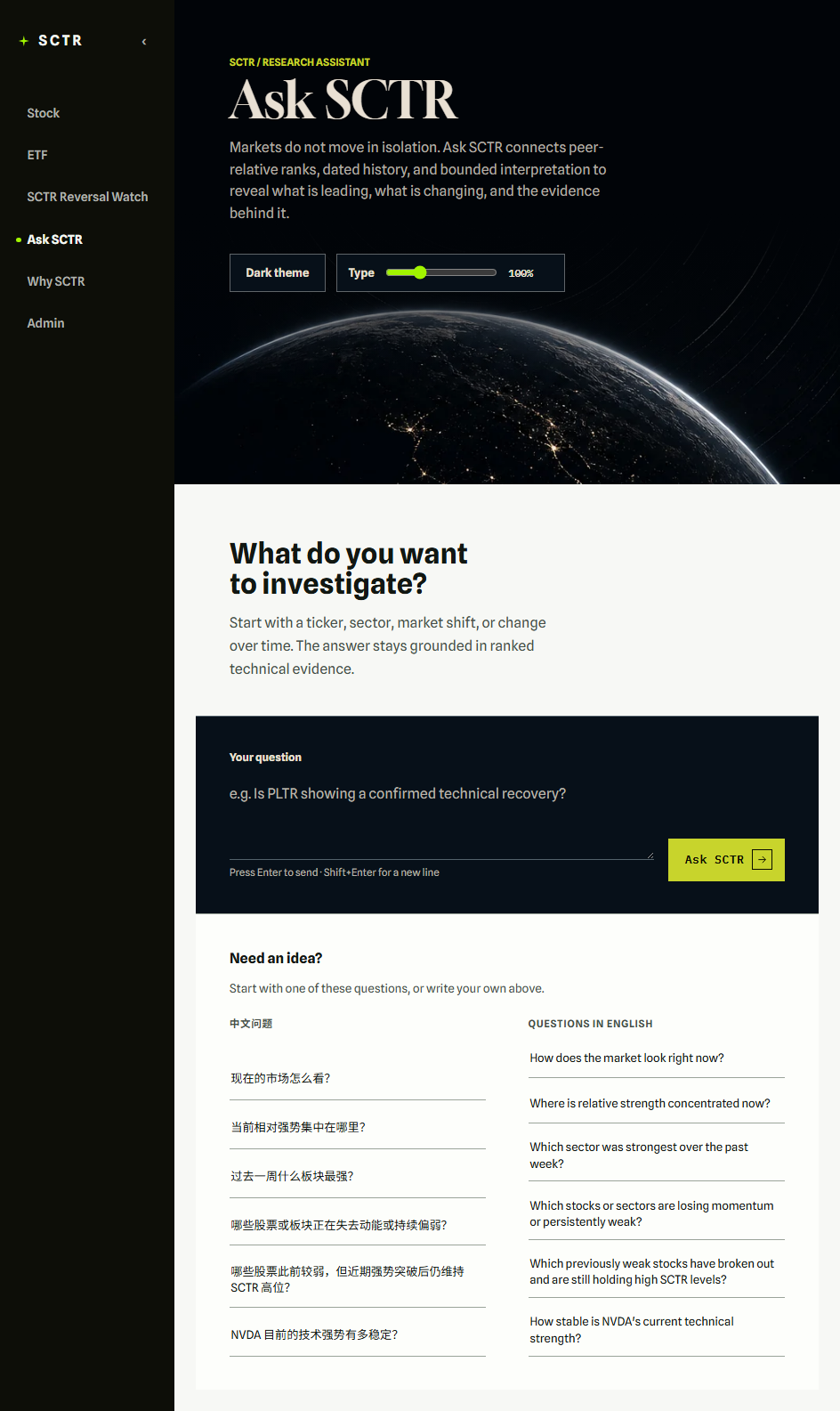
SCTR - Ask SCTR Chat Page
-
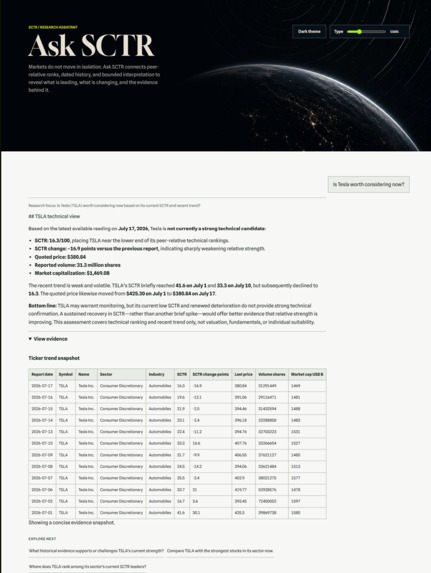
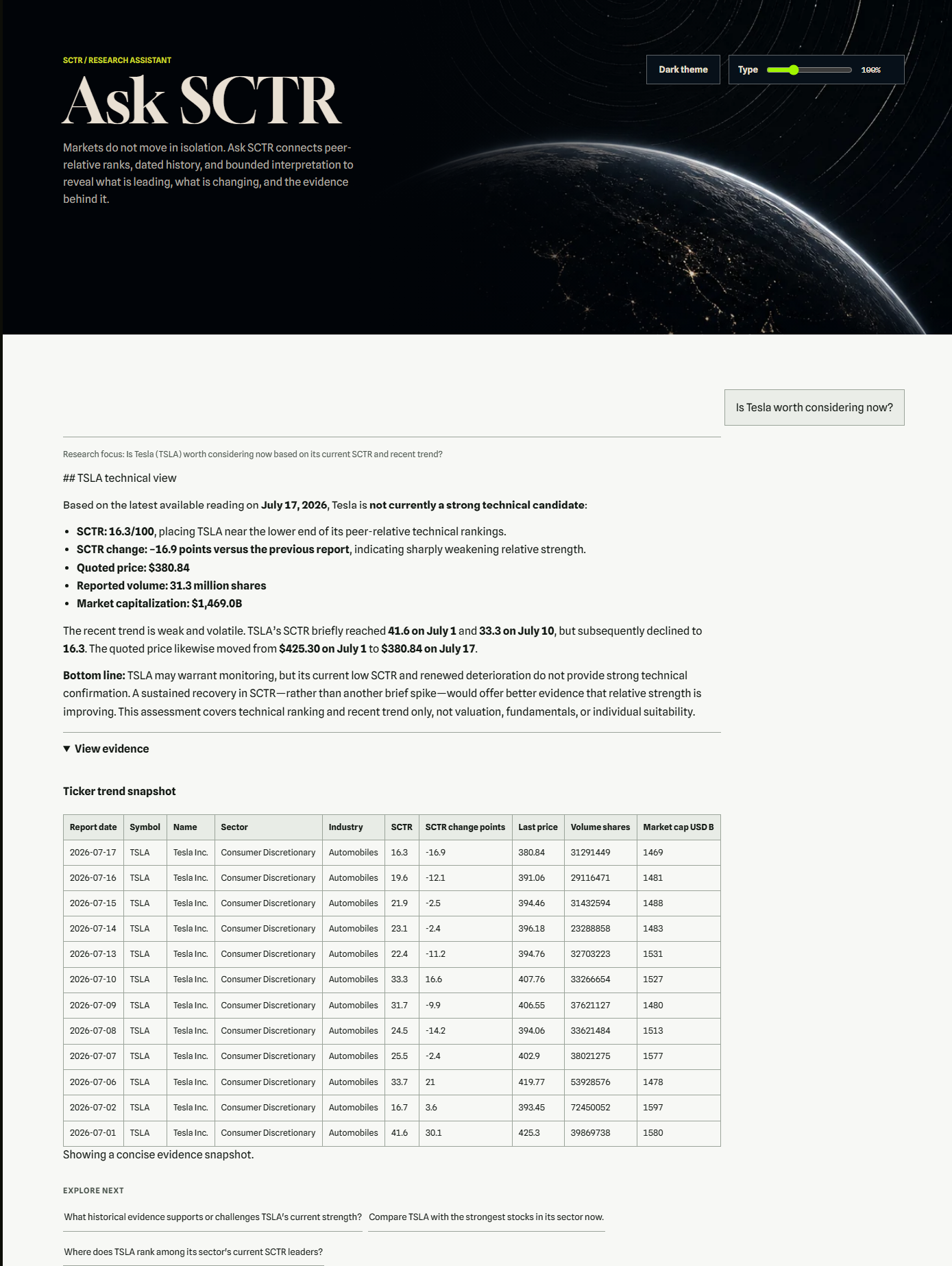
SCTR - Ask SCTR AI Chat Result grounded by evidence

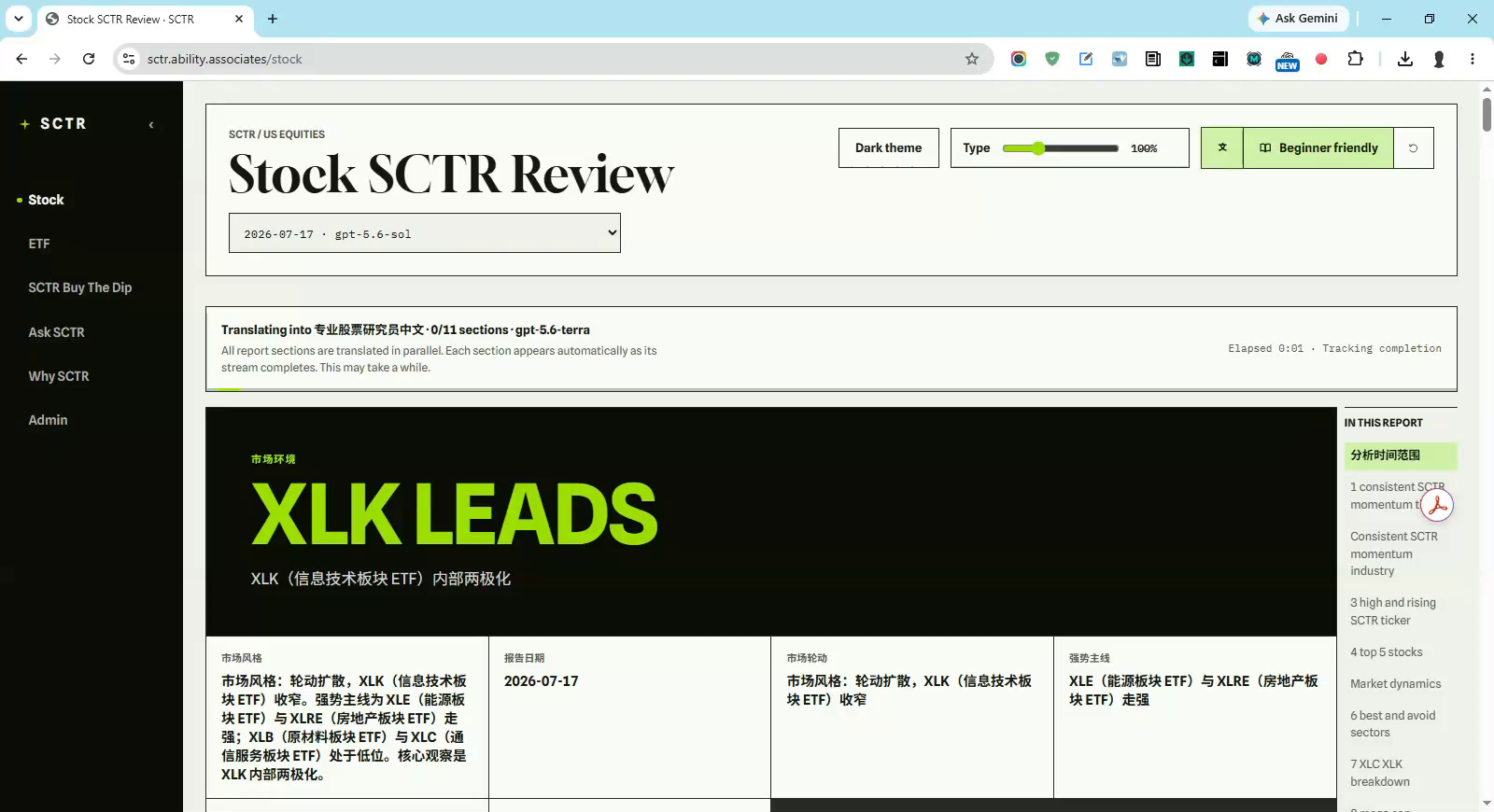
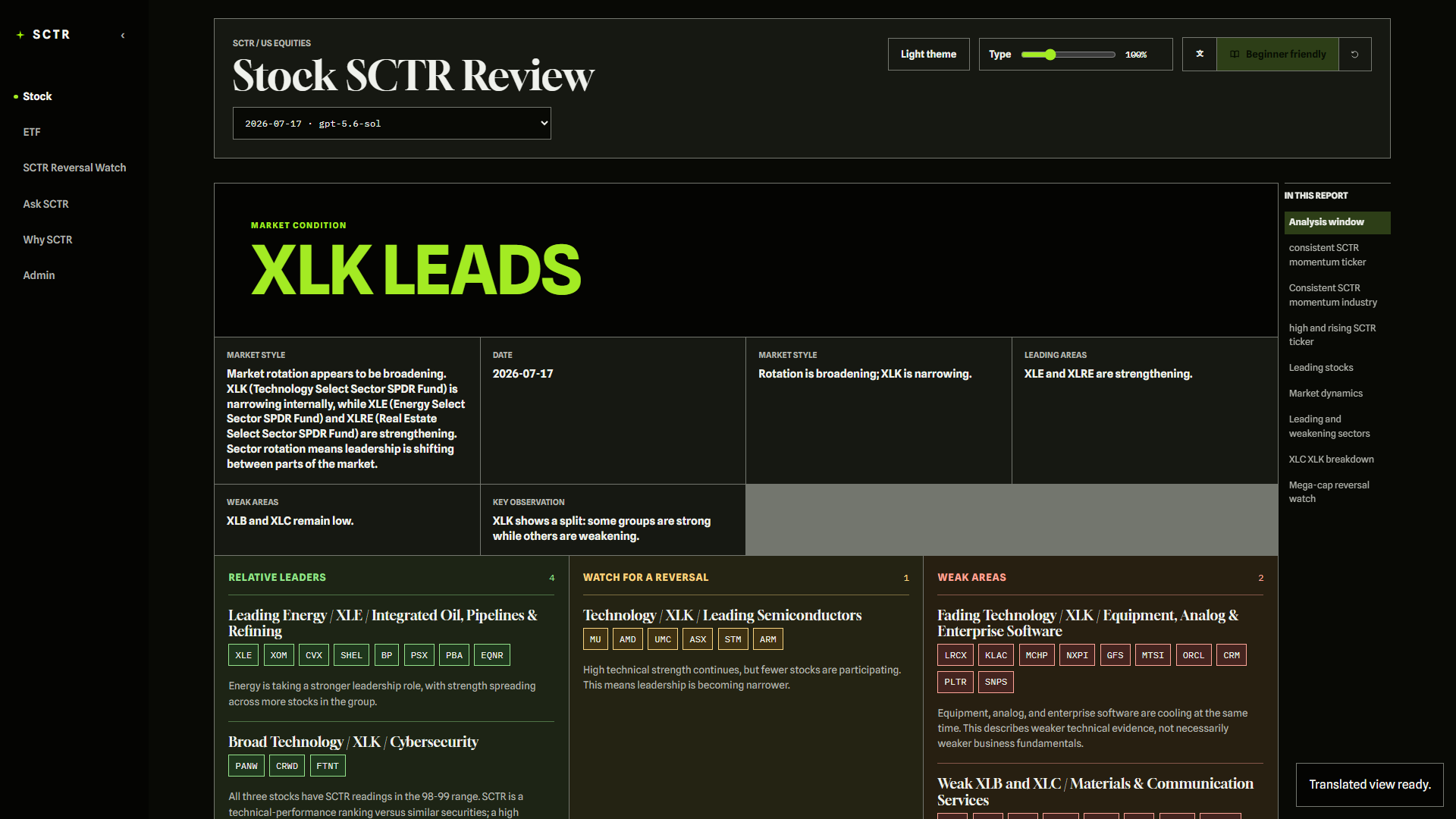
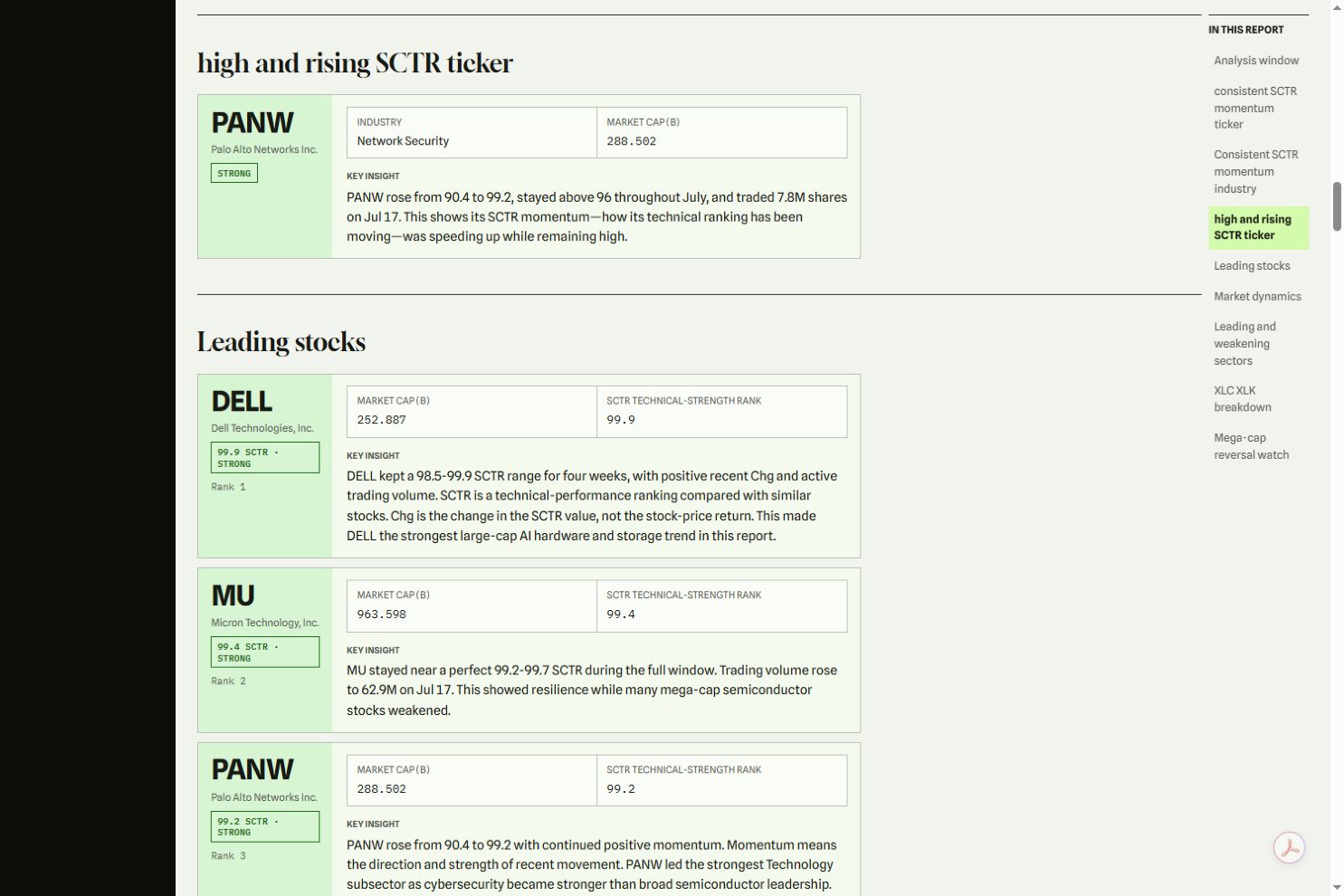
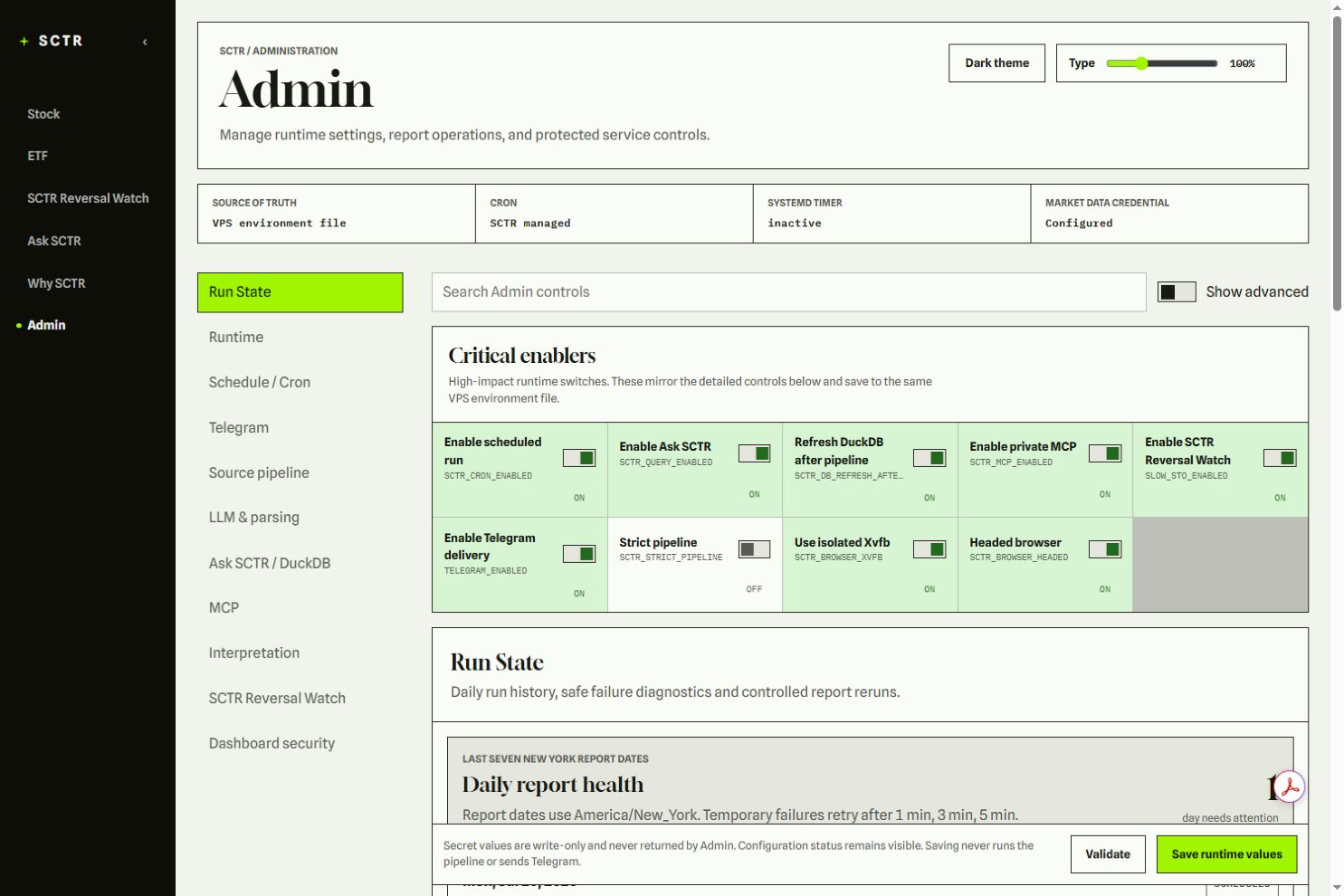
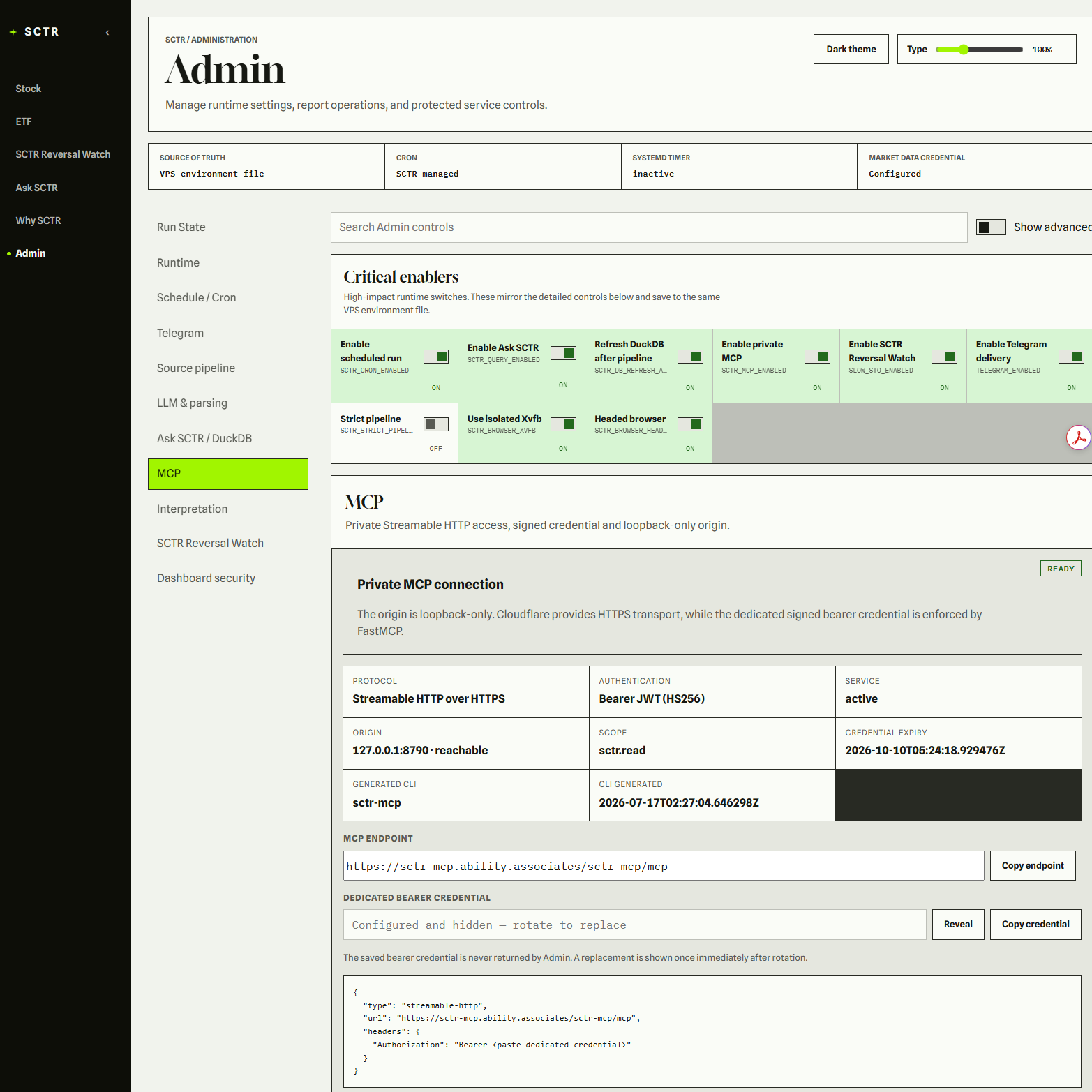
SCTR — a novel reference system for market leadership
Live product · Private website access: password is provided in the private GitHub repo · Source repository · Product architecture diagram · User journey diagram · Data, open-source, and licence disclosure
See the difference in 60 seconds
- Open the hosted product and enter the Product password.
- Open Ask SCTR.
- Ask: “Which sector is leading right now?”
- Expand View evidence to inspect the dated rankings.
- Open a Stock or ETF report and switch between Professional, Beginner friendly, and Chinese.
No installation or local setup is required.
The problem
Stock market information is everywhere. Clear understanding is not.
Prices shift. Headlines pile up. Competing views emerge.
The market is noisy. For anyone trying to follow it, there is a bigger challenge: knowing where to start reliably. The news cycle and market noise draw focus to whatever is newest, whether that is a price swing, headline, opinion, or prevailing sentiment.
Without a clear framework, people often begin with a random stock or fund rather than identifying where genuine strength sits in the market.
To fill that gap, they manually pull up charts, review financial data, compare indicators, and put in hours of work before knowing what actually deserves their attention.
Without comparison against similar peers, a widely discussed name can appear stronger than it is, and a short-term rise can seem like sustained leadership.
The relative strength reference system
That is why SCTR was created.
SCTR uses a structured peer-relative strength ranking system to answer four core questions:
- Where is relative strength most evident, and which sectors or groups are leading?
- What is gaining or losing momentum right now?
- Which investments have maintained leadership over time?
- What dated evidence supports this assessment?
Every Stock and ETF view includes the 0.00–99.99 peer-relative SCTR rank and its historical trend.
Not the noise.
Not the latest headlines.
Not shifting sentiment.
Just relative strength.
Imagine market gravity—inflation, interest rates, macro news—is constantly trying to pull every single asset down. Most instruments are just space debris: when market gravity hits, they plummet.
Relative Strength measures an asset's thrust. It tells you which assets have enough momentum to maintain escape velocity—holding high orbit or breaking out—while everything else around them gets dragged down into the atmosphere.
SCTR starts with market and sector hierarchy, then moves to the leader and underperformer inside the same peer context. Each Stock and ETF view makes level, direction, and persistence visible:
- high and rising;
- high and holding;
- high but fading;
- improving from weak; or
- persistently weak.
The product journey is:
User Uncertainty → Market Hierarchy → Relative Rank → Historical Context → Leader vs. Laggard Comparison → Constrained AI Explanation
What is novel about this product
SCTR is for people trying to understand market leadership without becoming full-time market analysts. The problem is not that market information is missing. The problem is overload. A normal person can open CNBC, Yahoo Finance, Reddit, broker charts, screeners, and analyst notes, and still not know where to begin. The loudest ticker often wins attention, even when its relative strength is already fading.
General chatbots have the same problem in another form. They can explain finance concepts, but they do not naturally understand market-relevance gravity: which names matter now, which peers they should be compared against, and which dated evidence should anchor the answer.
I built SCTR to give that person a clearer first step. Before AI explains anything, SCTR cuts through the noise and headlines and establishes a market-relative reference frame.
SCTR turns market leadership into a dated, peer-relative evidence system. Instead of asking an AI model to guess what matters, the product first retrieves structured SCTR evidence from DuckDB, then uses GPT-5.6 to explain that evidence in professional, beginner English, or beginner Chinese views. Codex helped turn the raw technical foundation into a working product: the hosted dashboard, Ask SCTR, protected Admin settings, MCP/CLI surfaces, testing, and security hardening.
The architecture is deliberately constrained. A pipelined peer-relative rank and dated history define the context. Deterministic services validate intent and retrieve records. GPT-5.6 explains, summarizes, and adapts those records, while invariant checks protect dates, ranks, tickers, values, signs, and units.
This shifts the product from chat-first generation to evidence-first peer-relative interpretation.
- Data anchoring: SCTR begins with a defined peer-relative reference frame instead of news commentary, a popular ticker, or market sentiment.
- Signal discovery: it moves through market and sector hierarchy before an individual security.
- Comparison: it places a relative leader beside an underperformer in the same peer group.
- Temporal context: dated prior ranks show whether strength is rising, holding, fading, improving, or persistently weak.
- AI interpretation: GPT-5.6 works between validated intent plans and retrieved evidence.
- Reading modes: professional, beginner English, and beginner Chinese views change the explanation while protected evidence remains stable.
- System reuse: the same bounded query services support the dashboard, MCP, and CLI; Telegram delivers prepared insights through its configured delivery path.
What changed when the model had evidence
I tested SCTR against the kind of questions a normal person asks before opening ten browser tabs.
The goal was not to prove that a model can sound smart. Generic models already do that. The question was simpler:
Can the product give a better starting point because it has dated, peer-relative market evidence?
On 20 July 2026, I tested the same six everyday research questions across four paths:
- SCTR MCP-grounded path:
query_sctrretrieved dated SCTR evidence from the live MCP server, then GPT-5.6 Sol explained only that evidence. - Generic GPT-5.6 Sol: no MCP, no tools, no SCTR data.
- Generic Gemini: no MCP, no tools, no SCTR data.
- Generic Claude: no MCP, no tools, no SCTR data.
Six everyday questions
| User question | What SCTR gave back | What generic models gave back | Why it matters |
|---|---|---|---|
| “I have cash but no idea where to research.” | Started with the market hierarchy: XLE ranked #1 with SCTR 96.7 and +27.5 change; XLK was high but falling; XLRE, XLF, and XLV were improving. | Suggested a generic process: use screeners, read filings, check valuation, consider ETFs. | SCTR gives the user a starting map, not just homework. |
| “NVDA is everywhere again.” | Returned dated NVDA evidence: on 2026-07-17, NVDA had SCTR 45.7, down 20.1, after 55.8, 66.0, and 66.4 on prior days. | Talked about earnings, export controls, valuation, and filings, but had no current relative-strength evidence. | SCTR separates attention from actual peer-relative strength. |
| “An ETF looks strong. Is it improving or fading?” | Distinguished high-and-improving ETFs from high-but-fading ETFs: HACK 99.5 +0.8 and CIBR 98.9 +0.9 versus SOXX/PSI 99.2 -0.5. | Explained how to use ratio charts, moving averages, and volume confirmation. | SCTR shows both level and direction. |
| “I already own NVDA.” | Compared NVDA against stronger peers: NVDA 45.7 -20.1 versus SNDK 99.7, MU 99.4, DELL 99.9, and PANW 99.2. | Suggested manually building comparison charts. | SCTR removes the chart-hopping step and creates the peer frame first. |
| “Which sector appears strongest?” | Identified Energy/XLE as strongest: rank #1, SCTR 96.7, +27.5; showed XLK as high but weakening and XLV as lower ranked but sharply improving. | Said they lacked live data and could only describe how to find sector strength. | SCTR gives a live evidence path where generic models can only give methodology. |
| Beginner Chinese user | Explained the same protected numbers simply in Chinese: XLE first, XLK high but weakening, XLRE/XLF/XLV improving. | Gave a generic Chinese investing process without current SCTR evidence. | SCTR keeps the facts stable across language and reading level. |
The creative idea is not “ask AI what stock to buy.” SCTR does not try to be a stock picker.
The creative idea is that the market reference frame comes before the model answer.
A normal chatbot starts with a prompt. SCTR starts with structure:
User uncertainty
    ↓
Market hierarchy
    ↓
Peer-relative rank
    ↓
Dated continuity
    ↓
Leader / laggard comparison
    ↓
GPT-5.6 explanation constrained by retrieved evidence
SCTR’s novelty is making hierarchy, dated continuity, evidence-constrained AI interpretation, and multi-surface delivery one repeatable pipeline and user journey. It is a genuine, brand-new user experience. The user is not left with general advice like “check the news” or “compare peers manually.” They can see where strength is concentrated, which names are leading or fading, and what date supports the view.
OpenAI Build Week Transformation
SCTR’s web product was born roughly one week before the challenge. Its original data pipeline and ranking, DuckDB-backed AI chat, Telegram delivery, authenticated MCP, generated CLI, protected dashboard, and initial reader controls were already working foundations underpinned by GPT-5.5.
After the 13 July 2026 cutoff, Codex and GPT-5.6 helped turn that young technical foundation into one coherent product:
- adaptive rendering across varied historical report shapes;
- a first-principles Why SCTR journey that establishes the reference frame before security selection;
- automatic beginner English and Chinese preparation with evidence invariants;
- integrated navigation across the story, research reports, and Ask SCTR;
- elevated mobile Ask SCTR discovery, composer behavior, and responsive flow;
- provenance protection and renderer-side safeguards for historical cached output;
- cache-safe landing delivery and dependable run-state visibility;
- separate Product and Admin identity, cookies, sessions, and Admin-authorized APIs;
- recursive diagnostic redaction that protects credentials across historical runtime excerpts;
- write-only Admin secrets, hash-first Product authentication, and MCP credential rotation output.
Codex collaboration
Codex worked across the full product-delivery loop: inspect the existing architecture, shape the product plan, implement bounded changes, evaluate the experience, diagnose regressions, harden security, verify the live runtime, and assemble traceable competition evidence.
Five qualifying Codex sessions produced the 20-commit Build Week range:
- adaptive rendering, run-state controls, provenance, cache safety, and Admin security;
- report safety and mobile Ask SCTR;
- Why SCTR, automatic adapted views, integrated navigation, and experience polish;
- cached-output safeguards, diagnostic redaction, and write-only Admin secrets;
- final product-language alignment, guarded status values, verification, and publication.
The entrant made the defining product decisions: start from market hierarchy, compare leaders and underperformers inside the same context, use dated continuity, preserve evidence across reading modes, keep the dashboard primary, and separate the private judging repository at the DuckDB boundary.
GPT-5.6 runtime role
GPT-5.6 is SCTR’s bounded interpretation layer.
question
    ↓
GPT-5.6 proposal
    ↓
deterministic plan validation
    ↓
read-only DuckDB retrieval
    ↓
normalized dated evidence
    ↓
GPT-5.6 explanation or adaptation
    ↓
invariant checks
    ↓
dashboard, MCP, or CLI response
It performs four responsibilities:
- Plan: converts a natural-language question into structured intent, universe, symbol or sector, time window, and result limit.
- Explain: compares returned ranks, history, and metadata to describe concentration, leadership, underperformance, and change.
- Summarise: compresses a prepared professional report while retaining its evidence trail.
- Adapt: produces beginner English and Chinese explanations from canonical evidence.
The configured runtime uses GPT-5.6 Sol for question planning, grounded answers, summaries, and full-report adaptation, with GPT-5.6 Terra supporting lower-latency parallel section adaptation.
Product architecture and security
SCTR uses a standard three-layer architecture, expanded into five operational boundaries and one cross-cutting security plane.
Cloudflare edge
Tunnel · HTTPS · WAF/DDoS
            │
            ▼
Presentation layer
Dashboard experience · reading modes · Ask SCTR · integration adapters
            │
            ▼
Application layer
Domain/query services · GPT-5.6 interpretation
            │
     ┌──────┴──────┐
     ▼             ▼
Data layer     Isolated runtime state
Read-only      Cache · feedback
DuckDB
- Data boundary: centralized read-only DuckDB connection, schema and version checks, and separate writable runtime state.
- Domain/query layer: named intents, allowlisted fields, bounded limits, parameterized retrieval, and dated evidence normalization.
- AI interpretation layer: GPT-5.6 planning, explanation, summarisation, and translation with protected factual invariants.
- Experience layer: Why SCTR, Stock and ETF reports, SCTR Reversal Watch, reading modes, Ask SCTR, responsive layouts, and explicit states.
- Integration layer: authenticated MCP, generated CLI, configured Telegram delivery, and protected Admin controls.
Cloudflare Tunnel, HTTPS, managed WAF, and DDoS protection operate at the deployment edge. The application security plane includes PBKDF2-SHA256 passwords, separate Product/Admin sessions, scoped access, rate limits, CSP/HSTS headers, write-only secret handling, diagnostic redaction, and read-only evidence enforcement.
View the full Product Architecture and diagrams →
User journey
- Open Why SCTR and follow Noise → The trail → Alignment → The rank → Clarity.
- Locate a leading sector, industry, or segment.
- Compare a relative leader with an underperformer inside the same peer context.
- Inspect the as-of date and prior ranks; classify evidence as rising, holding, fading, improving, or persistently weak.
- Switch between professional, beginner English, and beginner Chinese. The explanation changes; protected evidence remains stable.
- Ask SCTR: “Which sector is leading, who leads and underperforms inside it, and is that strength rising, holding, or fading?”
Evidence of real use
Telegram remains a primary delivery channel that brings prepared insights into an existing routine.
For the transformed SCTR web product, the measurement window was 11 July 2026 00:00 UTC inclusive to 18 July 2026 00:00 UTC exclusive.
- 327 Cloudflare visit estimates;
- 11,395 product-host requests;
- 67 successful Product unlock responses;
- 140 successful Ask SCTR API responses;
- 482 successful report-data responses;
- 63 successful Telegram relay operations, with zero non-2xx responses.
These are aggregate operational signals. Visit, unlock, and API figures can include repeat use and testing; they are not investment-performance claims.
“Before SCTR, my Sunday routine involved opening 20 different browser tabs of charts and news articles trying to figure out where money was actually moving… Now, I start with the sector hierarchy to locate actual strength first, then drill down.”
— Kevin Song, MBA“SCTR solves this by anchoring the interpretation… it presented a rock-solid, verifiable comparison side-by-side with exact dates and invariant checks.”
— Cindy Hu, CFA
Proof of work
- Final pre-cutoff baseline:
47ac25ecfa0be7c28fa4d92dc749cf9142a0e653 - Current qualifying source HEAD:
127aaf8ed284dd5fbe47d17572ab599b3ad50ea4 - Qualifying range: 20 commits, 43 changed files, 7,036 insertions, and 376 deletions.
- Source verification: 189 passed, 1 skipped at the integrated Phase 2 checkpoint, followed by 4 focused Admin/status contract tests.
- Private-repository verification: 73 passed across functional, security, integration, content-parity, and repository-hygiene checks.
- Confirmed core-functionality
/feedbackSession ID:019f69f3-730b-7702-9af9-e7805a74bd62
Detailed evidence
- Product decisions
- Product architecture
- Competition evidence: Codex and Git
- Judging criteria evidence
- Data, open-source, and licence disclosure
- Source repository
SCTR is for market research and interpretation education only. It is not investment advice.
Built With
- cloudflare
- cloudflare-ddos-protection
- cloudflare-tunnel
- cloudflare-waf
- css3
- duckdb
- fastmcp
- github
- gpt-5.6
- html5
- javascript
- model-context-protocol
- openai-api
- openai-codex
- pyjwt
- pytest
- python
- telegram-bot-api

Log in or sign up for Devpost to join the conversation.