Inspiration
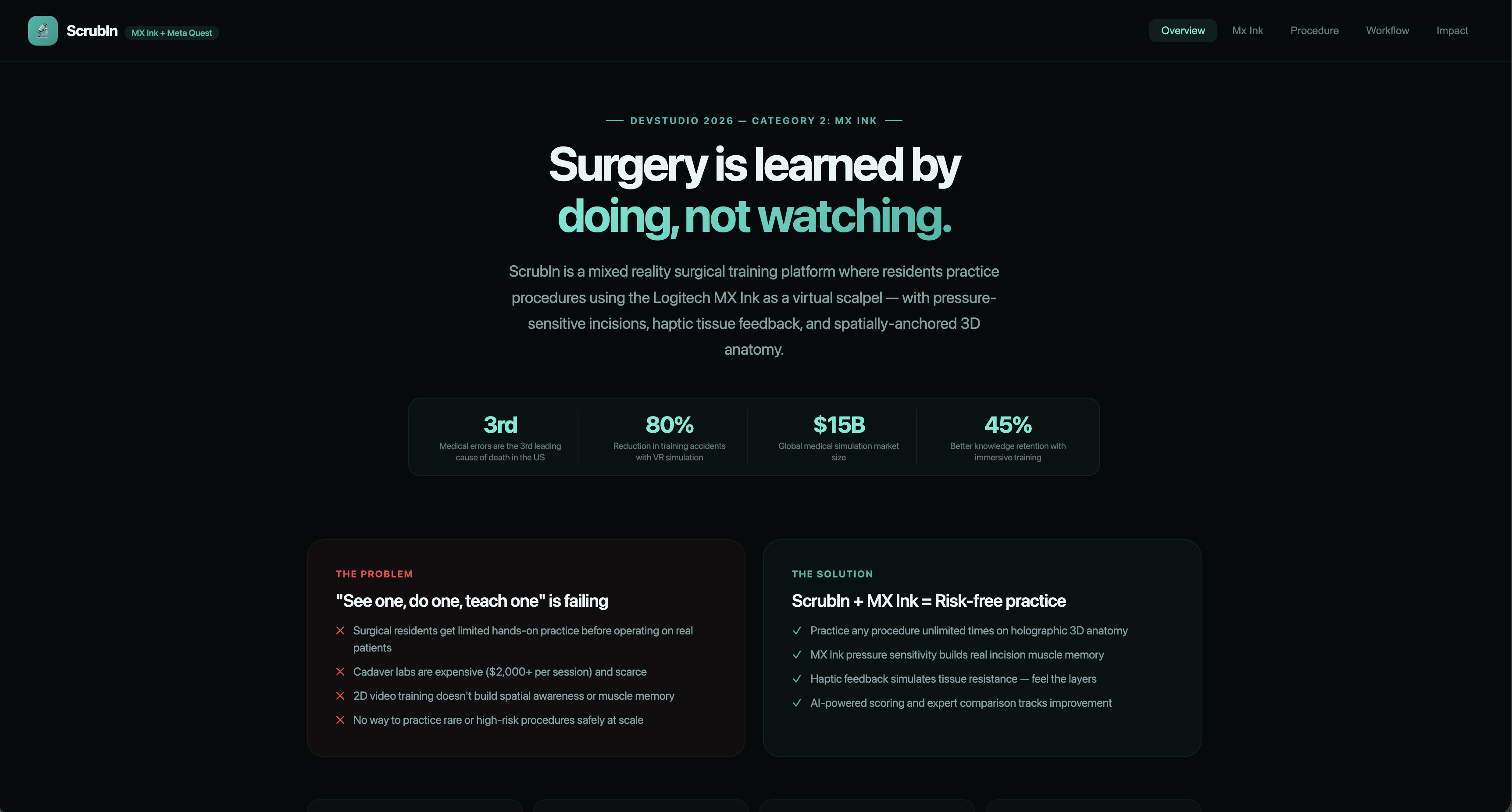
250,000 people die from medical errors in the US every year — the third leading cause of death. A major contributor: surgical training still follows the century-old "see one, do one, teach one" model.
Cadaver labs cost $2,000+ per session and are scarce. Existing VR simulators use bulky controllers that feel nothing like real instruments. Residents graduate having performed some procedures only a handful of times.
Then we looked at MX Ink: 4,096 levels of pressure sensitivity, haptic feedback, 28 grams — lighter than a scalpel. This isn't a drawing tool. It's the first consumer device that can genuinely simulate a surgical instrument.
The category examples list "Medical Simulation and Training" first. We took that seriously.
What it does
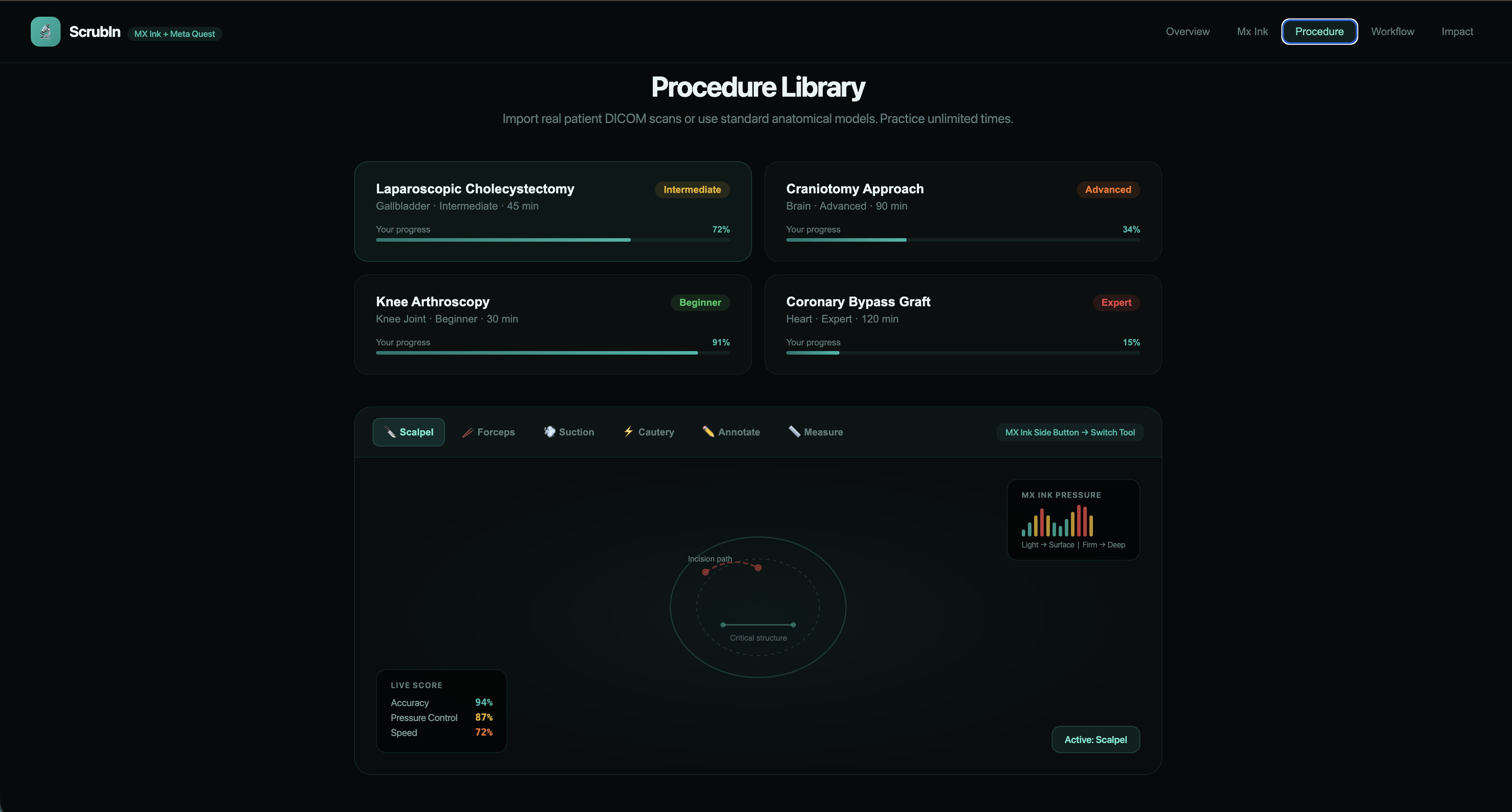
ScrubIn is a mixed reality surgical training platform on Meta Quest where the Logitech MX Ink becomes a virtual scalpel.
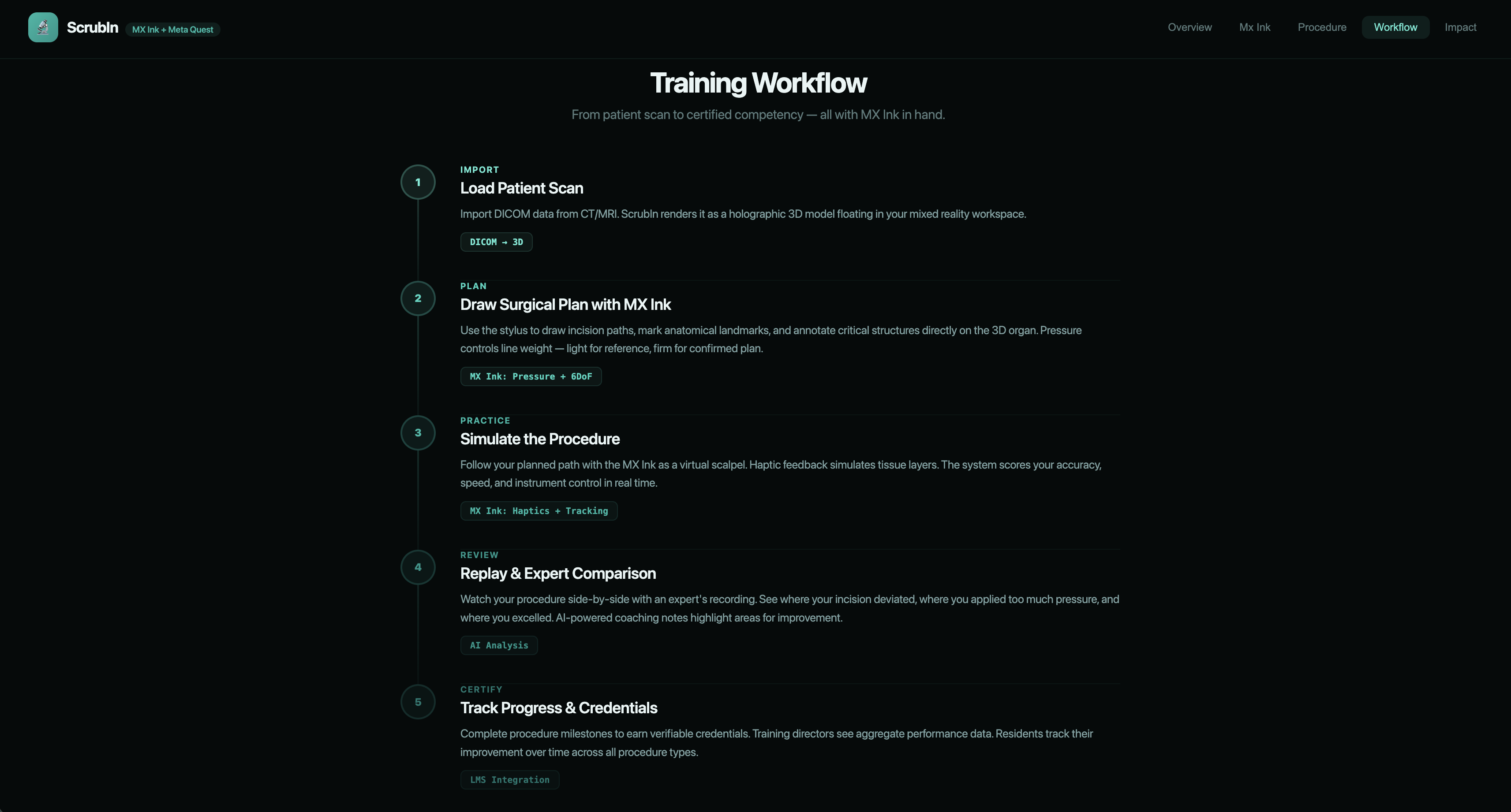
- Load patient imaging data (CT/MRI) as holographic 3D anatomy
- Plan — draw surgical paths directly on organs with MX Ink
- Practice — execute procedures with real-time scoring
- Review — AI coaching replays your performance side-by-side with an expert's recording
- Track — training directors get cohort analytics and competency dashboards
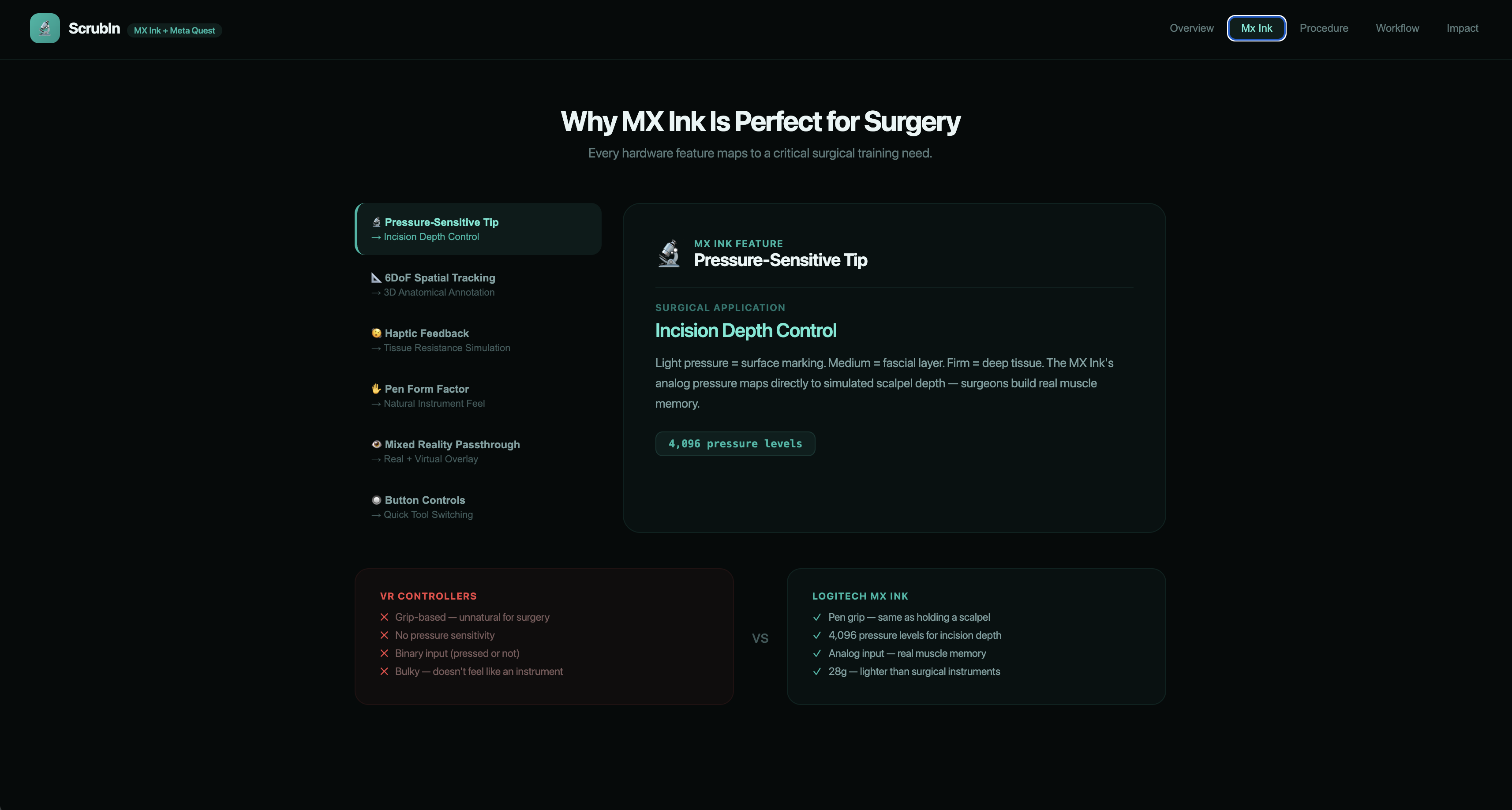
Pressure sensitivity controls incision depth — light for surface marking, firm for deep tissue. Haptic feedback simulates tissue resistance. Mixed reality passthrough lets you practice on a physical mannequin with holographic overlays, or go fully virtual.
How we designed it
Platform: Unity 2022 LTS targeting Meta Quest 2/3/3S
MX Ink Integration: OpenXR Interaction Profile — pressure data, 6DoF spatial tracking, haptic output, and button inputs
Medical Imaging: DICOM files (CT/MRI) converted to 3D anatomical models using the fo-dicom library
Haptic Design: Tissue density values mapped to MX Ink vibration intensity — cutting skin would feel different from cutting muscle or organ tissue
Scoring System: Tracks incision accuracy, pressure consistency, completion time, and instrument economy
Design Philosophy: Clinical and professional — not gamified. This is a medical tool.
Challenges we anticipate
Pressure-to-depth mapping. Real scalpel control is subtle muscle memory built over years. Translating 4,096 pressure levels into a system that teaches correct habits without feeling artificial will require extensive calibration with actual surgical residents.
DICOM inconsistency. Medical imaging data varies wildly across equipment manufacturers. Building a reliable import pipeline that produces clean 3D models from real patient scans will be a significant engineering effort.
Mixed reality lighting. Passthrough mode means variable lighting conditions. Ensuring holographic overlays stay properly anchored to physical surfaces across different environments is a known challenge in MR development.
Clinical validation. A training tool that teaches wrong habits is worse than no tool at all. We'll need partnerships with surgical programs to validate that MX Ink-based training translates to real operating room performance.
What makes this concept strong
Every MX Ink feature maps 1:1 to a surgical need:
- Pressure sensitivity → incision depth control
- Haptic feedback → tissue resistance simulation
- 6DoF tracking → spatial annotation on 3D anatomy
- Pen form factor → familiar instrument grip
- Mixed reality passthrough → mannequin-based practice
Nothing is forced. Nothing is a gimmick.
The zero learning curve is the key insight: surgeons already hold instruments like pens. Pick up MX Ink and start training. That's the kind of natural hardware-to-use-case fit that's rare to find.
The AI coaching replay — seeing your incision path overlaid on an expert's — would be immediately intuitive and needs no explanation.
What we learned through research
Hardware constraints can be design advantages. MX Ink wasn't built for surgery — but its limitations (single-point input, pen form factor, moderate haptics) actually mirror real surgical instruments more closely than multi-button VR controllers.
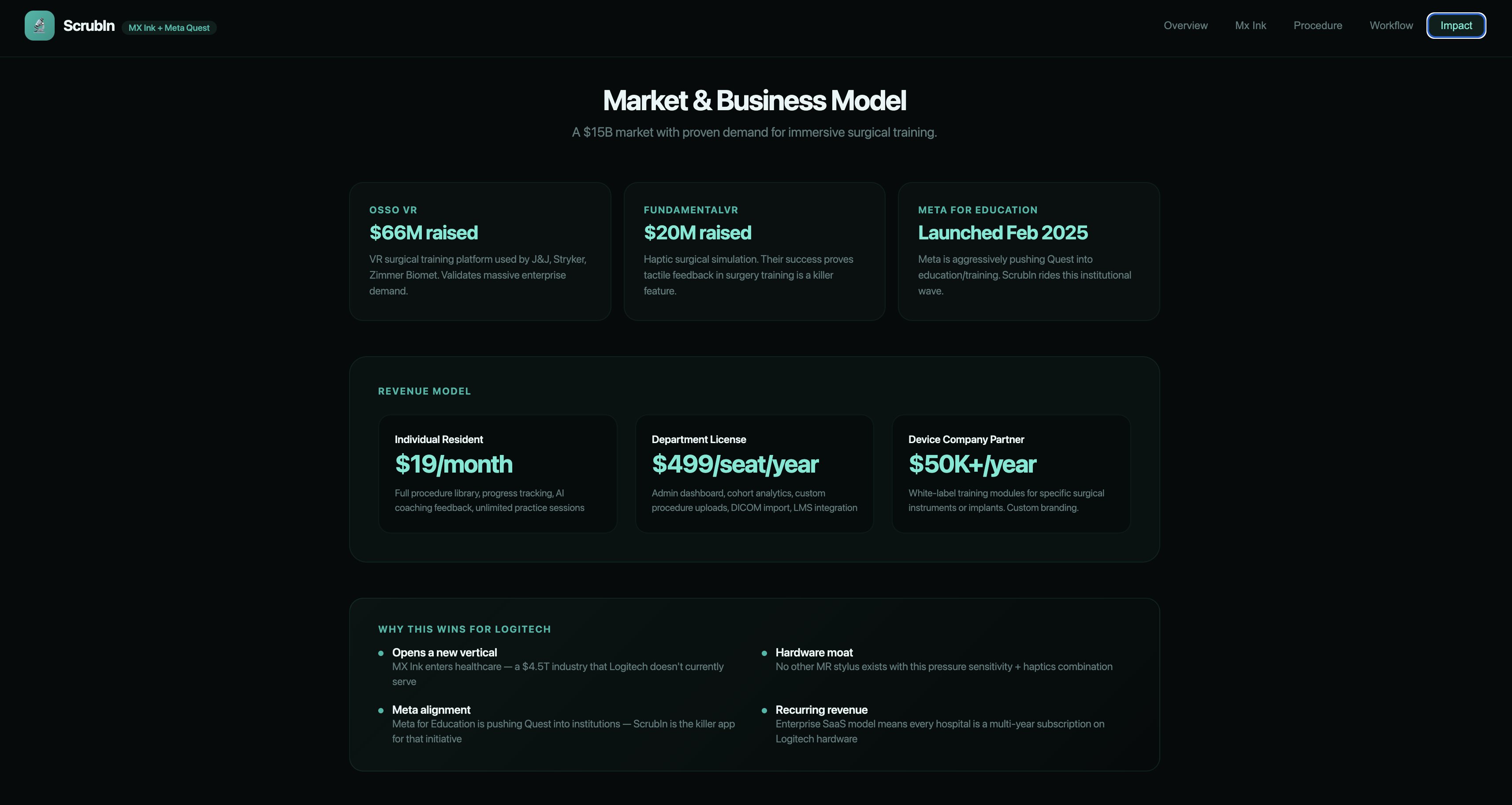
The market is ready. Osso VR raised $66M. FundamentalVR raised $20M. The medical simulation market is $15B and growing 15% annually. Meta launched Meta for Education in 2025, pushing Quest into institutional markets. Studies show 80% reduction in training accidents with immersive simulation.
The gap is clear. No existing solution combines mixed reality with a precision pressure-sensitive stylus. The hardware exists. The market exists. The need is urgent.
What's next for ScrubIn
Now (0–3 months) Build functional prototype with 2–3 core procedures (appendectomy, central line placement, chest tube insertion). Begin conversations with surgical residency programs for pilot testing.
Soon (6–12 months) Expand to 5+ procedures. Add multiplayer mentor mode — an attending annotates in real-time while a resident operates. Submit to Meta App Store for enterprise/education distribution. Hospital LMS integration.
Later Device company partnerships where instrument manufacturers (J&J, Stryker, Medtronic) build branded training modules. Expand into interventional radiology, dentistry, and veterinary medicine. Pursue FDA clearance as a certified assessment tool. Partner with Logitech to explore a medical-grade MX Ink variant with enhanced haptics.
The medical simulation market is $15B and growing 15% annually. ScrubIn is positioned to define stylus-based surgical training — and MX Ink is the hardware that makes it possible.

Log in or sign up for Devpost to join the conversation.