🌱 Inspiration
We’re constantly scrolling—but rarely stopping to ask: why does this content speak to me? Who benefits from this narrative? What identity is my feed shaping?
ScrollSage was inspired by this curiosity. We wanted to create a tool that reveals the invisible architecture of our social media bubbles: the values, ideologies, influencers, and brands that drive them. Think of it as cultural x-ray vision for your media taste.
🚀 What it does
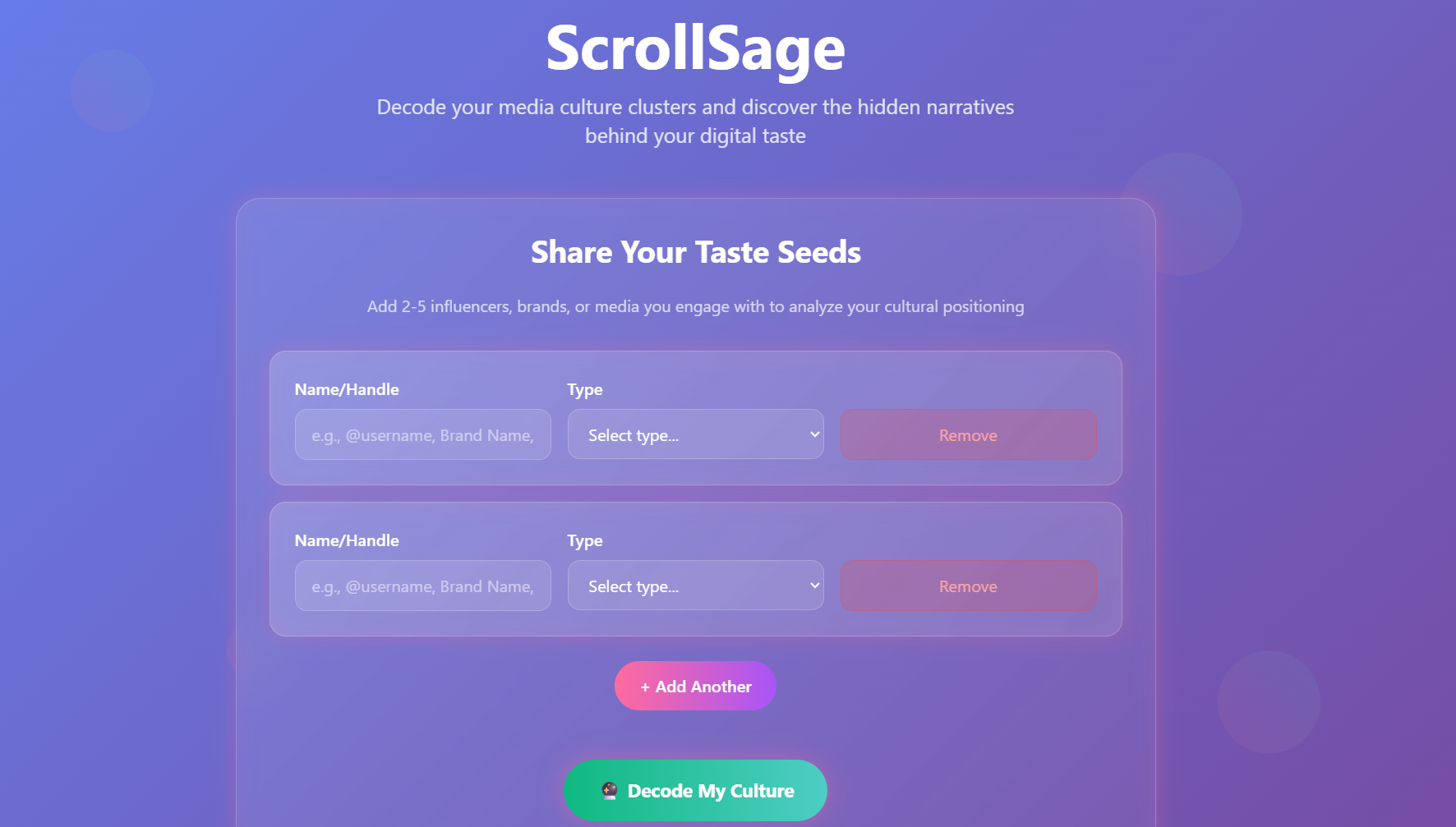
ScrollSage lets users upload a few pieces of media they love—like influencers, brands, or shows—and turns that into a personalized cultural analysis.
- It maps your taste profile using Qloo’s Taste Graph.
- It uses an LLM (Gemini) to explain the underlying narratives, ideologies, and marketing patterns in your media bubble.
- It suggests opposite-bubble content to expand your perspective.
- It highlights how media consumption shapes identity—for better or worse.
Each insight is delivered as a fluorescent, animated, glassy card, making abstract cultural ideas feel fun, visual, and intuitive.
🛠️ How we built it
- Frontend: HTML + TailwindCSS for a calm, Gen-Z, glassmorphism look with animated insight cards.
- Backend: Flask handles the API calls and flow logic, no database involved.
- Taste Engine: We use Qloo's
/searchand/v2/insightsendpoints to map user inputs (like “Zendaya” or “Glossier”) into structured cultural entities. LLM (Gemini): We feed Qloo results into a structured prompt that Gemini uses to:
- Decode shared ideologies and marketing patterns
- Reveal cultural identities
- Suggest counter-content
Deployment: Lightweight, Docker-ready stack built for fast deployment with just an API key and Flask server.
🧗 Challenges we ran into
- Structuring Qloo API calls correctly: getting valid
entity_ids,filter.type, and valid signal combinations took some trial and error. - Getting Gemini to return nuanced, critical insights rather than general summaries required careful prompt engineering.
- Designing the UI to be both aesthetic and informative—we didn’t want it to look like a dashboard, but like a mirror.
- Working without a database meant we had to design clean, ephemeral flows powered purely by user input and real-time APIs.
🏆 Accomplishments that we're proud of
- Built a fully functioning, database-free cultural analysis engine in a short sprint.
- Created a visually engaging UX that makes deep cultural insight feel accessible and scrollable.
- Successfully integrated Qloo + Gemini + Tailwind + Flask into a cohesive pipeline.
- Designed a novel use case: decoding your media bubble like a sociologist, marketer, and culture critic—all in one app.
📚 What we learned
- Media taste can be analyzed as structured cultural data, not just vibes.
- Every feed reflects an ideology, and some are shaped more by corporate interests than personal growth.
- LLMs + taste graphs = powerful tools for identity analysis and media literacy.
- Design matters—deep insight becomes usable when it feels intuitive, soft, and scrollable.
🔮 What's next for ScrollSage: Decode Your Feed
- 🔄 Let users contrast their taste graph with friends for “bubble comparison”.
- 🎯 Add interactive story interpretation: “How would you vs. someone from a different bubble read this news?”
- 📱 Build a browser extension that analyzes your actual Instagram/TikTok history in real-time.
- 🤖 Use feedback loops to improve Gemini's contrast and bias detection capabilities.
- 🌐 Deploy a live version with login-free access, powered only by API keys and local sessions.
Built With
- and
- bias-analysis
- contrast
- gen-z-inspired-ui-with-glassmorphism-and-animation-html-+-js-?-structure-and-interactions-qloo-api-?-for-building-the-taste-graph-and-cultural-insights-gemini-(llm)-?-for-narrative-decoding
- perspective
- python-?-for-backend-logic-and-api-integration-flask-?-lightweight-web-server-and-routing-tailwind-css-?-beautiful

Log in or sign up for Devpost to join the conversation.