Inspiration
Social media platforms are designed to keep users scrolling, but some content can pose serious risks for people with neurological or psychological conditions. We wanted to create a system that could identify potentially harmful videos before a user even sees them, rather than relying on the user to recognize and avoid triggering content themselves.
This inspired ScrollSafe—a browser extension that analyzes media using predicted brain activity and a user's individual risk profile to determine whether content could be potentially harmful.
What it does
ScrollSafe is a Chrome extension that detects videos and media being loaded by a webpage before they reach the user's screen.
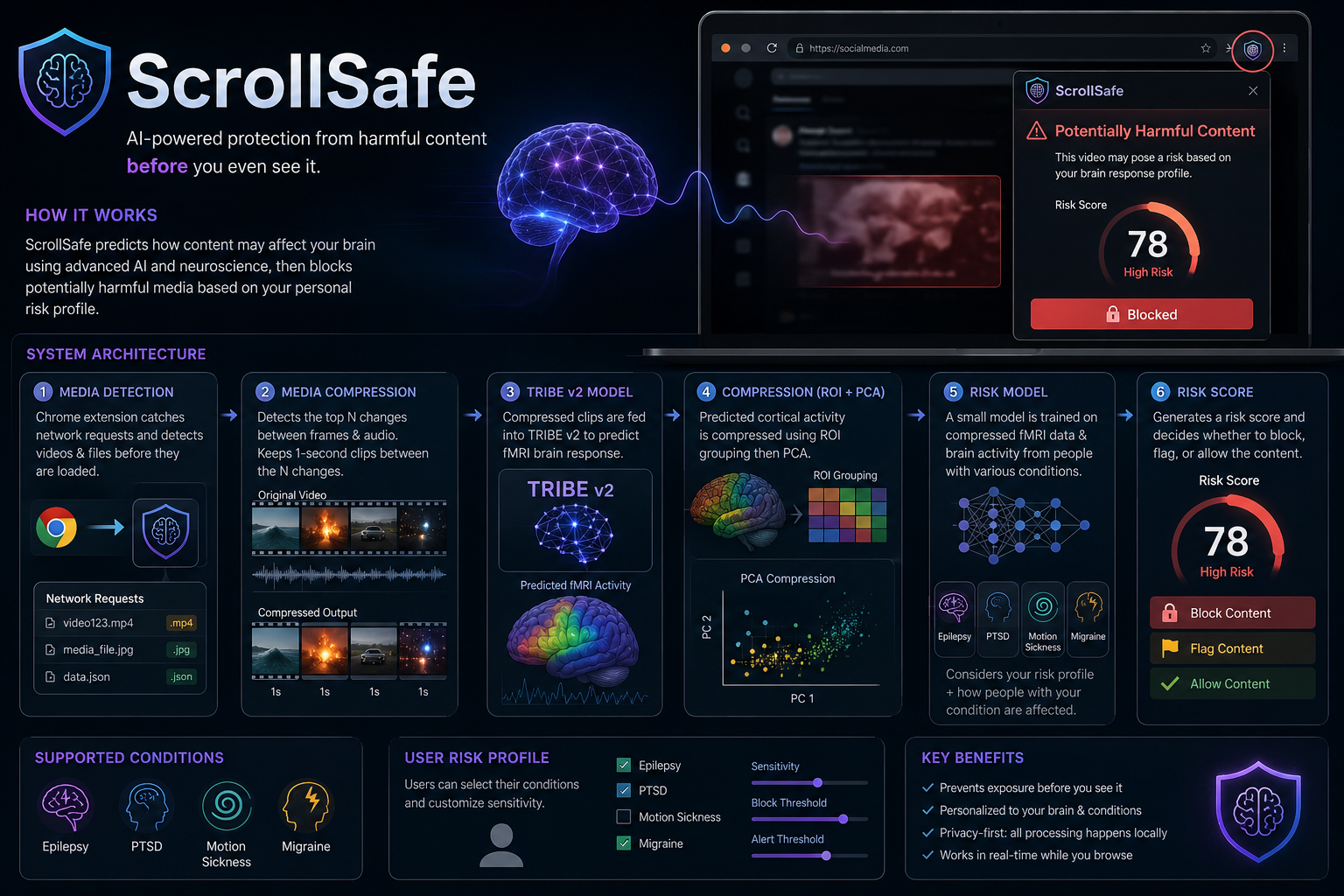
The media is compressed by identifying the most significant changes in the video and audio, allowing us to analyze only the most informative one-second segments. These clips are then passed through TRIBE v2, which predicts the corresponding fMRI response and cortical activity.
The predicted brain activity is compressed using ROI grouping and PCA, then passed into a lightweight risk model. The model considers both:
- The user's individual risk profile
- How people with that risk profile may respond to the content
ScrollSafe ultimately generates a risk score and can block or flag content that may pose a potential risk, ideally before the user scrolls to it.
Our initial focus is on risks associated with epilepsy, PTSD, motion sickness, and migraines.
How we built it
Our pipeline consists of several stages:
- Media Detection — A Chrome extension monitors network requests to identify videos and media before they are displayed.
- Media Compression — Videos are analyzed for significant changes in frames and audio. Rather than processing an entire video, we extract short segments around the most informative changes.
- TRIBE v2 Processing — The selected media is passed through TRIBE v2 to predict the associated fMRI response.
- Dimensionality Reduction — Predicted cortical activity is grouped into regions of interest (ROIs) and compressed using PCA.
- Risk Modeling — A smaller model analyzes the compressed brain-activity representation alongside the user's risk profile.
- Risk Score — The system produces a risk score that can be used by the extension to determine whether media should be allowed, flagged, or blocked.
Challenges we ran into
One of our biggest challenges was balancing accuracy and speed. Analyzing every frame of every video would be computationally expensive and could make real-time browsing impractical, so we had to develop a compression strategy that preserved the most important information.
We also faced the challenge of false positives and false negatives. Blocking harmless content could negatively affect the user experience, while failing to block genuinely risky content could defeat the purpose of ScrollSafe.
Another major challenge is ground truth. Establishing reliable labels for which types of media are harmful to specific individuals is difficult, especially because neurological responses can vary significantly between people.
Finally, scalability is a major consideration. A system that works on a small dataset or controlled environment needs to be optimized significantly before it could operate across the enormous volume of media encountered during normal web browsing.
Accomplishments that we're proud of
We're proud of building an end-to-end concept that connects browser-level media detection, video compression, predicted fMRI responses, dimensionality reduction, and personalized risk modeling into a single pipeline.
Instead of simply classifying the visual content of a video, ScrollSafe explores whether we can use predicted neural responses to estimate how content might affect different users.
We're also proud of designing the system around preemptive protection: identifying potentially risky content before the user actually encounters it.
What we learned
We learned that building an AI system for real-world applications involves much more than training a model. Latency, data quality, ground truth, scalability, and false-positive/negative tradeoffs can be just as important as model accuracy.
We also learned how challenging it is to translate research involving brain activity into a practical application. Neural responses are complex and highly individualized, so creating a reliable personalized risk score requires careful validation and substantial data.
Most importantly, we learned that responsible AI systems need to communicate uncertainty rather than treating predictions as absolute truth.
What's next for ScrollSafe
Our next step is improving the reliability and validation of the risk model. We want to investigate better ways to establish ground truth and evaluate how accurately predicted neural responses correspond to real-world user experiences.
We also want to optimize the pipeline so that it can operate with significantly lower latency and computational cost.
Future versions could expand beyond our initial risk categories and support additional types of potentially harmful stimuli, while giving users more control over their individual risk profiles.
Ultimately, our goal is to make ScrollSafe a fast, personalized safety layer for the internet—protecting users before potentially harmful content reaches them.

Log in or sign up for Devpost to join the conversation.