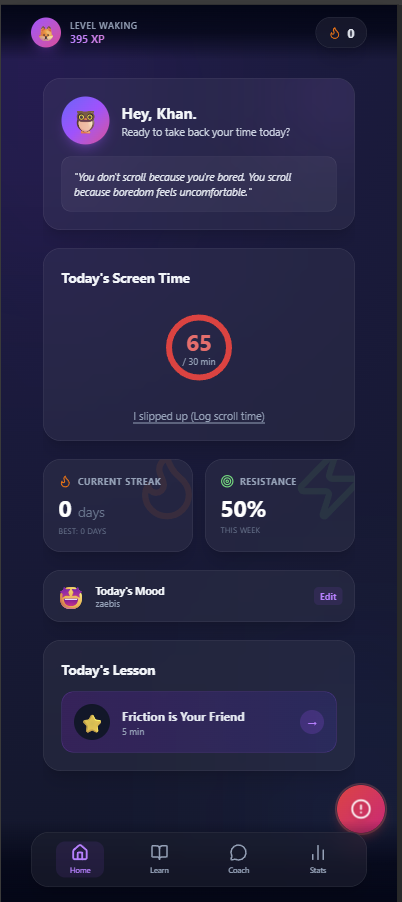
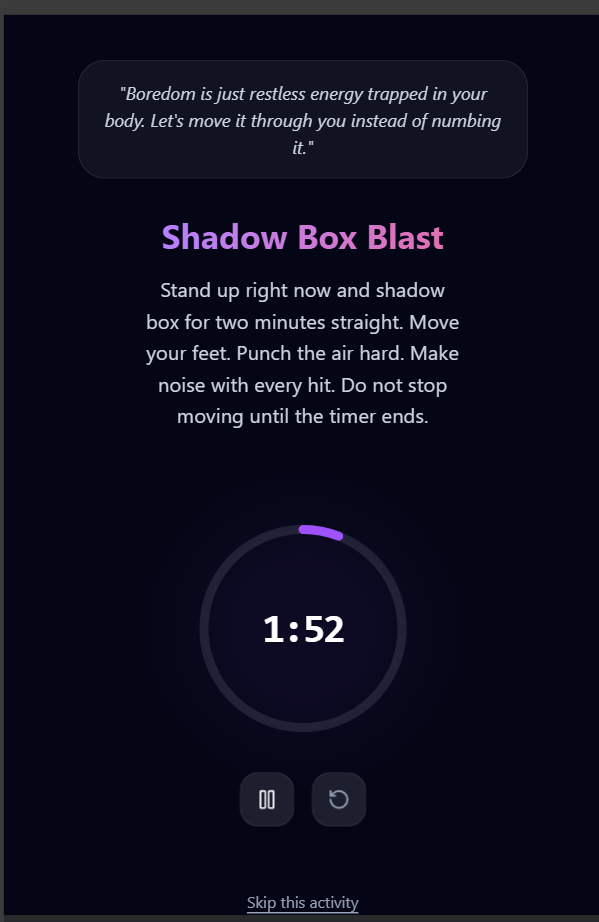
ScrollDetox — AI-Powered Doomscrolling Recovery Coach
Inspiration
We've all felt it. It's 11pm, you pick up your phone "for a second," and 45 minutes later you're watching videos about obscure historical events with no memory of how you got there. Doomscrolling isn't a willpower problem — it's a neurochemical one.
The average person touches their phone 2,617 times a day. Social platforms are engineered using the same variable reward mechanics as slot machines, exploiting the brain's dopamine system. Existing solutions (screen time limits, app blockers) treat the symptom. We wanted to treat the cause.
We were inspired by how Duolingo turned language learning — something people always intended to do but never did — into a daily habit through gamification, streaks, and micro-commitments. We asked: what if you could apply that same framework to unlearning a harmful habit?
What We Built
ScrollDetox is a mobile-first PWA featuring:
- Sage — an AI coach (powered by Claude) that adapts its tone, surfaces patterns in your behavior, and intervenes in real time when you're about to doomscroll
- The Craving Interrupt — a 60-second AI-guided intervention triggered the moment you feel the urge to scroll
- A progressive lesson curriculum across 6 tracks: Awareness, Replacement, Mindfulness, Digital Boundaries, Boredom Tolerance, and Dopamine Reset
- Weekly Scroll Autopsy — an AI-generated report that identifies your emotional patterns, peak vulnerability times, and one concrete focus for the coming week
- XP + streak system that rewards resistance, reflection, and consistency — progressing from "Zombie" to "Free"
How We Built It
The stack is intentionally lean for a hackathon:
- React (Vite) — mobile-first single page app
- Tailwind CSS — rapid UI with a calm dark palette
- Zustand — lightweight client-side state management
- localStorage — zero-backend persistence layer
- Ollama API — the brain behind Sage
The most interesting engineering challenge was the context pipeline.
Claude has no memory between API calls — so our app is the memory.
Before every call to Claude, we assemble a buildContextPackage() that
summarizes the user's mood trends, top triggers, resistance rate, recent
lesson reflections, and streak status into a rich dynamic system prompt.
This means Sage can say things like:
"You've had 3 cravings this week, all around 10pm — that's not boredom, that's anticipatory anxiety about tomorrow."
...not because Claude remembers, but because we fed it the right data.
The habit loop underlying the app is grounded in BJ Fogg's behavior model, where behavior $B$ is a function of motivation $M$, ability $A$, and a prompt $P$:
$$B = MAP$$
Doomscrolling scores high on all three: you're emotionally motivated, the phone is always within reach, and apps send constant prompts. ScrollDetox works by systematically lowering $M$ (processing the underlying emotion), raising the friction on $A$ (introducing a competing behavior), and replacing the $P$ (substituting the scroll trigger with a Sage check-in).
Challenges
The cold start problem. Sage has nothing to work with on day one. We solved this with a structured onboarding assessment that captures the user's top triggers, focus areas, and baseline scroll habits — giving Claude enough signal to be useful from the very first session.
Tone calibration. An AI wellness coach can easily tip into patronizing or preachy. We spent significant prompt engineering effort defining Sage's voice constraints: short sentences, no moralizing, celebrate wins loudly, call out avoidance gently. The difference between a coach people return to and one they abandon is almost entirely tone.
Stateless AI that feels stateful. Building the illusion of longitudinal memory from a stateless API required careful data architecture — deciding what to summarize, what to drop, and how to translate raw user data into natural language context that Claude reasons over well. The context builder ended up being the most iterated piece of the entire codebase.
What We Learned
The core insight: the intelligence isn't in the AI — it's in the data pipeline feeding it. Claude's responses feel personalized and longitudinally aware not because of model magic, but because we built a system that accumulates the right signals and surfaces them at the right moment.
We also learned that the most effective intervention point isn't after someone has already doomscrolled — it's the 3-second window between picking up the phone and opening the app. That's where the Craving Interrupt lives, and it's where the real behavioral change happens.
What's Next
- Native iOS/Android app with OS-level screen time API integration for automatic scroll detection (no manual logging)
- Accountability pods — anonymous groups of 5 with shared weekly challenges facilitated by Sage
- Longitudinal outcome tracking — does ScrollDetox actually reduce screen time over 30/60/90 days?
- Clinician dashboard for therapists to assign ScrollDetox as a between-session CBT homework tool
Built With
- ollama
- react


Log in or sign up for Devpost to join the conversation.