Inspiration
On every film set there is one person whose job is to notice that the wine glass was half full in take 2 and empty in take 4, that the tie was knotted in the wide and loose in the close-up, that the actor's cigarette is in the wrong hand. The script supervisor — "scripty" — does it with continuity photos, a lined script and an eye trained over years, at the pace of a shooting day. It is the last part of filmmaking that has never been touched by tooling: one academic paper in 2009 with a handful of citations, three shelved patents from companies that hit the same wall, and nothing open source.
The wall is not detection. Any vision model can see that a glass changed. The wall is intentional versus error: the glass emptied because the actor drank. Every previous attempt claimed to handle that and could not show how well. Scripty is built the other way round: it detects, it lets a second model rule intentional-or-error, and then it measures how often that ruling is wrong on an evaluation whose pass/fail conditions were written before the run.
What it does
- Ingest takes. Shot boundaries by histogram distance (OpenCV, deterministic), frames sampled at the start/middle/end of every shot plus every three seconds.
- Inventory every frame with Gemini 2.5 Flash (Vertex AI): 8–25 rows of (entity, attribute, value) per frame — props and their position/state/count, wardrobe, hair and makeup, set dressing, liquid levels, which hand holds what, which side of frame each character is on. Entity names are anchored to the character or the set so the same object gets the same name across frames.
- ClickHouse finds the candidates. One SQL query over
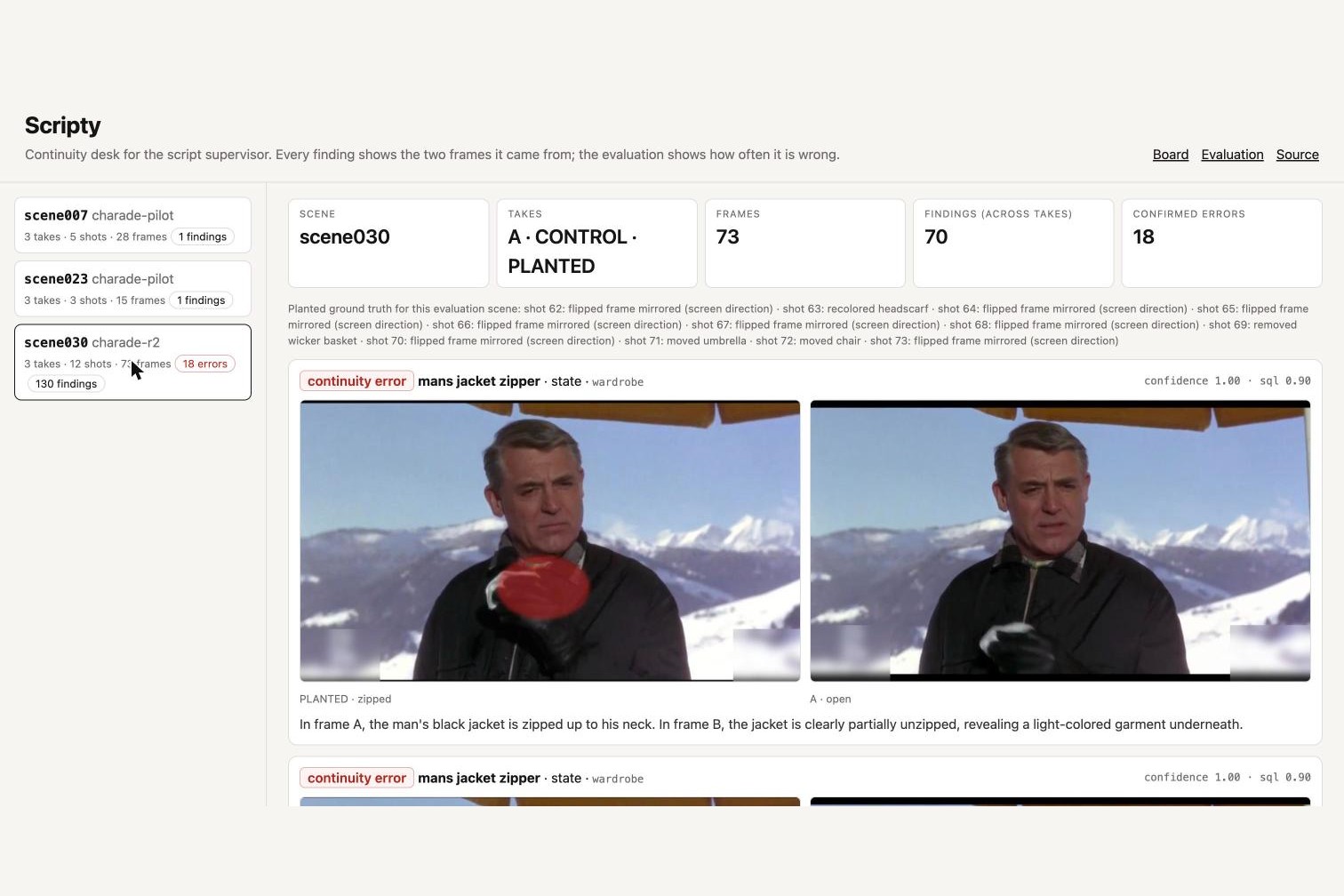
scripty.inventory: same scene, same entity and attribute, different value across takes or shots. Per-frame inventories are columnar, high-volume data — a shooting day is tens of thousands of rows — and the join is the mechanism, not a cache. - Gemini 2.5 Pro looks at each candidate pair and rules continuity_error / intentional_change / same / uncertain with a confidence and a two-sentence explanation citing what is visible in each frame.
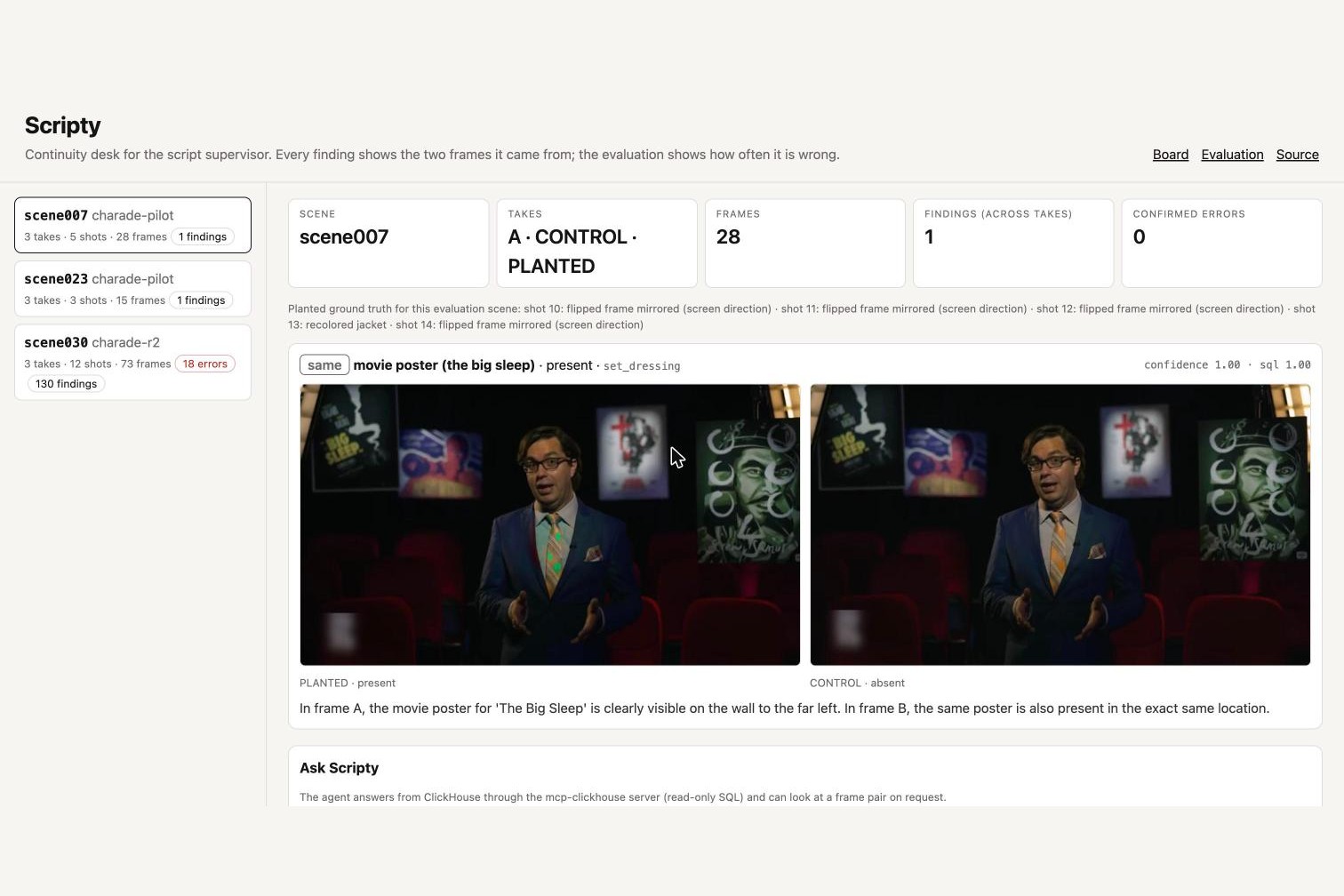
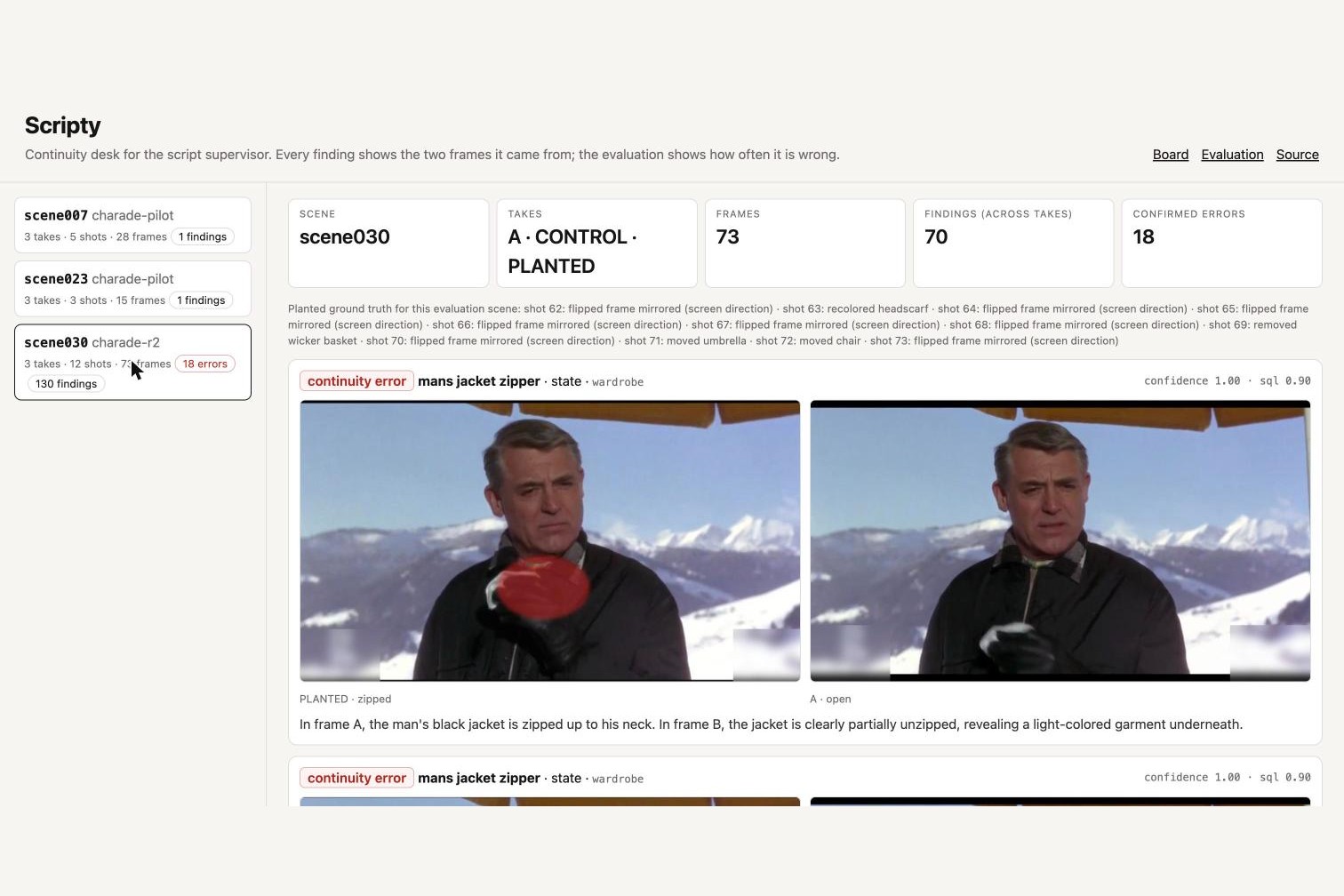
- The supervisor reads a ranked shortlist with both frames side by side, and asks the Scripty agent (Google ADK) questions in plain English — "what changed on the desk between take A and take C?" — which it answers through the official
mcp-clickhouseMCP server (read-only SQL, the only data access it has), plus one tool that lets it look at a frame pair. - The evaluation page shows recall, precision and the control false-positive rate from the pre-registered run, per planted kind, with every frame pair behind every number.
How I built it
| Layer | What | Runtime / partner use |
|---|---|---|
| Vision | google-genai on Vertex AI: gemini-2.5-flash inventory (JSON schema, temperature 0.1), gemini-2.5-pro pairwise verification |
Google Cloud AI, called on every frame and every candidate |
| Data | ClickHouse 24.8, self-hosted on Cloud Run (2 GiB, single node); tables frames, inventory, findings, eval_labels (ReplacingMergeTree) |
partner service at runtime |
| Agent | google-adk LlmAgent with McpToolset → mcp-clickhouse (run_query, list_tables) + a look_at_pair function tool |
partner MCP server at runtime |
| App | FastAPI + one static page on Cloud Run; evidence frames on a public GCS bucket | Google Cloud |
| Eval | plant.py: Gemini bounding boxes → OpenCV inpaint/move/recolour/mirror with a planting log as ground truth; eval_run.py computes the pre-registered metrics |
— |
| Footage | Charade (1963) and Night of the Living Dead (1968), public domain, archive.org | — |
The continuity query, verbatim:
SELECT a.entity, a.attribute, a.take AS take_a, a.value AS value_a, b.take AS take_b, b.value AS value_b,
       least(a.confidence, b.confidence) AS sql_score
FROM inv a INNER JOIN inv b ON a.entity = b.entity AND a.attribute = b.attribute AND a.frame_id < b.frame_id
WHERE lowerUTF8(a.value) != lowerUTF8(b.value) AND (a.take != b.take OR a.shot != b.shot)
ORDER BY sql_score DESC
The hard problem, named: intentional versus error
Three things the pilot scenes showed, all visible in the app:
- A mirrored frame was detected and then excused. The inventory correctly flipped "facing camera-right" to "facing camera-left" for the planted flop, ClickHouse surfaced it, and the verifier ruled intentional change — "he has turned his head, a plausible change in action." That is the intentional-versus-error wall exactly: the model prefers the benign story. The domain rule (a flopped shot reverses everything, not one head) is now in the verifier's instructions; how much it helps is in the per-kind table.
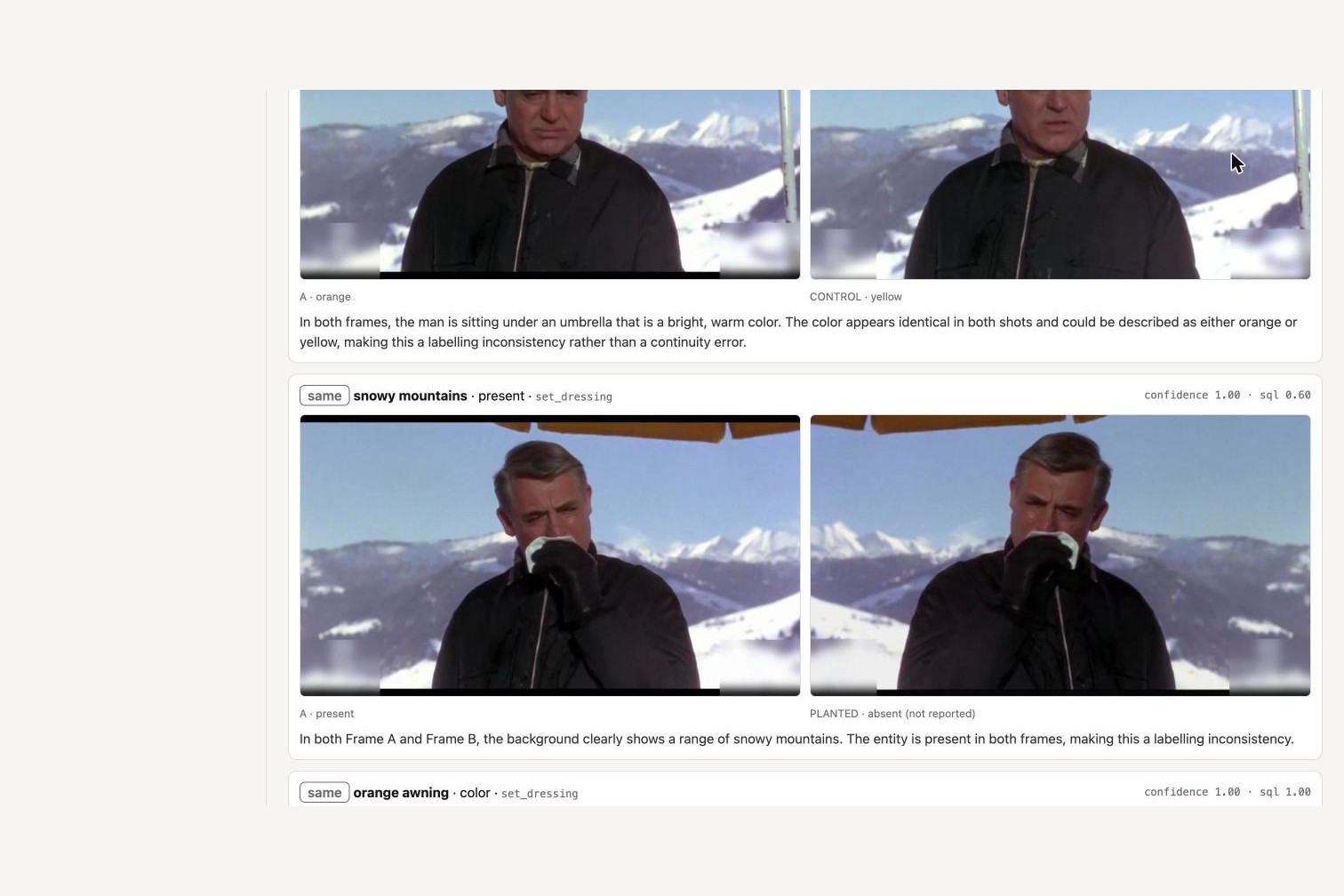
- The verifier's confidence carries no information. It returned 1.00 for confirmed errors, for "same", and for a control-take false positive ("hair styled → strands fallen forward" on two frames that differ only by reframing). The operating point was pre-registered as confidence ≥ 0.6, so it is reported as written — and the finding that confidence is uninformative is itself a result. The shortlist is ranked by SQL agreement and verdict, not by that number.
- Labelling drift is the noise floor. Without anchoring, only 35 % of entities were named identically across takes of the same shot; with the reference-take inventory ("continuity sheet") passed into the prompt and a controlled vocabulary, most entities are reused and the control take's per-attribute flip rate drops. Anchoring is what a real script supervisor does — the sheet from take 1 is the reference for take 2 — and it turned out to be the single most important design decision.
The evaluation (pre-registered)
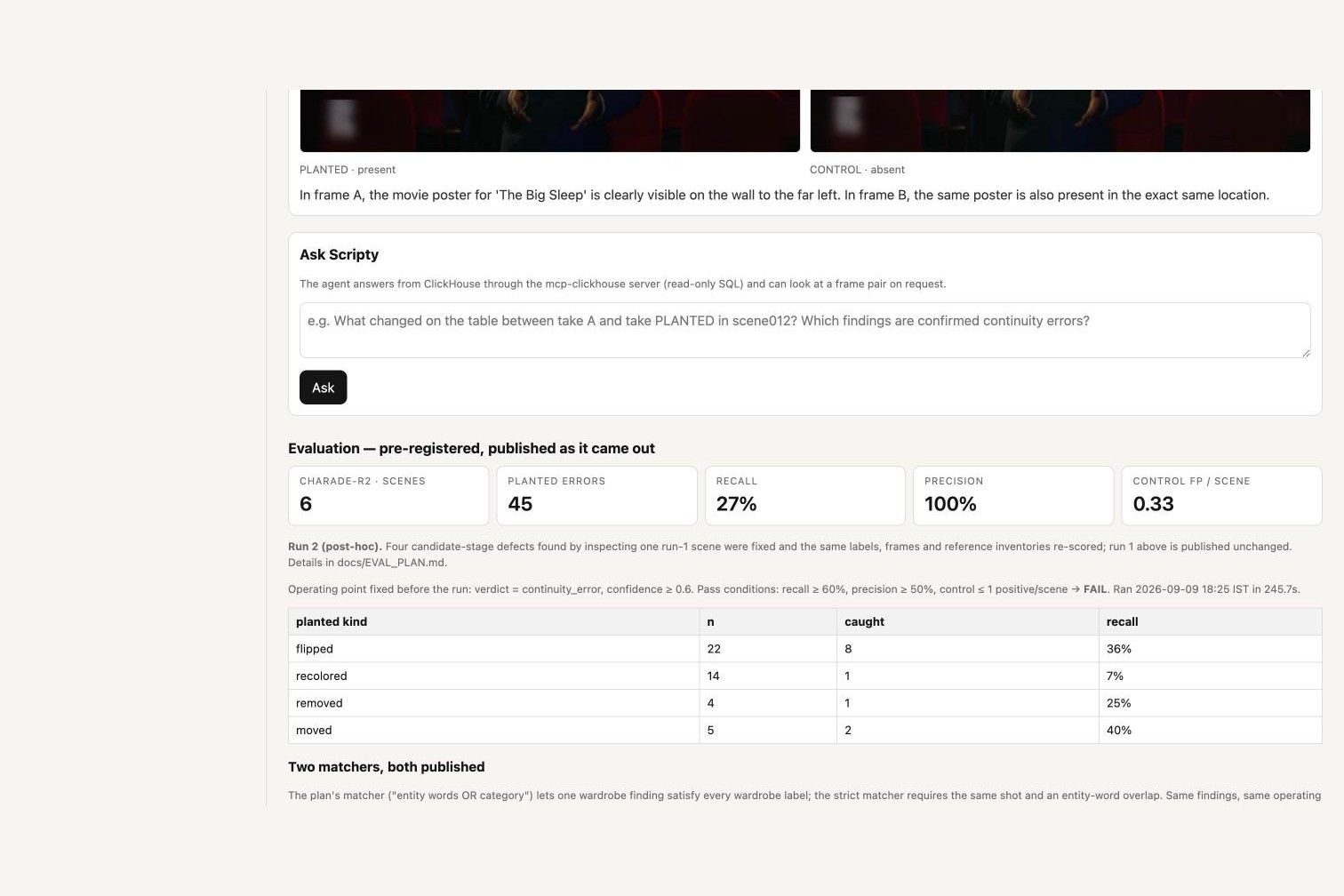
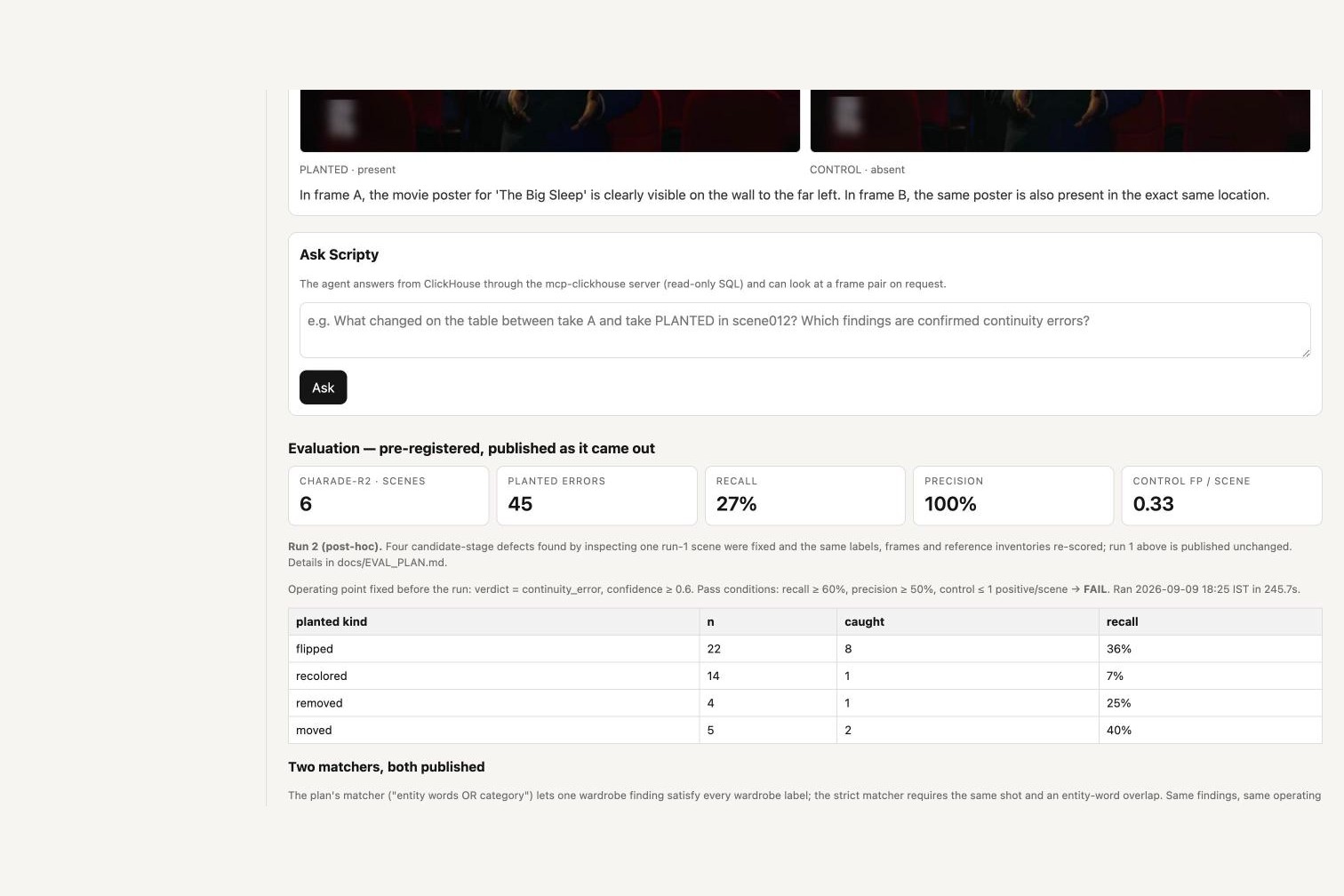
Population: 6 scenes selected deterministically from the full film (30–150 s, 3–12 shots), not a hand-picked sample. Three takes per scene: A (original frames), CONTROL (reframed and re-exposed, nothing changed), PLANTED (one planted error per shot: prop removed, moved, recoloured, or the frame mirrored). Operating point fixed before the run: verdict = continuity_error AND confidence ≥ 0.6. Pass conditions written first: recall ≥ 60 %, precision ≥ 50 %, control ≤ 1 positive per scene.
Result: it does not pass. Recall is 26.7 %, against the 60 % written down first. Precision is 100 % and the control take produced 0.33 false positives per scene, both comfortably inside their limits. So the honest summary is that everything it flags is real, and it finds about a quarter of what is there.
| run 1 | run 2 | pre-registered | |
|---|---|---|---|
| scenes | 4 | 6 | — |
| planted labels | 31 | 45 | — |
| recall | 38.7 % | 26.7 % | ≥ 60 % — fail |
| precision | 100 % | 100 % | ≥ 50 % — pass |
| control FP / scene | 2.75 | 0.33 | ≤ 1 — pass |
Per kind, run 2: flipped 8/22, moved 2/5, removed 1/4, recoloured 1/14.
Two things in that table are worth more than the headline. The control false positive rate fell from 2.75 per scene to 0.33 once the reference-take inventory anchored the labelling, which is the difference between a shortlist a supervisor would throw away and one they would read. And the run-2 changes that fixed mirrored frames (0/19 detected in run 1, 8/22 in run 2) coincided with recolour detection collapsing to 1/14 — a regression I would not have seen without the per-kind breakdown, and which I have not yet explained.
A caveat on the small numbers: an earlier single-scene rerun scored 100 % recall, and I nearly reported that. Extending the same code to all six scenes brought it to 26.7 %. One scene was not evidence, and the difference between those two numbers is the reason the population was fixed in advance rather than chosen after seeing results.
Challenges I ran into
- Names drift. Two independent inventories of the same shot named only 35 % of entities identically. The fix was not a better prompt but the script supervisor's own method: the first take's inventory becomes the continuity sheet that every later take is inventoried against, with a controlled vocabulary for colours, positions and states. Entity reuse went to most entities and the control take's flip rate fell.
- Planting is harder than detecting. Gemini Flash put a "shirt" bounding box on a man's cheek; a rectangle hue-shift on a white shirt changes nothing; segmentation masks time out at 504. What survived: Gemini 2.5 Pro boxes, each validated by cropping the box and asking a second model whether it shows the label; feathered inpainting for removals; a tint for unsaturated garments; and no removals of worn clothing (inpainting a jacket off a person is a glitch, not a continuity error).
- A mirrored watermark leaks the flip. The archive print carries a station logo in the corner; a mirrored logo would let a detector "find" the flopped frame for the wrong reason. Both bottom corners are blurred on every frame of every take.
- ClickHouse specifics. 24.8 rejects an inequality inside the JOIN condition (
allow_experimental_join_condition) — it lives in WHERE now; theclickhouse-connectclient is not safe for concurrent queries, so each thread gets its own; a 2 GiB Cloud Run node hit its memory ceiling on a trivial aggregation; and a Cloud Run disk is ephemeral, so every project is exported to JSONL in the bucket and restored on boot without repeating a single Gemini call. - Two MCP generations.
mcp-clickhouseneeds themcp2.x package; Google ADK'sMcpToolsetimportsmcp.shared.sessionfrom 1.x. They live in separate environments in the container (uv tool installfor the server) and talk over stdio.
Accomplishments that I'm proud of
- The first continuity checker with a published false-positive rate and a control condition.
- A partner integration that is the mechanism: the continuity check is a ClickHouse join, and the agent's only route to data is
mcp-clickhouse. - Built solo, from an empty repository, inside the contest window, on public-domain footage anyone can re-run.
What I learned
The evaluation was worth more than the detector. Every pilot run "worked" until the numbers said it did not: the first candidate query paired different men across shots, the first planting scored zero because the edits were unrecognisable, the verifier's confidence turned out to be always 1.00, and a control take with nothing changed still produced flagged findings. None of that is visible in a demo video; all of it is visible on the evaluation page, and that page is the reason a supervisor could decide whether to trust the shortlist before call time. Pre-registering the pass/fail conditions made the outcome a result instead of an argument.
What's next
Live ingest from on-set camera cards; the lined script as a first-class object (which line was spoken during which frame, so the agent can answer "what was she holding on that line"); a supervisor-in-the-loop feedback table so verified verdicts recalibrate the confidence; more kinds of planted error (liquid levels, cigarette burn-down) and human-labelled real errors from open-licence student films.


Log in or sign up for Devpost to join the conversation.