-
-
HCP Agent Assistant Prompter
Inspiration
Healthcare professionals are extremely busy, and patients feel the effects of that. Speaking from personal experience, even after a normal doctor's visit, especially when I'm sick and need medication right away, there's usually a delay before the prescription actually gets handled. A lot of that comes down to the workflow: a busy doctor has to manually cross-reference patient info, drug interactions, and dosages before anything moves. We wanted to see if verified AI agents could handle that communication in the background so the doctor only has to review and confirm.
What it does
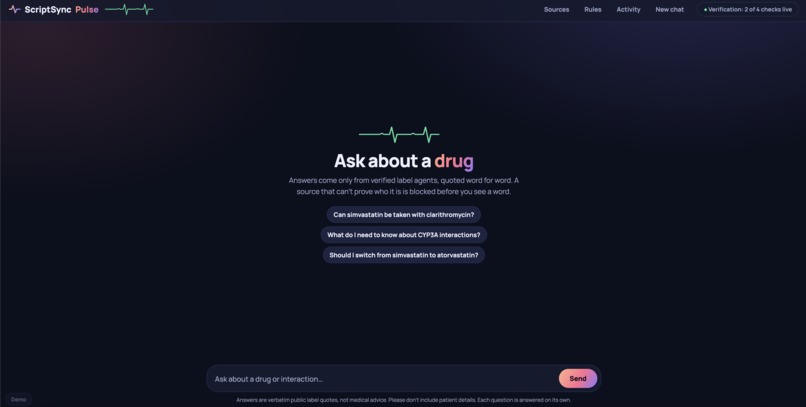
ScriptSync is a proof of concept for secure agent-to-agent communication in the prescribing workflow. There are two parties. On one side is a single agent for the doctor that works with current patient information at query time instead of storing it, which was a deliberate security choice. On the other side are drug-specific pharm agents, and we have two live right now, each grounded in official FDA label information for its assigned drug.
When a doctor or assistant asks whether a patient should go on a certain drug, the HCP agent talks to the relevant pharm agent, which responds with a grounded answer. For example, it might advise against a drug and cite real FDA information based on the patient's current medications, dosage, or health conditions. The output is a note the doctor can act on. In a fully built version, the agent could even stage a medication order instantly, but it would still require a 5 to 10 second confirmation from the healthcare professional before anything is placed.
All three of our agents are registered and verified through GoDaddy's Agent Name Service (ANS) on our domain, scriptsync.health, and proven to be owned by us. Agents will only talk to other agents whose identity can be cryptographically verified, so fake or unregistered agents never get into the loop.
How we built it
We built ScriptSync on an agentic platform, mainly Claude, and deployed the agents as live, ACTIVE registrations through ANS. Registering an agent works a lot like registering a website, with keys published through DNS and tied to our domain. Verification uses public and private key pairs along with certificates so each agent can prove it is who it says it is.
On the process side, we ran the project like a real software team. We used Scrum and a Kanban board to track what was in progress, what still needed to be done, and what was completed, which kept three people who had just met moving in the same direction all weekend.
Challenges we ran into
The biggest one was agent registration and getting agents that were actually live. The steps were clear on paper, but adding meaningful guardrails to make sure everything worked as it should was hard. Our agents cited drug information well and were genuinely informative, but we fell short on the assistant agent we envisioned, one that would synthesize the results from each individual pharm agent into a single overview of what the patient needs. Coming up with one idea that covered both tracks was also a challenge.
The other side of it was teamwork. None of us had real experience with this, and none of us had worked together before. Figuring out how to push and pull code efficiently without conflicts, and how to divide work under pressure with people you just met, was hard but honestly one of the most valuable parts of the weekend.
Accomplishments that we're proud of
We registered our own domain and got real agents registered through ANS, not mockups. We set up a verification system using public and private keys plus certificates that ensures an agent is actually registered instead of a fake, and we built a demo simulation showing what happens when an unregistered agent tries to join the conversation. In something as sensitive as healthcare, proving identity before agents exchange anything felt like the right thing to get working first.
What we learned
You can't just tell an agentic tool to build something like this for you, and we weren't relying on that. Even with tools like Claude that are praised for coding ability, there's still a gap in what they can and can't do, like managing sensitive information and keys, which still requires human input. In healthcare that's probably a good thing.
We also learned how agent registration actually works and how similar it is to registering a website, and how it adds layers of security so agents trained on sensitive information will only talk to other agents that are proven to be real and registered. It also raised authorization questions we understand much better now. Is this doctor authorized to talk to this pharm specialist? Is this a trainee or a nurse who isn't allowed to place an order, and if so, why is that conversation happening at all? Right now there's no layer verifying that the person using the tool is an HCP, but a simple login page where only healthcare professionals have credentials would let the agent refuse to engage until the user proves who they are.
What's next for ScriptSync
The path forward is clear. Right now, a doctor or assistant can ask our agents whether a patient should go on a drug, and the agent will give a real answer with reasoning, citing FDA information against the patient's current medications and health issues.
From here, we'd scale up to many more pharm agents, with the HCP agent deciding which ones make the most sense to pull from based on the patient in front of it, eventually placing medication orders that the doctor confirms in seconds. Beyond that, we want a management layer where a practice can oversee all of its doctor assistant agents in one place: which doctors' patients map to which files, and which pharm agents are recommending what to which HCP, so we can verify that valid patient info is producing correct pharm guidance before an official note gets written. And finally, HCP login verification, so agents only engage with people who can prove they're healthcare professionals, closing the human side of the trust loop the way ANS already closes the agent side.
Built With
- claude
- cryptography
- dns
- express.js
- fastapi+uvicorn
- fda-drug-labels
- github
- github-actions
- godaddy-ans
- node.js
- porkbun
- python
- railway
- typescript


Log in or sign up for Devpost to join the conversation.