-
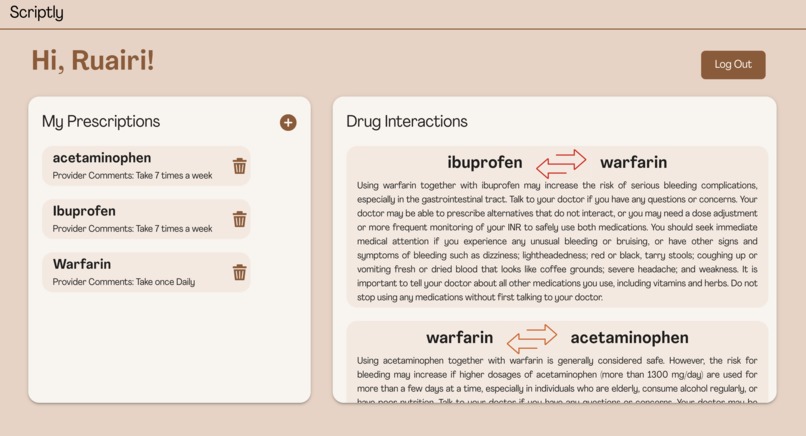
Main Page - Logged In

Inspiration
Inspiration for this project came from our friend Makaya, who shared her experience working as a pharmacy tech. She often saw people coming in with mismatched pills, unsure of which one was which. This confusion often made them wary of potential drug interactions. We wanted to create something that would give patients more confidence in managing their prescriptions. Our app aims to empower users by providing clear drug identification, dosage instructions, and interaction warnings—all in one place. It’s all about making patients feel more in control and less anxious about their medications.
What it does
Our app allows users to easily input their prescribed medications and dosages, helping them track their treatment plans. It then calculates potential drug interactions based on the medications entered, alerting users about any risks or adverse effects that may occur when taken together. While the app doesn't provide pill images or medication purposes, it focuses on ensuring patients have the information they need to manage their medications safely. This service helps users avoid dangerous drug interactions and stay informed about their prescriptions.
How we built it
We developed the project using a fast and efficient React + Vite frontend, paired with a robust Node.js backend powered by Express. For seamless, scalable data storage, we leveraged MongoDB Atlas, while Puppeteer and Cheerio were utilized for precise and powerful web scraping capabilities.
Challenges we ran into
Throughout the development process, we faced several unexpected hurdles. First, many of the APIs we explored for pill images and drug-drug interactions were either deprecated, shut down, or hidden behind paywalls, which meant we spent a significant amount of time researching and trying to integrate solutions that ultimately weren’t viable. We also ran into bot detectors that made it difficult to scrape drug interaction information, which was a major setback. Additionally, while we intended to include drug images for a more complete experience, the image APIs we found either didn’t have robust enough databases or took an unnecessarily long time to provide API keys, which further delayed our work.
Accomplishments that we're proud of
In less than 24 hours, we built a full-stack web app from scratch, which was a huge milestone for us, especially since it was our first time creating something this comprehensive. We learned a tremendous amount about both front-end and back-end development, from designing functional UIs to developing robust backends with REST APIs. Additionally, we gained hands-on experience with web scraping using Puppeteer and Cheerio, allowing us to gather important drug interaction data. This project pushed our limits and provided valuable lessons that we’ll carry forward in our development journey.
What we learned
We learned a lot about web development, as this was our first time participating in a hackathon and building a complete web application. Through trial and error, we explored web scraping techniques, responsive frontend design, and debugging strategies. We also gained experience in collaborative coding, version control, and optimizing performance under time constraints. This hackathon strengthened our problem-solving skills and gave us valuable hands-on experience in full-stack development.
What's next for Scriptly
Scriptly can improve by gathering user feedback to refine features, such as enhancing the drug suggestion algorithm and expanding the drug interaction database. Launching a mobile app would help users manage prescriptions on-the-go, while integrating with healthcare providers and pharmacies could streamline medication monitoring. Personalized health recommendations based on user data could also add value. Additionally, partnerships with insurance companies and adding features for caregivers would broaden the platform’s utility, making Scriptly an even more essential tool for managing prescriptions safely and effectively.
Built With
- axios
- cheerio
- express.js
- mongodb
- node.js
- puppeteer
- react

Log in or sign up for Devpost to join the conversation.