-
-
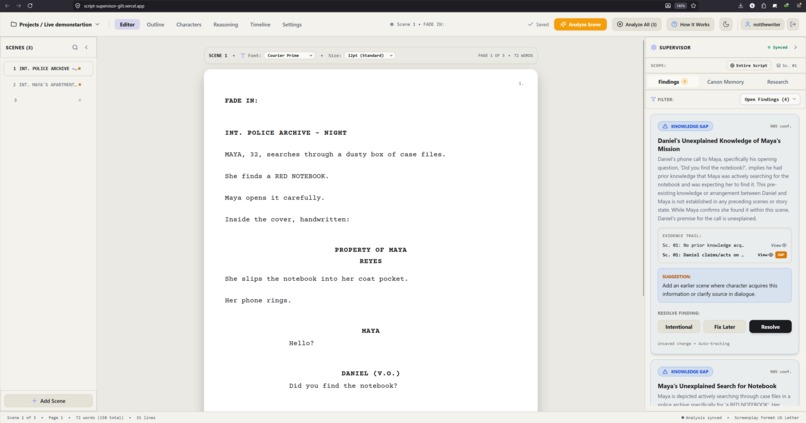
Landing page of Script Supervisor
-
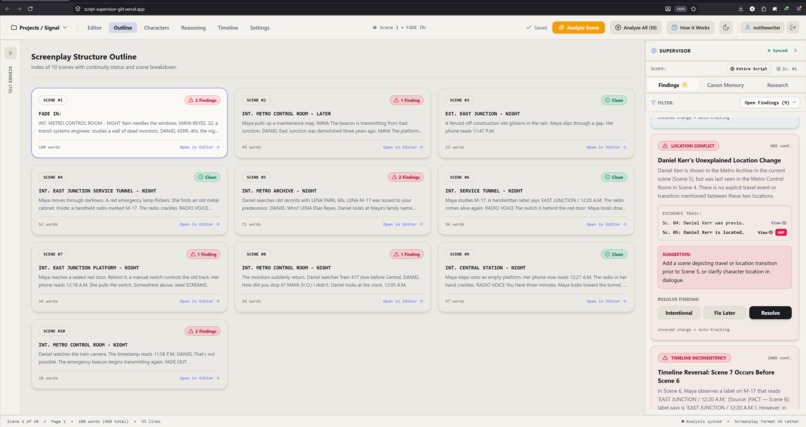
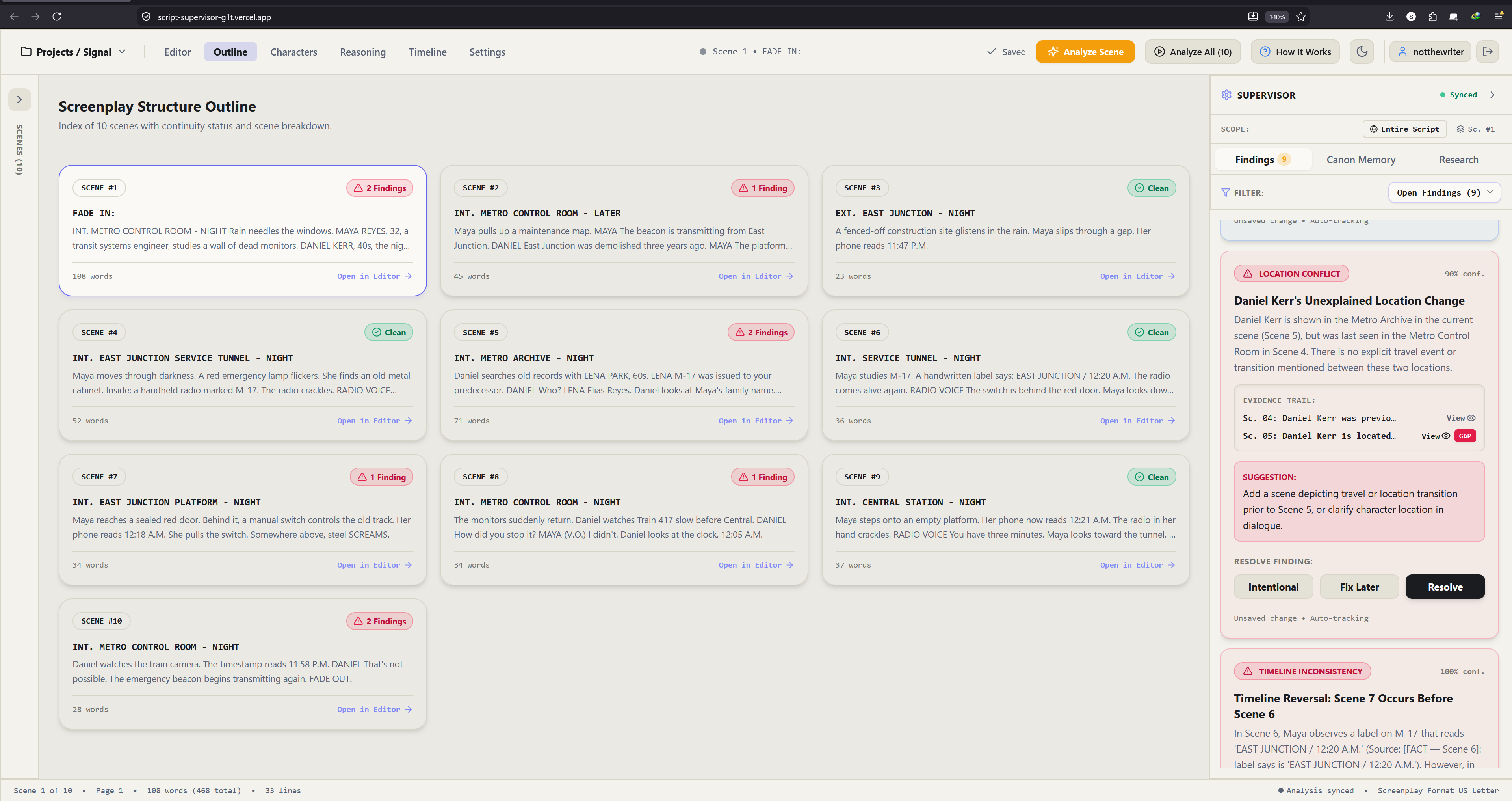
Outline tab
-
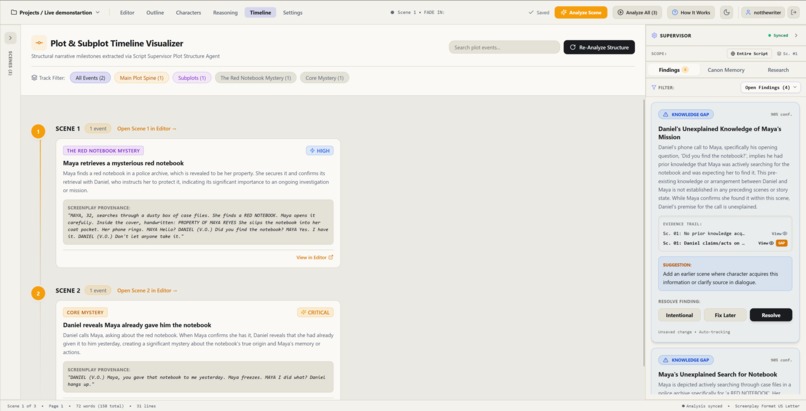
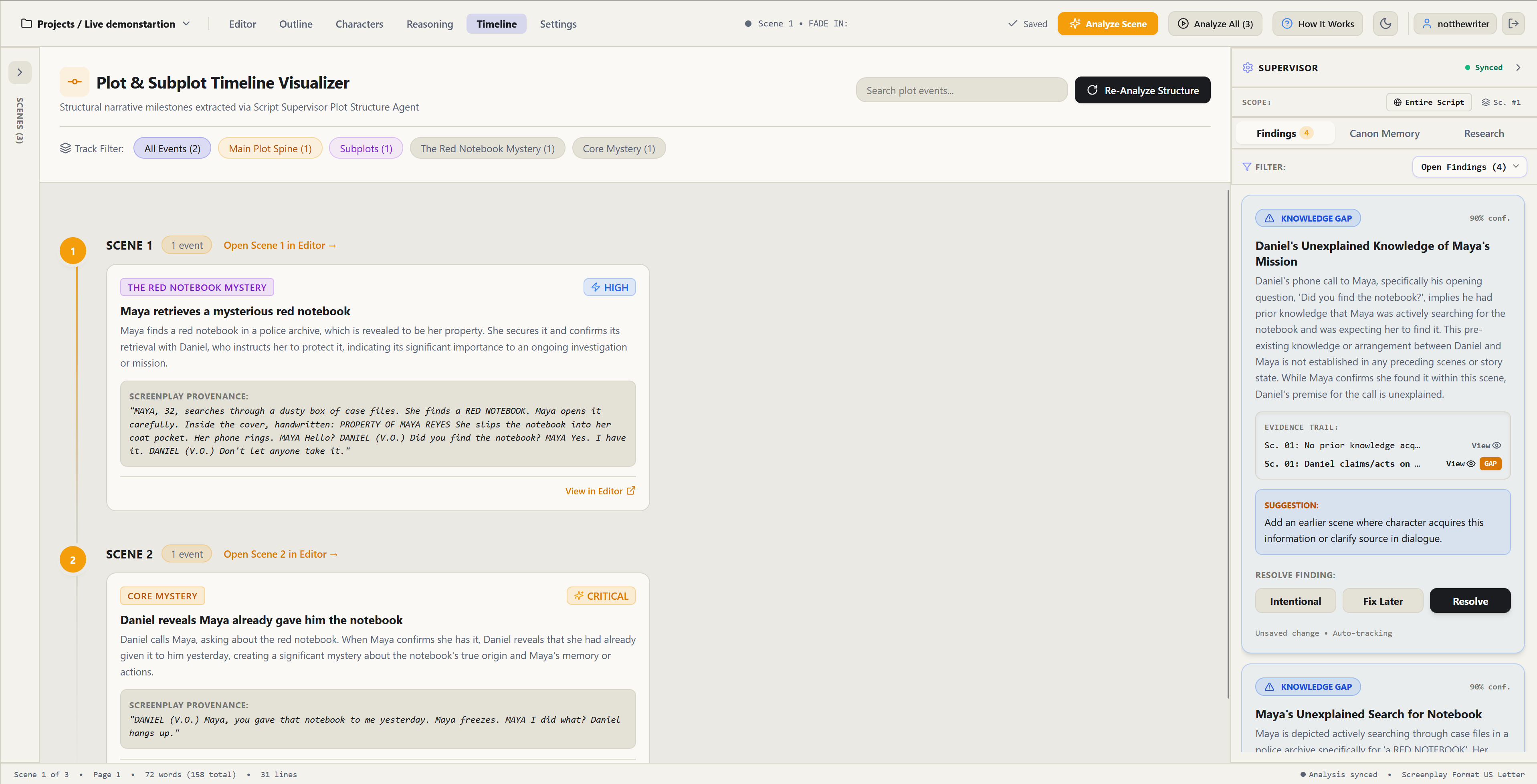
Timeline tab
💡 Inspiration
Every time I watch a movie and spot an inconsistency, I wonder how it slipped through. Screenwriting is a distributed problem — you're building a world across hundreds of pages, and the mental overhead of tracking every fact you've ever established is enormous.
Agentic Cinema Hackathon provided me with a platform to explore this problem and work on a solution. I wanted to build something that works like a real script supervisor: the person on set whose entire job is remembering what everything looked like in the last shot.
🎬 What It Does
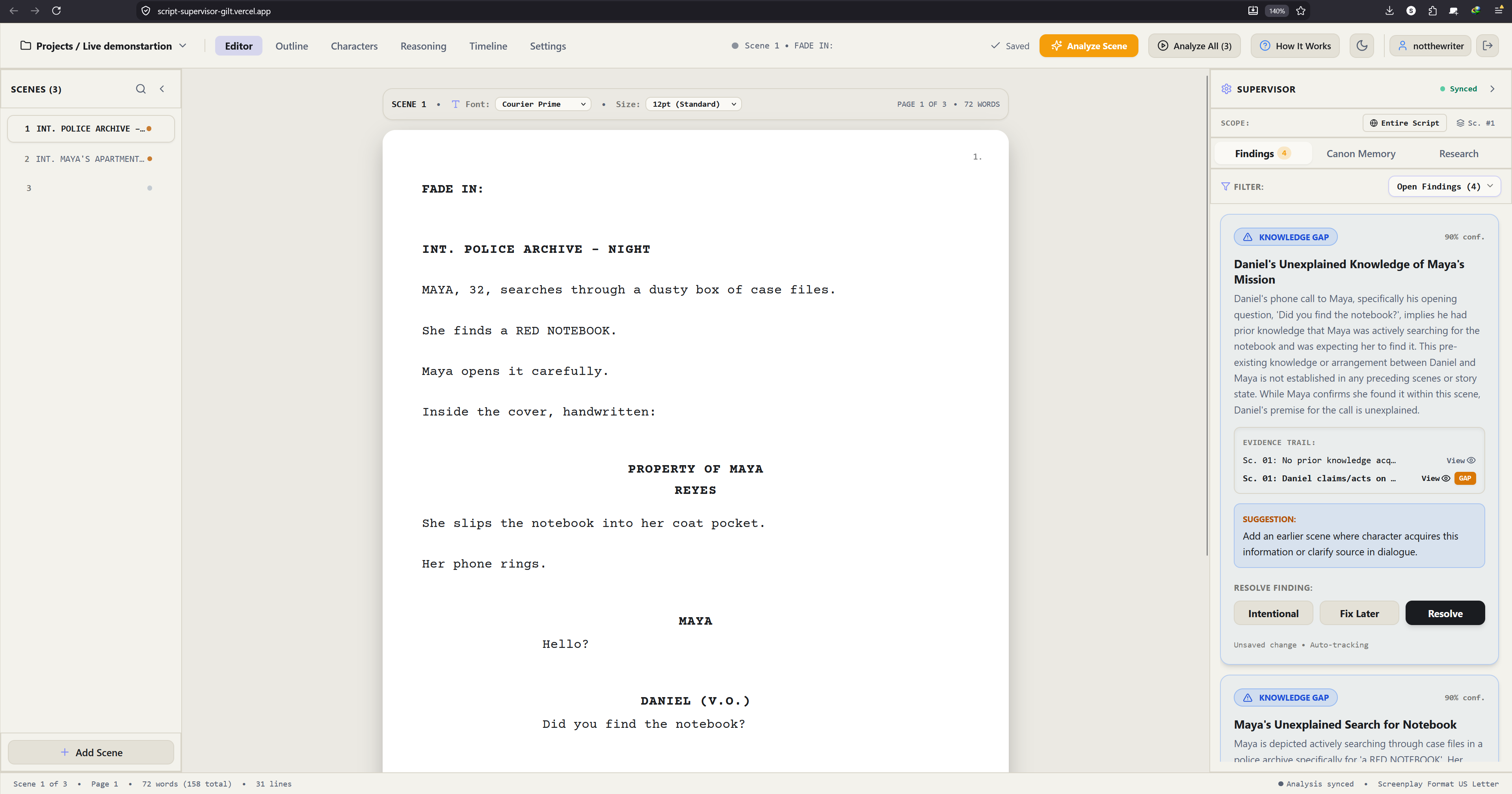
Script Supervisor reads a screenplay scene by scene, builds a structured memory of the story world, and checks each new scene against everything that came before it. When it finds something suspicious, it shows you the evidence — which earlier scene established the conflict and how confident it is.
For dialogue that makes real-world claims, it pulls live web sources through the Parallel API and has Gemini evaluate them. Writers review every finding and their decisions get remembered, feeding into every future analysis.
🔧 How I Built It
The application is built around a persistent story memory rather than treating each scene as an isolated LLM prompt. The core workflow is:
$$ \text{Screenplay} \to \text{Scene Understanding} \to \text{Story Memory} \to \text{Context Retrieval} \to \text{Reasoning} \to \text{Findings} \to \text{Writer Decision} \to \text{Persistent Memory} $$
| Layer | Technology | Role |
|---|---|---|
| Frontend | Next.js + React + TypeScript | Screenplay workspace and Supervisor interface |
| Backend | FastAPI + Python | Analysis pipeline and orchestration |
| LLM | Gemini | Scene understanding, classification, reasoning, research evaluation |
| Web Research | Parallel | Real-world source retrieval for fact-checking |
| Database | CockroachDB | Story state, issues, research, world rules, writer decisions |
| Data Layer | SQLAlchemy + Pydantic | Backend models and service layer |
| Hosting | Vercel + Google Cloud Run | Frontend and containerised backend |
| Secrets | Google Cloud Secret Manager | Production credentials kept out of the application |
😤 Challenges I Ran Into
- Getting entity extraction consistent was the hardest part — the same character appearing under slightly different names across scenes would break continuity checks downstream.
- False positives were the other ongoing fight; getting the system to respect fictional world rules and past writer decisions is what made it usable rather than just noisy.
🏆 Accomplishments I'm Proud Of
- The research pipeline being genuinely grounded in real sources with actual URLs, rather than Gemini guessing from training data, is something I'm proud of getting right.
- The writer decision memory actually works the way I hoped — once you dismiss something as intentional, the system stops raising it in every subsequent scene.
- Designed and developed the entire application in a span of 10 days. This is my first time doing so, and it was an enriching experience.
🚀 What's Next for Script Supervisor
Multi-draft comparison — track how the story changes between revisions and flag continuity regressions introduced by edits, not just within a single draft.
Collaborative review — right now it's a solo tool; adding multi-user support so a writing room or script editor can review and annotate findings together is the obvious next step.
Richer timeline visualisation — the plot timeline exists, but there's a lot more that could be shown: character arcs overlaid, relationship changes plotted across scenes, location threads.
Built With
- google-cloud
- nextjs
- parallel
- python
- vercel

Log in or sign up for Devpost to join the conversation.