Inspiration
Script coverage is the backbone of Hollywood's development process, but it's bottlenecked by human readers who take days or weeks to analyze each screenplay. With studios receiving thousands of submissions annually, promising scripts often get lost in the shuffle. We were inspired to democratize this process by building an AI-powered agent that delivers professional-grade script coverage in minutes, not weeks—giving every screenwriter the feedback they deserve while helping development teams make faster, data-driven decisions.
What it does
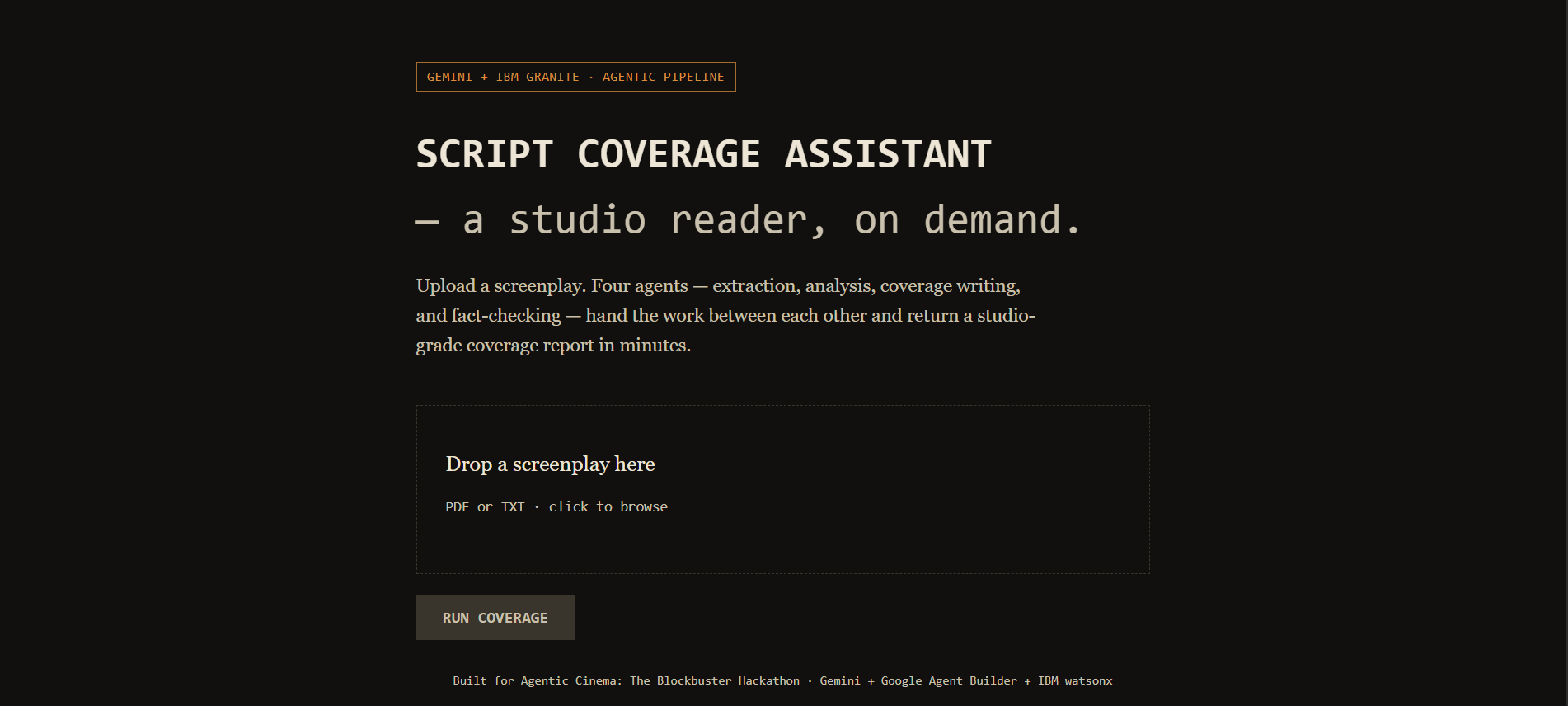
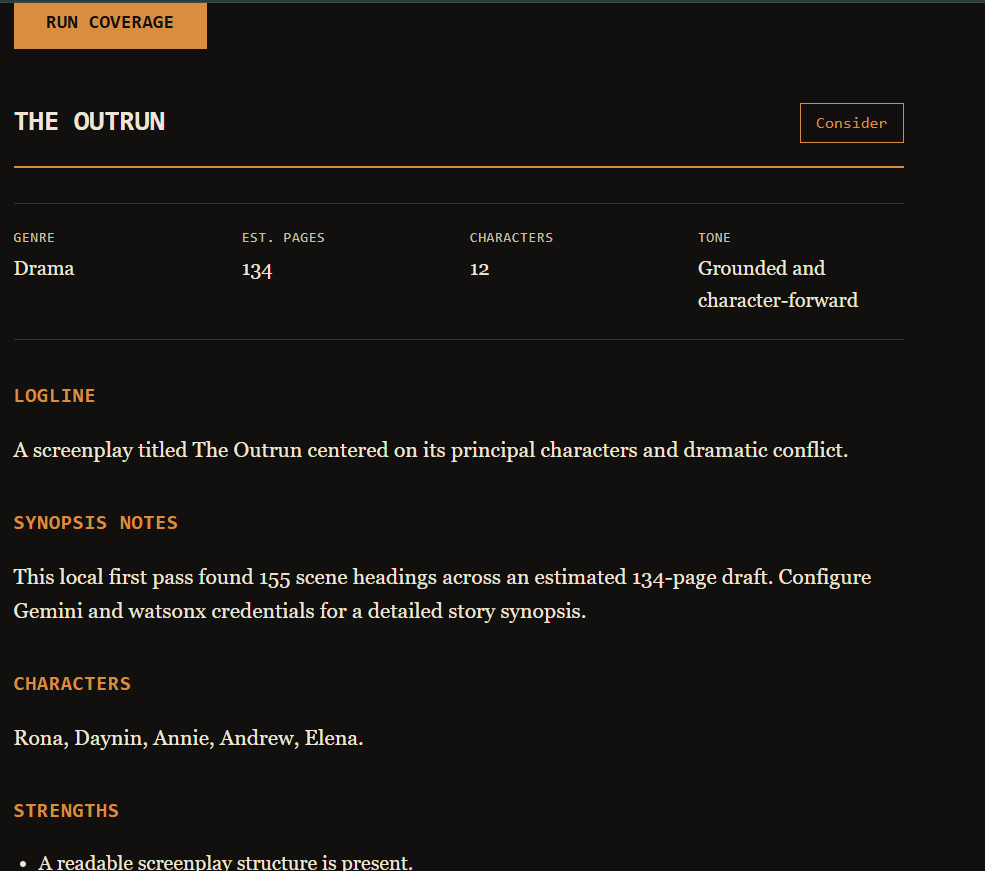
Script Coverage Assistant is an agentic workflow that automatically analyzes screenplays and generates comprehensive coverage reports including:
- Logline generation and synopsis extraction
- Character breakdown with arc analysis
- Structure analysis identifying plot points, pacing issues, and beat sheets
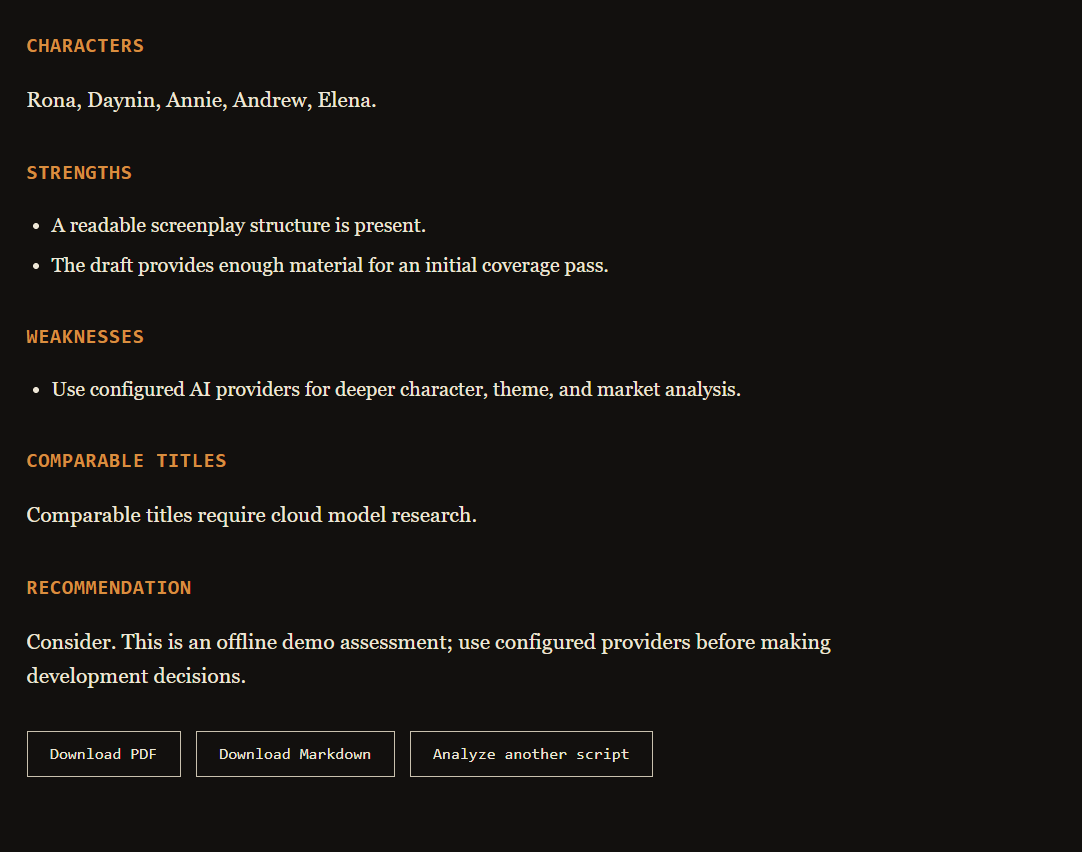
- Strengths and weaknesses assessment
- Market viability insights and comparative analysis
- Continuity checking for plot holes and logic issues
The agent processes full-length screenplays and delivers studio-quality coverage that would normally take human readers 4-6 hours, completing the task in under 5 minutes.
How we built it
We built Script Coverage Assistant using:
- Google Cloud Agent Builder and Gemini Enterprise for the core agentic workflow orchestration
- Gemini API for natural language understanding and screenplay analysis
- [PARTNER: IBM/Grafana Labs/Parallel/Clickhouse/Replit] for [specific integration - e.g., data storage, analytics, or workflow management]
- Multi-step deterministic agent pipeline that:
- Parses screenplay format (PDF/Fountain/Final Draft)
- Extracts structural elements (scenes, dialogue, action)
- Analyzes narrative components using targeted Gemini prompts
- Synthesizes findings into professional coverage format
- Generates actionable recommendations
Challenges we ran into
- Screenplay format complexity: Scripts come in multiple formats. Building a robust parser that maintains scene hierarchy and character attribution was challenging.
- Maintaining context across long documents: Feature-length screenplays (90-120 pages) require the agent to track character arcs, plot threads, and thematic elements across thousands of words without losing coherence.
- Balancing speed vs. depth: We needed to optimize the agent to provide thorough analysis without excessive API calls or processing time.
- Avoiding generic feedback: Early iterations produced formulaic responses. We refined our prompt engineering to deliver specific, actionable insights tied to exact script moments.
Accomplishments that we're proud of
- Sub-5-minute turnaround for complete coverage reports on 110-page scripts
- High accuracy in identifying key structural elements (inciting incident, midpoint, climax) during testing
- Successfully integrated [PARTNER] with Gemini Enterprise to create a seamless enterprise pipeline
- Built a deterministic multi-step agent that solves real enterprise friction in film development workflows
- Created an intuitive interface where writers can upload scripts and instantly receive professional-grade feedback
What we learned
- Agentic workflows excel at complex, multi-stage tasks: Breaking script analysis into discrete, sequential steps (parsing → structural analysis → character analysis → synthesis) produced far better results than monolithic prompts.
- Enterprise AI requires reliability: We learned to build fallback mechanisms and validation checks to ensure consistent output quality.
- The film industry needs practical AI tools: Rather than replacing human readers, our tool augments their capabilities, handling the mechanical aspects of coverage while humans focus on creative judgment.
- Google Cloud Agent Builder provides powerful orchestration capabilities for building production-ready agents.
What's next for Script Coverage Assistant
- Multi-language support: Expand coverage to analyze scripts in Spanish, Mandarin, Hindi, and other major film markets
- Genre-specific models: Fine-tune analysis for different genres (horror, rom-com, thriller) with genre-specific benchmarks
- Comparative analysis: Compare scripts against successful films in similar categories using database integration
- Collaborative features: Enable development teams to share, annotate, and discuss coverage reports
- Integration with production tools: Connect with scheduling and budgeting platforms to automatically generate breakdowns for pre-production
- Writer dashboard: Track script improvements over multiple drafts with version comparison
Built With
- ai/ml
- fastapi
- gemini-api
- git
- google-cloud
- ibm
- javascript
- natural-language-processing
- node.js
- python
- react
- rest-api
- screenplay-analysis

Log in or sign up for Devpost to join the conversation.