
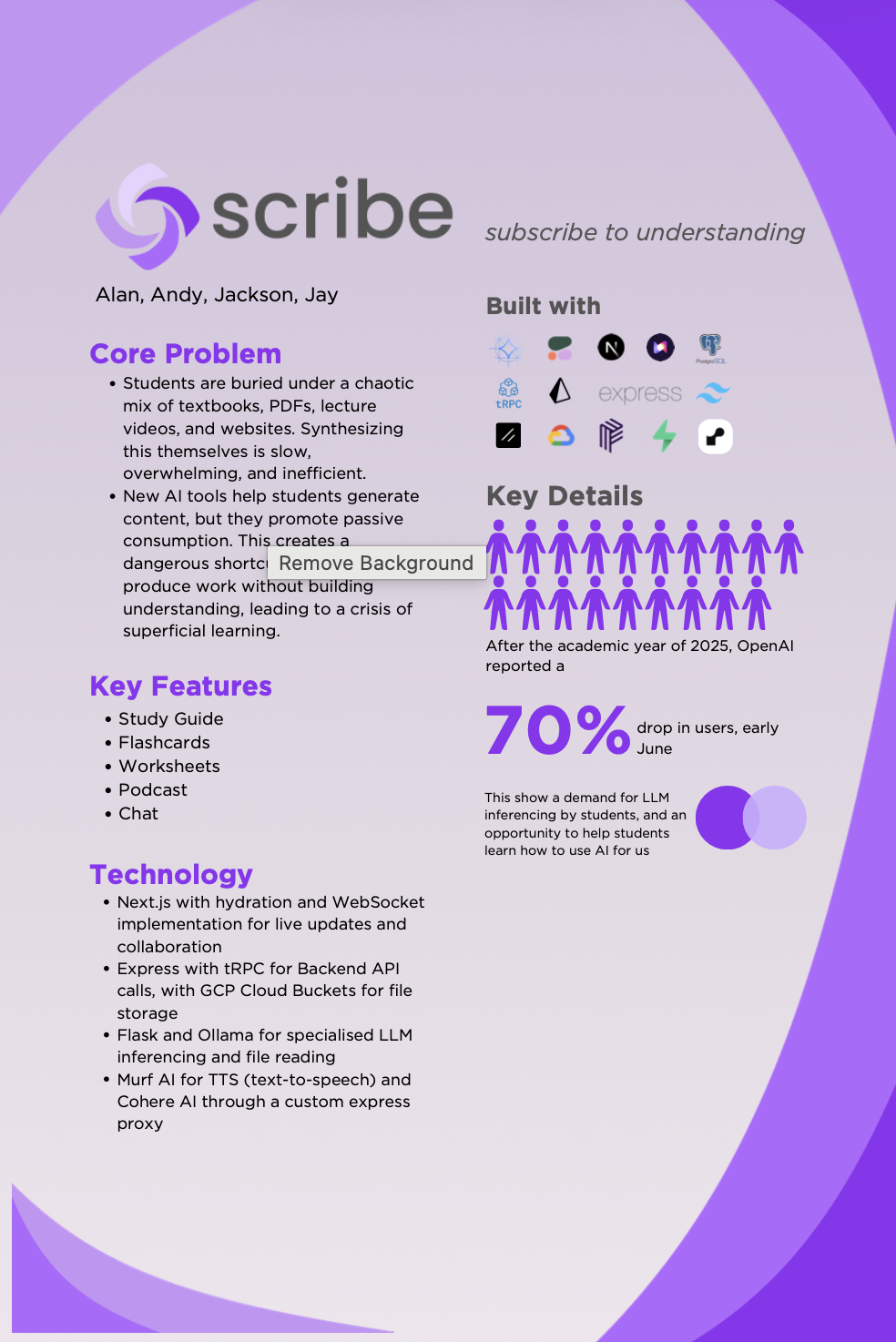
Scribe transforms source materials into an interactive, connected learning system—mind maps, flashcards, audio—designed to combat superficial AI-assisted learning and build true, lasting knowledge.
- Problem and Motivation: What is the specific problem your project tackles? Why is it significant or challenging to address?
Most AI-powered study tools today are designed around users’ passive knowledge consumption, where users upload materials and receive summaries, notes, or key points generated by the system. Unfortunately, this hardly help with engaging in a active learning environment where the user could exercise their own critical thinking skills and learning strategies. Active learning strategies (e.g., self-questioning, interactive problem-solving), on the other hand, are shown by research to significantly outperform passive methods in terms of knowledge retention and skill transfer. We focus on the following problem: how can AI move beyond summarization to construct interactive, personalized learning environments that engage students in active knowledge building? In addition to the benefits of active learning, another layer of significance for this problem is that passive AI tools risk reinforcing surface-level learning habits. This could be greatly harmful when a student walks out of a classroom and attempts to tackle real-world challenges. Our tool thus aims to intervene how students study, turning generative AIs into a learning companion that encourages a durable construction of knowledge.
- Project Overview: Summarize your solution and explain how it directly addresses the identified problem. How is it different from existing solutions?
Our app, Scribe, is an AI-powered study tool that turns passive content reading into active learning. Users can organize all kinds of learning resources in workspaces, where the AI automatically analyzes all uploaded files to produce a comprehensive study guide. The user could edit the generated study guide for their own pacing or ease of understanding. Beyond this, scribe brings active engagement through self-assessment with flashcards, as well as deeper practice with worksheets. For the worksheets, specifically, user responses are auto-graded by the AI, after which feedbacks will be returned for what to improve. In addition, each workspace is implemented with a chat section, where invited users can make collaborative discussions. Finally, the AI could synthesize all contents (study guides, flashcards, worksheets, and even user discussions) in to spoken podcasts. Unlike existing tools that stop at summarization, Scribe personalization the AI assistance as a true study companion. Through interaction and collaboration, we help students build durable knowledge and critical thinking skills.
- Technical Implementation: Highlight the innovative aspects of your solution and detail the technologies or methods you used. Be sure to describe how you considered accessibility and ensured a positive user experience.
We adopted a multi-agent approach for data analysis and user interactions. The core inferencing lies on a remote server hosted at https://onethingai.com, on which the Gemma 3, 27B model is deployed. A file processing and inferencing pipeline is implemented on the server which performs the generation of study guides, mind maps, flashcards and worksheets. The memory of the server-run model is shared with 1) a Cohere API, and 2) Murf API, which are responsible for question grading and podcast generation. We choose not to perform question grading through prompting the Gemma 3 on the server, due to the observed increase in hallucination rate resulted from the injection of potentially incorrect information, which degrades future file comprehension performances. On the frontend, we use Next.js with hydration and WebSocket implementation to support live updates and collaboration. For the backend API layer, we rely on Express with tRPC, while GCP Cloud Buckets handle file storage efficiently and securely.
- Impact and Scalability: What impacts does your solution have, and how can it scale effectively to reach more users or communities? What ideas do you have for potential future work on this project?
Scribe’s impact is dual: it directly enhances student comprehension by transforming passive content into active learning systems, and it serves as a critical countermeasure to the “AI learning crisis” by promoting engagement over passive AI consumption. We foster collaborative understanding through features like a student chat, creating a community of learners.
We scale effectively through our technical architecture. Our server is designed for fine-tuning on user data, which allows our AI to continuously improve and adapt to diverse educational contexts and subjects, ensuring relevance and efficacy for a growing user base.
Future work is focused on deepening our proactive approach to the AI crisis. This includes enhancing the chat into a robust peer-to-peer explanation platform, implementing more adaptive, SRS-based learning loops, and developing educator dashboards to visualize class-wide comprehension gaps, thereby repositioning AI as a partner in education rather than a shortcut.
- Design Process and Collaboration: What were some challenges you faced over the course of the hackathon? How did you overcome those challenges? What did you learn about the design process? How did your team delegate tasks, resolve conflicts, and communicate with each in order to work together most effectively?
Scribe equips students with the skills and mindset necessary to thrive in a digitally interconnected world by transforming AI into a partner in learning rather than a passive shortcut. By actively engaging learners in self-assessment, problem-solving, collaboration, and reflective practice, Scribe cultivates critical thinking and adaptability—essential skills in navigating rapidly changing digital and global contexts. The collaborative chat feature broadens perspectives by fostering peer-to-peer exchange and shared understanding, simulating the diverse and interconnected discussions students will encounter beyond the classroom. In countering the “AI learning crisis,” Scribe instills values of responsibility and engagement, ensuring students learn to leverage AI thoughtfully rather than rely on it superficially. Planned features such as peer explanation platforms, adaptive spaced-repetition systems, and educator dashboards further encourage accountability, resilience, and community-minded learning. Through these, students not only strengthen comprehension but also grow as thoughtful global citizens who can critically evaluate information, respect diverse viewpoints, and contribute meaningfully in a connected, digital society.
- Education: How does your educational solution prepare students to thrive in an interconnected and digitally driven world, broaden their perspectives on global issues, and foster their growth as thoughtful, engaged, and responsible global citizens? Consider specific skills, attitudes, or values your project cultivates to support these outcomes.
https://docs.google.com/document/d/1VBlpKv5h_e7MnQk69T4QlpCqGWAtFUnf3d4cFZuhcFM/edit?tab=t.0
Built With
- cohere
- express.js
- flask
- gcp
- gemma
- murfai
- next.js
- ollama
- postgresql
- prisma
- shadcn/ui
- supabase
- tailwind
- trpc

Log in or sign up for Devpost to join the conversation.